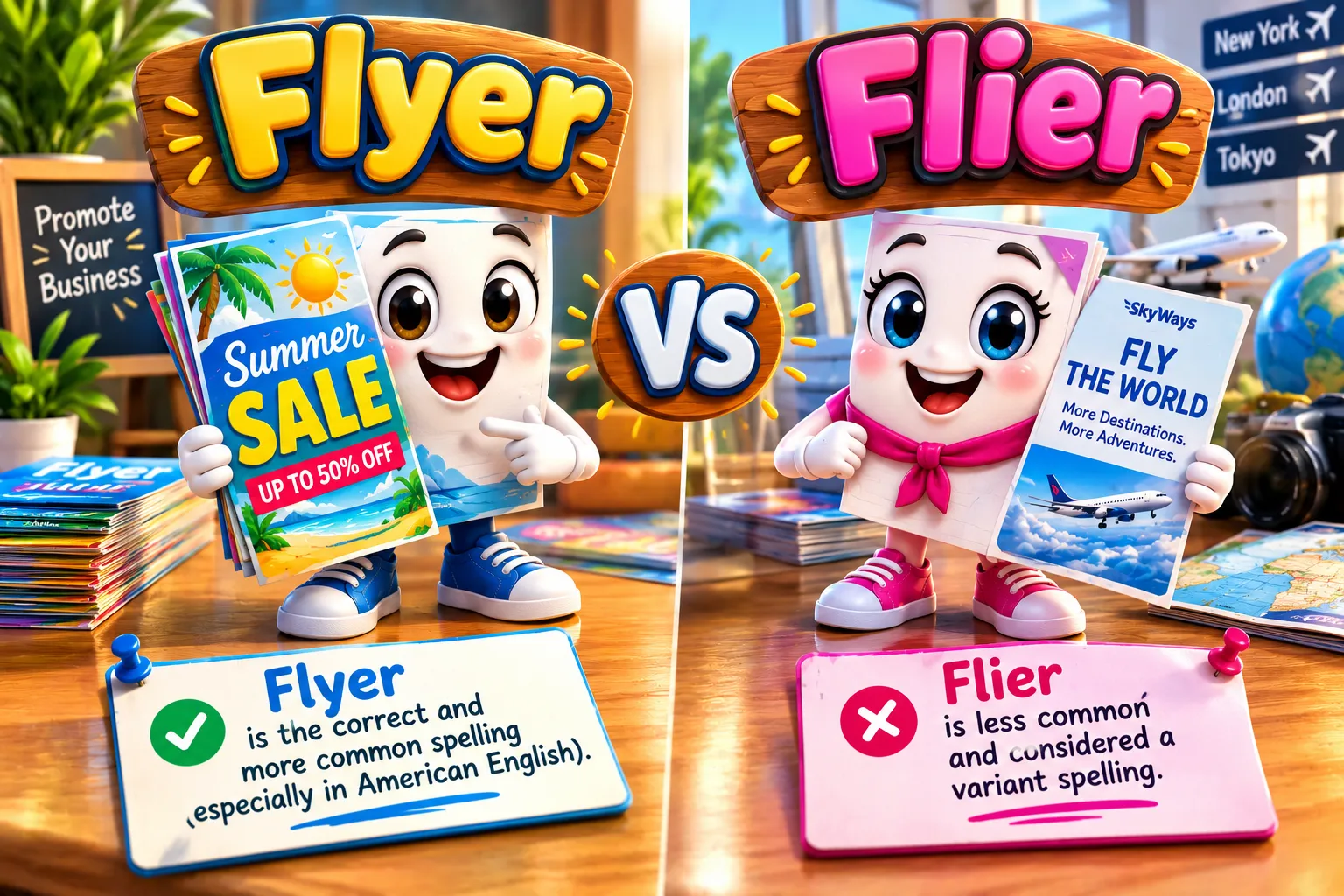
Flyer and flier are both correct spellings, but flyer is the more widely used form, while flier is especially common in American English.
I have often seen writers stop when they need to use the word flyer or flier. The difference looks small, but it can make you wonder whether one spelling is wrong. I have faced this question many times while helping English learners and checking everyday writing.
Both forms are legitimate. That is the good news.
The tricky part is deciding which spelling fits your audience and context. A flyer can mean a small printed sheet used to advertise an event, product, or service. It can also refer to someone who flies or travels by air. Flier can carry the same meanings, but dictionaries often identify it as a mainly American spelling or variant.
This creates a common spelling problem. You may see flyer on a British website and flier in American writing, yet both can appear in English dictionaries.
In this guide, I will explain flyer vs. flier, their meanings, history, regional usage, common mistakes, and practical examples. By the end, you will know which form to choose with confidence.
Flyer or Flier Quick Answer
Flyer and flier can both refer to a printed advertisement or a person who flies. Neither spelling is simply “wrong.”
Cambridge Dictionary lists flyer as the main form and notes flier as a mainly U.S. spelling. For example, a business may distribute flyers to advertise an event.
You might write:
We printed 500 flyers for the concert.
Or:
The airline offers rewards to frequent fliers.
The choice often depends on the style and variety of English you are using.
The Origin and Background of Flyer and Flier
The two spellings come from the same basic word: fly.
The noun flyer dates back to the mid 15th century. Etymonline explains that it originally referred to something that flies. Later meanings developed from the idea of movement through the air.
The advertising meaning came much later. Etymonline dates the sense of a small printed handbill to 1889, describing it as American slang connected with something designed to be widely distributed.
The word fly itself has an even older history. Etymonline traces the verb to Old English fleogan, meaning “to fly” or “move through the air.”
Over time, English formed nouns from the verb. Flyer and flier became two spelling variants.
This is a good example of how etymology can explain modern spelling differences. The two forms are not unrelated words. They developed from the same base.
Flyer vs. Flier: Key Differences
The biggest point is simple:
Flyer is generally the safer and more widely recognized spelling.
Flier is also correct and is especially associated with American English in dictionary usage.
Cambridge describes flier as a “mainly US spelling” of flyer. It also lists flyer as the standard headword for the advertising sense.
| Term | Meaning | When to Use | Region/Context |
| Flyer | Advertisement or person who flies | General writing and advertising | Widely used; common internationally |
| Flier | Same basic meanings as flyer | Especially in American English | Mainly U.S. usage |
| Flyers | Plural of flyer | Several advertisements or flyers | General English |
| Fliers | Plural of flier | Several people or printed items | Especially U.S. English |
When flyer means an advertisement
A flyer is a small piece of paper containing information about a product, service, event, or activity.
For example:
The gym handed out flyers for its new membership plan.
This is one of the most common modern meanings.
When flyer means a person
Flyer can also describe someone who flies, especially a person traveling by air or operating an aircraft.
For example:
She is a frequent flyer who travels for work.
Cambridge lists flyer for a person who operates an aircraft or travels as a passenger and gives flier as another spelling.
What about flier?
Flier can be used in the same contexts.
For example:
The company sent promotional fliers to local businesses.
Cambridge specifically gives flier as an American spelling and also records it for a printed advertisement.
So the difference is mainly spelling preference and regional usage, not meaning.
Which Version Should You Use?
Your audience should guide your choice.
For British English
Flyer is a strong choice.
Cambridge presents flier as mainly U.S. spelling, making flyer the safer option for British English.
For American English
You can use either form, but flier is an established American variant.
For example:
The airline offers special rewards to frequent fliers.
At the same time, flyer is also widely used in American English, so choosing flyer will not normally cause a problem.
For international readers
Choose flyer.
It is easy to recognize and works well across different varieties of English.
For a consistent brand style
Pick one spelling and stay consistent.
If your website uses flyer throughout its marketing content, do not randomly switch to flier on another page unless there is a reason.
Consistency makes your writing look more polished.
Common Mistakes with Flyer or Flier
1. Thinking flier is always wrong
❌ Flier is an incorrect spelling.
✅ Flier is an accepted spelling variant.
Why?
Major dictionaries recognize both forms. Cambridge identifies flier as a mainly U.S. spelling.
2. Assuming flyer only means an advertisement
❌ A flyer can only be a piece of paper.
✅ A flyer can also refer to a person who flies.
The context tells you which meaning is intended.
3. Mixing spellings in the same document
❌ The company printed flyers, then mailed additional fliers without a style reason.
✅ The company printed flyers, then mailed additional flyers.
Why?
Both forms are valid, but unnecessary switching can make your style look inconsistent.
4. Assuming the spelling changes the pronunciation
Both flyer and flier are pronounced essentially the same.
The difference is in spelling, not the basic sound.
5. Choosing based only on appearance
Some writers think flier looks more logical because it removes the extra y.
That does not make it more correct. Both forms have established usage.
Flyer or Flier in Real-World Examples
Professional email
I have attached the flyer for next week’s training session for your approval.
Here, flyer refers to a promotional or informational document.
News headline
Local businesses distribute flyers ahead of the community festival.
The plural form refers to printed promotional material.
Social media post
Our summer sale starts Friday! Pick up a flyer in store for the latest offers.
The word works naturally in casual promotional content.
Formal document
The survey was promoted through printed flyers distributed at public libraries.
The spelling is clear and suitable for professional writing.
Travel context
Frequent fliers may qualify for additional loyalty benefits.
Here, fliers refers to people who travel by air.
Flyer or Flier Data, Trends & Usage
Exact monthly search-volume figures for “flyer” and “flier” vary by SEO platform, country, and date. Without direct access to a current Ahrefs or Semrush keyword database, it would be misleading to invent a precise number.
A better source for long term written usage is Google Books Ngram Viewer, which tracks words and phrases in published books. Google explains that its Ngram tool can compare terms across years and corpora.
For this topic, dictionary evidence gives us a clearer practical answer than a raw search-volume figure:
- Flyer is the main dictionary form in Cambridge.
- Flier is recognized as a mainly U.S. spelling.
- Both spellings can refer to printed advertising material.
- Both can describe someone who flies.
- The difference is largely one of regional preference and style.
Search intent
The search intent behind “flyer or flier” is primarily informational.
People usually want to know:
- Which spelling is correct?
- Is flier an American spelling?
- Does flyer mean a person who flies?
- Which form should I use in business writing?
- Is there a difference between flyer and flier?
This makes the topic especially useful for English learners, editors, marketers, and writers who work across British and American English.
Standalone Flyer vs. Flier Comparison Table
| Term/Variant | Meaning | Region/Context | Best Used When |
| Flyer | Printed advertisement or person who flies | Broad international usage | You want the safest general spelling |
| Flier | Variant of flyer | Mainly American English | Your style follows U.S. usage |
| Flyers | Multiple flyers | General English | Referring to several printed advertisements |
| Fliers | Multiple fliers | Often American English | Following a U.S. spelling preference |
| Frequent flyer | Person who travels by air often | International | Discussing air travel or loyalty programs |
One useful detail is frequent flyer. Even in American English, this phrase is commonly written with flyer, so you should not assume that every American writer prefers flier.
That is why a simple rule such as “American = flier, British = flyer” is too rigid.
Flyer or Flier: A Simple Memory Trick
If you are unsure, remember this:
Flyer = the safest general choice.
Think of:
Flyer → flying + paper
It can remind you of both major meanings.
If you are writing specifically for an American audience, flier is also perfectly acceptable.
The key is not to treat one spelling as wrong.
Frequently Asked Questions
Q: What does flyer mean?
A: Flyer can mean a small printed advertisement or information sheet. It can also refer to someone who flies or travels by air. Cambridge lists both meanings.
Q: Is flyer or flier correct?
A: Both flyer and flier are correct. Flyer is the more broadly useful spelling, while flier is identified by Cambridge as mainly American.
Q: Is flier an American spelling?
A: Yes. Cambridge describes flier as a mainly U.S. spelling of flyer. It remains an accepted form in American English.
Q: Is flyer British or American?
A: Flyer is used in both British and American English. It is not limited to one country. Cambridge uses it as the main form and lists flier as mainly American.
Q: Which spelling should I use for an advertisement?
A: Flyer is the safest choice for a broad audience. If your organization’s style guide prefers American variants, flier is also acceptable.
Q: Which is correct: frequent flyer or frequent flier?
A: Frequent flyer is the more familiar and widely recognized form. However, frequent flier can also be found, particularly in American usage.
Q: Where do flyer and flier come from?
A: Both forms developed from fly. Etymonline dates the noun flyer to the mid 15th century and records several meanings that developed over time, including “something that flies” and later the advertising sense.
Q: Do flyer and flier have different pronunciations?
A: No major pronunciation difference separates the two standard spellings. They are normally pronounced the same way, which is one reason writers sometimes confuse them.
Conclusion
Choosing between flyer and flier is easier once you know that both spellings are correct. The main difference is not meaning. It is mostly regional preference, style, and context.
Flyer is the best all-purpose choice. It is widely recognized and works well in international, British, and American English. Flier is also correct, especially when you are following an American style.
Both words can describe a printed advertisement. They can also refer to someone who flies. Your sentence will usually make the intended meaning clear.
If you are writing for a mixed or international audience, I recommend using flyer. If your publication follows a specific American style guide and prefers flier, use that form consistently.
Most importantly, do not treat flier as a spelling mistake. Major dictionaries recognize it as a legitimate variant.
Now you know the difference. Choose the spelling that fits your audience, keep your style consistent, and write with confidence.
Read More:
Yay or Nay: Easy Meaning, Usage & Examples

I’m **Rubab Naaz**, an English language content writer with over 10 years of experience creating educational and SEO-focused articles. I specialize in spelling comparisons, grammar, vocabulary, synonyms, commonly confused words, and English usage. My passion is helping students, writers, and professionals improve their language skills through accurate, well-researched, and easy-to-understand content. Every article I write is designed to make learning English simple, practical, and engaging.










