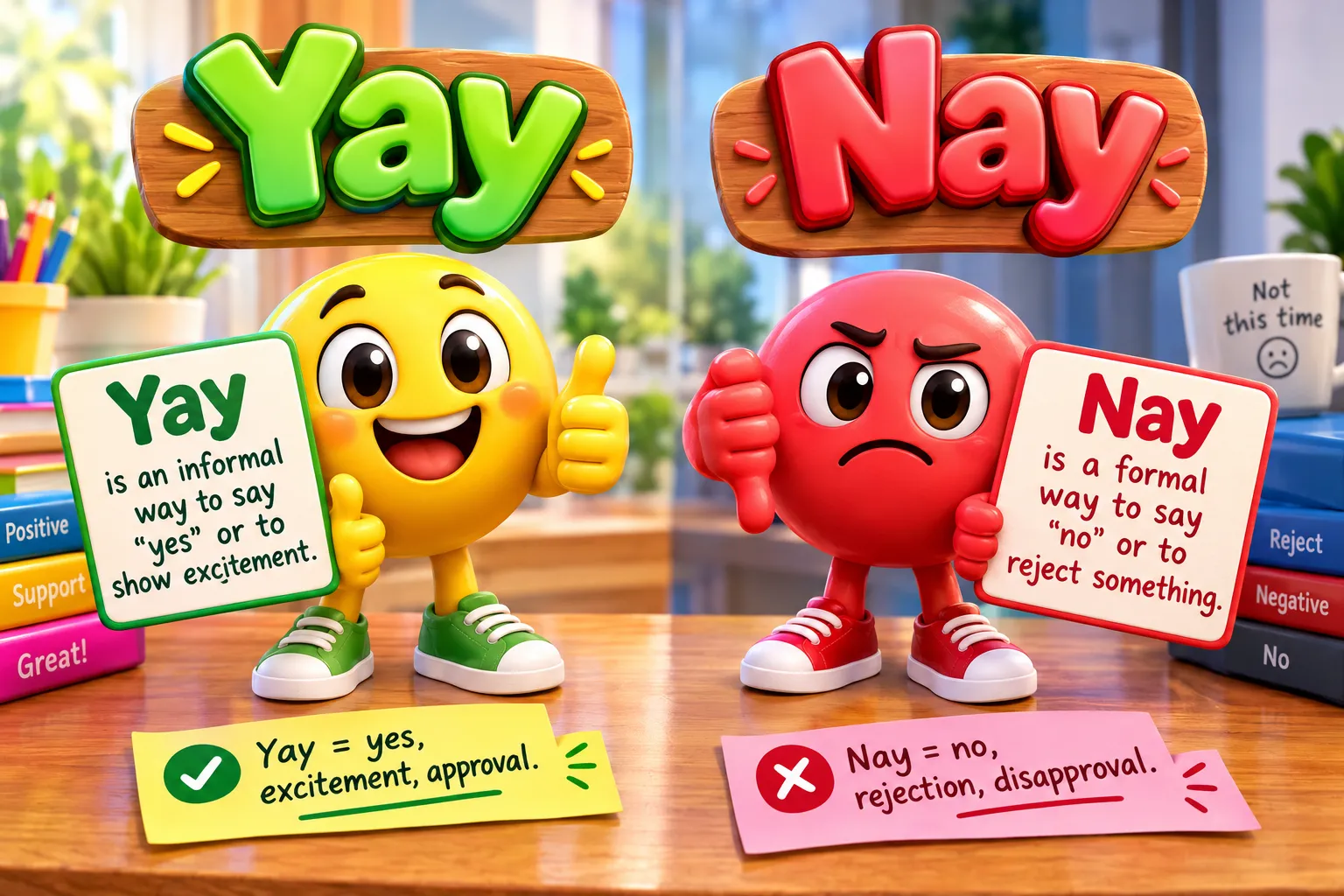
Yay or nay is an informal way to ask whether someone approves or disapproves of something; yay shows excitement, while nay means no or opposition.
I have often seen English learners pause when they come across the phrase “yay or nay?” At first, it looks simple. But once yay, yea, yeah, and nay enter the picture, the difference can become confusing.
I have come across this mix-up many times while helping people improve their English. The words may sound alike, but they do not have the same meaning or use. Yay is an informal expression of excitement or approval, while nay can mean “no” or show disagreement. Yea is different again and is often used for an affirmative vote in formal settings. Yeah is simply a casual way to say “yes.”
Even a small spelling change can affect the meaning of a sentence. That is why knowing the difference matters, especially when you want your writing to sound clear and natural.
In this guide, I will explain what “yay or nay” means, how it differs from “yea or nay,” where these words come from, and when to use each one. You will also find simple examples to help you remember the difference with ease.
Yay or Nay Quick Answer
The phrase yay or nay is a casual way to ask for an opinion, approval, or rejection.
- Yay = excitement, happiness, or approval.
- Nay = no, rejection, or opposition.
- Yea = yes, especially an affirmative vote.
- Yeah = an informal form of yes.
So, if you ask a friend, “New haircut: yay or nay?”, you are asking whether they like it.
However, when talking about a formal vote, yea or nay is usually the better expression.
Cambridge Dictionary defines yay as an informal exclamation used to show that you are very pleased about something. It also records another informal use meaning “to a particular degree,” as in describing size.
The Origin and Background of Yay and Nay
The history of these words is more interesting than their short spellings suggest.
Where does yay come from?
Modern yay, when used as an excited exclamation, is relatively recent. Dictionary.com records this sense from the 1960s and says its origin may be an alteration of yeah.
There is also an older-looking use of yay in expressions such as “yay big” or “yay high.” This means roughly “this big” or “this high,” often with a hand gesture showing the size. Dictionary sources connect this use with yea.
That gives yay more than one linguistic path.
Where does nay come from?
Nay has a much older history. It has traditionally been used to express no, refusal, denial, or opposition. It also appears in formal voting language.
That is why you may see:
The motion received 30 yeas and 12 nays.
Here, nay is not a cheerful opposite of yay. It is the negative side of a formal vote.
This distinction is useful when studying etymology and historical English. Words can look like natural pairs while actually having different histories and grammatical functions.
Yay Explained: Meaning and Usage
Yay is mainly an interjection.
An interjection is a word used to express a sudden feeling or reaction. Other familiar interjections include wow, ouch, hey, and hooray.
Use yay when you want to show:
- Happiness
- Excitement
- Celebration
- Approval
- Enthusiasm
For example:
Yay! Our team made the final.
Here, yay does not simply mean “yes.” It expresses excitement about good news.
You can also put it after a statement:
The weekend starts tomorrow, yay!
This use is casual. It works well in conversations, texts, social media posts, and friendly messages.
It would usually sound too informal in a formal academic paper.
Nay Explained: Meaning and Usage
Nay has a very different job.
It can mean no, rejection, or opposition. It is especially associated with formal voting, older language, and deliberate or literary speech.
For example:
The committee recorded eight votes in favor and three nays.
In ordinary conversation, however, nay can sound old-fashioned.
You would normally say:
No, I don’t agree.
rather than:
Nay, I don’t agree.
The second sentence is grammatically possible, but it gives the speaker a more formal, dramatic, or old-style voice.
That is one reason context matters so much in English.
Yay vs Nay: Key Differences
The easiest way to understand the pair is to focus on the feeling behind each word.
| Term | Meaning | When to Use | Region/Context |
| Yay | Joy, excitement, approval | Celebrations and casual reactions | Informal English |
| Nay | No, rejection, opposition | Voting or deliberate disagreement | Formal, literary, or traditional contexts |
| Yea | Yes, affirmative vote | Formal voting | Government, meetings, official decisions |
| Yeah | Informal yes | Casual conversation | Everyday spoken English |
Notice the important difference between yay and yea.
They are pronounced alike, but they are not the same word.
Yay! expresses excitement.
Yea traditionally expresses an affirmative vote.
That makes them a useful example of homophones: words that sound the same but have different meanings and spellings.
Simple examples
Yay:
Yay! We finally finished the project.
Nay:
Two members voted nay.
Yea:
The motion passed after the members voted yea.
Yeah:
Yeah, I can help you tomorrow.
The meaning becomes much easier when you connect each spelling with its purpose.
Which Version Should You Use?
Your best choice depends on the situation.
For casual conversation
Use yay when you are expressing excitement.
Yay! We are going on vacation.
Use yeah when you simply mean yes.
Yeah, that sounds good.
For a formal vote
Use yea and nay.
Members were asked to vote yea or nay.
This is the traditional formal pairing.
For social media
Yay or nay works well when you want a playful opinion.
New logo — yay or nay?
It feels short, friendly, and conversational.
For academic writing
Avoid yay or nay unless you are discussing the phrase itself.
Instead, use clearer terms such as:
- approve or reject
- for or against
- yes or no
- support or oppose
This keeps your writing precise.
Common Mistakes with Yay or Nay
1. Using yay for a formal yes vote
❌ The members voted yay on the proposal.
✅ The members voted yea on the proposal.
Why?
In formal voting language, yea is the traditional affirmative term.
2. Using yea to express excitement
❌ Yea! We won the match!
✅ Yay! We won the match!
Why?
The exclamation expresses happiness, so yay is the natural choice.
3. Confusing yay with yeah
❌ Yay, I understand your point.
If you simply mean yes:
✅ Yeah, I understand your point.
Why?
Yeah is an informal agreement. Yay expresses excitement.
4. Using nay in every situation
❌ Nay, I don’t want pizza.
✅ No, I don’t want pizza.
Why?
Nay is possible, but it can sound old fashioned or dramatic in everyday speech.
5. Assuming yay and yea are interchangeable
They may sound identical, but spelling carries meaning.
Yay → excitement
Yea → affirmative vote
That is one of the most useful rules to remember.
Yay or Nay in Real-World Examples
The phrase is common in informal communication because it lets people ask for a quick opinion.
Professional email
Could you give me a quick yay or nay on the revised design before lunch?
This can work in a friendly internal email. For a formal client message, approval or rejection may sound better.
News headline
New city parking plan: yay or nay?
The headline uses the phrase to make the question feel direct and engaging.
Social media post
Thinking about changing the website logo. Yay or nay?
This invites followers to give a simple reaction.
Formal report
The committee recorded 14 yea votes and six nay votes on the proposal.
Here, yea and nay fit the formal voting context much better than yay.
Friendly conversation
I found a great restaurant for Saturday. Yay or nay?
The phrase feels natural because the conversation is informal.
Yay or Nay Data, Trends & Usage
There is a catch with search data for short words such as yay and nay.
Tools such as Google Trends measure relative search interest, not a fixed worldwide number of searches. They can show how interest changes by time, location, and search term, but they do not provide a simple global count of every use of a word.
I also would not give you a made up monthly search volume from Ahrefs or Semrush without access to that specific dataset. Doing so would make the article look precise while giving you unreliable numbers.
What does the available usage evidence show?
The strongest pattern is context driven interest.
People searching for yay or nay are often trying to understand:
- What the phrase means
- Whether yay or yea is correct
- Whether nay means no
- How to use the phrase in a sentence
- Whether the phrase is suitable for formal writing
The phrase also appears naturally in modern online discussion. Recent web examples show “yay or nay” being used for quick opinions on topics ranging from sports decisions to marketing and technology.
Corpus and frequency insight
There is another reason exact frequency can be misleading.
Yay has a common modern informal meaning, while yea and nay often occur in special contexts such as voting, historical writing, and formal language.
That means a raw word-frequency comparison does not always tell you how people use each word today.
For practical writing, yes/no is far more natural than yea/nay in ordinary conversation. The older forms remain useful because they have specific cultural and institutional uses.
Search intent
For this topic, the main search intent is informational.
A reader usually wants a quick answer to a spelling or usage question, not a product or service.
That makes a clear definition, comparison table, examples, and yay vs yea vs yeah vs nay explanation especially useful.
Standalone Yay or Nay Comparison Table
| Term/Variant | Meaning | Region/Context | Best Used When |
| Yay | Excitement or approval | Modern informal English | Celebrating or showing enthusiasm |
| Nay | No or opposition | Formal, traditional, or literary English | Rejecting something or recording a negative vote |
| Yea | Yes or approval | Formal voting | Casting an affirmative vote |
| Yeah | Informal yes | Everyday English | Agreeing in casual speech |
| Yes | Agreement or affirmation | Standard English | Most general and neutral situations |
| No | Refusal or negative answer | Standard English | Most general and neutral situations |
This table shows why yay or nay should not automatically replace yea or nay.
The phrase you choose should match your meaning and your audience.
Yay, Yea, Yeah, and Nay: The Easy Memory Trick
Here is a simple way to remember the four words:
Yay = celebration
Think:
Yay!
You are happy.
Yea = vote
Think:
Yea or nay?
You are deciding formally.
Yeah = casual yes
Think:
Yeah, sure.
You are agreeing in everyday speech.
Nay = no
Think:
Yea or nay?
You are choosing the negative side.
This small pattern can prevent many spelling mistakes.
Frequently Asked Questions
Q: What does yay mean?
A: Yay is an informal interjection that expresses happiness, excitement, approval, or celebration. Cambridge Dictionary lists it as an informal expression of pleasure.
Q: What does nay mean?
A: Nay means no, refusal, or opposition. It is especially common in formal voting language and can also appear in older or literary English.
Q: Is “yay or nay” correct?
A: Yes, yay or nay is a recognized informal expression for asking whether someone approves or disapproves. However, yea or nay is the traditional expression for a formal yes-or-no vote.
Q: Is yay the same as yea?
A: No. Yay expresses excitement or approval, while yea traditionally means yes, especially in voting. They are pronounced alike but have different meanings.
Q: Is yay the same as yeah?
A: No. Yeah is an informal way to say yes. Yay is mainly an emotional exclamation showing excitement or happiness.
Q: Can I use yay or nay in formal writing?
A: You can use it when the tone is intentionally casual. For formal reports, academic writing, contracts, or official documents, yes or no, approve or reject, or yea or nay may be more suitable depending on the context.
Q: Where does yay come from?
A: The modern exclamation yay is relatively recent. Dictionary.com dates this sense to the 1960s and suggests it may have developed as an alteration of yeah. Another use, such as “yay big,” is linked to yea.
Q: What is the opposite of yay?
A: There is no perfect opposite in every situation. If yay means excitement or approval, nay can express rejection in a “yay or nay” question. In formal voting, however, the traditional pair is yea and nay.
Q: Is nay still used today?
A: Yes. It still appears in formal votes, news reports about voting, historical writing, and some deliberately formal or humorous speech. In ordinary conversation, no is usually more natural.
Conclusion
Understanding yay or nay becomes easy once you separate the four similar-looking words.
Yay is the cheerful one. Use it when you are excited, pleased, or celebrating. Nay expresses rejection or a negative response and often carries a formal or old fashioned tone. Yea is the traditional affirmative term in formal voting. Yeah is simply an informal way to say yes.
The biggest mistake is treating yay and yea as different spellings of the same word. They sound alike, but their jobs are different. This makes them a useful example of homophones in English.
For casual questions, “yay or nay?” is perfectly natural. For official voting, choose “yea or nay.” And when you simply want a clear everyday answer, “yes or no” is usually the safest choice.
Once you connect each spelling with its purpose, the confusion disappears.
Bookmark this guide so you never second guess yay, yea, yeah, or nay again.
Read More:
Gases or Gasses: Easy Guide to the Correct Spelling

I’m an English language educator and SEO content writer having experience creating clear, accurate, and engaging English learning content. I specialize in spelling differences, grammar, vocabulary, synonyms, commonly confused words, and English usage. My goal is to publish well-researched, easy-to-understand articles that help students, writers, educators, and professionals improve their English with confidence through practical explanations and real-world examples.