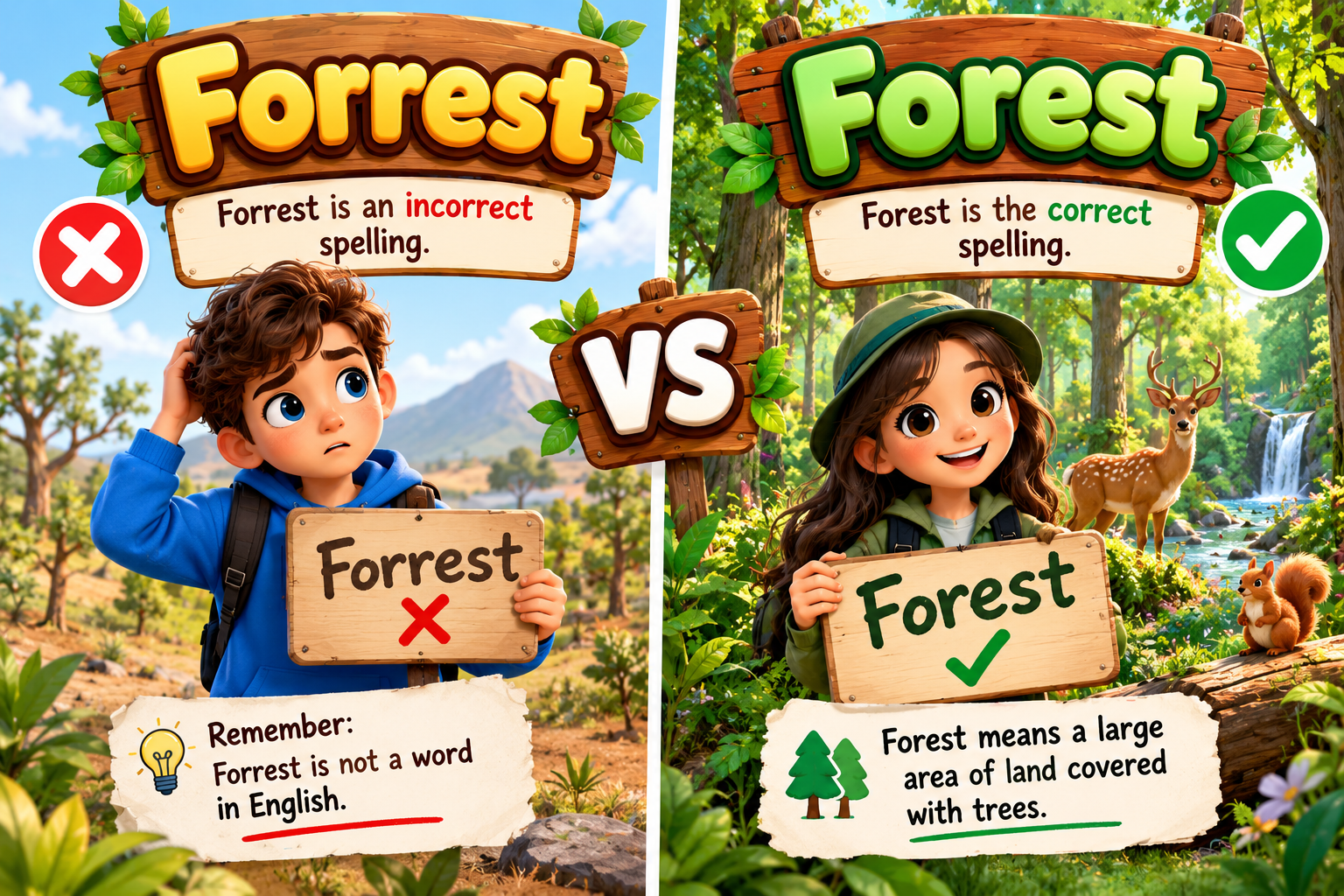
Forest is the correct spelling for a large area covered with trees. Forrest is usually a personal name or surname, not the standard spelling of the common noun.
I have made this spelling mistake myself. I remember typing forrest when I meant a place filled with trees. The extra r looked harmless, so I did not notice it at first. Then I saw the word again in a sentence and stopped to check.
That was when I realized why the mistake is so easy to make. Forest and Forrest look almost identical. They also sound very similar in many varieties of English. The difference is only one letter, but that letter changes how the word is used.
The problem becomes even more confusing because Forrest is a real English name. You may have seen it in names such as Forrest Gump or as a surname. So your eyes can easily accept the spelling even when you need the ordinary word for a wooded area.
If you are writing about trees, wildlife, hiking, or nature, there is a simple rule to remember. Forest is the standard common noun. Forrest is mainly used as a name.
Forrest or Forest Quick Answer
When you mean a large area covered with trees and plants, use forest.
Cambridge Dictionary defines forest as a large area of land covered with trees and plants, usually larger than a wood.
For example:
- We walked through the forest before sunset.
- The forest is home to many wild animals.
Forrest, with two r’s, is normally a proper name. It can be a first name or surname. Behind the Name lists Forrest as an English name that comes from an English surname meaning “forest.”
So the basic rule is easy:
Forest = trees and woodland.
Forrest = usually a person’s name.
The Origin and Background of Forest and Forrest
The story becomes clearer when you look at etymology, or the study of word origins.
The common noun forest has a long history in English. Etymonline dates the noun to the late 13th century and traces it through Old French forest, meaning a forest, wood, or woodland. It may ultimately connect to Medieval Latin and the idea of woods outside a protected area.
The word replaced the older English wudu, which is related to modern wood. That is one reason English has several words connected with wooded land.
The spelling Forrest has a different role today. It developed as an English surname and later became a given name. Behind the Name describes Forrest as an English surname-derived name connected with the word forest.
That history explains an important point:
Forrest is not simply an alternative modern spelling of forest.
It is mainly a name form.
This is similar to other words that become names. A common word can develop into a surname or first name while keeping a different spelling.
Forrest or Forest Explained Key Differences
The easiest way to separate the two is to ask yourself one question:
Am I talking about a place, or am I naming a person?
If you mean a wooded area, choose forest.
If Forrest appears as part of someone’s name, keep the capital F and the double r.
| Term | Meaning | When to Use | Region/Context |
| forest | A large area covered with trees and plants | Nature, geography, wildlife, travel | Standard English |
| Forrest | A personal name or surname | Names of people | English proper name |
| wood | An area of trees, often smaller than a forest | Everyday descriptions | British and American English |
| woodland | Land covered mainly by trees | Nature, geography, formal writing | Broad English use |
What does forest mean?
Forest is a noun.
It refers to a large area where trees and other plants grow.
The hikers entered the forest early in the morning.
Cambridge also lists related expressions such as forest floor, forest ranger, rainforest, and tropical rainforest.
The word can also be used in a broader or figurative way.
For example:
A forest of tall buildings filled the skyline.
Here, forest does not describe actual trees. It describes something that appears in a large, dense group.
What does Forrest mean?
Forrest is usually a proper noun.
It can be a first name or surname.
Forrest arrived early for the meeting.
The capital F matters because names are normally capitalized.
One well-known example is Forrest Gump, the title character from the 1994 film. The name helped make this spelling familiar to many English speakers. Behind the Name also records the name’s connection with the English surname meaning “forest.”
Why do people confuse them?
The two spellings differ by only one letter:
forest
forrest
That makes the mistake easy to miss, especially when typing quickly.
The confusion can become stronger because Forrest is a legitimate English name. Your spell checker may also accept it if it recognizes the word as a name.
Which Version Should You Use?
Your choice is actually quite simple.
If you mean a natural area
Use forest.
The forest contains hundreds of plant species.
This is the standard spelling for the common noun. Cambridge uses forest for a large area covered with trees and plants.
If you mean a person’s name
Use Forrest if that is the person’s actual spelling.
Forrest Smith works at the local university.
Do not change someone’s name to Forest just because the word normally has one r.
If you want a neutral alternative
You can also use:
- woodland
- woods
- tree-covered area
- wooded area
The best choice depends on the exact meaning and context.
Common Mistakes with Forrest or Forest
1. Writing “forrest” for a wooded area
Incorrect:
We spent the day walking through the forrest.
Correct:
We spent the day walking through the forest.
The common noun has only one r.
2. Changing someone’s name to “Forest”
Incorrect:
Forrest Gump → Forest Gump
Correct:
Forrest Gump
Names should keep their correct spelling.
3. Using a lowercase name
Incorrect:
forrest lives next door.
Correct:
Forrest lives next door.
A person’s name is a proper noun, so it begins with a capital letter.
4. Assuming Forrest is a British or American spelling of forest
Incorrect idea:
“Forrest” is the American spelling.
Correct idea:
Forest is the standard spelling in English. Forrest is mainly used as a name.
There is no general British-versus-American spelling rule that changes forest to forrest.
5. Trusting pronunciation alone
The words can sound very similar, so listening may not solve the problem.
When you are writing, focus on the meaning and context, not only the sound.
Forrest or Forest in Real-World Examples
The best way to understand the difference is to see each spelling in a natural setting.
Professional email
The team will meet near the forest entrance at 9 a.m.
Here, forest describes a location.
News headline
Fire crews continue efforts to protect the forest.
Again, forest refers to an area covered with trees.
Social media post
Spent the weekend hiking through the forest and enjoying the fresh air!
The spelling with one r is correct because the post refers to nature.
Formal document
The report examines changes in forest cover across the region.
This is a standard use of forest in environmental and academic writing.
Personal name
Forrest will join the project next Monday.
Here, Forrest is a person’s name, so the capital letter and double r are correct.
Forrest or Forest Data, Trends & Usage
There is a useful SEO point behind this spelling pair.
Forest has a broad meaning and appears in many areas of English. It is used in everyday conversation, geography, ecology, travel, environmental writing, news, and education. Cambridge’s dictionary entry includes many common combinations such as forest floor, forest ranger, ancient forest, and rainforest.
Forrest, by contrast, is mainly encountered as a proper name. Search interest for the spelling can therefore come from people looking for names, surnames, famous people, or fictional characters rather than from people looking for the meaning of woodland.
I would not present an exact monthly search-volume number for “forrest” vs. “forest” without access to a current paid SEO database such as Ahrefs or Semrush. Search volume changes over time and differs by country.
The available dictionary evidence does show a clear usage difference:
- Forest is a standard English common noun.
- Forrest is primarily a personal name or surname.
- Forest has many related terms in environmental and forestry vocabulary.
- Forrest is much more dependent on proper-name context.
The search intent for “forrest or forest” is therefore mainly informational. People usually want to know which spelling is correct and when the double r is acceptable.
This matters for students, ESL learners, bloggers, editors, and anyone writing about nature. A single extra letter can make a sentence look like a spelling mistake.
A Second Comparison: Related Words
| Term/Variant | Meaning | Region/Context | Best Used When |
| forest | Large area covered with trees | Standard English | Talking about wooded land |
| Forrest | First name or surname | Proper-name context | Referring to a person |
| woods | An area of trees | Everyday English | Using a casual term |
| woodland | Land dominated by trees | General and formal English | Writing about habitats or land |
| forestry | Science and practice of managing forests | Academic/professional | Discussing forest management |
| forester | A person who manages or works with forests | Professional context | Talking about forest workers |
The related word forestry has its own meaning. Cambridge defines it as the science of planting and taking care of large areas of trees.
A forester, meanwhile, is a person who takes care of a forest.
These words are useful because they help you build a larger vocabulary around forest.
Frequently Asked Questions
Q: What does forest mean?
A: Forest is a noun for a large area covered with trees and plants. Cambridge also uses the word in expressions such as forest floor, forest ranger, and rainforest.
Q: Is forrest a correct spelling?
A: Forrest is a correct spelling when it is used as a person’s name or surname. It is not the normal spelling of the common noun referring to a wooded area.
Q: Which is correct, forrest or forest?
A: Use forest when you mean an area filled with trees. Use Forrest when you are writing a person’s name that is spelled that way.
Q: Is Forrest an English name?
A: Yes. Behind the Name lists Forrest as an English masculine name derived from an English surname connected with the meaning “forest.”
Q: Is Forrest an American spelling of forest?
A: No. Forrest is not a standard American spelling variant of forest. The standard common noun is forest in both American and British English. Forrest is mainly used as a proper name.
Q: Why is Forrest spelled with two r’s?
A: The double-r spelling developed as part of the surname and personal-name form. It should not be treated as a general spelling rule for the noun forest.
Q: Can I use forest as a person’s name?
A: Yes. Forest can also be used as a personal name. Behind the Name lists Forest as a variant of Forrest or as a name taken directly from the English word forest.
Q: What is the easiest way to remember forest vs. Forrest?
A: Think of one R for real trees: forest. Think of Forrest with two R’s as a person’s name. This simple memory trick can help you avoid the spelling mistake.
Conclusion: Forrest or Forest Made Simple
The difference between Forrest or forest is much easier once you separate the common word from the proper name.
Use forest when you are talking about a large area covered with trees and plants. It is the standard spelling in English. Cambridge confirms this meaning in both its learner and advanced dictionary entries.
Use Forrest when you are referring to a person whose name has that spelling. It can be a first name or surname. The spelling is real, but it has a different job in the sentence.
You can also use related words such as woods, woodland, and forestry when they better match your meaning.
The key is simple: forest is the place; Forrest is usually the name.
Once you remember that small difference, you will be much less likely to add an extra r when writing about trees, hiking, wildlife, or nature.
Bookmark this guide so you never second-guess “Forrest or forest” again.
Read More:
Alum or Alumni: The Easy Usage Guide

I’m an English language educator and content writer with more than 10 years of experience helping learners improve their English skills. I specialize in spelling differences, grammar, vocabulary, synonyms, commonly confused words, and English usage. My goal is to create accurate, easy-to-understand articles that make learning English simple, practical, and enjoyable for students, writers, and professionals around the world.