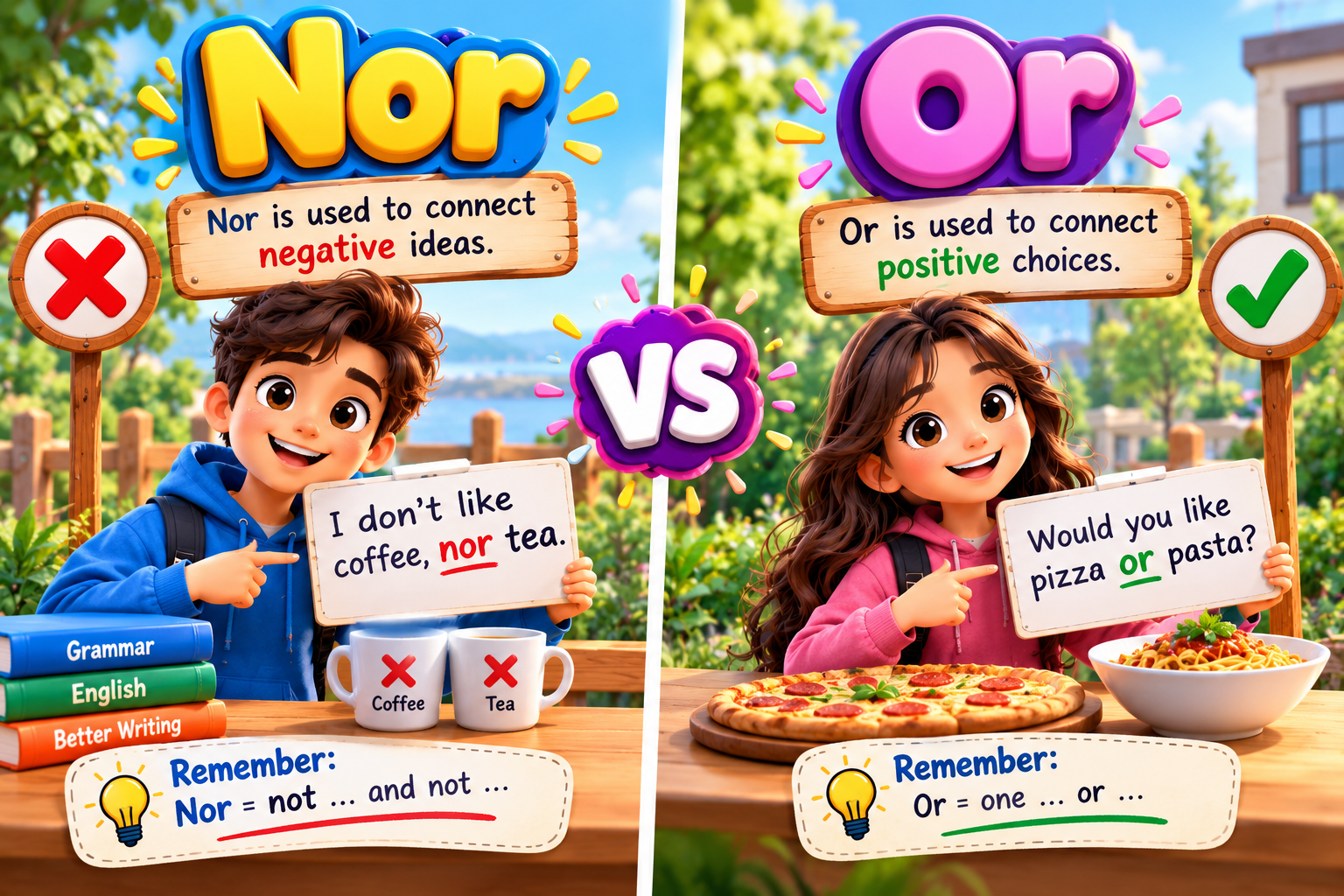
Nor vs or depends on the meaning: or presents a choice or alternative, while nor usually introduces another negative option, often after neither.
I used to pause whenever I came across nor in a sentence. Or felt easy because I used it all the time when giving choices. But nor seemed more formal, and I was never quite sure when it belonged in a sentence.
The confusion usually starts with phrases like neither…nor. You may know that or means a choice, but then you see a sentence such as “Neither answer is correct, nor is the explanation clear.” Suddenly, the rule feels less simple.
I have also noticed that people sometimes use or where nor would be expected, especially in longer sentences. The reverse can happen too. A writer may choose nor simply because it sounds more formal, even when or would be the natural choice.
The good news is that you do not need to memorize a long grammar rule. Once you understand the basic job of each conjunction, the difference becomes much easier. This guide will show you exactly when to use nor, when to use or, and how neither…nor works.
Nor vs Or Quick Answer
Use or when you are connecting choices, alternatives, or possibilities.
Would you like tea or coffee?
Use nor when you are connecting negative alternatives, especially after neither.
She likes neither tea nor coffee.
Cambridge Dictionary defines or as a conjunction used to connect different possibilities. Cambridge defines nor as a conjunction used before the second or final part of a set of negative possibilities, usually after neither.
A simple memory rule is:
or = choice
nor = negative choice
There are some extra uses, but this rule covers most everyday sentences.
The Origin and Background of Nor and Or
Both nor and or have a long history in English.
According to Etymonline, nor dates from the mid-13th century. It developed from forms connected with negative words and or. Its meaning was linked to the idea of “and not.”
The history of or goes even further back. Etymonline traces it to Old English oþþe, which expressed alternatives such as “either” or “or.”
This history helps explain why the two words are closely related. English has long used them to show different kinds of alternatives.
The word neither is also part of this story. It comes from older English forms meaning roughly “not either.” Etymonline notes that neither has been paired with nor for centuries.
Today, these words are classified as conjunctions when they connect words, phrases, or clauses. Cambridge describes conjunctions as words that connect parts of a sentence.
So this is not simply a spelling difference. Nor and or perform different grammatical jobs.
Nor vs Or Explained Key Differences
The easiest way to understand the difference is to look at the type of idea you are connecting.
| Term | Meaning | When to Use | Region/Context |
| or | Shows alternatives or possibilities | Choices and options | Standard English |
| nor | Adds another negative alternative | Usually after neither or another negative idea | Standard English |
| neither…nor | Rejects both options | Two negative choices | Standard English |
| either…or | Presents two possible choices | Positive or neutral alternatives | Standard English |
When to use or
Use or when you want to show a choice.
You can take the bus or walk home.
You can also use or when there are several possibilities.
The meeting is on Monday, Tuesday, or Wednesday.
Cambridge explains that or can connect different possibilities and alternatives.
It can also appear after a negative verb:
I don’t eat meat or fish.
In this structure, or continues the negative meaning of the verb. Cambridge’s grammar guidance specifically discusses this use.
When to use nor
Use nor to introduce another negative possibility.
The most common pattern is:
neither + option A + nor + option B
Neither answer is correct, nor is the explanation clear.
A simpler example is:
He is neither angry nor upset.
Cambridge gives similar examples with neither…nor and explains that nor normally introduces the second part of a negative pair.
What about “neither…or”?
This is one of the most common mistakes.
Incorrect:
She is neither tired or hungry.
Correct:
She is neither tired nor hungry.
The standard correlative pair is:
neither…nor
not:
neither…or
What about “either…nor”?
The same idea works in reverse.
Incorrect:
You can either stay nor leave.
Correct:
You can either stay or leave.
The standard pair is:
either…or
Cambridge identifies either…or as a coordinating structure for alternatives.
Which One Should You Use?
Choosing between nor and or becomes easier when you look at the sentence around it.
For ordinary choices, use or
If the sentence offers an option, or is usually the right choice.
Would you like a window seat or an aisle seat?
This is a normal choice. There is no need for nor.
For “neither,” use nor
When you write neither, the matching conjunction is normally nor.
Neither option is cheap nor convenient.
For a clean parallel structure, you can also write:
Neither option is cheap, and neither is convenient.
After a negative verb, use or
You do not always need nor simply because the sentence is negative.
I don’t want tea or coffee.
That sentence is perfectly natural.
Cambridge notes that or is used after a negative verb to continue the negative meaning.
For formal writing, do not use nor just to sound formal
Nor can sound more formal, but that does not mean it should replace or everywhere.
Choose the conjunction based on the grammar and meaning.
Common Mistakes with Nor vs Or
1. Using “or” after “neither”
Incorrect:
Neither John or Sarah attended.
Correct:
Neither John nor Sarah attended.
Why? The standard pair is neither…nor.
2. Using “nor” after “either”
Incorrect:
You can either call nor email me.
Correct:
You can either call or email me.
Why? The standard pair is either…or.
3. Using “nor” for every negative sentence
Incorrect:
I don’t like pizza nor pasta.
This can occur in some varieties or styles, but for simple everyday English, or is the natural choice:
I don’t like pizza or pasta.
Cambridge specifically notes that or can follow a negative verb.
4. Forgetting the negative meaning of nor
Incorrect:
Would you like tea nor coffee?
Correct:
Would you like tea or coffee?
The question asks for a choice. It does not reject both options.
5. Breaking parallel structure
Less clear:
She neither likes cooking or cleaning.
Better:
She neither likes cooking nor cleaning.
The two connected parts should follow the same grammatical pattern.
Nor vs Or in Real-World Examples
Professional email
Please let me know whether you would prefer a morning appointment or an afternoon appointment.
The writer is presenting two choices, so or is appropriate.
News headline
Neither side nor the officials confirmed the final details.
Here, nor connects two negative subjects.
Social media post
I can’t decide whether to watch a movie or read a book tonight.
The writer is choosing between two options.
Formal document
The applicant may submit the form either online or by post.
The structure either…or clearly presents two possible methods.
Another formal example
The report found neither sufficient evidence nor reliable data to support the claim.
The sentence rejects both items and therefore uses neither…nor.
Nor vs Or Data, Trends & Usage
The search intent behind “nor vs or” is mainly informational. People who search this phrase are usually trying to solve a grammar problem, not buy a product or find a specific website.
Exact monthly search-volume figures for “nor vs or” can change by country, language, and SEO platform. Without a current Ahrefs, Semrush, or Google Keyword Planner dataset, it would be misleading to present a precise monthly number.
Corpus tools can still help explain usage. Google Books Ngram Viewer, for example, allows users to compare word frequencies across large collections of books. However, frequency alone does not tell you whether a word is grammatically correct in a particular sentence.
The more useful distinction is grammatical:
- or is a very common coordinating conjunction.
- nor has a more specific negative function.
- neither…nor is a common paired construction.
- either…or presents alternatives.
- or can also follow negative verbs.
Cambridge’s grammar guidance confirms that or connects alternatives and that neither…nor is the negative counterpart of either…or.
This topic remains useful for ESL learners, students, editors, and professional writers. Grammar-checking tools may flag a sentence, but understanding the meaning behind the correction helps you make better choices yourself.
A Second Comparison: Related Structures
| Term/Variant | Meaning | Region/Context | Best Used When |
| or | Gives a choice | General English | Presenting alternatives |
| nor | Adds a negative alternative | General English | Following neither or another negative structure |
| either…or | Gives two or more options | General English | Offering alternatives |
| neither…nor | Rejects two or more options | General English | Saying that both choices are not true |
| or else | Gives an alternative or warning | General English | Showing a consequence or second option |
| and/or | Means one, the other, or both | Formal and technical contexts | When either or both possibilities are allowed |
Cambridge defines and/or as meaning that either one of two things or both are possible.
For simple writing, however, it is often clearer to explain the exact possibilities instead of relying on and/or.
Frequently Asked Questions
Q: What does nor mean?
A: Nor is a conjunction used to introduce another negative possibility. It commonly appears after neither, as in neither…nor.
Q: What does or mean?
A: Or is a conjunction that connects alternatives or possibilities. It can also be used after a negative verb and in structures such as either…or.
Q: What is the difference between nor and or?
A: Or normally presents alternatives. Nor normally adds another negative alternative, especially when paired with neither.
Q: Should I say “neither…nor” or “neither…or”?
A: Use neither…nor in standard English. For example, “Neither answer is correct, nor is the explanation complete.”
Q: Should I use “either…or” or “either…nor”?
A: Use either…or. It presents alternatives, such as “You can either call me or send an email.”
Q: Can nor be used without neither?
A: Yes. Nor can appear without neither, especially after a negative statement or in formal structures. Cambridge gives examples such as “Nor have I” and notes that nor can sometimes replace or in formal language.
Q: Is nor more formal than or?
A: Nor can have a more formal feel in some constructions, but it is not simply a formal replacement for or. The correct choice depends on the sentence’s meaning and grammar.
Q: Can or be used in a negative sentence?
A: Yes. Or commonly follows a negative verb, as in “She doesn’t eat meat or fish.” Cambridge specifically records this use.
Conclusion: Nor vs Or Made Simple
The difference between nor vs or is much easier when you focus on the job each word performs.
Use or when you are giving a choice, showing alternatives, or presenting different possibilities. It works in everyday questions, statements, and structures such as either…or.
Use nor when you are adding another negative option. The most familiar pattern is neither…nor. You can also see nor after a negative statement, especially in more formal constructions.
A useful shortcut is:
Choice → or
Negative pair → nor
Remember that a negative sentence does not automatically require nor. For example, “I don’t want tea or coffee” is completely natural.
Once you understand that difference, choosing between these conjunctions becomes much easier. You will also have a better grasp of related structures such as either…or, neither…nor, and and/or.
Bookmark this guide so you never second-guess nor and or again.
Read More:
Forrest or Forest: The Easy Spelling Rule

I’m **Rubab Naaz**, an English language content writer with over 10 years of experience creating educational and SEO-focused articles. I specialize in spelling comparisons, grammar, vocabulary, synonyms, commonly confused words, and English usage. My passion is helping students, writers, and professionals improve their language skills through accurate, well-researched, and easy-to-understand content. Every article I write is designed to make learning English simple, practical, and engaging.










