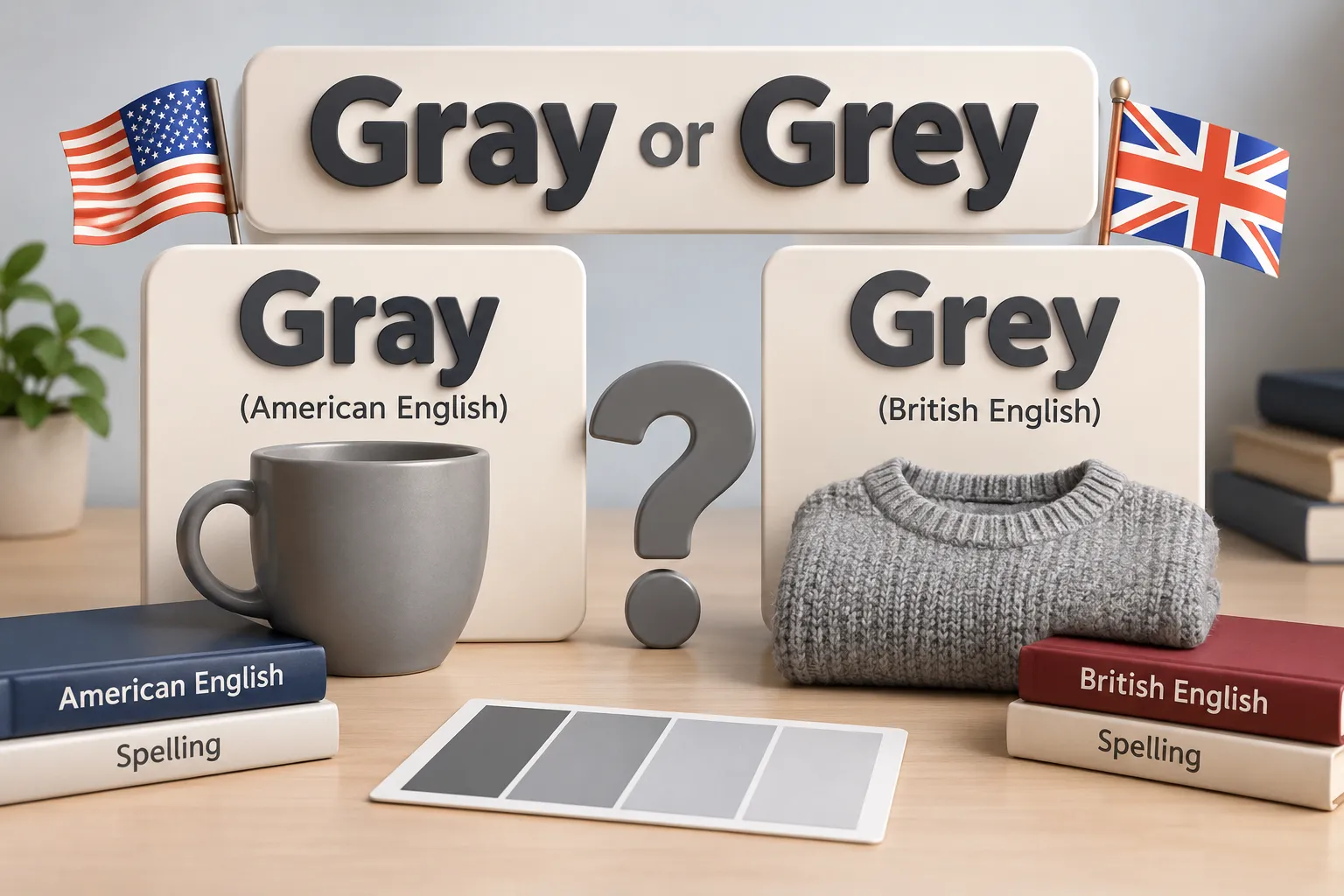
Gray and grey are both correct spellings for the same color; gray is standard in American English, while grey is preferred in British English.
Have you ever typed gray and then stopped to wonder whether it should be grey? You are not alone. This tiny spelling difference can make even confident writers pause.
I have seen this confusion often in student work, websites, emails, and everyday writing. The tricky part is that neither spelling is simply “wrong.” The right choice depends mainly on the type of English you are using.
Imagine writing a school assignment for a U.S. teacher. You write grey sweater. Then you check a British dictionary and see grey everywhere. Next, an American dictionary shows gray. Suddenly, one little letter feels like a grammar problem.
It is not.
Gray and grey normally have the same meaning, pronunciation, and grammatical uses. The main difference is regional spelling. Cambridge lists gray as the U.S. spelling of grey, while grey is mainly the UK form.
This guide will show you when to use each form, where the difference came from, which related words change spelling, and which special names you should never alter.
Gray or Grey Quick Answer
Both gray and grey describe the color between black and white.
- Gray → preferred in American English
- Grey → preferred in British English
- Both → same basic meaning
- Both → normally pronounced /ɡreɪ/
For example:
- The designer chose a gray background. (American English)
- The designer chose a grey background. (British English)
Cambridge confirms that gray is the U.S. spelling and grey is mainly the UK spelling.
So, if you are asking, “Which one is correct?”, the answer is simple: both are correct. Choose the form that matches your English variety and keep it consistent.
The Origin and Background of Gray and Grey
The story of gray/grey goes much further back than modern American and British English.
According to Etymonline, the word comes from Old English græg, with the Mercian form grei. It can be traced further to Proto-Germanic grewa-, meaning “gray.” Related forms appear in several Germanic languages.
This makes the word a useful example of etymology. Etymology is the study of where words come from and how their forms and meanings develop.
The spelling did not always follow the neat U.S.-versus-UK split we know today. Etymonline notes that the distinction between British grey and U.S. gray developed in the 20th century.
That is why it is misleading to think that one spelling is the original “correct” form and the other is a mistake.
English has many regional spelling differences:
- color / colour
- favorite / favourite
- center / centre
- gray / grey
These differences are part of the history of English, not signs that one group cannot spell.
Gray vs. Grey Explained What Is the Difference?
The biggest point is this:
The ordinary color word has the same meaning in both forms.
The difference is mainly orthographic, which means it concerns spelling.
| Term | Meaning | When to Use | Region/Context |
| gray | Color between black and white | Standard regional spelling | American English |
| grey | Same color | Standard regional spelling | British English |
| gray/grey | Can also describe hair, weather, or mood | Depends on English variety | General English |
The word can work as several parts of speech.
As an adjective
It describes something that has the color.
She bought a gray jacket.
In British English:
She bought a grey jacket.
As a noun
It can name the color itself.
Gray is a neutral color.
Or:
Grey is often used in minimalist designs.
As a verb
It can describe something becoming gray or grey.
His hair began to gray.
British English commonly uses:
His hair began to grey.
Cambridge lists gray/grey as an adjective, noun, and verb, with the regional spelling distinction carrying across these uses.
Which Version Should You Use?
The easiest rule is to match your audience.
For American English → use gray
Choose gray for:
- U.S. school assignments
- American business writing
- U.S.-focused websites
- American publications
- Most standard U.S. documents
Example:
The building has a gray exterior.
For British English → use grey
Choose grey for:
- UK schoolwork
- British publications
- British business writing
- Writing that follows UK spelling
Example:
The building has a grey exterior.
For Canadian English → usually grey
Canadian English commonly prefers grey, although gray is also correct. The Canadian government’s language guidance specifically says Canadians prefer grey, while noting that gray is also correct.
For international writing
If you write for readers around the world, the best approach is to choose one spelling system and stay consistent.
If your website already uses British spelling, use grey.
If it follows American spelling, use gray.
Consistency makes your writing look polished.
Common Mistakes With Gray and Grey
1. Saying “grey” is always wrong
Mistake:
Grey is an incorrect spelling.
Correction:
Grey is the standard British spelling.
British English dictionaries recognize grey as the normal UK form.
2. Saying “gray” is always wrong
Mistake:
Gray is misspelled English.
Correction:
Gray is the standard American spelling.
Cambridge directly identifies gray as the U.S. spelling.
3. Switching forms without a reason
You might write:
The gray wall matched the grey floor.
The sentence is understandable, but unexplained switching can make your regional spelling look inconsistent.
For American English, prefer:
The gray wall matched the gray floor.
For British English:
The grey wall matched the grey floor.
4. Changing a proper name
Some names have a fixed spelling.
For example:
- Earl Grey
- Grey’s Anatomy
- Greyhound
You should not change an established name just to match the spelling used elsewhere in your document.
The Canadian government’s writing guidance also advises writers to preserve proper names such as Grey Cup and Gray’s Anatomy in their established forms.
5. Forgetting related forms
The spelling difference can continue into related words.
| American English | British English |
| gray | grey |
| grayed | greyed |
| graying | greying |
| grayish | greyish |
| grayer | greyer |
Cambridge specifically identifies greying as the mainly UK spelling of graying. (Cambridge Dictionary)
Gray or Grey in Real World Examples
Seeing the words in different settings makes the rule easier to remember.
Professional email
American English:
Please review the gray sections of the attached report before Friday.
British English:
Please review the grey sections of the attached report before Friday.
News headline
American style:
Gray Skies Bring Cooler Weather to the City
British style:
Grey Skies Bring Cooler Weather to the City
Social media post
American English:
Loving this soft gray color for the new design.
British English:
Loving this soft grey colour for the new design.
Notice that the spelling can appear alongside other regional differences such as color/colour.
Formal report
American English:
The survey identified a gray area in the current policy.
British English:
The survey identified a grey area in the current policy.
Here, gray area/grey area means an unclear situation rather than a literal color.
Gray or Grey Data, Trends & Usage
There is an important limit when discussing online search data: exact monthly search volumes change by country, search engine, device, and SEO tool. Without a current Ahrefs, Semrush, or Google Keyword Planner export, it would be misleading to invent a precise number.
So what can we verify?
Corpus data
Google’s Ngram Viewer allows researchers to compare word frequency in large collections of books and to select different English-language corpora. Its current interface covers data through 2022 and offers English, American English, and British English corpus options.
This makes Ngram useful for studying historical patterns in gray and grey, but it should not be confused with current Google search volume.
Regional usage
Dictionary evidence gives us a clear regional pattern:
- gray → U.S. English
- grey → mainly UK English
- grey → also preferred in Canadian English
Cambridge and the Government of Canada both document this regional difference.
Search intent
The search intent behind “gray or grey” is mainly informational.
People usually want to know:
- Which spelling is correct?
- Is there a meaning difference?
- Which version should I use?
- Is one spelling American or British?
- What happens to related words such as graying?
This matters for students, ESL learners, editors, bloggers, and anyone writing for an international audience.
Gray vs. Grey: A Second Comparison Table
| Term/Variant | Meaning | Region/Context | Best Used When |
| Gray | Color between black and white | American English | Writing for a U.S. audience |
| Grey | Same color | British English | Writing for a UK audience |
| Grey | Same color | Often preferred in Canadian English | Following Canadian spelling |
| Gray | Scientific radiation unit | International scientific term | Referring to the SI unit gray (Gy) |
| Earl Grey | Name of a tea | Proper name | Always preserve the established name |
| Greyhound | Dog breed/name | Fixed term | Keep its established spelling |
The last few rows show why a simple “America = gray, Britain = grey” rule is useful but not absolute. Proper names and specialized terms can have fixed spellings.
Gray or Grey: Related Words You May Also Search
Once you understand this spelling pair, several other forms become easier.
Gray/grey hair
American English:
Her hair is turning gray.
British English:
Her hair is turning grey.
Graying/greying
American:
His hair is graying.
British:
His hair is greying.
Grayish/greyish
American spelling normally uses:
a grayish shade
British spelling normally uses:
a greyish shade
The same regional pattern often carries through the word family.
FAQ: Gray or Grey
Q: What does gray or grey mean?
A: It normally means the color between black and white. The word can also describe hair, weather, objects, and figurative ideas such as an unclear “gray area.”
Q: How do you use gray correctly?
A: Use gray when following standard American English spelling. It can function as an adjective, noun, or verb.
Q: Is grey acceptable in formal writing?
A: Yes. Grey is fully acceptable in formal British English and other varieties that favor British spelling. The key is to follow the required style consistently.
Q: Which is correct, gray or grey?
A: Both are correct. American English generally prefers gray, while British English generally prefers grey.
Q: Do gray and grey sound different?
A: Normally, no. Both are pronounced /ɡreɪ/. The difference is in spelling rather than ordinary pronunciation.
Q: Where does the word gray come from?
A: It traces back to Old English græg and ultimately to a Proto-Germanic form associated with the meaning “gray.” The modern British/American spelling distinction developed much later.
Q: Can I use gray and grey in the same document?
A: You can, but it is usually better to choose one regional spelling and stick with it. Keep a different spelling when it belongs to a proper name, title, quotation, or fixed term.
Conclusion: Gray or Grey?
The gray or grey question looks small, but it teaches an important lesson about English: spelling can change across regions without changing the meaning.
Remember these four points:
- Gray is the standard choice in American English.
- Grey is the standard choice in British English.
- Both spellings normally describe the same color and have the same pronunciation.
- Proper names and fixed terms may keep their established spelling.
The best choice is not about picking the “better” word. It is about knowing your audience and your style guide. If you are writing for American readers, gray is usually the safest choice. If you are writing in British English, choose grey.
And if you still hesitate, use the simple memory trick: A = America → gray; E = England → grey.
Now you can write with confidence instead of stopping over one little vowel. Bookmark this guide so you never second-guess gray or grey again.
Readmore

I specialize in English grammar, spelling, word choice, and language usage. My content is based on research from grammar references, style guides, dictionaries, and real-world usage to ensure it is accurate and practical.
At Spelling Comparison, I write guides that explain why words are confused, how they are used, and which form is correct in context. I also include proofreading tips, examples, and writing advice readers can apply immediately.
My goal is to publish clear, reliable content that helps readers make better writing decisions. Each guide is written for accuracy, clarity, and usefulness in school, work, business, and everyday communication.










