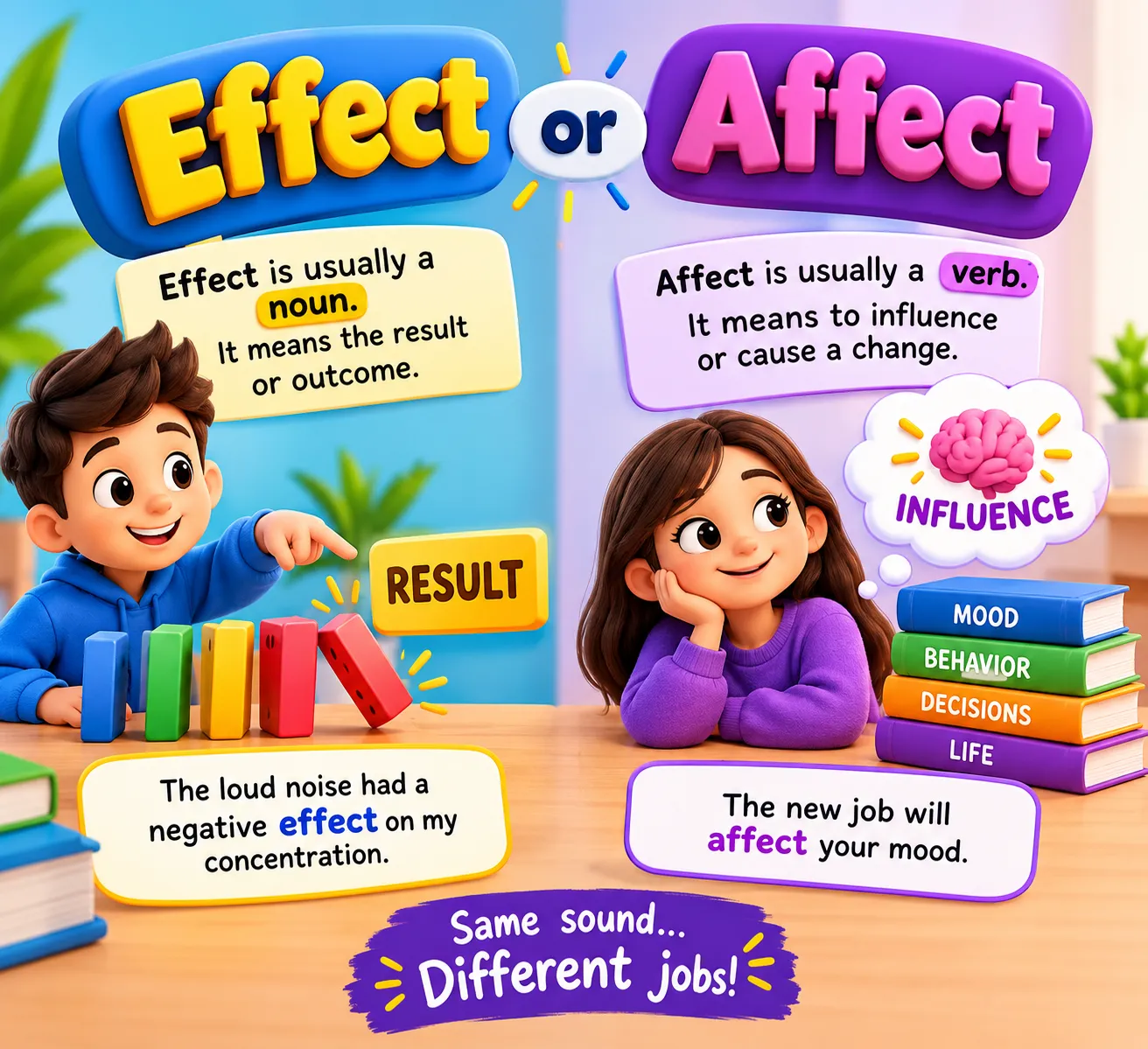
Affect is usually a verb meaning “to influence,” while effect is usually a noun meaning “the result” of that influence.
Have you ever typed a sentence, stopped, and thought, “Is this affect or effect?” You are not alone. Even strong writers mix these two words up.
I have seen this mistake many times in student essays, emails, reports, and everyday writing. The problem is easy to understand. Affect and effect sound almost the same, and their meanings are closely linked.
But there is a simple pattern that solves most cases.
Think of a cause and its result. Something can affect you. The change it creates is an effect. Once you see that connection, the pair becomes much easier.
There are also a few exceptions. Effect can work as a verb, and affect can work as a noun in psychology. These uses are less common, but they matter in formal writing.
This guide breaks down the difference in plain English. You will learn the meanings, history, grammar rules, common mistakes, real-world examples, and a few memory tricks that can help you choose the right word with confidence.
Effect or Affect Quick Answer
For most everyday writing, use:
- Affect = verb = influence or change
- Effect = noun = result or outcome
For example:
The loud noise affected my concentration.
Here, affected describes an action. The noise influenced your concentration.
Now look at this:
The loud noise had a negative effect on my concentration.
Here, effect names the result.
Cambridge Dictionary gives the same basic rule: affect is normally a verb meaning to influence or cause change, while effect is normally a noun referring to the result of an influence.
A simple memory trick
Remember:
Affect → Action
Effect → End result
It is not a perfect rule for every sentence, but it works extremely well for common usage.
The Origin / Background of Effect and Affect
The confusion between these words has a long history. Their forms are closely related to Latin words, but they entered English through different paths and developed several meanings.
According to Etymonline, affect as a noun comes from Latin affectus, connected with a state of mind or disposition. The verb affect, meaning “to influence,” developed from related Latin forms and has been used in English for centuries.
Effect also has Latin roots. Etymonline traces the noun to Old French efet and Latin effectus, linked with accomplishment, performance, or something brought about. Its meaning later developed toward the modern idea of a result or consequence.
That history helps explain why the words feel related. Both can describe a connection between an action and what happens because of it.
There is another reason they cause trouble: they are homophones or near-homophones in many varieties of English. Their pronunciation is very similar, so you cannot always solve the problem by listening.
Grammar is usually the better guide.
Effect vs. Affect Explained Key Differences
The most useful difference is their part of speech.
| Term | Meaning | When to Use | Region/Context |
| affect | influence or change | When describing an action | Common in all major forms of English |
| effect | result or outcome | When naming what happened because of something | Common in all major forms of English |
| effect as a verb | bring about or cause | Formal writing and specific contexts | More formal |
| affect as a noun | emotional state or expression | Psychology and related fields | Specialized |
1. Affect as a verb
Use affect when something changes or influences something else.
Examples:
- Poor sleep can affect your focus.
- Rising prices may affect small businesses.
- The delay affected our travel plans.
Cambridge lists this as the main everyday meaning of the verb: to have an influence on someone or something or to cause a change.
2. Effect as a noun
Use effect when you mean the result.
Examples:
- The new rule had a major effect on attendance.
- The medicine produced a mild effect.
- The storm had a lasting effect on the town.
Cambridge defines effect as the result of a particular influence.
3. Effect as a verb
This is where the usual rule gets interesting.
Effect can be a verb meaning to bring about or cause something to happen.
For example:
The new policy effected major changes in the department.
This is formal and less common than the noun effect. Etymonline records the verb from the late 16th century, with the sense of producing a result or bringing something to an intended end.
Do not replace every instance of affect with effect just because both can be verbs.
Compare:
The policy affected the staff.
The policy influenced the staff.
The policy effected major changes.
The policy brought those changes about.
The meanings are different.
4. Affect as a noun
Affect can also be a noun, but this use is mainly found in psychology and related academic fields.
In this context, affect refers to an emotional state or the way emotion is expressed. Cambridge lists this as a specialized psychological meaning.
So you may see:
The patient’s affect appeared flat.
This is correct, but it is very different from the everyday verb affect.
Which Version Should You Use?
For beginners, students, and everyday writers, keep the basic rule in mind.
For students
Use affect when you mean “influence.”
Use effect when you mean “result.”
This will cover most school assignments.
For professional emails
The same rule works well.
The schedule change affected the project.
The schedule change had an unexpected effect on the project.
Both are natural and clear.
For formal or academic writing
Watch the grammar closely. Academic writing often uses both words in the same paragraph because it discusses causes and results.
For example:
The training program affected employee performance, producing a measurable effect on productivity.
The first word describes the influence. The second names the result.
Common Mistakes With Effect or Affect
Mistake 1: Using “effect” instead of “affect”
❌ The weather effected our plans.
✅ The weather affected our plans.
Why? You mean that the weather influenced the plans.
Mistake 2: Using “affect” as a noun
❌ The new rule had a strong affect on sales.
✅ The new rule had a strong effect on sales.
Why? You are naming the result. That calls for the noun effect.
Mistake 3: Writing “affect” after “an”
❌ The change had an affect on attendance.
✅ The change had an effect on attendance.
The phrase “have an effect on” is a common and useful structure.
Mistake 4: Confusing “effected” and “affected”
These forms are not interchangeable.
- Affected = influenced or changed
- Effected = brought about or caused
Example:
The heat affected the equipment.
The heat influenced the equipment.
The manager effected several changes.
The manager brought the changes about.
Mistake 5: Assuming the first-letter trick always works
The memory trick A = Action and E = End result is useful.
But English has exceptions.
That is why grammar and meaning should come first. Use the trick to check your choice, not as an absolute law.
Effect or Affect in Real World Examples
Seeing the words in different types of writing makes the difference easier to remember.
Professional email
The supplier delay may affect our delivery schedule, so we are reviewing alternative options.
Here, affect describes the influence of the delay.
News headline
New Transport Rules Could Affect Morning Traffic
The rules may influence traffic.
Social media post
I never expected one small change to have such a positive effect on my routine.
Here, effect means the result.
Formal report
The revised training plan affected staff performance and had a measurable effect on customer response times.
Both words can appear together because they perform different grammatical jobs.
Effect or Affect Data, Trends & Usage
There is strong evidence that this pair is a persistent English usage problem, but search-volume figures need care.
Exact monthly Google search numbers for “affect or effect” vary by country, keyword tool, database, and month. Public search results do not provide a stable, authoritative number that can responsibly be presented as a universal monthly figure. For that reason, it is better not to invent a search-volume number.
The topic is clearly part of a wider family of commonly confused English words. Cambridge itself groups affect/effect with other easily confused pairs such as accept/except and principle/principal.
Corpus tools offer another useful view. Google Books Ngram Viewer tracks how words and phrases occur across a large digitized book corpus and allows users to compare frequency over time. Its current system includes English data through recent corpus releases, with the latest dataset covering books through 2022.
One caution matters: Ngram frequency is not the same as Google search volume. A word can be common in books without being a common search query.
The search intent behind effect or affect is mainly informational. People usually want to solve a grammar or spelling problem, check a sentence, or learn the difference between the two words.
This remains useful today because people write constantly in emails, school systems, online forms, reports, social posts, and AI-assisted writing tools. A tiny word choice can change the grammar of an otherwise strong sentence.
Standalone Comparison: Effect vs. Affect
| Term/Variant | Meaning | Region/Context | Best Used When |
| affect | influence or change | General English | You need a verb for influence |
| effect | result or outcome | General English | You need a noun for a result |
| effect (verb) | bring about | Formal English | You mean “cause to happen” |
| affect (noun) | emotional expression/state | Psychology | You are using the specialized technical meaning |
The key is not simply the spelling. Look at the job the word performs in the sentence.
A Fast Way to Remember Effect or Affect
When you are stuck, ask yourself one question:
Am I talking about the influence, or am I talking about the result?
If you mean influence, choose affect.
If you mean result, choose effect.
Try this:
Lack of sleep can ______ your memory.
The answer is affect because lack of sleep can influence your memory.
Now:
Lack of sleep can have a negative ______ on memory.
The answer is effect because you are naming the result.
This simple test will solve most everyday cases.
FAQ: Effect or Affect
Q: What does affect mean?
A: Affect is usually a verb meaning to influence or cause a change. For example, a noisy room can affect your ability to concentrate.
Q: What does effect mean?
A: Effect is usually a noun meaning a result, outcome, or consequence. It often follows words such as “the,” “an,” or “this.”
Q: Is affect a verb or a noun?
A: It is most often a verb in everyday English. It can also be a specialized noun in psychology, where it refers to emotional state or expression.
Q: Is effect a verb or a noun?
A: Effect is most commonly a noun. It can also be a formal verb meaning to bring about or cause something to happen.
Q: Which is correct: “affect on” or “effect on”?
A: The standard phrase is usually “effect on.” For example, “The change had an effect on sales.” When you use affect as the verb, you normally say that something “affects” something else.
Q: Are affect and effect pronounced the same?
A: In common English pronunciation, they are very similar, which adds to the confusion. The grammatical role and meaning are usually more useful than pronunciation when choosing between them.
Q: Where do affect and effect come from?
A: Both have Latin roots, but their English histories are not identical. Affect is linked to Latin affectus and related forms, while effect developed through Old French from Latin effectus.
Q: Can I use effect as a verb in formal writing?
A: Yes. Effect can mean “bring about,” as in “The reform effected major changes.” However, this is more formal and less common than the everyday noun effect.
Conclusion: Effect or Affect Made Easy
The difference between effect and affect looks harder than it really is.
For everyday English, start with the main pattern:
- Affect is usually a verb.
- Effect is usually a noun.
- Affect means to influence or change something.
- Effect means the result of that influence.
There are exceptions. Effect can be a formal verb meaning “bring about,” while affect can be a specialized noun in psychology. These uses are real, but you will meet them less often in ordinary writing.
When you are unsure, focus on meaning first. Ask whether you are describing an influence or naming a result. Then check the word’s role in the sentence.
That small habit can prevent a very common grammar mistake.
Now you know how effect or affect works. Bookmark this guide so you can check the difference whenever these two words make you hesitate.
Readmore

I’m Daniel sultan, an English language writer and SEO content specialist with experience researching spelling, grammar, vocabulary, and English usage. Through SpellComparison.com, I create clear, accurate, and well-researched guides that help readers understand commonly confused words, spelling differences, and grammar rules with confidence.
Every article I write is based on trusted language references, established style guides, and real-world usage to ensure it is accurate, practical, and easy to understand. My goal is to make learning English simple and reliable by providing fact-checked content, clear explanations, and real-life examples that students, writers, educators, and professionals can trust.