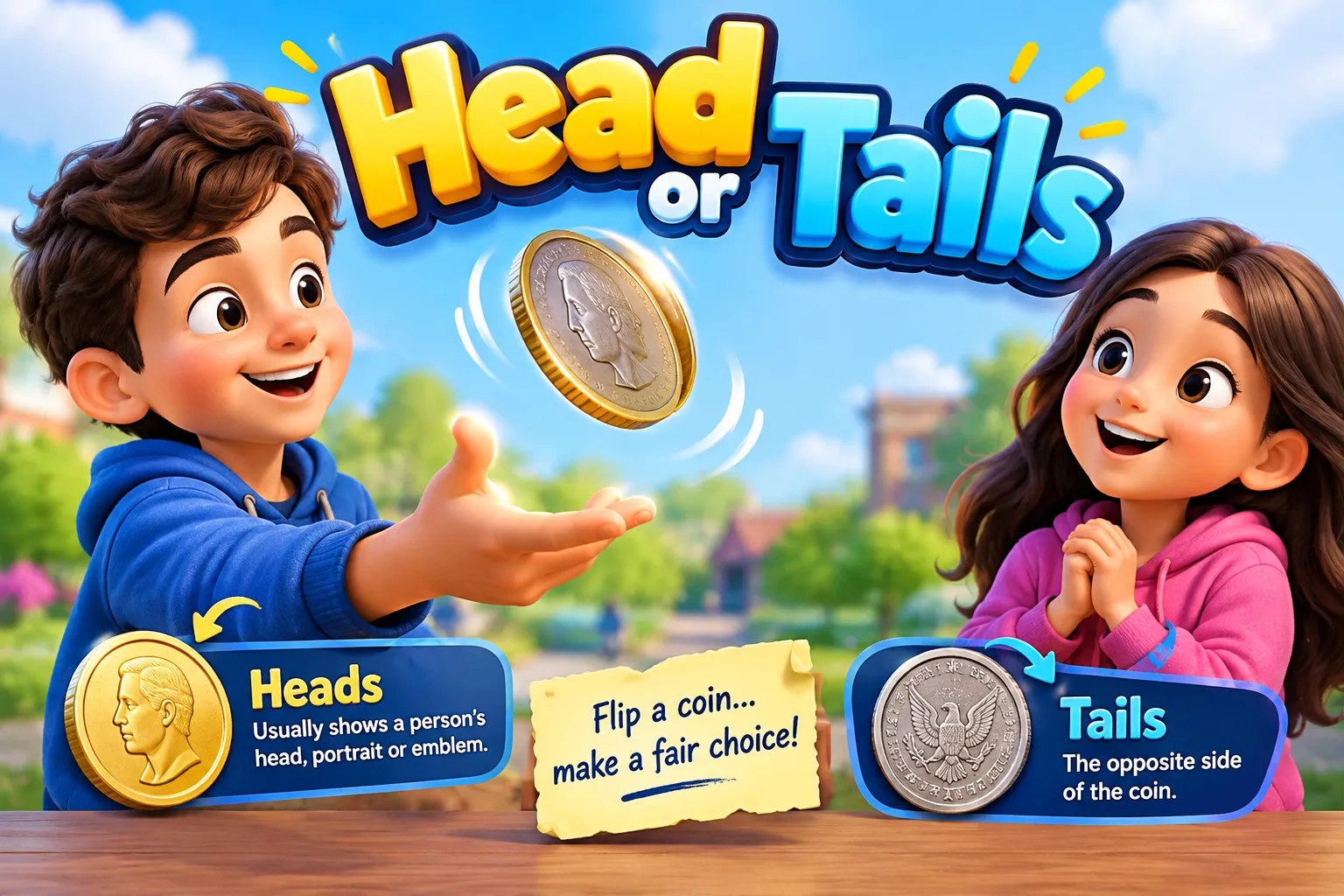
Head or tails is a phrase used when choosing between the two sides of a coin, usually in a coin toss to make a random decision.
Have you ever stood with a friend, held a coin in your hand, and said, “Heads or tails?” It sounds simple. Yet this tiny phrase has a long history and several uses beyond a basic coin toss.
I have seen learners pause over this phrase because they are unsure whether head or heads is correct, whether tails refers to an animal, and why people say “heads or tails” when a coin has only one head. The confusion becomes greater when the phrase appears in sports, games, decisions, or everyday speech.
The good news is that the idea is easy once you understand the words and the tradition behind them.
In this guide, you will learn what head or tails means, where the phrase comes from, how a coin toss works, common mistakes, real examples, and how the phrase is used today. You will also see the difference between head, heads, tail, and tails.
Let’s flip the coin and find out.
Sure — here is the Quick Answer section in a clean, SEO-friendly tabular format:
Head or Tails Quick Answer
| Point | Explanation |
| Meaning | Head or tails asks you to choose one of the two sides of a coin before it is tossed. |
| Heads side | The heads side usually features a person’s head, portrait, emblem, or main design. |
| Tails side | The tails side is the opposite side of the coin. |
| Common use | The phrase is mainly used when tossing a coin to make a random choice. |
| Example 1 | “Call it. Heads or tails?” |
| Example 2 | “I picked tails, but the coin landed on heads.” |
| Purpose | A coin toss can provide a simple and fair way to make a decision. |
The Origin and Background of Head or Tails
The words head and tail are much older than the coin-tossing phrase.
Head comes from Old English hēafod, meaning the upper or principal part of the body. Over time, the word gained many wider meanings, including the idea of something being at the front, top, or leading position.
Tail also has Old English roots. It developed from an older Germanic word referring to the rear part or appendage of an animal.
Merriam-Webster records the many modern senses of head, while its entry for tail shows how the word can refer to the rear or opposite end of something.
The coin meanings grew from these basic ideas. A ruler’s or leader’s portrait was often placed on one side of a coin. The opposite side became associated with the reverse or “tail” side.
The exact design differs from coin to coin. Some coins have a person’s portrait. Others show a national symbol, building, animal, or emblem.
That is why heads and tails are best understood as traditional names for the two sides of a coin rather than literal descriptions of every modern coin.
Head or Tails Explained Key Differences
There are four useful forms to understand:
| Term | Meaning | When to Use | Region/Context |
| head | The top/front part of a body or object | General meaning | Global English |
| heads | The “head” side of a coin | Coin tosses | Common English |
| tail | The rear part of an animal or object | General meaning | Global English |
| tails | The opposite side of a coin | Coin tosses | Common English |
Why do people say “heads” instead of “head”?
In a coin toss, heads is normally used as the name of the coin side.
You might say:
“I choose heads.”
You would not normally say:
“I choose head.”
The plural form has become the standard expression for the coin side.
Cambridge Dictionary defines heads or tails as the choice between the two sides of a coin when it is tossed.
What does “tails” mean?
In this phrase, tails does not mean several animal tails.
It means the reverse side of a coin.
So when someone says, “I call tails,” they are predicting that the coin will land with its tails side facing upward.
Which Version Should You Use?
For everyday English, the safest choice is simple:
- For a coin toss: say heads or tails.
- For the body part: say head or tail.
- For a random choice: use heads or tails when a coin is involved.
- For formal writing: explain the coin toss clearly if your audience may not know the expression.
- For learners: remember the fixed phrase “heads or tails?”
There is no need to change the expression to make it sound more formal.
For example:
“We used a coin toss to decide who would go first.”
This is neutral and suitable for formal writing.
Common Mistakes with Head or Tails
1. Saying “head or tail” for a coin toss
Mistake: “Head or tail?”
Better: “Heads or tails?”
The traditional coin-toss expression uses the plural forms.
2. Treating “tails” as an animal tail
Mistake: “The coin has two tails.”
This can be misleading because tails is being used as a name for one side of the coin.
Better: “The coin has a heads side and a tails side.”
3. Confusing “heads” with a person’s head
Mistake: “The heads of the players were wet.”
That sentence may mean the players’ heads were wet, not anything related to coins.
Better: “The coin landed on heads.”
Context changes the meaning.
4. Writing “head or tails” in a coin-toss question
Less natural: “Head or tails?”
Natural: “Heads or tails?”
The latter is the established phrase.
5. Assuming every coin has a person’s head
Modern coins do not all show a human portrait. Some feature animals, buildings, plants, symbols, or other designs.
The terms heads and tails can still describe the two sides.
Head or Tails in Real World Examples
The phrase appears in many everyday situations.
Professional email
“If both proposals receive equal support, we can use a coin toss and call heads or tails.”
This keeps the tone clear and neutral.
News writing
“The captain won the toss after calling tails before the match.”
Sports reports often use coin-toss language when describing who gets the first choice.
Social media
“Can’t decide where to eat tonight. Heads or tails?”
Here, the coin toss becomes a fun way to make a small decision.
Formal document
“In the event of an equal result, the order of selection will be determined by a coin toss.”
This version is more formal and avoids relying on the reader’s familiarity with the phrase.
Head or Tails Data, Trends & Usage
Search data for small phrases can change over time, and exact monthly figures depend on the SEO platform, country, and date. Public tools do not always provide a stable, universal number for a phrase such as head or tails.
Google Trends is therefore more useful for comparing relative search interest than claiming an exact worldwide search volume. Its data is normalized rather than presented as raw monthly searches.
The phrase has strong informational intent. People usually search it because they want to understand:
- what heads or tails means;
- how a coin toss works;
- which side is heads;
- how to use the phrase;
- or why the expression uses plural forms.
Corpus tools such as Google Ngram Viewer can also help show how word and phrase usage changes across published books over time. However, Ngram data should not be treated as a direct measure of modern internet searches.
One useful point is that head and tail are much broader words than their coin-toss meanings. They occur in many areas of English, including anatomy, leadership, objects, animals, grammar, and idioms.
Today, the phrase also remains useful because people still use coin flips for quick, neutral choices. Digital coin-flip tools have simply moved the same idea from a physical coin to a screen.
A Second Comparison: Related Expressions
| Term/Variant | Meaning | Region/Context | Best Used When |
| Heads or tails? | Asking which coin side someone chooses | General English | Starting a coin toss |
| Call it | Tell me your chosen side before the result | Informal speech | Beginning a toss |
| Coin toss | A random choice made by tossing a coin | Formal and informal | Explaining the method |
| Heads | One named side of a coin | General English | Predicting the result |
| Tails | The other named side | General English | Predicting the result |
The phrase “call it” is especially useful in spoken English. A person may say, “Call it in the air,” meaning the other person should choose heads or tails while the coin is being tossed.
Is Head or Tails an Idiom?
Not exactly.
Heads or tails is better described as a fixed expression connected to coin tossing.
It can also become part of informal decision-making language. For example, someone might say, “Let’s leave it to heads or tails.”
The phrase is not a conjunction or a special grammar rule. Its meaning comes from the conventional names given to the two sides of a coin.
Head or Tails and Linguistics
From a linguistics point of view, head is an interesting word because it has many meanings.
It can refer to:
- a body part;
- a leader;
- the top or front of something;
- a toilet, in some contexts;
- a person counted as an individual;
- or one side of a coin.
Tail also has several senses. It can mean an animal’s rear appendage, the back end of something, or the opposite side of a coin.
This is an example of polysemy: one word develops several related meanings.
It is not a homophone issue. Head and tail have different sounds and different spellings. The challenge comes from their many meanings and the special vocabulary used for coins.
FAQ: Head or Tails
Q: What does “head or tails” mean?
A: It refers to the two sides of a coin. The phrase is normally used when someone is about to toss a coin and asks you to choose a side. Cambridge Dictionary lists heads or tails as a coin-toss expression.
Q: Is it “head or tails” or “heads or tails”?
A: The standard phrase is “heads or tails?” The plural forms are used when naming the two possible coin sides.
Q: Which side of a coin is heads?
A: Traditionally, the heads side is the side associated with a portrait or principal design. Modern coins vary, so the design does not always show an actual human head.
Q: What does “tails” mean on a coin?
A: Tails means the side opposite the heads side. It is a conventional coin term, not a statement that the coin literally has an animal tail.
Q: Is “heads or tails” formal English?
A: Yes, the phrase is standard English. However, in a formal report, you may prefer coin toss if you want to describe the process in a more direct way.
Q: Where does the word “head” come from?
A: Head has Old English roots and is related to older Germanic forms. Its meanings expanded over centuries to include ideas such as leadership and the front or top of something.
Q: Can “heads or tails” be used without actually tossing a coin?
A: Yes. People sometimes use it playfully when asking someone to make a quick choice. The literal expression, however, refers to selecting one side of a coin.
Conclusion
Heads or tails may look like a very small phrase, but it carries a useful piece of English vocabulary.
Remember these key points:
- Heads names one side of a coin.
- Tails names the opposite side.
- The normal coin-toss question is “Heads or tails?”
- Head and tail also have many other meanings in English.
- The phrase is widely understood in everyday speech and writing.
The biggest mistake to avoid is dropping the s from heads when you mean the coin side. If you are talking about a body part, however, head is the normal word.
Once you connect heads = one coin side and tails = the other, the phrase becomes easy to remember.
Next time someone hands you a coin and asks, “Heads or tails?”, you will know exactly what they mean. Bookmark this guide so you never second-guess the phrase again.
Readmore

I specialize in English grammar, spelling, word choice, and language usage. My content is based on research from grammar references, style guides, dictionaries, and real-world usage to ensure it is accurate and practical.
At Spelling Comparison, I write guides that explain why words are confused, how they are used, and which form is correct in context. I also include proofreading tips, examples, and writing advice readers can apply immediately.
My goal is to publish clear, reliable content that helps readers make better writing decisions. Each guide is written for accuracy, clarity, and usefulness in school, work, business, and everyday communication.










