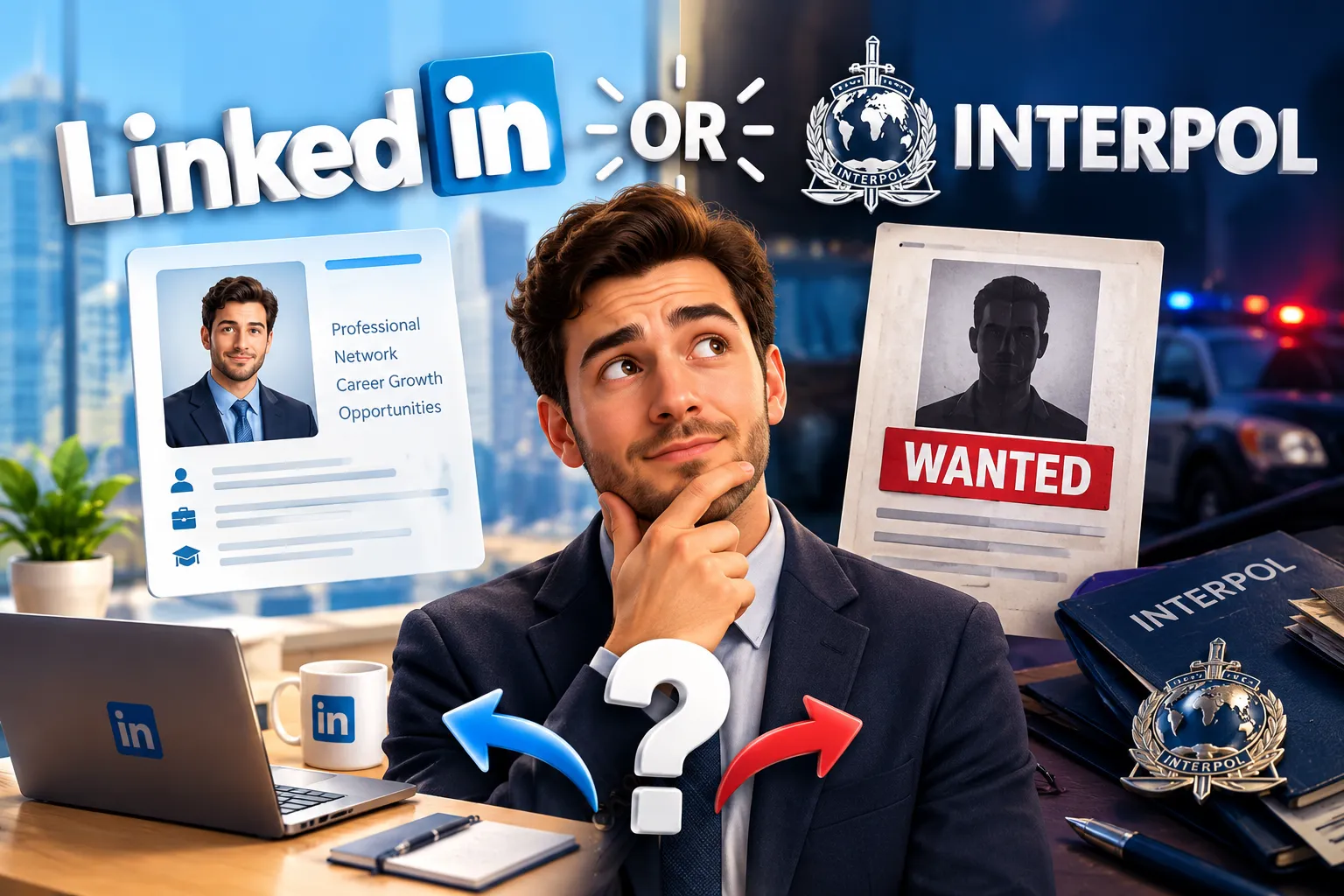
LinkedIn or Interpol usually refers to a fun guessing game where you decide whether a person’s photo looks like a professional LinkedIn profile or an INTERPOL wanted-person image.
Have you ever looked at a profile photo and thought, “Is this a business professional or someone wanted by the police?” That strange question is the idea behind LinkedIn or Interpol.
At first, the two names seem almost impossible to compare. LinkedIn is a professional networking platform. INTERPOL is an international organization that helps police forces cooperate across borders.
Yet the contrast makes the phrase funny.
I first came across the idea while looking at how people present themselves online. A polished photo, a serious face, and a plain background can make almost anyone look like a corporate executive—or like someone from a police database. That is exactly why the LinkedIn or Interpol concept works so well as a visual guessing game.
This guide explains what the phrase means, how the game works, what LinkedIn and INTERPOL actually do, and why the comparison became an internet joke. You will also learn an important fact many people get wrong: INTERPOL does not simply act as a worldwide police force that arrests people itself.
Let’s break it down.
LinkedIn or Interpol Quick Answer
LinkedIn or Interpol is mainly used as the name of a photo-based guessing game. You see a person’s image and try to decide whether the person appears to be a LinkedIn professional or someone associated with an INTERPOL wanted-person notice.
The game itself is based on visual clues. A serious portrait, formal clothing, neutral background, and direct expression may make a photo look like either type.
A website using this exact concept describes its game as “Professional or Criminal?” and asks players to choose between LinkedIn and Interpol.
A simple example
Imagine a photo of a man wearing a dark suit against a plain gray wall.
You might think:
- LinkedIn: He looks like a lawyer or company executive.
- Interpol: His photo looks like an official identification image.
The joke comes from how similar some serious profile pictures can look.
The Origin and Background of LinkedIn or Interpol
The phrase LinkedIn or Interpol is not an English grammar issue like affect or effect. It compares two proper names that represent completely different worlds.
LinkedIn began in 2002 and officially launched on May 5, 2003. It was created as a professional networking service. LinkedIn says it now has more than 1 billion members in more than 200 countries and territories.
People use LinkedIn to:
- Build professional profiles
- Find jobs
- Connect with colleagues
- Recruit employees
- Share professional content
- Promote businesses and skills
LinkedIn describes its network as a place where professionals connect, stay informed, and advance their careers.
INTERPOL
INTERPOL has a very different history.
The organization traces its origins to international police cooperation in 1923, when representatives from 20 countries met in Vienna. The organization was then known as the International Criminal Police Commission.
Its formal name today is the International Criminal Police Organization – INTERPOL. INTERPOL says the short name was chosen in 1946 as a telegraphic address.
Today, INTERPOL has 196 member countries. It helps national police forces share information and cooperate on international crime
So, the two names have no shared linguistic origin. The connection comes from the visual joke and guessing-game format.
LinkedIn or Interpol Explained Key Differences
The easiest way to understand the phrase is to separate the two organizations.
| Term | Meaning | When You See It | Region/Context |
| Professional networking platform | Jobs, careers, business networking | Global | |
| INTERPOL | International police cooperation organization | Cross-border crime and police cooperation | 196 member countries |
| LinkedIn profile | A person’s professional online identity | Recruiting and networking | Online |
| INTERPOL notice | International police alert or request | Wanted-person and investigative cases | International law enforcement |
LinkedIn is about professional identity
A LinkedIn profile normally shows information such as:
- Your name
- Job title
- Work history
- Education
- Skills
- Professional photograph
- Career interests
The goal is to help other professionals understand who you are and what you do.
INTERPOL is about police cooperation
INTERPOL helps police in different countries exchange information and cooperate on investigations.
Its work includes areas such as:
- Terrorism
- Cybercrime
- Organized crime
- Financial crime
- Anti-corruption
INTERPOL says its General Secretariat coordinates daily activities and supports police through technical and operational assistance
One major misconception
INTERPOL is not simply a global police department.
For example, a Red Notice is not an international arrest warrant. INTERPOL explains that a Red Notice is a request to locate and provisionally arrest a wanted person while legal action is considered. Each member country decides what legal effect the notice has under its own laws.
That distinction matters.
Which Version or Approach Should You Use?
Your choice depends on what you mean.
For career and business topics → LinkedIn
Use LinkedIn when talking about:
- Your career
- Professional networking
- Job searches
- Recruiting
- Business contacts
- Professional branding
Example:
“I found the vacancy through LinkedIn.”
For international policing → INTERPOL
Use INTERPOL when discussing:
- International crime
- Police cooperation
- Red Notices
- Cross-border investigations
- International criminal databases
Example:
“The national police contacted INTERPOL during the investigation.”
For the online guessing game → LinkedIn or Interpol
Use the full phrase when discussing the game or meme.
Example:
“We played LinkedIn or Interpol and tried to guess which photos were police images.”
Common Mistakes with LinkedIn or Interpol
1. Treating INTERPOL as a normal police department
Mistake: “INTERPOL arrested the suspect.”
Better: “Police arrested the suspect after cooperation through INTERPOL.”
INTERPOL facilitates cooperation. National authorities carry out arrests under their own legal powers.
2. Writing “Interpol” in every formal context
Mistake: “Interpol issued an international arrest warrant.”
Better: “INTERPOL issued a Red Notice.”
The second sentence is more precise.
3. Thinking LinkedIn and INTERPOL are related organizations
They are not.
LinkedIn is a professional technology platform. INTERPOL is an intergovernmental organization focused on international police cooperation.
4. Assuming every INTERPOL notice is public
Most INTERPOL Notices are intended for police use. Only some extracts are made public when the requesting country wants public assistance.
5. Assuming a serious photograph proves anything
This is the biggest mistake in the guessing game.
A person’s expression or photograph cannot reliably tell you whether they are a criminal. The game is designed for entertainment, not real criminal identification.
LinkedIn or Interpol in Real World Examples
Here are fresh examples showing how the phrase and its two parts work in different settings.
Professional email
“Please send me your LinkedIn profile so I can review your professional background.”
News headline
INTERPOL helps police coordinate international investigation
Social media post
“This photo looks so serious that I honestly cannot tell: LinkedIn or Interpol?”
Formal report
“The investigation involved cooperation between national law-enforcement authorities and INTERPOL.”
Casual conversation
“That profile picture looks like it belongs in a LinkedIn or Interpol challenge.”
Notice the difference. LinkedIn works naturally in career contexts. INTERPOL belongs to law-enforcement contexts. The combined phrase is mainly playful.
LinkedIn or Interpol Data, Trends & Usage
There is an interesting SEO issue here.
“LinkedIn” and “INTERPOL” are both established global names, but “LinkedIn or Interpol” is a much narrower search phrase. It is also strongly connected with the online guessing-game concept.
The game website currently presents the idea as a deduction game in which users see a person’s photograph and select LinkedIn or Interpol.
What about search volume?
A precise monthly search-volume figure for “LinkedIn or Interpol” is not reliably available from the public sources checked for this article. It would be misleading to invent an Ahrefs or Semrush number.
Google Trends is useful for comparing search interest, but its values are relative, not absolute monthly search counts. Google explains that Trends normalizes results to a 0–100 scale based on the selected time and location. Very low-volume searches can also appear as zero.
So an SEO writer should not turn a Trends score into a fake number such as “12,000 monthly searches.”
Useful factual numbers
The two names have very different scales:
- LinkedIn: more than 1 billion members across more than 200 countries and territories.
- INTERPOL: 196 member countries.
- INTERPOL’s roots: international police cooperation began in 1923.
- LinkedIn launch: May 5, 2003.
Search intent
For “LinkedIn”, search intent is often navigational or informational.
People may want to:
- Open their account
- Find a professional
- Learn about jobs
- Understand LinkedIn features
For “INTERPOL”, intent is often informational or navigational.
People may want to:
- Check a Red Notice
- Learn about international police cooperation
- Understand INTERPOL’s role
- Find official information
For “LinkedIn or Interpol”, the intent is more entertainment-focused. The searcher may be looking for the game, an explanation, or examples.
Standalone Comparison: LinkedIn vs INTERPOL
| Term/Variant | Meaning | Region/Context | Best Used When |
| Professional network | Global business and careers | Talking about work or networking | |
| INTERPOL | International police organization | Global law enforcement | Talking about international crime |
| LinkedIn profile | Professional online profile | Employment and business | Discussing someone’s career identity |
| INTERPOL Red Notice | International alert/request | Cross-border law enforcement | Discussing wanted-person alerts |
| LinkedIn or Interpol | Photo-based guessing concept | Internet entertainment | Comparing professional-looking and police-style photos |
This table highlights an important point: LinkedIn and INTERPOL are not competing versions of the same thing. They serve completely different purposes.
Frequently Asked Questions
Q: What does LinkedIn or Interpol mean?
A: It usually refers to a guessing game in which players decide whether a photograph looks like a LinkedIn professional profile or an INTERPOL-related wanted-person image. The humor comes from the serious style of both types of photographs.
Q: Is LinkedIn or Interpol an official organization?
A: No. The phrase is not the name of a joint organization. It is associated with an online guessing-game concept. LinkedIn and INTERPOL are separate organizations with different purposes.
Q: Is LinkedIn the same as INTERPOL?
A: No. LinkedIn is a professional networking platform. INTERPOL is an intergovernmental organization that supports cooperation between police authorities in different countries.
Q: What does INTERPOL actually do?
A: INTERPOL helps police forces share information and coordinate international cooperation. It provides databases, communication systems, technical support, and tools such as Notices.
Q: Does INTERPOL arrest people?
A: INTERPOL does not have the same arrest powers as a national police force. For example, a Red Notice is an international alert and request, not an arrest warrant. National authorities decide what action to take under their laws.
Q: When should I use LinkedIn?
A: Use LinkedIn when you mean professional networking, careers, recruiting, or the platform itself. It is especially common in business and employment contexts.
Q: Why are LinkedIn and INTERPOL compared in the game?
A: Both can be associated with serious-looking photographs. A formal portrait can look like a professional profile or an official identification image, which creates the joke behind the game.
Q: Where did INTERPOL come from?
A: INTERPOL traces its roots to international police cooperation established in Vienna in 1923. The organization was originally called the International Criminal Police Commission. (Conclusion
LinkedIn or Interpol is a clever internet comparison built around two names that normally have nothing to do with each other.
LinkedIn belongs to the world of careers, professional identity, networking, and jobs. INTERPOL belongs to the world of international police cooperation and cross-border crime. One helps professionals build connections. The other helps police forces share information across national borders.
The phrase became entertaining because serious profile photographs can sometimes look surprisingly similar to official police images. That makes the guessing game work.
There is also a useful lesson behind the joke. A photograph cannot tell you whether someone is a criminal. Real INTERPOL alerts follow legal and police procedures, and a Red Notice is not itself an arrest warrant.
So, remember the simple rule: LinkedIn = professional network. INTERPOL = international police cooperation. LinkedIn or Interpol = the playful guessing-game idea.
Now you know the difference. Bookmark this guide so you can explain LinkedIn or Interpol with confidence next time you see the phrase.
Readmore

I’m Daniel sultan, an English language writer and SEO content specialist with experience researching spelling, grammar, vocabulary, and English usage. Through SpellComparison.com, I create clear, accurate, and well-researched guides that help readers understand commonly confused words, spelling differences, and grammar rules with confidence.
Every article I write is based on trusted language references, established style guides, and real-world usage to ensure it is accurate, practical, and easy to understand. My goal is to make learning English simple and reliable by providing fact-checked content, clear explanations, and real-life examples that students, writers, educators, and professionals can trust.










