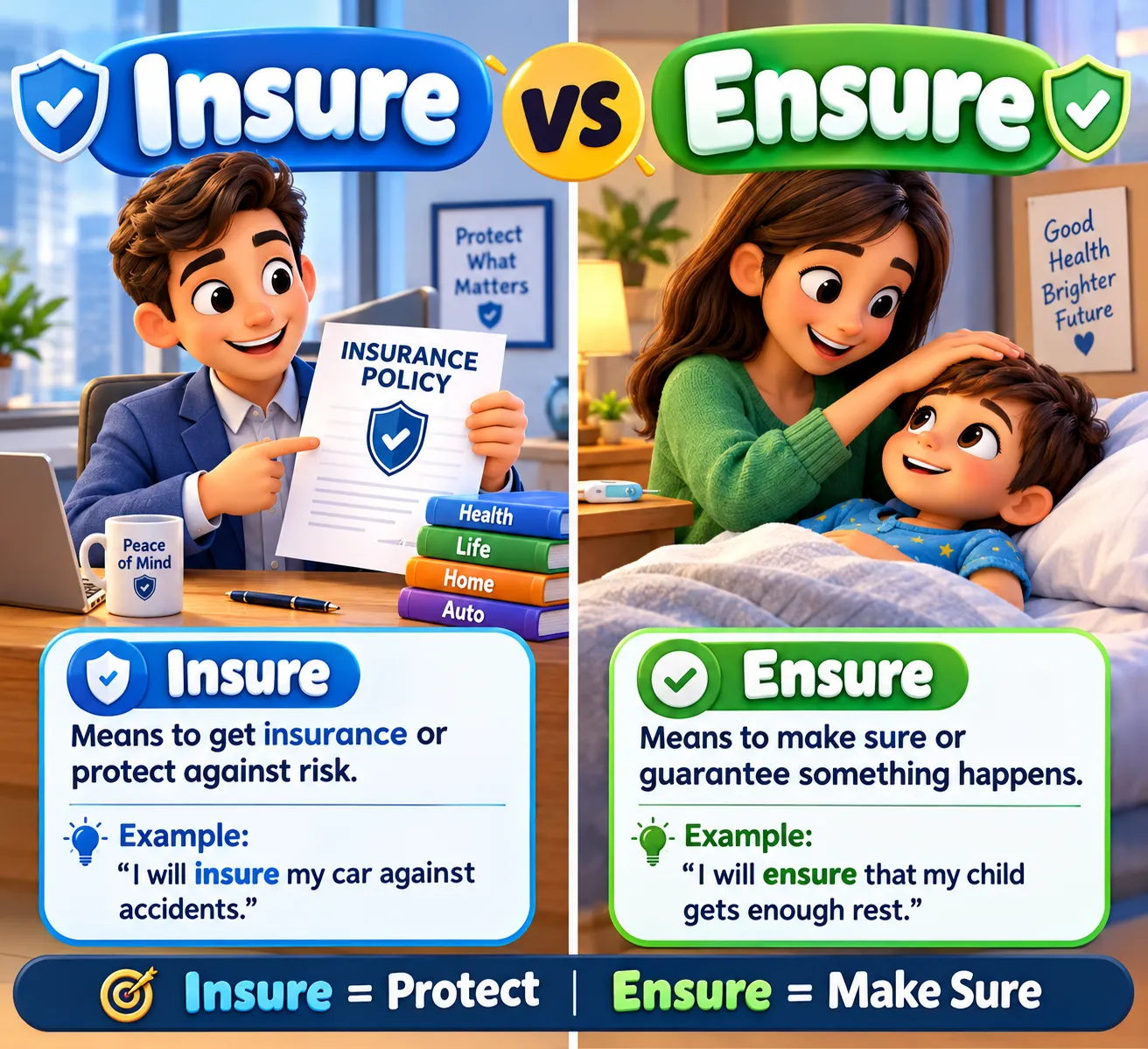
Insure means to protect someone or something with insurance. Ensure means to make sure something happens or is true.
I have often come across sentences where people use insure when they really mean ensure. The words look and sound alike, so it is easy to mix them up. Yet, they have different meanings.
Imagine writing a work email and saying, “Please insure that all files are saved.” You may mean to ask someone to make sure the files are safe. In that case, ensure is the better word. Insure usually refers to protecting something through an insurance policy.
I know this small spelling choice can be confusing, especially when you want your writing to sound clear and professional. The good news is that you can learn the difference with a simple rule. Think of insurance when you use insure. Think of making sure when you use ensure.
In this guide, I will explain the meaning, usage, and history of both words. You will also find clear examples, common mistakes, comparison tables, and easy tips to help you choose the right word in emails, schoolwork, and everyday writing.
Insure or Ensure Quick Answer
Both words are verbs, but they are used for different purposes in most standard English writing.
- Insure means to arrange financial protection against a loss, such as damage to a car or home.
- Ensure means to make sure that something happens or that a result is achieved.
For example, you might insure your laptop against theft. You might also ensure that your files are backed up before you travel.
According to Cambridge Dictionary, ensure means to make something certain to happen. Insure usually relates to insurance and financial protection, although American English sometimes uses it to mean “make certain.”
The Origin and Background of Insure or Ensure
The history of these words helps explain why people often confuse them.
Where does “insure” come from?
The word insure dates back to the 15th century. According to the Online Etymology Dictionary, it developed from an older form of ensure and originally carried the idea of making something safe or secure.
By the 17th century, insure had gained its familiar financial meaning. It became linked to protecting people or property against loss in exchange for insurance payments.
Today, you may see it in phrases such as:
- Insure a car against theft.
- Insure a house against fire.
- Insure valuable jewelry before a trip.
These examples all involve protection against a possible financial loss.
Where does “ensure” come from?
Ensure dates back to the late 14th century. The Online Etymology Dictionary traces it to Anglo-French enseurer, which was related to the idea of making something safe or certain.
Its modern meaning focuses on making sure that something happens or remains true.
For example, a teacher may ensure that every student understands the task. A manager may ensure that a report is ready before a meeting.
Why are these words confused?
The two words share a common history and have overlapping meanings. In some contexts, both can suggest making something secure or certain.
However, modern writing often separates their main uses. Insure is the clearest choice for financial coverage, while ensure is usually best for making sure a result happens.
This distinction is especially useful in business writing, school assignments, and professional emails.
Insure or Ensure Explained Key Differences
The easiest way to choose between these words is to ask yourself one question: Are you talking about an insurance policy or making something happen?
| Term | Meaning | When to Use | Region/Context |
| Insure | Protect against financial loss through insurance | When arranging coverage for a car, home, or other property | Standard English, especially financial contexts |
| Ensure | Make sure something happens or is true | When checking that a task, result, or condition is achieved | Standard English worldwide |
| Assure | Tell someone something confidently to remove doubt | When giving a person confidence or reassurance | Standard English |
| Guarantee | Promise or confirm that something will happen or be provided | When making a firm promise about an outcome or service | Standard English |
Examples of “insure”
Use insure when a person or organization arranges insurance coverage.
- We decided to insure our new car before driving it home.
- The company will insure the equipment against accidental damage.
- She wants to insure her artwork before sending it overseas.
Notice that each sentence refers to protection against a possible loss.
Examples of “ensure”
Use ensure when you want to make certain that something happens or is done correctly.
- Please ensure that every page has a page number.
- The team checked the figures to ensure accuracy.
- We arrived early to ensure a good seat.
Here, the focus is on taking steps to achieve a result, not buying insurance.
What about “assure”?
The word assure is another common source of confusion. It usually relates to giving someone confidence or removing their doubts.
For example:
– I assured my colleague that the files were safe.
This sentence describes reassurance. It does not mean that I bought insurance or took steps to guarantee a particular result.
For a simple memory trick, think of insure = insurance, ensure = make sure, and assure = reassure someone.
Which Word Should You Use?
Your choice depends on what you want to say and the type of writing you are doing.
For students and English learners
Use ensure when you mean “make sure.” This is the clearest choice for essays, homework, and general writing.
Example: “Check your answers to ensure they are correct.”
Use insure when the sentence refers to an insurance policy.
For business professionals
Choose insure when discussing policies, premiums, claims, and coverage. Choose ensure when discussing quality, deadlines, safety steps, or work standards.
Example: “Please ensure that the client receives the updated report.”
If the same email discusses property coverage, insure may be the right word instead.
For British English
In British English, it is best to keep the distinction clear. Use insure for insurance and ensure for making sure.
For American English
American English sometimes uses insure to mean “make certain.” Cambridge Dictionary recognizes this usage. However, ensure is still a clear and widely accepted choice for general writing.
Microsoft’s style guidance on ensure, insure, and assure recommends keeping ensure for making sure and insure for providing insurance. This is a useful rule for writing that needs to be clear to readers around the world.
My recommendation: Use ensure whenever you mean “make sure,” unless you have a specific reason to follow a style guide that permits insure in that sense.
Common Mistakes with Insure or Ensure
Even experienced writers sometimes mix up these words. Here are five mistakes to avoid.
1. Using “insure” instead of “ensure”
Incorrect: Please insure that the room is ready.
Correct: Please ensure that the room is ready.
Why? The sentence asks someone to check that a task is complete. It does not refer to an insurance policy.
2. Using “ensure” when discussing insurance coverage
Incorrect: I need to ensure my car against theft.
Correct: I need to insure my car against theft.
Why? The sentence refers to financial protection against a possible loss.
3. Confusing “assure” with “ensure”
Incorrect: The teacher ensured the students that the test was fair.
Correct: The teacher assured the students that the test was fair.
Why? The teacher is giving the students confidence, not making an event happen.
4. Assuming “insure” and “ensure” are always interchangeable
Incorrect for clear international writing: We will insure that the order arrives on time.
Preferred: We will ensure that the order arrives on time.
Why? Although insure can mean “make certain” in some American English contexts, ensure avoids confusion for a wider audience.
5. Choosing a word without checking the meaning
Incorrect: The manager will assure that all safety checks are complete.
Correct: The manager will ensure that all safety checks are complete.
Why? The manager is responsible for making sure the checks are done. If the manager were simply telling someone that the checks were complete, assure might fit.
A helpful habit is to replace the word with “buy insurance” or “make sure.” If “make sure” fits your meaning, ensure is usually the best option.
Insure or Ensure in Real-World Examples
These examples show how to use the words naturally in different types of writing.
1. Professional email
Hi Team,
Please ensure that the presentation is complete and all figures have been checked before tomorrow’s meeting.
Thank you for your help.
Best regards,
Alex
The word ensure is correct because the sender wants the team to make sure everything is ready.
2. News headline
Local Business Insures Historic Building Against Fire Damage
The word insures fits because the business has arranged financial protection for the building.
3. Social media post
Planning a trip soon? Remember to insure your belongings if your travel insurance policy covers them. A little preparation can help you manage unexpected losses!
Here, insure refers to financial protection. The exact coverage depends on the policy.
4. Formal report
The quality control team reviewed the final product to ensure that it met all required safety standards. The company also insured its production equipment against covered risks.
This example uses both words correctly. Ensure refers to meeting a standard, while insured refers to financial protection.
Insure or Ensure Data, Trends and Usage
Understanding these words is useful for grammar, but it can also help you create better SEO content.
Search volume and keyword trends
I do not have verified current monthly search-volume figures for “insure or ensure.” Rather than invent numbers, it is better to use a keyword research tool to check the latest data.
You can compare the two phrases using Google Trends. Google’s official Trends help guide explains that search terms measure interest in the exact words entered, while topics can include related searches.
For SEO research, compare:
- Main keyword: insure or ensure
- Related keywords: ensure vs insure, insure meaning, ensure meaning, assure vs ensure, and insure vs ensure examples
- Search intent: Informational, because readers want to understand the difference and learn correct usage.
- Regional interest: Compare countries and time periods in Google Trends rather than assuming which country searches most.
- Content opportunity: Give readers clear definitions, simple examples, a comparison table, and common mistakes in one place.
Why does this distinction still matter?
People write emails, reports, applications, and online content every day. A wrong word can change the meaning of a sentence or make a message less clear.
Grammar tools can suggest corrections, but they may not always understand the exact meaning you want. Knowing the difference helps you review your own writing with confidence.
For publishers and SEO writers, a focused article can answer several related questions without repeating the same keyword too often. Clear language benefits both readers and search engines.
Which word is more common?
Both words are established English verbs, but their frequency depends on the type of text. Insure is common in insurance and financial writing, while ensure appears in many general and professional contexts.
I have not verified a current corpus count or exact frequency ratio, so I would not claim that one is a specific number of times more common than the other. The important point is to choose by meaning, not popularity.
Insure or Ensure Standalone Comparison Table
This table adds useful forms and related terms to help you choose the correct word in more detailed sentences.
| Term/Variant | Meaning | Region/Context | Best Used When |
| Insure | Arrange financial protection | Insurance and finance | Buying coverage for a person or property |
| Insured | Covered by an insurance policy | Insurance documents | Describing a person, vehicle, or item with coverage |
| Insurer | A company or organization that provides insurance | Financial and legal writing | Naming the provider of a policy |
| Ensure | Make certain that something happens | General and professional English | Confirming that a task or outcome is achieved |
| Ensuring | Making sure something happens | Ongoing actions and formal writing | Describing a step taken to achieve a result |
| Assure | Give someone confidence or remove doubt | Personal and professional communication | Reassuring a person |
| Reassure | Help someone feel less worried | Everyday and professional English | Responding to someone’s concern |
One useful detail: insured and insurer are related to insure, while ensuring is a form of ensure. Recognizing these word forms can help you avoid errors when writing longer sentences.
Frequently Asked Questions
Q: What is the main difference between insure and ensure?
A: Insure usually means to arrange financial protection against loss. Ensure means to make certain that something happens or is true. This distinction is a reliable guide for most writing.
Q: Is “insure” ever correct when I mean “make sure”?
A: Yes. In American English, insure can also mean “make certain.” However, ensure is often the clearer choice when writing for an international audience.
Q: Is ensure more formal than insure?
A: Neither word is inherently more formal than the other. Both are suitable for professional writing when used with the correct meaning.
Q: Can I use insure and ensure in the same sentence?
A: Yes, when the sentence involves both insurance and making sure something happens. For example, a business can insure its equipment and ensure that staff follow safety rules.
Q: What is the difference between ensure and assure?
A: Ensure focuses on making an outcome certain, while assure usually means giving someone confidence. You ensure that a task is done, but you assure a colleague that you have completed it.
Q: Where do insure and ensure come from?
A: Both words developed from related Anglo-French forms connected to the idea of making something safe or certain. Their meanings later became more distinct, especially when insure developed its financial meaning.
Q: Which word should I use in an academic essay?
A: Use ensure when you mean “make sure,” and use insure when discussing insurance. This distinction keeps your meaning clear and follows common editorial guidance.
Conclusion: Insure or Ensure?
Choosing between insure and ensure becomes much easier when you focus on the meaning of your sentence. Both words have a shared history, but they serve different purposes in modern English.
Remember these three simple rules:
- Insure is mainly about financial protection. Use it when discussing insurance for a car, home, business, or valuable item.
- Ensure means to make sure something happens or is done correctly. It works well in emails, reports, essays, and everyday writing.
- Assure means to give someone confidence or remove doubt. Use it when you want to reassure another person.
Although American English sometimes uses insure to mean “make certain,” choosing ensure for that meaning is a safe and clear option for most readers.
I recommend learning these words through short examples and checking the meaning whenever you are unsure. With a little practice, you will find it easier to choose the right word without stopping to think each time.
Now you know the difference between insure and ensure. Bookmark this guide and share it with anyone who wants to improve their English grammar and writing skills.
Read More:
Cold or Flu: Easy Guide to Symptoms and Differences

I’m an English language educator and content writer with more than 10 years of experience helping learners improve their English skills. I specialize in spelling differences, grammar, vocabulary, synonyms, commonly confused words, and English usage. My goal is to create accurate, easy-to-understand articles that make learning English simple, practical, and enjoyable for students, writers, and professionals around the world.