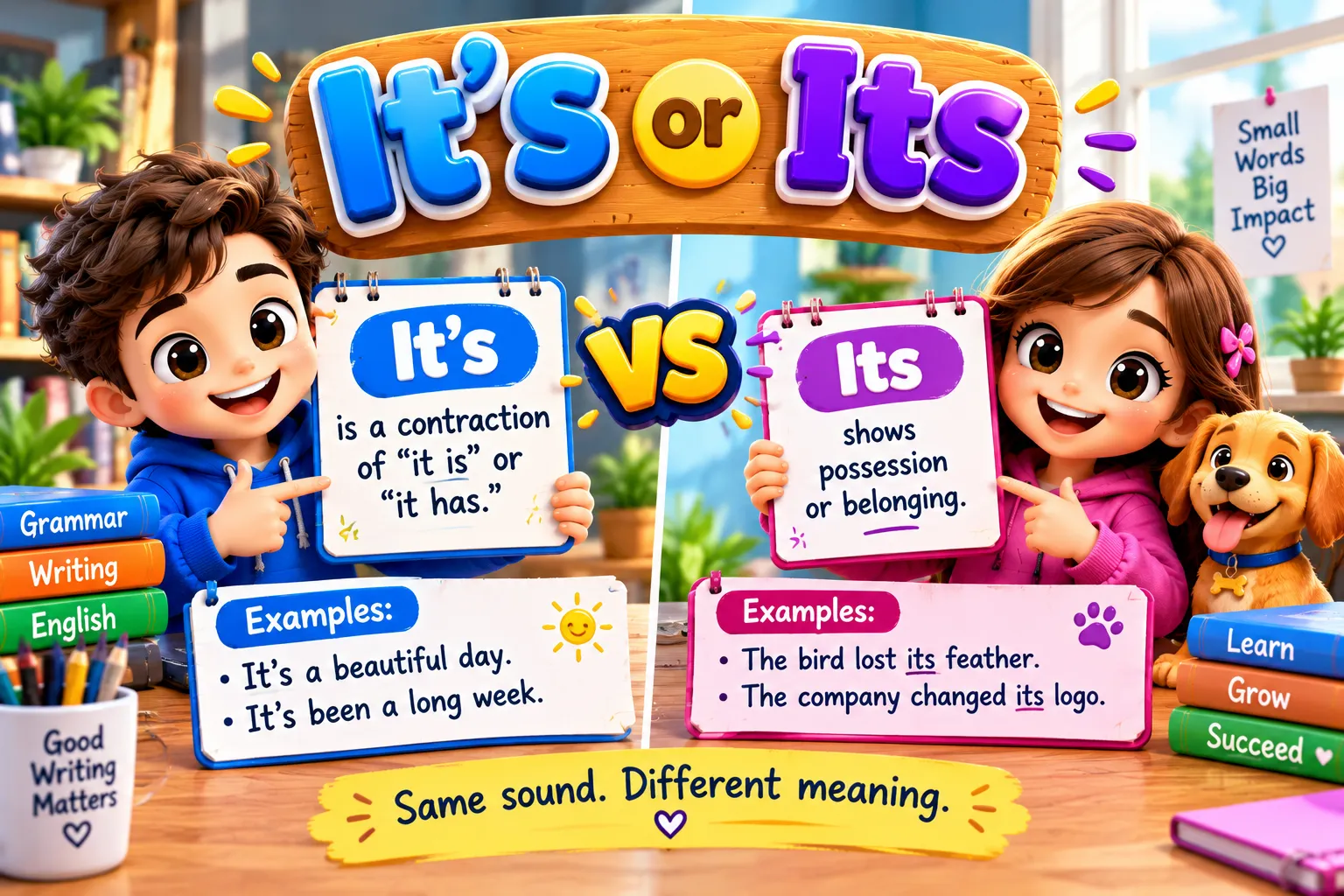
Its shows that something belongs to a thing or animal, while it’s is short for “it is” or “it has.” The easiest way to choose the right word is to replace it’s with “it is” or “it has” and see if the sentence still makes sense.
I used to get confused when writing emails or articles because I was never completely sure whether to use it’s or its. Both words sounded the same to me, and their similar spelling made it even harder to remember the difference. I often had to stop and think before choosing the correct one.
I remember noticing sentences like “The dog wagged it’s tail” and assuming they were correct. Later, I learned that the correct sentence is “The dog wagged its tail” because its shows possession. On the other hand, in a sentence like “It’s a lovely day,” the apostrophe is necessary because it’s means “it is.”
After learning this simple rule, I became more confident in my writing. I realized that even a small apostrophe mistake could affect the clarity and professionalism of my emails, school assignments, and blog posts. The best part was discovering that I did not need to memorize complicated grammar rules to get it right.
Through my experience, I learned that understanding the difference between it’s and its makes writing much easier. In this guide, I will share what I learned, explain the meanings and origins of both words, and provide practical examples to help others avoid the same confusion. I will also show a simple trick that has helped me choose the correct word more confidently.
It’s or Its Quick Answer
The main difference is simple: its shows possession, while it’s is a contraction. A contraction joins words and leaves out some letters, which an apostrophe marks.
Look at these examples:
- Its: The bird cleaned its feathers.
- It’s: It’s getting dark outside.
In the first sentence, its tells us that the feathers belong to the bird. In the second, it’s means “it is.”
Remember this simple rule: if you can replace it’s with “it is” or “it has,” use the apostrophe. If you are showing ownership, use its.
The Origin and Background of It’s and Its
The history of these words helps explain why they are so easy to confuse.
The possessive form appeared in English during the late 1500s. Earlier forms of English often used his as a possessive form for things that we now describe with its. The modern form developed from it and a possessive ending.
Interestingly, its was once commonly written as it’s. That older spelling continued into the early 19th century, according to Etymonline. Over time, writers settled on its for possession, helping distinguish it from the contraction it’s.
Today, the apostrophe has a clear role in the contraction. It marks missing letters in it is or it has. However, possessive determiners such as my, your, his, her, and its do not use apostrophes.
This is why the rule may feel unusual. We often use an apostrophe to show possession with a noun, as in “the dog’s bowl.” But possessive words such as its follow a different pattern.
It’s and Its Explained: Key Differences
The words have different meanings and grammatical roles. The Cambridge dictionary explains that its is a possessive determiner, while it’s is the contracted form of “it is” or “it has.”
1. When to use its
Use its when you want to show that something belongs to or relates to an animal, object, place, or organization.
Examples:
- The company changed its logo.
- The tree lost its leaves.
- The phone needs its screen repaired.
Here, its connects the noun to something associated with it.
2. When to use it’s
Use it’s when you mean “it is” or “it has.”
Examples:
- It’s too cold to swim.
- It’s been a busy week.
- I think it’s ready for delivery.
Try expanding the contraction. “It’s been a busy week” becomes “It has been a busy week,” so the apostrophe is correct.
Quick comparison table
| Term | Meaning | When to use | Example |
| Its | Belonging to it | To show possession | The cat licked its paw. |
| It’s | It is | To describe a state or fact | It’s warm today. |
| It’s | It has | With a suitable verb phrase | It’s already started. |
| Its own | Belonging exclusively to it | To stress possession | The shop has its own website. |
Which Version Should You Use?
Your choice depends on what you want to say, not where you live. Both forms are standard in British, American, Australian, and other varieties of English.
- For students: Use its for ownership and it’s for “it is” or “it has.” This rule works well in essays and exams.
- For professionals: Check the meaning before sending reports, proposals, or emails. A quick edit can prevent an avoidable grammar error.
- For bloggers and content writers: Use the correct form in titles, headings, captions, and body text. Clear writing helps readers understand your message.
- For English learners: Learn the full forms first. Once you can identify “it is” and “it has,” choosing it’s becomes easier.
A useful trick is to replace it’s with the full phrase. If the sentence sounds wrong, you may need its instead.
For example, “The business increased it’s sales” becomes “The business increased it is sales.” That does not work, so the correct sentence is “The business increased its sales.”
Common Mistakes with It’s and Its
Even strong writers can make this mistake when typing quickly. Here are five errors to watch for.
1. Wrong: The dog hurt it’s leg.
Correct: The dog hurt its leg.
Why? The leg belongs to the dog. No apostrophe is needed.
2. Wrong: Its going to rain soon.
Correct: It’s going to rain soon.
Why? The sentence means “It is going to rain soon.”
3. Wrong: The machine has lost it’s power.
Correct: The machine has lost its power.
Why? Its shows that the power belongs to the machine.
4. Wrong: The report is finished, and its been checked.
Correct: The report is finished, and it’s been checked.
Why? Here, it’s means “it has.”
5. Wrong: The company updated its’ website.
Correct: The company updated its website.
Why? Its never needs an apostrophe to show possession.
The main cause of these mistakes is that the two words sound alike. The apostrophe also tricks writers into applying the possessive rule for nouns, such as “the manager’s desk,” to its.
It’s or Its in Real-World Examples
Here is how the two forms appear in different types of writing.
In a professional email
“Hi Sarah, the client has reviewed the proposal, and it’s ready for your approval.”
In this sentence, it’s means “it is.”
In a news headline
“Local Museum Reopens Its Doors After Major Renovation”
The word its shows that the doors belong to the museum.
In a social media post
“It’s finally Friday! The café has added its new summer menu.”
The first use means “it is.” The second shows that the menu belongs to the café.
In a formal report
“The department revised its annual plan after reviewing the results. It’s now focused on reducing costs and improving service.”
Here, its refers to the department, while it’s means “it is.”
It’s or Its: Data, Trends and Usage
The difference between it’s and its is a small grammar point, but it has practical value in writing, editing, and search engine optimization.
Search volume and search interest
Exact monthly search-volume figures for “it’s or its” and related queries require a dedicated keyword research tool, such as Ahrefs or Semrush. No verified monthly figures are available in the sources used for this guide, so assigning numbers would be misleading.
Google Trends offers a way to compare search interest over time and across regions. However, its scores are normalized from 0 to 100 rather than reported as exact search counts. Google also explains that low-volume searches and punctuation can affect what appears in its data.
Word frequency in published books
Google Books Ngram Viewer lets readers explore how words and phrases appear in published books over time. Its English language corpus tools can help researchers investigate historical usage, but contractions and apostrophes may be processed as separate tokens. This means results need careful interpretation before making a direct comparison.
Why this distinction matters today
Emails, online articles, reports, and social posts are often written quickly. Spell-checkers can catch many errors, but they may not recognize a wrong word when the spelling itself is valid. Both its and it’s are correct words, so context matters.
Search intent: This topic is mainly informational. Readers want to understand the rule, compare the two forms, and correct mistakes in their own writing.
It’s vs. Its: A Standalone Comparison Table
| Term or variant | Meaning | Region or context | Best used when |
| Its | Possession or association | Standard English | Showing what belongs to something |
| It’s | It is | Standard English | Describing a state, fact, or condition |
| It’s | It has | Standard English | Forming a suitable perfect-tense phrase |
| Its own | Emphatic possession | Formal and informal writing | Highlighting something independent or separate |
| Its’ | Not a standard form | Incorrect in standard English | Do not use it as a possessive spelling |
Frequently Asked Questions
Q: What does it’s or its mean?
A: Its shows possession or association. It’s is a contraction of “it is” or “it has.” The correct choice depends on the meaning of your sentence.
Q: How can I remember when to use it’s?
A: Expand it’s into “it is” or “it has.” If the expanded sentence makes sense, the contraction is likely correct. If not, check whether you need its to show possession.
Q: Is its or it’s correct in formal writing?
A: Both are correct in formal writing when used properly. Use its for possession and it’s for the contraction. In very formal documents, you may choose to write “it is” or “it has” in full.
Q: Why does its not have an apostrophe?
A: English possessive determiners such as my, your, his, and its do not use apostrophes. The apostrophe in it’s marks letters omitted from “it is” or “it has.”
Q: Is it’s ever correct before a noun?
A: Yes, if it means “it is” or “it has” and the sentence structure allows it. For example, “It’s a problem” means “It is a problem.” Use its when the word shows possession, as in “its cover.”
Q: Where do the words it’s and its come from?
A: Its developed as the possessive form of it in early modern English. The apostrophe spelling was once used for possession, too, but modern standard English distinguishes its from the contraction it’s. Etymonline provides further historical details in its entry..
Q: Can I use it’s in an academic essay?
A: Yes. Contractions are accepted in many forms of academic writing, but some style guides or instructors prefer full forms. Follow your required style guide, and always make sure the apostrophe is correct.
Conclusion
Knowing when to use it’s or its can make your writing clearer and more professional. Although the two words sound alike, they serve different purposes. Its shows possession, while it’s stands for “it is” or “it has.”
Keep these three tips in mind:
- Use its when something belongs to or relates to an object, animal, or organization.
- Use it’s when you can replace it with “it is” or “it has.”
- Check the full meaning of your sentence instead of relying only on how the word sounds.
You do not need to memorize dozens of grammar rules to master this difference. A quick substitution test can help you catch most errors before you publish an article, submit an assignment, or send an important email.
Now try the rule in your next sentence, and bookmark this guide so you never second-guess it’s or its again.
Read More:
Your or You’re: Easy Grammar Guide

I’m an English language educator and content writer with more than 10 years of experience helping learners improve their English skills. I specialize in spelling differences, grammar, vocabulary, synonyms, commonly confused words, and English usage. My goal is to create accurate, easy-to-understand articles that make learning English simple, practical, and enjoyable for students, writers, and professionals around the world.










