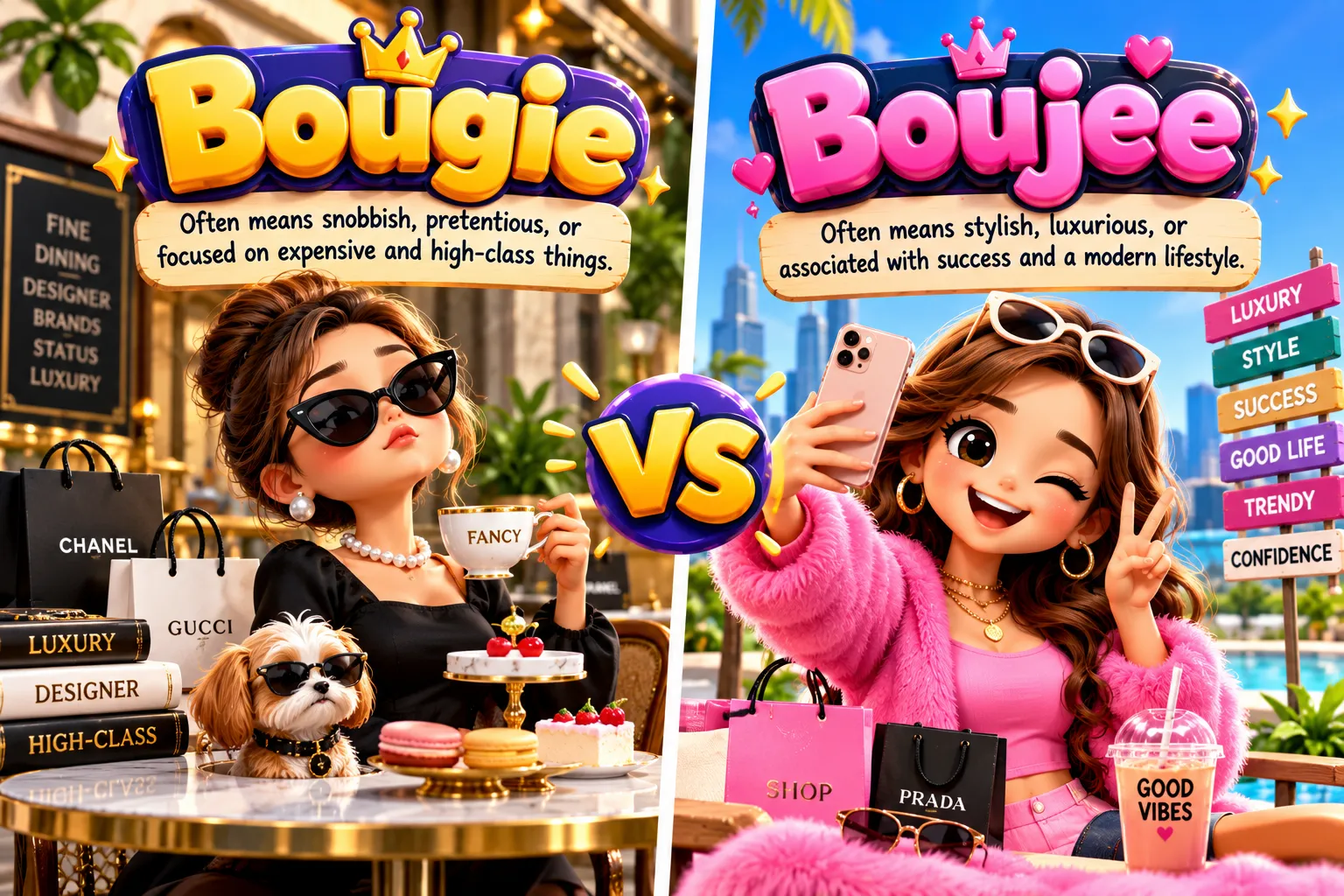
Bougie and boujee both describe someone or something that seems fancy, luxurious, or high class. Bougie often suggests being pretentious or acting above your means, while boujee often has a playful, stylish, or aspirational tone.
I have often come across the words bougie and boujee in social media posts, casual chats, and discussions about fashion, food, and lifestyle. I have noticed that many people use these spellings without knowing which one fits best. They look almost the same, but their tone can change depending on the context.
I remember seeing people use bougie to describe someone who loves expensive coffee, fancy restaurants, or luxury brands. Others use boujee when talking about stylish outfits, dream vacations, or a glamorous lifestyle. This made me curious about the difference between these two popular slang words.
Both words relate to luxury, status, and expensive tastes. However, bougie can suggest that someone is snobbish or pretentious, while boujee often sounds playful, trendy, or positive.
If you have ever wondered which spelling to use in a caption, message, or article, you are not alone. In this guide, I will explain the meanings, origins, and differences between bougie and boujee, with simple examples to help you choose the right word with confidence.
Bougie or Boujee Quick Answer
Both bougie and boujee are used in modern English slang to describe fancy tastes, luxury, or a high status lifestyle. The main difference is often tone, not meaning.
- Bougie: Often suggests someone is snobbish, pretentious, or overly focused on status.
- Boujee: Often sounds playful, stylish, or proud of enjoying the finer things in life.
Examples:
- “He is too bougie to eat at a regular diner.”
- “We booked a boujee hotel for our weekend trip.”
These are common slang spellings, not a pair of words with completely separate meanings. The context and the speaker’s tone help you understand the message.
The Origin and Background of Bougie and Boujee
The story of these words starts with the French word bourgeois. It referred to the middle class, including people linked to towns, trade, and business.
Over time, bourgeois also became linked to social status, wealth, and material comfort. In some settings, it carried a negative meaning. It could suggest that someone cared too much about money, social rank, or appearances.
According to Dictionary.com, the slang form bougie developed as a shortened form of bourgeois. It is recorded in American English from the late 1960s.
How did boujee become popular?
Boujee is an alternative spelling of bougie. It is closely linked to African American Vernacular English (AAVE) and hip-hop culture.
The 2016 song Bad and Boujee by Migos helped bring the term to a much wider audience. The word became familiar to many people through music, online posts, memes, and everyday conversations.
Today, people may use either spelling to describe expensive clothes, stylish homes, fine dining, or a taste for luxury. The word can be an insult, a joke, or a compliment.
This history also shows how language changes. A word can start with a negative tone and later become a playful way to express pride in personal style.
Bougie vs. Boujee: Key Differences
The two spellings are closely related, but writers often choose them for different effects.
1. Bougie
Bougie is the more established spelling in dictionaries. It can describe a person who likes expensive things or acts as if they are above others.
It may sound critical when it suggests snobbery or an attempt to appear wealthy.
Example: “My cousin has become so bougie that she complains about every budget restaurant.”
Here, the word gently criticizes the cousin’s expensive tastes.
2. Boujee
Boujee is a popular alternative spelling with strong links to music and internet slang. It often gives a sentence a more playful or fashionable feel.
Example: “I gave my bedroom a boujee makeover with soft lights and gold cushions.”
In this case, the word describes a stylish look rather than criticizing anyone.
Comparison table
| Term | Meaning | When to Use | Region/Context |
| Bougie | Fancy, status-conscious, or pretentious | Casual speech and writing when you want the established spelling | American English slang; also understood elsewhere |
| Boujee | Luxurious, stylish, or fancy | Social media, music, captions, and playful conversation | Modern slang and hip-hop culture |
| Bourgeois | Related to the middle class; sometimes linked to materialism | Social commentary, essays, or formal discussion | General English |
| Posh | Elegant, expensive, or associated with high social status | Everyday speech, especially in British English | Common in British English |
| Bougie-style | Having a fancy or luxury-inspired look | Informal descriptions of fashion, food, or home design | Casual slang |
The main lesson is simple: bougie and boujee can both be correct in slang. Choose the spelling that fits your audience and the tone you want. Bourgeois is the better choice when you need a standard word for more formal writing.
Which Version Should You Use?
Your choice depends on where you are writing and how you want to sound.
- For students and English learners: Use bougie when you want the more established slang spelling. Learn boujee too, because you may see it in songs and online posts.
- For social media users: Choose boujee for a fun caption about fashion, food, travel, or a luxury lifestyle.
- For bloggers and casual writers: Either spelling can work. Stay consistent throughout your post.
- For professional emails and formal reports: Avoid both unless you are discussing slang or quoting someone’s words. Use terms such as luxurious, expensive, stylish, or status conscious instead.
- For global readers: Explain the word the first time you use it. Not everyone knows modern American slang.
For example, a caption such as “Feeling boujee tonight” suits an informal post. A report about high-end hotels would sound clearer with “luxury hotels.”
Common Mistakes with Bougie and Boujee
These words are easy to mix up, especially if you are learning English through social media. Watch out for these mistakes.
1. Thinking one spelling is always wrong
Incorrect claim: “Boujee is not a real word.”
Better: “Boujee is an alternative spelling of bougie.”
Both spellings appear in modern slang references. However, bougie is the more established spelling.
2. Using bougie in every formal sentence
Awkward: “The company purchased a bougie office building.”
Better: “The company purchased a luxury office building.”
The second sentence is clearer and more suitable for a business report.
3. Assuming the word is always a compliment
Misleading: “Calling someone bougie always means they have good taste.”
Better: “Calling someone bougie can praise their style or criticize their attitude.”
The meaning depends on context, tone, and the relationship between the speakers.
4. Confusing boujee with boogie
Incorrect: “We had a boujee dance at the party.”
Better, if you mean a fun dance: “We had a boogie at the party.”
Boogie can refer to a style of dance or music. Bougie and boujee relate to luxury and social status. They sound similar, but their meanings differ.
5. Treating bougie as a precise measure of wealth
Misleading: “Only rich people can be boujee.”
Better: “Someone can have boujee tastes without being rich.”
The slang often describes preferences or the way someone presents themselves. It does not prove how much money that person has.
Bougie or Boujee in Real-World Examples
The best way to learn slang is to see how it works in different settings. These examples show how the words fit into everyday writing.
1. In a professional email
The team selected a more luxurious venue for the annual dinner to create a special experience for our guests.
A professional email usually works better with luxurious than with bougie. The formal word is clear and suits a business setting.
2. In a news headline
Young Travelers Embrace Boujee Stays and Luxury Experiences
Here, boujee gives the headline a modern, casual feel. A writer might use it when covering lifestyle trends aimed at younger readers.
3. In a social media post
A little self-care, a fresh outfit, and a boujee brunch. Weekend goals! ✨
The word adds a fun tone and helps the caption feel relaxed.
4. In a formal report
The survey examined consumer interest in premium products and high-end services.
A formal report should use clear, precise terms. Words like premium and high-end are better than slang in this context.
Bougie vs. Boujee Data, Trends, and Usage
Are people searching for bougie or boujee more often? The answer needs real search data rather than a guess.
What do search trends tell us?
Google Trends lets you compare search interest for both spellings. It reports relative interest over a selected period and location, using a scale from 0 to 100. It does not provide exact monthly search counts.
I could not verify current monthly search volumes or a reliable country-by-country comparison for these terms. For that reason, I will not give made-up numbers.
Here are the main points to understand:
- Search intent: Most people searching “bougie or boujee” want a definition, a spelling comparison, or examples of how to use the word.
- Spelling choice: Bougie is the more established dictionary spelling, while boujee is a recognized alternative.
- Music and internet culture: The song Bad and Boujee, released by Migos in October 2016, helped bring the alternative spelling to a much wider audience.
- Regional use: The term has strong roots in American slang and hip-hop culture, but it is also understood in many online communities around the world.
- Why it matters: Social media spreads slang quickly. Knowing a word’s tone helps you understand captions, comments, and messages without taking every phrase literally.
For SEO research, compare both terms in Google Trends using the same country and date range. Use a keyword tool such as Ahrefs or Semrush if you need estimated monthly search volume. Treat those estimates as estimates, not exact counts.
Frequently Asked Questions
Q: What does bougie or boujee mean?
A: Both words describe someone or something associated with fancy tastes, luxury, or social status. Depending on the situation, they can suggest good style or an attitude that seems snobbish.
Q: Is bougie or boujee the correct spelling?
A: Both spellings are used in modern slang. Bougie is the more established form, while boujee is a common alternative, especially in casual online writing.
Q: Is boujee a compliment or an insult?
A: It can be either. A friend may use it to praise your stylish outfit, but another person may use it to tease you for acting too fancy or caring too much about status.
Q: Can I use bougie in formal writing?
A: You can use it when discussing slang, quoting someone, or writing about popular culture. In most business reports, school essays, and formal documents, words such as luxurious, pretentious, or status-conscious are clearer.
Q: What is the difference between boujee and bougie?
A: The main difference is spelling and style. Bougie is the more established spelling, while boujee often carries a playful, modern tone. Their meanings overlap, so context matters more than the final letters.
Q: Where did bougie and boujee come from?
A: The slang traces back to bourgeois, a word borrowed from French and associated with the middle class. The modern slang developed in American English, with important roots in African American speech and hip-hop culture.
Q: Can I call a person boujee?
A: Yes, in casual conversation. You might use it for someone who enjoys designer clothes, expensive restaurants, or luxury travel. Keep in mind that the person may hear it as teasing rather than praise.
Q: Is boujee the same as rich?
A: No. Being rich means having a lot of money or wealth. Being called boujee usually refers to taste, behavior, or the appearance of enjoying a high-end lifestyle. Someone can have expensive tastes without being wealthy.
Conclusion: Should You Use Bougie or Boujee?
The choice between bougie and boujee is easier once you understand their shared meaning. Both words are used for luxury, fancy tastes, and attitudes linked to social status. The spelling you choose mainly depends on your audience and the tone of your message.
Remember these three tips:
- Choose bougie when you want the more established spelling.
- Choose boujee for a playful, modern caption or casual post.
- Use words like luxurious, stylish, or pretentious when you need a more precise or formal expression.
Neither spelling is automatically wrong in informal slang. Still, the word can sound positive or negative, so think about how your reader might take it. A playful comment among friends may not work the same way in a work email.
Language keeps changing as music, culture, and social media introduce new forms of expression. Learning these small differences helps you understand modern English and use it with more confidence.
Now you know the difference between bougie and boujee. Bookmark this guide, share it with a friend, and use the spelling that best fits your next message or post.
Read More:
It’s or Its: The Easy Guide to Correct Usage

I’m Daniel sultan, an English language writer and SEO content specialist with experience researching spelling, grammar, vocabulary, and English usage. Through SpellComparison.com, I create clear, accurate, and well-researched guides that help readers understand commonly confused words, spelling differences, and grammar rules with confidence.
Every article I write is based on trusted language references, established style guides, and real-world usage to ensure it is accurate, practical, and easy to understand. My goal is to make learning English simple and reliable by providing fact-checked content, clear explanations, and real-life examples that students, writers, educators, and professionals can trust.