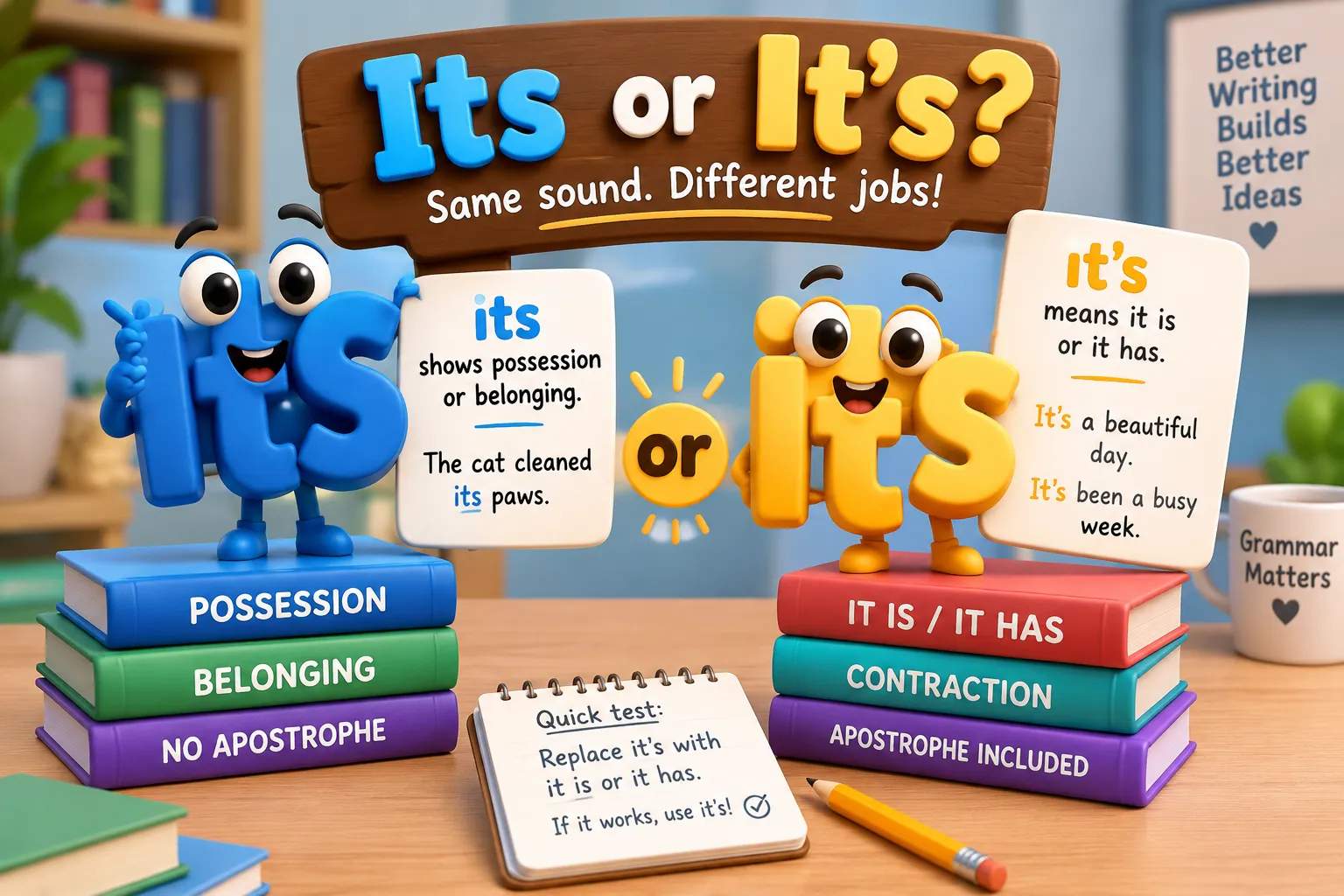
Its shows possession or belonging, while it’s is a contraction of it is or it has.
Have you ever typed a sentence, looked at its and it’s, and suddenly wondered which one belongs there? I have seen this small apostrophe cause big problems in student essays, emails, and everyday writing. The tricky part is that both forms sound the same when spoken.
That makes its or it’s a classic English grammar problem.
The good news is that the difference is simple once you know what the apostrophe is doing. Its usually tells you that something belongs to or is connected with something else. It’s, on the other hand, stands for it is or it has.
I use one simple test when teaching this point: expand it’s. If you can replace it with it is or it has, you need the apostrophe. If that does not work, its is usually the right choice.
This guide will show you the difference, explain the history behind these forms, uncover common mistakes, and give you practical examples you can use right away.
Its or It’s Quick Answer
The easiest rule is this:
- its = shows possession or connection
- it’s = it is or it has
Compare these two sentences:
- The bird cleaned its feathers.
- It’s getting dark outside.
In the first sentence, its means the feathers belong to the bird.
In the second, it’s means it is.
Cambridge Dictionary gives the same basic distinction: its is a possessive determiner, while it’s is the contracted form of it is or it has.
A fast trick is to replace it’s with it is:
It’s cold today.
It is cold today. ✓
Now try:
The phone lost it’s signal.
Replace it:
The phone lost it is signal. ✗
That sounds wrong, so you need its:
The phone lost its signal.
The Origin and Background of Its and It’s
The history of its is more interesting than it first appears.
According to Etymonline, its developed in the late 16th century from it plus a possessive ending. Early forms were often written it’s, but the apostrophe was later dropped. Etymonline also notes that the spelling it’s remained in use for some time before the modern distinction became established.
Why did this happen?
English already used apostrophes in contractions. So it’s could naturally be understood as a shortened form of it is. At the same time, writers needed a clear possessive form for the pronoun it.
Eventually, the two jobs became separated:
- its developed as the possessive form.
- it’s became the contraction for it is or it has.
This is a useful example of language change. English grammar did not appear fully formed. Spelling, pronunciation, and grammar have changed over centuries.
The word it itself also has deep roots. Etymonline traces it to Old English hit, a neuter pronoun. Its use developed through Middle English into the modern pronoun we use for things, animals, situations, and ideas.
So this tiny apostrophe represents a much bigger story in English etymology and linguistics.
Its or It’s Explained Key Differences
Here is the core difference:
| Term | Meaning | When to Use | Region/Context |
| its | belonging to it | Before a noun to show possession | Standard English |
| it’s | it is | As a contraction of it is | Standard English |
| it’s | it has | As a contraction of it has | Standard English |
| its own | belonging to it alone | To emphasize possession | Formal and informal English |
1. Its shows possession
Use its when something belongs to, relates to, or is connected with a thing, animal, organization, or idea.
Examples:
- The company changed its policy.
- The cat chased its toy.
- The school opened its new library.
- The machine has lost its power.
Notice something important: its has no apostrophe.
This may feel strange because possessive nouns often use ‘s:
Sarah’s book
the teacher’s desk
But possessive pronouns and determiners do not always follow that pattern.
Cambridge lists its alongside possessive forms such as my, your, his, our, and their.
2. It’s means it is
Use it’s when you mean it is.
For example:
It’s too late to call.
You can expand it:
It is too late to call.
Both work.
More examples:
- It’s a beautiful morning.
- It’s hard to explain.
- It’s my favorite book.
- It’s time to leave.
3. It’s can also mean it has
This is the second meaning that often gets missed.
For example:
It’s been a busy week.
Here, it’s means:
It has been a busy week.
Cambridge confirms that it’s can represent both it is and it has.
Another example:
It’s changed a lot.
This means:
It has changed a lot.
Which Version Should You Use?
Use the replacement test when you are unsure.
For students
Try replacing it’s with it is or it has.
- If the sentence still makes sense, choose it’s.
- If it becomes awkward or grammatically wrong, choose its.
For professional writers
Pay special attention to its in reports, emails, articles, and business documents. A missing or misplaced apostrophe can make otherwise polished writing look careless.
For formal or academic writing
Both forms are grammatically correct when used properly. However, you may choose the full forms it is or it has when you want a more formal tone.
For example:
It is important to review the results.
This can sound more formal than:
It’s important to review the results.
The difference is style, not correctness.
Common Mistakes with Its or It’s
Mistake 1: Using it’s for possession
Wrong: The company changed it’s logo.
Correct: The company changed its logo.
Why? The logo belongs to the company. You cannot replace its with it is.
Mistake 2: Using its before an adjective
Wrong: Its very cold today.
Correct: It’s very cold today.
Why? The sentence means:
It is very cold today.
Mistake 3: Thinking every possessive needs an apostrophe
Wrong: The dog hurt it’s leg.
Correct: The dog hurt its leg.
The apostrophe does not mark possession here. Its is already the possessive form.
Mistake 4: Confusing it’s with its own
Wrong: The robot fixed it’s own error.
Correct: The robot fixed its own error.
The phrase its own clearly expresses possession.
Mistake 5: Forgetting that it’s can mean it has
Some writers know that it’s means it is but forget its second use.
It’s finished.
Depending on context, this can mean:
It is finished.
or:
It has finished.
The surrounding sentence tells you which meaning is intended.
Its or It’s in Real World Examples
Seeing the forms in different settings makes the rule easier to remember.
Professional email
The software has completed its update, so you can restart the system.
Here, its refers to the software.
News headline
It’s Time for Cities to Rethink Public Transport
Here, it’s means it is.
Social media post
It’s finally Friday!
The meaning is it is finally Friday.
Formal report
The organization reviewed its safety procedures after the inspection.
The procedures belong to the organization, so its is correct.
Everyday conversation
It’s been a long day, but the work is finished.
Here, it’s means it has.
Its or It’s Data, Trends & Usage
There is no reliable public source that gives a single, universal monthly Google search volume for “its or it’s” across every country and search tool. Search-volume figures can also vary by platform, country, language, and date. It would be misleading to present an invented number as an exact statistic.
There is, however, useful corpus evidence.
Google Books Ngram Viewer tracks how words and phrases appear across a large collection of books. Google explains that its Ngram system measures occurrences in book corpora and that contractions are processed as separate tokens during analysis.
The distinction between its and it’s is therefore more complex in corpus searches than simply comparing two visible spellings. Google Ngram can normalize contractions such as it’s into forms such as it ‘s for analysis.
What does this tell us?
- Its is a standard possessive form used across modern English.
- It’s is a common contraction in everyday and written English.
- Both appear widely in books and other written material.
- Corpus searches must account for punctuation and tokenization.
- The difference is grammatical rather than regional.
The topic also matters for modern writers because grammar tools and AI writing assistants may flag its/it’s errors. But automated tools are not a substitute for understanding the sentence. Knowing the rule lets you check the suggestion yourself.
Its or It’s: A Useful Comparison Table
| Term/Variant | Meaning | Region/Context | Best Used When |
| its | belonging to it | Standard English | Showing possession |
| it’s | it is | Standard English | Describing something with it is |
| it’s | it has | Standard English | Using a contraction of it has |
| it is | full form | Formal or careful writing | You want maximum clarity or formality |
| it has | full form | Formal or careful writing | You want to avoid a contraction |
One useful edge case is its own:
The country has its own system.
Here, its comes before the noun phrase own system and still expresses possession.
Cambridge specifically explains that its functions as a possessive determiner and notes that it is not normally used alone as a possessive pronoun.
Why Is Its or It’s So Confusing?
The main problem is pronunciation.
In normal speech, its and it’s are usually pronounced the same way. You cannot hear the apostrophe.
That means your ears cannot solve the problem.
Your grammar must do it.
There is also a misleading pattern in English. Writers learn:
John’s car
Mary’s phone
the dog’s bowl
So they may naturally assume:
the dog’s → its’s
But English does not work that way. Its is an established possessive form, and the apostrophe is not used.
This is similar to other confusing word pairs where sound does not give you enough information. Examples include:
- your / you’re
- their / there / they’re
- whose / who’s
- whose / who’s
- then / than
The best solution is to focus on function, not sound.
A Simple Trick to Remember Its or It’s
Use this three-second test:
Step 1: Look at the word
Is it its or it’s?
Step 2: Expand the apostrophe
Try:
it is
or:
it has
Step 3: Check the meaning
If one of those expansions works, use it’s.
If neither works, use its.
For example:
The phone is old, but its battery still works.
Try:
The phone is old, but it is battery still works.
That fails.
So its is correct.
Now:
It’s already late.
Try:
It is already late.
That works.
So it’s is correct.
This tiny habit can prevent many grammar errors.
FAQ: Its or It’s
Q: What does its mean?
A: Its is a possessive determiner. It shows that something belongs to or is connected with a thing, animal, organization, or idea.
Q: What does it’s mean?
A: It’s is a contraction of it is or it has. The apostrophe represents letters removed from the longer expression.
Q: Is it’s correct in formal writing?
A: Yes. It’s is grammatically correct when it means it is or it has. In very formal writing, some writers prefer the full forms for a more formal tone.
Q: Which is correct: “The dog hurt its leg” or “The dog hurt it’s leg”?
A: The dog hurt its leg is correct. The word its shows that the leg belongs to the dog. It’s would mean it is or it has, which does not fit here.
Q: Can it’s mean it has?
A: Yes. For example, “It’s been raining” means “It has been raining.” Cambridge Dictionary lists both meanings for the contraction.
Q: Why doesn’t its have an apostrophe?
A: English developed its as a possessive form without the apostrophe. Etymonline records that earlier forms were sometimes written it’s, but the apostrophe was later dropped.
Q: Is “its” a pronoun or adjective?
A: In modern grammar, its is commonly described as a possessive determiner when it comes before a noun, such as “its color.” Some dictionaries also describe it as a possessive pronoun, so terminology can vary. Cambridge distinguishes possessive determiners from possessive pronouns and gives its as the form associated with it.
Conclusion
The difference between its and it’s becomes easy once you stop relying on pronunciation.
Remember the two jobs:
- its shows possession or connection.
- it’s means it is or it has.
- The apostrophe in it’s signals a contraction.
- The possessive its does not need an apostrophe.
The most useful habit is the expansion test. Whenever you see it’s, try replacing it with it is or it has. If the sentence still works, keep the apostrophe. If it does not, its is probably the form you need.
This small grammar rule can make a noticeable difference in your emails, essays, reports, captions, and everyday writing. Once the distinction becomes automatic, you will rarely need to stop and think about it.
Bookmark this guide so you never second-guess “its or it’s” again.
Readmore

I’m an English language educator and SEO content writer having experience creating clear, accurate, and engaging English learning content. I specialize in spelling differences, grammar, vocabulary, synonyms, commonly confused words, and English usage. My goal is to publish well-researched, easy-to-understand articles that help students, writers, educators, and professionals improve their English with confidence through practical explanations and real-world examples.










