Led is the past tense and past participle of lead, while lead is usually the present-tense verb meaning to guide, direct, or be in front.
Have you ever written a sentence like “She lead the team yesterday” and then stopped to wonder if lead really looked right? You are not alone. This tiny spelling choice causes a surprisingly large number of mistakes.
I have seen this confusion often when helping English learners improve their writing. The problem is not only spelling. Lead has more than one pronunciation and more than one meaning. The word can mean “guide,” but it can also mean a heavy metal. Then there is led, which looks almost like a different word but is actually the past form of the verb lead.
That mix can make a simple sentence feel harder than it should.
The good news is that there is one very useful rule: use lead for the present, and led for the past when you mean “guide” or “direct.” Cambridge Dictionary confirms that led is the past simple and past participle of lead.
Once you understand the tense, pronunciation, and context, the choice becomes much easier.
LedLed or Lead Quick Answer
| Word | When to Use | Meaning | Example |
|---|---|---|---|
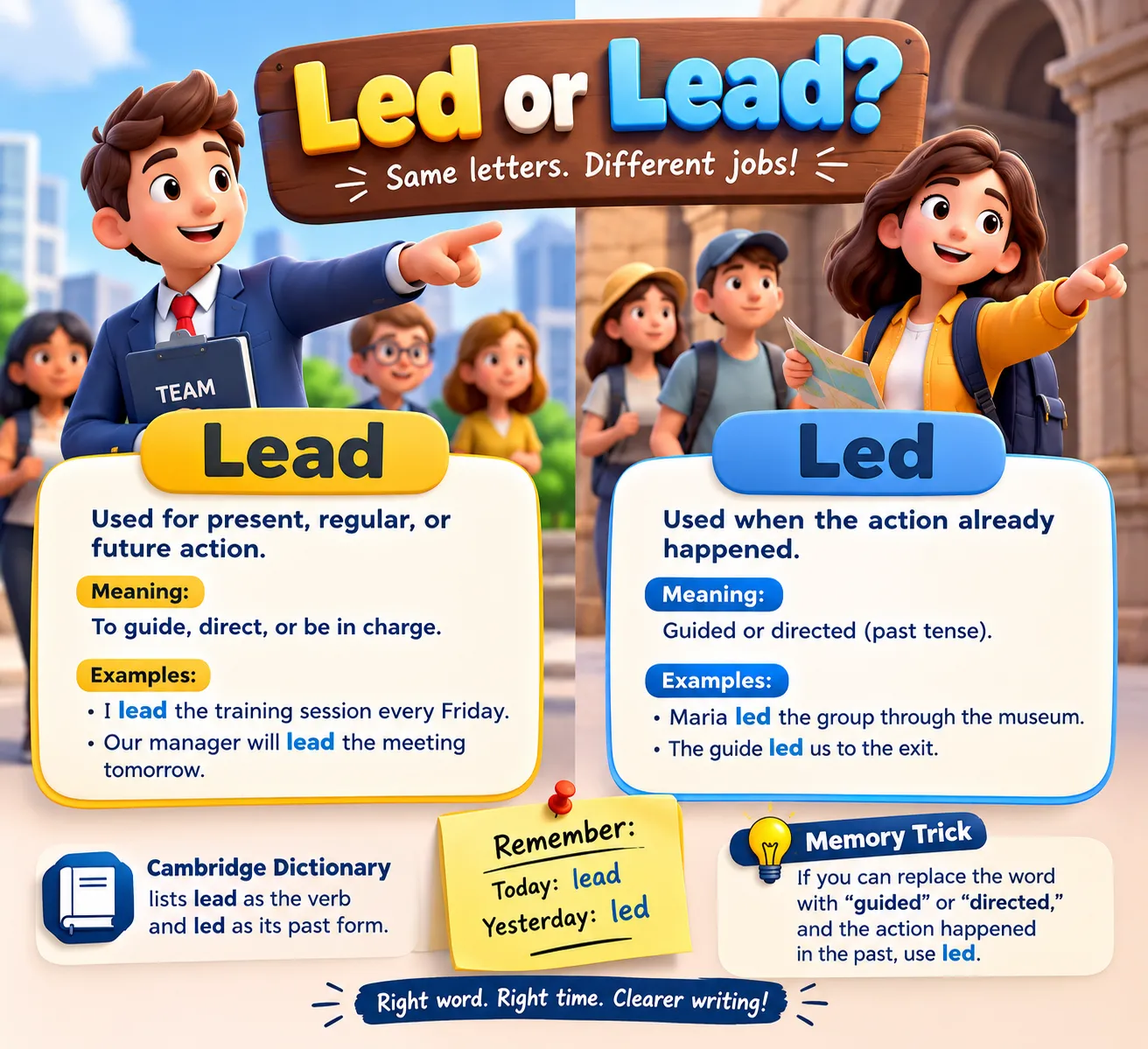
| Lead | Present, regular, or future action | To guide, direct, or be in charge | “I lead the training session every Friday.” |
| Lead | Future action | To guide or direct | “Our manager will lead the meeting tomorrow.” |
| Led | Past action | Guided or directed | “Maria led the group through the museum.” |
| Led | Past action | Guided someone to a place | “The guide led us to the exit.” |
Easy Memory Trick
| Time | Correct Word | Think of It As |
|---|---|---|
| Today / Now | Lead | I lead |
| Every day / Regularly | Lead | I lead |
| Tomorrow / Future | Lead | I will lead |
| Yesterday / Past | Led | I led |
| Already happened | Led | I led |
Remember:
Today → lead | Yesterday → led
If you can replace the word with guided or directed, and the action happened in the past, led is usually correct.
The Origin and Background of Lead and Led
The history of lead goes back a very long way.
According to the Online Etymology Dictionary, the verb lead comes from Old English lædan, meaning to guide, cause someone to go, or show the way. It is related to older Germanic words connected with the idea of traveling or going.
The word developed many meanings over time. By around the late 14th century, lead could also mean being in first place. Later, it gained uses connected with leadership, card games, music, journalism, and other areas.
This is why led is not a competing spelling of lead when you mean “guided.” It is the past-tense form.
There is another twist, though.
Lead can also be a noun for the heavy metal. In that meaning, it is pronounced /led/, like red. Cambridge gives this metal meaning separately from the verbSo English has two different words spelled lead:
- lead = /liːd/ → guide or direct
- lead = /led/ → the metal
And led is pronounced /led/ too. Cambridge confirms the pronunciation of led as /led/.
That is one reason this word pair can be so confusing for English learners.
Lead vs Led Explained Key Differences
The main difference is grammar and time.
| Term | Meaning | When to Use | Region/Context |
| lead /liːd/ | guide, direct, or be in charge | Present or base form | Standard English |
| led /led/ | past form of lead | Past actions | Standard English |
| lead /led/ | a heavy metal | Noun | Science, industry, everyday English |
| leading /ˈliːdɪŋ/ | guiding or being first | Present participle/adjective | General English |
1. Lead as a verb
Use lead for an action happening now or as a base verb.
- “The coach leads the team with confidence.”
- “I want to lead the project.”
- “This road leads to the old town.”
Cambridge defines the verb as showing the way, controlling a group, or causing something to move toward a particular result.
2. Led as a verb
Use led when the action is complete or happened in the past.
- “The captain led the players onto the field.”
- “Her advice led me to a better solution.”
- “The investigation led to a new discovery.”
Notice that led does not need an extra ending such as -ed. It is already the irregular past form.
3. Lead as a noun
The spelling lead can also refer to the metal.
- “The workers tested the old paint for lead.”
- “The battery contains materials that include lead.”
Here, lead is pronounced like led, not like the verb meaning “guide.
Which Version Should You Use?
For beginners and students, focus on the time of the action.
If the action is happening now
Use lead.
“I lead a small study group.”
If the action happened before
Use led.
“I led a study group last year.”
If you are writing formal English
Choose the form based on grammar, not sound.
- Present/base verb → lead
- Past tense → led
- Past participle → led
- Present participle → leading
Collins also lists led as the past tense and past participle of lead.
For global English, this rule works across both British and American English.
Common Mistakes with Lead and Led
Mistake 1: Using lead for a past action
Wrong: “She lead the team yesterday.”
Correct: “She led the team yesterday.”
Why? The word yesterday clearly places the action in the past.
Mistake 2: Writing “leaded” as the past tense
Wrong: “He leaded the discussion.”
Correct: “He led the discussion.”
The normal past form of the verb is led, not leaded. Cambridge and Collins both identify led as the past form.
Mistake 3: Pronouncing the verb like the metal
Wrong idea: lead meaning “guide” sounds like red.
Correct idea: The verb lead rhymes with need.
Cambridge gives the verb pronunciation as /liːd/ and the past form led as /led/.
Mistake 4: Assuming every “lead” sounds the same
It does not.
- lead = guide → /liːd/
- lead = metal → /led/
- led = past of lead → /led/
Context tells you which meaning is intended.
Mistake 5: Confusing “lead” with “leader”
Lead can be a verb.
Leader is a noun for a person who leads.
For example:
- “She will lead the project.”
- “She is an excellent leader.”
Lead and Led in Real World Examples
Seeing the words in different settings makes the difference easier to remember.
Professional email
“Daniel will lead the client meeting on Thursday and share the notes afterward.”
This refers to a future action, so lead is correct.
News headline
“Local Research Team Led Major Climate Study”
Here, the study has already happened or the leadership is being reported as a completed event. Led is the past form.
Social media post
“Proud of the students who led today’s community project!”
The project leadership happened today and is being described as completed, so led fits.
Formal report
“The survey results led researchers to review the original findings.”
The results produced an effect in the past, so led is appropriate.
Lead or Led Data, Trends & Usage
This topic matters because lead and led are both common words, but their roles are different.
A September 2026 word-frequency comparison published by PlainSpell, using Wordfreq 3.1 data from a 2021 mixed-text snapshot, reports approximately 158 occurrences per million words for lead and 129 for led in written English. That source combines material such as books, news, web text, subtitles, Wikipedia, and social media.
The same comparison reports an approximate U.S. monthly Google search volume of 27,100 for the query family around “lead vs led,” based on keyword data covering September 2025 through August 2026. Treat this as an SEO estimate rather than an exact count of every search.
What does this tell us?
The confusion is real because both forms are common.
It also shows why the topic has strong informational search intent. People are usually trying to solve a grammar or spelling problem, not buy something.
This matters even more in:
- ESL learning
- school writing
- workplace emails
- online publishing
- AI-assisted writing
- grammar checking
One useful linguistic point is that lead and led are not simply spelling variants. They serve different grammatical functions. In the verb sense, led marks past time, while lead is the base form.
Lead vs Led: Standalone Comparison
| Term/Variant | Meaning | Region/Context | Best Used When |
| lead /liːd/ | guide or direct | All major English varieties | The action is present, habitual, or future |
| led /led/ | past form of lead | All major English varieties | The guiding action happened in the past |
| lead /led/ | heavy metal | Science and general English | Talking about the substance |
| leading /ˈliːdɪŋ/ | guiding, directing, or being first | General English | Describing an ongoing action or role |
| leader | person who guides others | General English | Naming the person, not the action |
The distinction is grammatical rather than regional. British and American English both use led as the past form of lead.
A Simple Trick to Remember Lead or Led
Try this three-step test.
Step 1: Find the time word
Look for words such as:
- yesterday
- last week
- earlier
- previously
- in 2025
These often point to led.
Step 2: Check the verb
Ask:
Does the sentence mean “guide” or “direct”?
If yes, you are probably dealing with the verb lead.
Step 3: Check whether the action is past
If the action is finished, use led.
For example:
Present: “They lead the research team.”
Past: “They led the research team.”
This simple contrast solves most lead or led questions.
FAQ: Lead or Led
Q: What does lead mean?
A: As a verb, lead means to guide, direct, or be in charge of something. It can also be a noun meaning the heavy metal, with a different pronunciation
Q: What does led mean?
A: Led is the simple past and past participle of the verb lead. It describes an action of guiding or directing that has already happened.
Q: Is “lead” or “led” correct for the past tense?
A: Led is correct when you mean the past tense of the verb lead. For example, “The teacher led the class.”
Q: How do you pronounce lead and led?
A: The verb lead meaning “guide” is pronounced /liːd/, like need. Led is pronounced /led/, like bed. The noun lead meaning the metal is also pronounced /led/.
Q: Can lead be a noun?
A: Yes. Lead can mean the heavy metal, and it can also refer to ideas such as an advantage, a clue, or a position of control. Its meaning depends on context.
Q: Where does the word lead come from?
A: The verb traces back to Old English lædan, connected with guiding or showing the way. The Online Etymology Dictionary records several later meanings that developed from this older sense.
Q: Is “leaded” the past tense of lead?
A: No. When lead means “guide,” its normal past tense is led. Leaded exists in other uses, including adjectives related to something containing or covered with lead, but it is not the normal past form of the verb.
Conclusion: Lead or Led?
The difference between lead and led looks small, but the grammar behind it is clear.
Use lead when you are talking about the base or present form of the verb meaning “guide” or “direct.” Use led when that action happened in the past. The same rule works in school assignments, professional writing, reports, emails, and everyday conversation.
Remember one simple pair:
Present → lead
Past → led
There is one extra detail worth keeping in mind. Lead can also mean the metal, and that noun has the same pronunciation as led. Context tells you which meaning is intended.
Once you stop relying only on how the words sound, the spelling becomes much easier.
Now you know exactly when to use lead and led—try the rule in your next piece of writing and make the correct choice with confidence.
Readmore

I’m Daniel sultan, an English language writer and SEO content specialist with experience researching spelling, grammar, vocabulary, and English usage. Through SpellComparison.com, I create clear, accurate, and well-researched guides that help readers understand commonly confused words, spelling differences, and grammar rules with confidence.
Every article I write is based on trusted language references, established style guides, and real-world usage to ensure it is accurate, practical, and easy to understand. My goal is to make learning English simple and reliable by providing fact-checked content, clear explanations, and real-life examples that students, writers, educators, and professionals can trust.