Kindergarten is the standard spelling for a school or class for young children. Kindergarden is a common misspelling, not a standard spelling variant.
I have noticed that kindergarten is one of those words that can make even careful writers stop for a second. The spelling feels strange because the word sounds as if it should contain the familiar English word garden.
That is where the confusion starts.
When I hear the word spoken quickly, I can understand why someone might write kindergarden. The two forms look almost identical, and the familiar word garden makes the incorrect version feel natural.
But there is a simple way to remember the correct spelling: kindergarten ends in -garten, not -garden.
The reason goes back to the word’s German origin. Kindergarten was borrowed into English from German, so its original spelling stayed largely intact. Etymonline traces the English word to German Kinder-Garten, literally meaning “garden of children,” and credits German educator Friedrich Fröbel with coining the term.
In this guide, you will learn why kindergarten is correct, why kindergarden is so easy to write by mistake, how the word developed, and how to use it confidently.
Kindergarten or Kindergarden Quick Answer
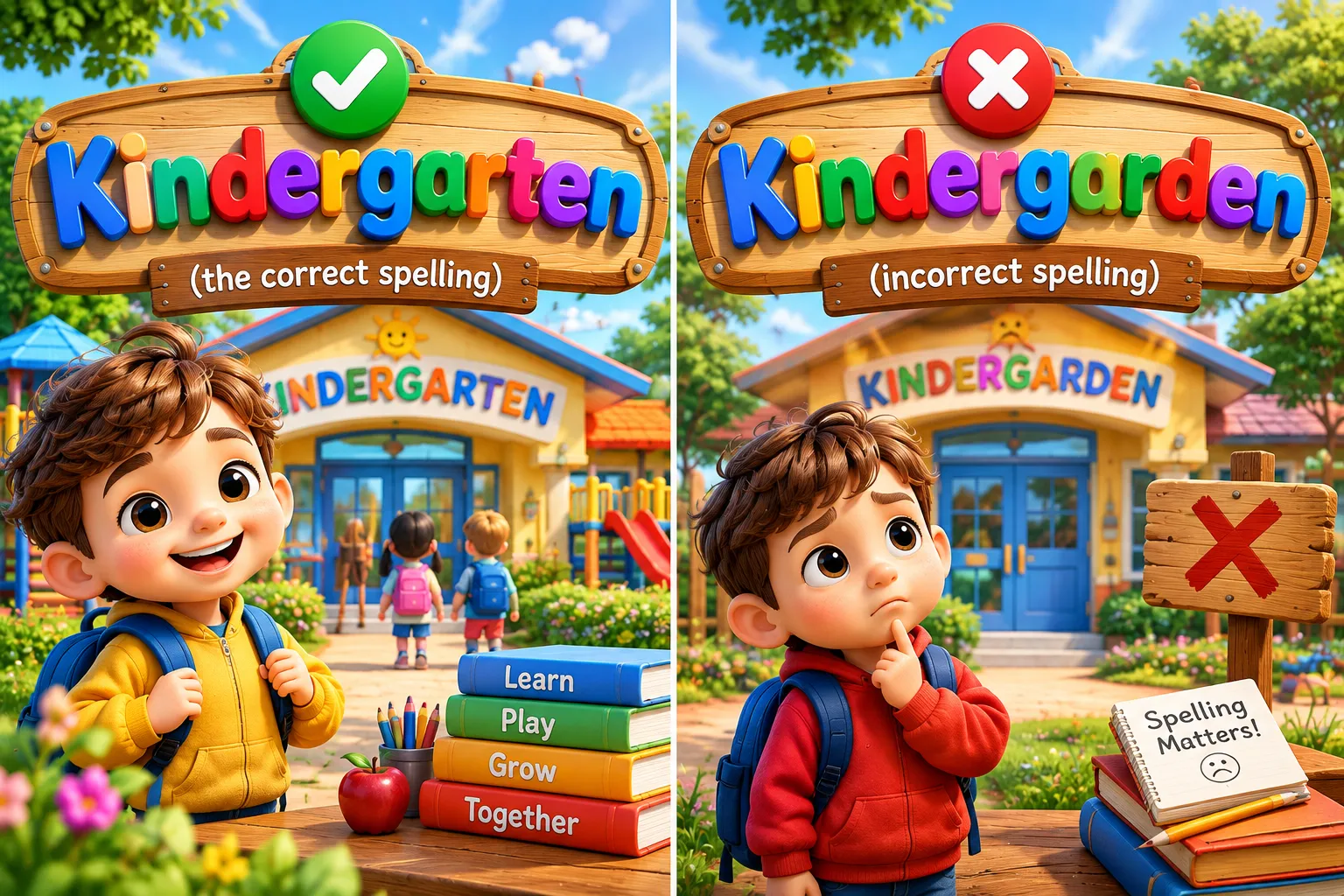
The correct spelling is kindergarten.
Kindergarden is a common misspelling caused partly by the familiar English word garden. The standard English word keeps the t from German Garten.
For example:
- Correct: My daughter starts kindergarten next year.
- Incorrect: My daughter starts kindergarden next year.
Cambridge Dictionary lists kindergarten as a noun. In American English, it refers to the first year of school for children around five; in British English, it can refer to a nursery school.
So, whenever you mean the educational setting, write kindergarten.
The Origin and Background of Kindergarten
The spelling becomes much easier when you know where the word came from.
Kindergarten is a German loanword. Etymonline dates the English word to 1852 and traces it to German Kinder-Garten, which literally means “children’s garden.”
The two German parts are:
| German Part | Meaning |
| Kinder | children |
| Garten | garden |
The term was coined by German educator Friedrich Fröbel. His idea used the image of a garden to describe the way young children could be nurtured and helped to develop.
The important spelling point is Garten.
It contains a t, not a d.
That is why English has:
Kinder + garten = kindergarten
rather than:
Kinder + garden = kindergarden
Etymonline also records kindergarden as a later partially anglicized form, attested from 1879. However, kindergarten is the established standard spelling in English.
Why does “kindergarden” feel correct?
The answer is simple: garden is already an English word.
When people hear kindergarten, they may mentally divide it like this:
kinder + garden
That spelling feels familiar.
But the word was borrowed as a German term. Its ending is -garten, so replacing the t with d creates the common misspelling kindergarden.
Kindergarten Explained: Key Differences
There is not really a meaning difference between kindergarten and kindergarden because only one is the standard spelling.
| Term | Meaning | When to Use | Region/Context |
| Kindergarten | School or class for young children | Use this spelling in standard English | American, British, and international English |
| Kindergarden | Common misspelling of kindergarten | Avoid it in standard writing | Not a standard spelling variant |
| Kindergartens | Plural of kindergarten | Use when referring to more than one | Standard English |
| Kindergartner | A child attending kindergarten | Common noun for a kindergarten pupil | Especially common in American English |
| Kindergartener | A child attending kindergarten | Variant form of kindergartner | English usage |
Cambridge gives kindergarten as a noun and shows that its exact educational meaning can vary by country. In the US, it commonly refers to a school year for five-year-olds, while in the UK it can refer to a nursery school.
Examples
Kindergarten
The children enjoyed their first day of kindergarten.
Kindergartens
Several kindergartens operate in the local area.
Kindergartner
Each kindergartner received a new reading book.
The spelling kindergarden should not replace kindergarten in these examples.
Which Version Should You Use?
The answer is straightforward: use kindergarten.
For American English
Use kindergarten.
My son will start kindergarten in August.
Cambridge defines the American use as a class or school year for young children, often around five years old.
For British English
The spelling is still kindergarten.
However, the local education term may differ. Cambridge notes that British English uses kindergarten for a nursery school, while other terms such as nursery and reception are also used depending on the setting and age group.
For international writing
Use kindergarten.
It is the recognized English spelling and avoids confusion.
For professional writing
Always choose kindergarten in:
- School applications
- Emails
- Educational reports
- Academic assignments
- Articles
- Websites
- News writing
- Formal documents
If you are writing about a specific country’s education system, also check whether a local term such as nursery, preschool, or reception is more precise.
Common Mistakes with Kindergarten
1. Writing “kindergarden”
❌ My child starts kindergarden next month.
✅ My child starts kindergarten next month.
The mistake happens because garden is a familiar English word.
2. Forgetting the “t”
❌ Kindergarden
✅ Kindergarten
Think of the German word Garten.
3. Writing “kinder garden”
❌ She works at a kinder garden.
✅ She works at a kindergarten.
The word is written as one word in English.
4. Using “kindergardens” as the plural
❌ Several kindergardens opened nearby.
✅ Several kindergartens opened nearby.
The plural is formed by adding -s to the standard spelling.
5. Assuming it is a British-American spelling difference
❌ British English = kindergarden
❌ American English = kindergarten
✅ Both use kindergarten as the standard spelling.
The main difference between British and American usage is often the educational meaning or terminology, not the spelling itself.
Easy Memory Trick
Remember this:
Kinder + Garten = Kindergarten
Or simply:
Garten has a T → kindergarten has a T.
That one small rule can help you avoid the mistake every time.
Kindergarten in Real-World Examples
Professional email
Please confirm the date of the kindergarten orientation meeting.
News headline
New kindergarten opens to local families this autumn.
Social media post
Our little one had a wonderful first week of kindergarten! 🎒
Formal report
The study examined language development among children attending kindergarten.
School document
Kindergarten registration forms must be submitted before the deadline.
In each case, kindergarten is the correct spelling.
Kindergarten Data, Trends & Usage
Exact monthly search-volume figures for kindergarten and kindergarden require current data from tools such as Semrush, Ahrefs, or Google Keyword Planner. No verified current search-volume figures are available from the authoritative dictionary sources used for this article, so specific numbers should not be presented as fact.
There is stronger evidence for the word’s established status in English.
Cambridge includes kindergarten as a standard dictionary entry and provides examples from English-language corpora.
Etymonline traces its English use to 1852, showing that the word has been established in English for well over a century.
The search intent behind kindergarten or kindergarden is primarily informational. People are usually checking:
- Which spelling is correct?
- Why does kindergarten have a t?
- Is kindergarden acceptable?
- What does kindergarten mean?
- Where did the word come from?
This makes the topic especially useful for students, parents, teachers, ESL learners, editors, and writers.
Kindergarten vs Kindergarden: Standalone Comparison
| Term/Variant | Meaning | Region/Context | Best Used When |
| Kindergarten | Early education class or school | Standard English | Referring to the educational setting |
| Kindergarden | Common spelling error | Nonstandard | Avoid in formal and standard writing |
| Kindergartens | More than one kindergarten | Standard English | Talking about several schools or classes |
| Kindergartner | Child who attends kindergarten | Common in American English | Referring to a kindergarten pupil |
| Kindergartener | Child who attends kindergarten | English variant | Referring to a kindergarten pupil |
| Pre-kindergarten | Education before kindergarten | Mainly American usage | Referring to an earlier educational stage |
FAQs About Kindergarten or Kindergarden
Q: Which is correct, kindergarten or kindergarden?
A: Kindergarten is the standard spelling. Kindergarden is a common misspelling.
Q: Why is kindergarten spelled with a “t”?
A: The word comes from German Kindergarten, meaning “children’s garden.” The German word Garten contains t, so the English spelling retains it.
Q: Is kindergarden ever correct?
A: It is not the standard English spelling for the educational term. Although historical sources record kindergarden as an anglicized form, kindergarten is the established spelling used in standard English.
Q: Is kindergarten used in British English?
A: Yes. Cambridge includes kindergarten in British English, where it can mean a nursery school. British education also commonly uses terms such as nursery and reception for particular stages.
Q: Is kindergarten an American word?
A: No. The word comes from German and entered English in the 19th century. It is now used in several varieties of English, although its educational meaning can vary by country.
Q: What does kindergarten literally mean?
A: It comes from German Kinder-Garten, literally “children’s garden.” The name reflects Friedrich Fröbel’s educational idea of nurturing children’s development.
Q: What is the plural of kindergarten?
A: The usual plural is kindergartens. For example, “The city has several kindergartens.”
Conclusion
The spelling choice between kindergarten and kindergarden is easy once you know the word’s history.
Kindergarten is the standard spelling. Kindergarden is a common misspelling that likely feels natural because the English word garden is so familiar.
The key is the German origin. Kindergarten comes from Kinder-Garten, meaning “children’s garden.” The German word Garten keeps the t, which gives English the spelling kindergarten.
The word is used in both American and British English, although its exact educational meaning can differ. In the United States, it commonly refers to the first year of school for young children. In British English, it can refer to a nursery school.
When you are writing an email, school document, article, assignment, or report, choose kindergarten.
The easiest memory trick is:
Kinder + Garten = Kindergarten.
Remember the T, and you will not have to second-guess this spelling again. Bookmark this guide so you can quickly check kindergarten or kindergarden whenever the spelling slips your mind.
Read More:
Apologize or Apologise: Easy Spelling Guide

I’m an English language educator and SEO content writer having experience creating clear, accurate, and engaging English learning content. I specialize in spelling differences, grammar, vocabulary, synonyms, commonly confused words, and English usage. My goal is to publish well-researched, easy-to-understand articles that help students, writers, educators, and professionals improve their English with confidence through practical explanations and real-world examples.