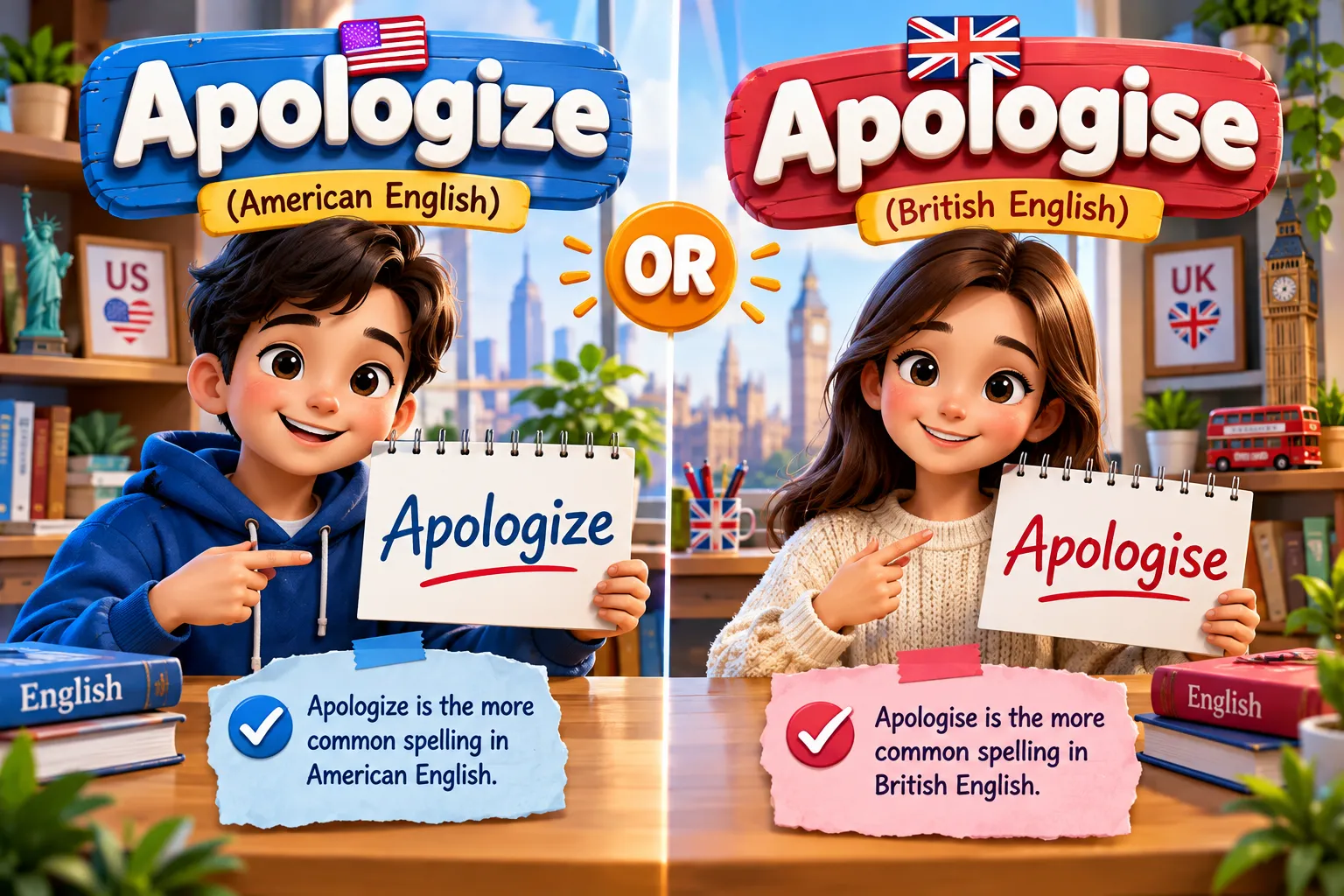
Apologize and apologise mean the same thing. Apologize is the usual American spelling, while apologise is commonly used in British English and other varieties that follow British spelling.
I have often paused over apologize and apologise when writing for an international audience. The difference is only one letter, but that small z or s can make you wonder whether one version is wrong.
I have seen this happen in emails, school assignments, websites, and formal letters. A writer may type apologise, then change it to apologize because a spell checker marks it. Someone else may do the opposite. Both writers can be correct.
The key is regional spelling. The two words have the same meaning, pronunciation, and grammatical role. The main difference is the variety of English being used.
Cambridge Dictionary lists apologize as the main form and notes that British English usually uses apologise. Oxford also gives apologize as the standard headword and identifies apologise as the British English form.
Once you understand that pattern, this spelling choice becomes much easier.
Apologize or Apologise Quick Answer
Both apologize and apologise are correct spellings of the same verb.
They mean to say that you are sorry for something you have done or for causing a problem. Cambridge Dictionary classifies the word as a verb and gives patterns such as apologize to someone and apologize for something.
For example:
- American English: I apologize for the delay.
- British English: I apologise for the delay.
The meaning does not change. The spelling changes because of regional English conventions.
The Origin and Background of Apologize and Apologise
The difference between -ize and -ise has a long history.
Etymonline traces apologize to the 1590s, when it meant roughly “to speak in defense.” The modern sense of acknowledging regret developed later. The word ultimately connects with Greek apologizesthai, meaning “to give an account.”
The related noun apology also has an interesting history. Etymonline traces it through Latin to Greek apologia, meaning a speech or defense. Its modern sense of expressing regret developed over time.
The spelling difference comes from the wider -ize / -ise variation in English. Etymonline explains that this variation has roots in French and Middle English, while English later developed different regional preferences. American English has favored -ize, while -ise remains dominant in Britain.
So apologise is not a misspelling of apologize. It is a recognized British spelling.
Apologize vs Apologise: Key Differences
| Term | Meaning | When to Use | Region/Context |
| Apologize | To say you are sorry | Use when following American spelling | American English |
| Apologise | To say you are sorry | Use when following British spelling | British English and other varieties influenced by it |
| Apologized | Past tense of apologize/apologise | Use for something that already happened | Both, with the same -ed ending |
| Apologizing | Present participle/gerund | Use for an action happening now or as a noun-like form | American English |
| Apologising | Present participle/gerund | Use when following British -ise spelling | British English |
Oxford lists apologize as an intransitive verb and gives forms such as apologized and apologizing. It also notes apologise as the British English spelling.
Simple examples
American English
The company apologized for the shipping problem.
British English
The company apologised for the shipping problem.
Notice that the grammar and meaning stay the same. Only the spelling changes.
Which Version Should You Use?
Your choice should depend mainly on your audience and the spelling system used in your writing.
If you write American English
Use apologize.
This is the natural choice for writing intended for readers in the United States.
Examples:
- I apologize for the mistake.
- We apologize for the inconvenience.
- She apologized to her manager.
If you write British English
Use apologise.
This keeps your spelling consistent with other British forms.
Examples:
- I apologise for the mistake.
- We apologise for the inconvenience.
- She apologised to her manager.
If you write for an international audience
Choose one spelling system and stay consistent.
Do not switch between apologize, apologise, realize, realise, organize, and organise without a reason.
Consistency makes your writing look more polished.
Common Mistakes with Apologize or Apologise
1. Treating “apologise” as incorrect
Mistake:
I apologise for the delay.
Correction:
This is correct in British English.
Cambridge specifically identifies apologise as the usual UK spelling.
2. Treating “apologize” as incorrect
Mistake:
American writers should use apologise.
Correction:
American English normally uses apologize.
The difference is regional, not grammatical.
3. Mixing spelling systems
Less consistent:
We apologise for the delay, but we will organize the event tomorrow.
Better British English:
We apologise for the delay, but we will organise the event tomorrow.
Better American English:
We apologize for the delay, but we will organize the event tomorrow.
4. Using “apology” as a verb
Incorrect:
I apology for my mistake.
Correct:
I apologize for my mistake.
Apology is a noun. Apologize/apologise is the verb. Cambridge Grammar Today makes this distinction clear.
5. Using the wrong preposition
The common patterns are apologize to someone and apologize for something.
For example:
I apologized to my colleague for the mistake.
Oxford lists both to and for in its usage patterns for the verb.
Apologize or Apologise in Real-World Examples
Professional email
American English:
We apologize for the delay in processing your request.
British English:
We apologise for the delay in processing your request.
Both are suitable for professional communication.
News headline
Company apologizes after service disruption.
A publication using American spelling may choose apologizes.
A British publication may use:
Company apologises after service disruption.
Social media post
We apologize to everyone affected by yesterday’s event.
Or, in British spelling:
We apologise to everyone affected by yesterday’s event.
Formal document
The department apologizes for any inconvenience caused.
With British spelling:
The department apologises for any inconvenience caused.
The choice should match the document’s overall spelling style.
Apologize or Apologise Data, Trends & Usage
Exact current monthly search-volume figures for apologize and apologise require access to paid SEO platforms such as Ahrefs or Semrush. The available sources here do not provide a verified current monthly search-volume comparison, so it would be misleading to invent numbers.
There is, however, useful corpus evidence.
Collins connects both apologise and apologize with Google Books Ngram data, showing that the two forms can be studied across published English over time.
Academic research has also used the Google Books Corpus to examine apology expressions. One study notes that the corpus contains roughly five million books and 361 billion words and reports an increase over time in phrases such as “I’m sorry” and “I apologise/I apologize.”
The practical SEO lesson is simple: people search for both spellings because both occur in real English. The main search intent is informational. Readers usually want to know which spelling is correct and whether the difference is grammatical or regional.
That makes this topic especially useful for English learners, editors, teachers, international businesses, and anyone writing for readers in more than one English-speaking region.
Apologize vs Apologise: Standalone Comparison
| Term/Variant | Meaning | Region/Context | Best Used When |
| Apologize | Say sorry | American English | Writing for a US audience |
| Apologise | Say sorry | British English | Writing for a UK audience |
| Apologized | Said sorry in the past | Both varieties | Describing a completed action |
| Apologizing | Saying sorry | American English | Following US spelling conventions |
| Apologising | Saying sorry | British English | Following UK spelling conventions |
| Apology | A statement expressing regret | Both varieties | Referring to the noun rather than the verb |
This table highlights an important point: apology does not change to apologizy or apologisy. The regional spelling difference mainly affects the verb and related -ize/-ise forms.
Frequently Asked Questions
Q: What does apologize mean?
A: Apologize means to tell someone that you are sorry for something you did or for causing a problem. It is a verb.
Q: Is apologise also correct?
A: Yes. Apologise is the usual British English spelling of apologize. The two forms have the same meaning.
Q: What is the difference between apologize and apologise?
A: There is no difference in meaning. Apologize is preferred in American English, while apologise is commonly preferred in British English.
Q: Is apologize correct in British English?
A: Yes, apologize can be found in British English, although apologise is usually preferred. The spelling choice often depends on the style followed by the writer or publication.
Q: Is apologise acceptable in American English?
A: It can be understood, but apologize is the standard spelling normally expected in American English. For US focused writing, apologize is the safer choice.
Q: Where do apologize and apologise come from?
A: Both forms trace back to the same word history. Etymonline connects apologize with Greek apologizesthai, while the -ize/-ise variation developed through the history of English and related European languages.
Q: Is apology the noun form of apologize?
A: Yes. Apology is the noun, while apologize/apologise is the verb. For example, you can make an apology or apologize for a mistake.
Conclusion
The choice between apologize and apologise is much simpler once you know that the two words have the same meaning.
Apologize is the usual American spelling. Apologise is commonly used in British English. Neither spelling changes the meaning of the verb.
The same regional pattern appears in other words, such as realize/realise, organize/organise, and recognize/recognise. This is why the difference is best understood as a matter of spelling convention, not grammar.
When you write, think about your audience first. If your text follows American English, choose apologize. If it follows British English, choose apologise. Most importantly, keep your spelling consistent throughout the same piece of writing.
Now you can use either form with confidence. Choose the spelling that matches your English variety, check your style guide when needed, and keep your writing consistent.
Read More:
Dwarfs or Dwarves: Which Spelling Is Correct?

I specialize in English grammar, spelling, word choice, and language usage. My content is based on research from grammar references, style guides, dictionaries, and real-world usage to ensure it is accurate and practical.
At Spelling Comparison, I write guides that explain why words are confused, how they are used, and which form is correct in context. I also include proofreading tips, examples, and writing advice readers can apply immediately.
My goal is to publish clear, reliable content that helps readers make better writing decisions. Each guide is written for accuracy, clarity, and usefulness in school, work, business, and everyday communication.