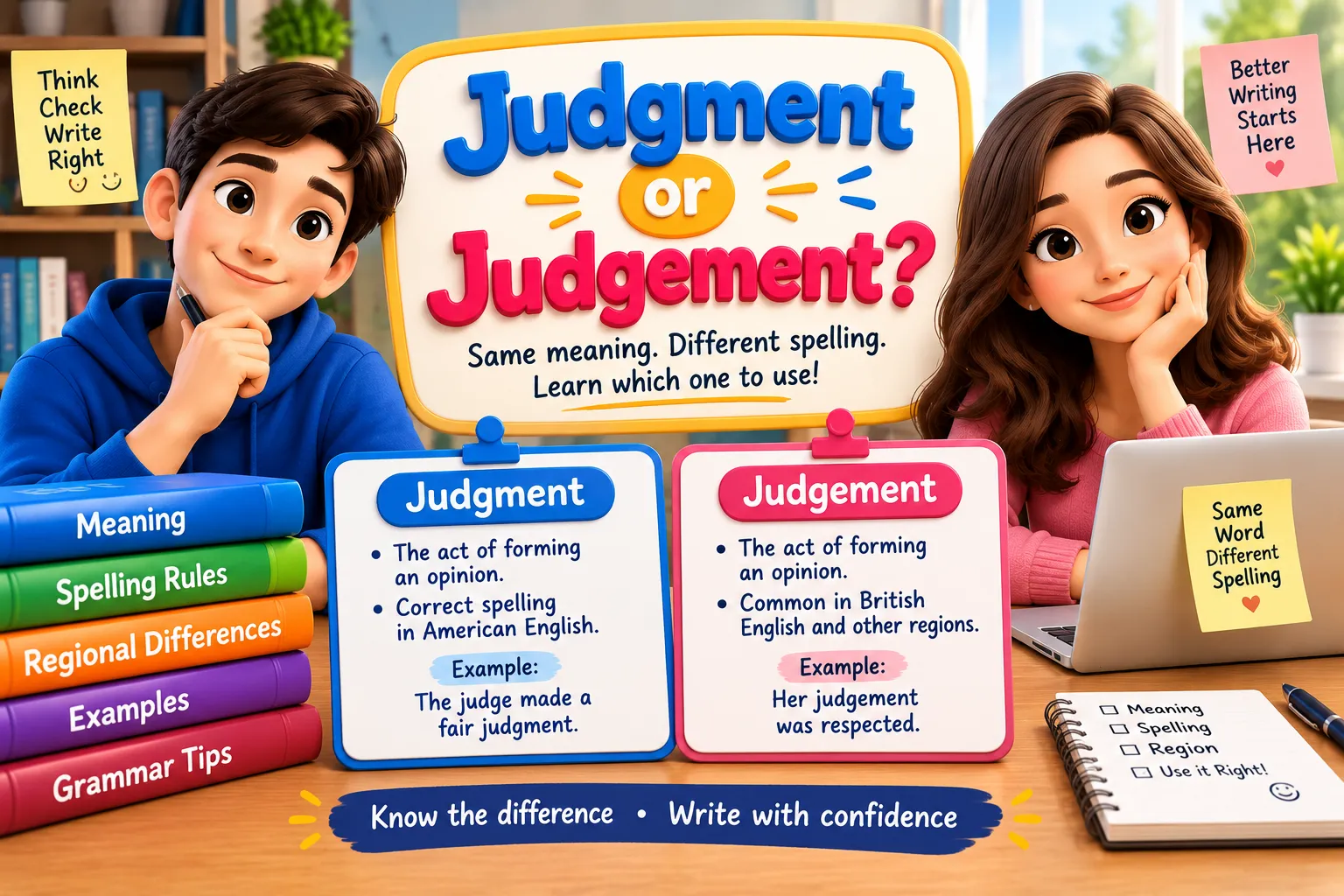
Judgment or judgement refers to the ability to make decisions, form opinions, or reach a conclusion. Judgment is the standard spelling in American English, while judgement is common in British English, although judgment is also used in British legal contexts.
Have you ever written a sentence, stopped at the word judgment, and wondered whether you had forgotten an e? You are not alone. Many English learners and native speakers face this small spelling puzzle.
The confusion often appears in school assignments, business reports, emails, and legal documents. You may see judgment on an American website and judgement in a British article. Both look right, so which one should you choose?
The answer depends mainly on the type of English you are using. Unlike pairs such as affect or effect, these two spellings generally share the same meaning. The main difference is regional spelling preference and, in some cases, legal style.
When writing, consistency matters. Choosing one spelling convention and following it throughout your work makes your writing look clear and professional.
In this guide, you will learn the meaning of judgment and judgement, their history, the difference between American and British usage, and how to avoid common mistakes. You will also find practical examples, comparison tables, and answers to frequently asked questions.
Let’s make this spelling choice simple.
Judgment or Judgement Quick Answer
Both judgment and judgement are nouns. They describe the ability to make sensible decisions, an opinion formed after careful thought, or an official decision made by a court.
Here are two examples:
- “Her judgment helped the team solve a difficult problem.” This spelling is standard in American English.
- “His judgement improved after years of experience.” This spelling is common in British English.
The meanings are the same in these examples.
Remember this simple rule:
- American English: Use judgment.
- British English: Judgement is common, but judgment is also accepted, especially in legal writing.
- International writing: Follow your organization’s preferred style guide and stay consistent.
The Origin and Background of Judgment or Judgement
Understanding the history of these words helps explain why two spellings exist.
Where Does the Word Judgment Come From?
The word judgment is linked to the verb judge. It describes the act of deciding, assessing, or forming an opinion.
According to some websites, judgment can refer to the process of making a decision, the ability to make sound decisions, or a formal legal decision.
The word developed through the history of English and has roots in Anglo-French and Latin vocabulary associated with judging and deciding. Its spelling reflects the way English adopted and adapted words from other languages.
The ending -ment appears in many English nouns. It often turns a verb into a noun that describes an action, result, or state.
For example:
- Agree → Agreement
- Pay → Payment
- Judge → Judgment
These words show how English uses suffixes to form nouns.
Why Does Judgement Have an Extra E?
The spelling judgement includes an extra e before the ending -ment.
This spelling is common in British English. It follows a pattern found in some other words, such as acknowledgement.
However, English spelling does not follow one perfect rule. Some words keep an extra letter in one spelling tradition but not another.
According to the dictionary, judgement is used in British English and refers readers to judgment. Cambridge also lists judgment as a standard spelling with the same core meanings.
This explains why you may see both forms in reliable dictionaries.
The key point: The extra e does not change the word’s meaning. It reflects a spelling variation.
Judgment or Judgement Explained: Key Differences
The main difference between judgment and judgement is the spelling convention used by the writer.
1. Judgment: American English
Judgment is the preferred spelling in American English.
It can describe:
- The ability to make good decisions.
- An opinion formed after thinking.
- A decision made by a judge or court.
Examples:
- The manager used good judgment when choosing the new supplier.
- We should reserve judgment until all the facts are clear.
- The court issued its judgment after reviewing the evidence.
Notice that the spelling stays the same in personal, professional, and legal contexts in American English.
2. Judgement: British English
Judgement is common in British English, particularly in general writing.
It can describe a person’s ability to make decisions or an opinion about a situation.
Examples:
- Her judgement of the situation was accurate.
- The coach showed excellent judgement during the final match.
- His first judgement of the book changed after he read the ending.
In British legal writing, however, judgment is also widely used. Legal documents may follow specific court or institutional rules.
3. Is There a Difference in Meaning?
No. In ordinary use, the two spellings have the same meaning.
Both can describe:
- A decision based on thought or evidence.
- The ability to make sensible choices.
- An opinion about a person, action, or event.
- A formal decision made by a court.
The choice is mainly about spelling conventions rather than meaning.
Comparison Table: Judgment vs. Judgement
| Term | Meaning | When to Use | Region/Context |
| Judgment | A decision, opinion, or ability to decide wisely | Standard American spelling | American English |
| Judgement | The same core meanings as judgment | Common spelling in general British writing | British English |
| Judgment | A formal decision made by a court | Legal writing, depending on the applicable style | American and British legal contexts |
Which Spelling Should You Use?
Your audience and writing purpose can help you choose the right form.
For American Readers
Use judgment when writing for American schools, businesses, websites, or publications.
For example, an American business report might say:
“The board exercised sound judgment when reviewing the proposal.”
This spelling matches standard American usage.
For British Readers
Use judgement in general British English if that is the convention followed by your organization or publication.
For example:
“The committee’s judgement was based on the available evidence.”
However, do not automatically change judgment to judgement in British legal documents. Check the relevant legal style guide.
For Students and English Learners
Choose the spelling expected by your teacher, textbook, or examination board.
If you are learning American English, remember judgment. If you are learning British English, you may encounter both spellings, so pay attention to the examples in your course materials.
For SEO Writers and Bloggers
Think about your target audience before publishing.
- For a US audience, use judgment.
- For a UK audience, use judgement in general content if it matches your chosen style.
- For a global audience, choose one spelling convention and use it consistently.
Do not switch spellings simply to repeat a keyword. Clear, natural writing is more useful than unnecessary repetition.
Common Mistakes with Judgment or Judgement
These mistakes can make your writing less consistent or change the intended meaning of a sentence.
Mistake 1: Mixing Both Spellings
Incorrect: The manager used good judgment, but her final judgement was different.
Better: The manager used good judgment, but her final judgment was different.
The first sentence is not necessarily grammatically wrong, but it mixes spelling styles without a clear reason.
Mistake 2: Thinking One Spelling Is Always Wrong
Incorrect: Judgement is never correct.
Correct: Judgement is common in British English.
The extra e does not automatically make the word incorrect. Regional spelling conventions matter.
Mistake 3: Forgetting Legal Usage
Incorrect assumption: Every British legal document must use judgement.
Better approach: Check the relevant legal style guide.
The spelling judgment is also used in British legal contexts. Legal terminology can follow conventions that differ from general writing.
Mistake 4: Confusing Judgment with Judge
Incorrect: The judge made a good judge about the case.
Correct: The judge made a good judgment about the case.
A judge is a person who makes decisions in court. A judgment is a decision or the ability to decide wisely.
Mistake 5: Using Judgment When You Mean Judging
Incorrect: Her judgment people without knowing them is unfair.
Correct: Her habit of judging people without knowing them is unfair.
Judgment is a noun, while judging is the -ing form of the verb judge. The correct choice depends on how the word functions in the sentence.
Judgment or Judgement in Real World Examples
Here is how you can use these spellings in different types of writing.
1. Professional Email
Dear Team,
Thank you for sharing your feedback on the project proposal. We will review the available information before making a final judgment.
Please send any additional comments by Friday.
Best regards,
Alex
Why it works: The email uses judgment, which is standard in American English. For a British audience, judgement may be suitable in general business writing.
2. News Headline
Example: Court Delivers Judgment in Major Property Dispute
This headline uses judgment, a common spelling in legal reporting. The exact style may depend on the publication and jurisdiction.
3. Social Media Post
Good judgment comes from learning, listening, and thinking before you act. You do not need to have every answer right away. Take your time, consider the facts, and make the best choice you can.
This example uses the American spelling. If your social media page follows British English, you can change judgment to judgement.
4. Formal Document or Report
Example: The review panel reached its judgment after examining the submitted evidence.
This sentence suits a formal report. If the document follows British English, check whether the relevant style guide prefers judgement or retains judgment for the context.
Judgment or Judgement Data, Trends, and Usage
Spelling differences are not only a grammar issue. They also affect what people search for and how words appear in published writing.
1. Search Volume: Judgment vs. Judgement
Exact monthly search volumes require current keyword research from tools such as Ahrefs, Semrush, or Google Keyword Planner. No verified monthly figures are available for this article, so exact numbers would be misleading.
People commonly search for questions such as:
- Judgment or judgement: Which is correct?
- Judgment vs. judgement
- American vs. British spelling
- How to spell judgment in legal writing
These searches have informational intent. Readers want to understand the spelling difference and choose the correct form for their audience.
You can compare regional interest using google trends Remember that its interest scores are relative measures, not direct monthly search counts.
2. Word Frequency in Published Books
Google’s nagram viewers lets readers compare how often words appear in books over time.
You can compare judgment and judgement in the American English and British English collections. The results depend on the selected corpus, date range, and other settings.
This is useful because a spelling that is common in one region may be less common in another. However, book frequency alone does not determine whether a spelling is correct.
3. Regional Usage
The main regional pattern is straightforward:
- United States: Judgment is the standard spelling.
- United Kingdom: Judgement is common in general writing, while judgment also appears, especially in legal contexts.
- International English: Follow the preferred spelling convention of your audience or organization.
The spelling you choose should fit the type of English you are writing.
4. Why This Difference Matters Today
People now write for international audiences through websites, online courses, email, and social media.
A spelling checker may flag one form based on its language settings, even when that form is accepted in another variety of English.
For SEO writers, the best approach is to select the correct regional spelling and keep it consistent. That makes content easier to read and helps avoid confusing readers.
Standalone Comparison Table: Judgment and Related Words
The following table adds related terms that can help you choose the right word for your sentence.
| Term/Variant | Meaning | Region/Context | Best Used When |
| Judgment | A decision, opinion, or ability to decide | American English; also used elsewhere | Writing for a US audience or following a style guide that uses this form |
| Judgement | Same core meaning as judgment | Common in British general writing | Following a British spelling convention |
| Judge | A person who decides legal cases; also a verb meaning to form an opinion | General English | Referring to the person or the act of assessing |
| Judging | The act of forming an opinion or evaluating something | General English | Describing an ongoing action |
| Judicious | Showing good sense and careful thought | Formal English | Describing a wise or careful decision |
These words are related, but they are not interchangeable. For example, a judge may make a judgment, while a judicious decision is one made with care and good sense.
Frequently Asked Questions About Judgment or Judgement
Q1: What does judgment or judgement mean?
A: Both spellings refer to a decision, an opinion formed after thought, or the ability to make sensible choices. The word can also describe an official decision made by a court.
Q2: How do you spell judgment correctly?
A: In American English, write judgment. In British English, judgement is common in general writing, but judgment is also accepted in some contexts, including legal writing.
Q3: Is judgement wrong in American English?
A: Judgment is the standard American spelling. You may still encounter judgement in other English varieties or in material written by people using different spelling conventions.
Q4: Is judgment or judgement better for formal writing?
A: Both can be appropriate. The best choice depends on your audience, publication, and style guide. Legal writing may have specific conventions, so check the relevant rules before editing a formal document.
Q5: What is the difference between judgment and decision?
A: A judgment often involves forming an opinion or assessing information. A decision is a choice made between options. The words overlap in some contexts, but they do not always mean exactly the same thing.
Q6: Where does the word judgment come from?
A: The word is linked to judge and has roots in Anglo-French and Latin terms related to judging and deciding. Its spelling developed as English adopted and adapted words from other languages.
Q7: Should I use judgment or judgement in an SEO article?
A: Choose the spelling that matches your target audience. Use judgment for standard American English and consider judgement for general British English when it matches your style. Keep the spelling consistent throughout the article.
Conclusion: Judgment or Judgement Which Is Correct?
The choice between judgment and judgement is easier than it first appears. Both spellings express the same core idea: making a decision, forming an opinion, or assessing a situation.
The main difference is regional usage. Judgment is the standard spelling in American English, while judgement is common in general British writing. The spelling judgment is also used in British legal contexts, so legal writers should check the rules that apply to their documents.
Remember that good writing is not only about spelling each word correctly. It is also about matching your language to your audience and keeping your style consistent.
If you write for an American audience, choose judgment. If you write for a British audience, follow the relevant style guide and use its preferred form. For international content, consistency is your safest choice.
You now have a simple way to handle this common spelling question. Bookmark this guide, use the right form in your next article, and share it with someone who wants to improve their English spelling.
Readmore

I am an English language specialist with over 10 years of experience writing about grammar, spelling differences, and language usage. Dedicated to helping writers communicate with confidence, my detailed guides break down complex rules into clear, real-world advice. At Spelling Comparison, my focus is on providing actionable proofreading tips and vocabulary deep-dives to ensure your writing is always accurate, clear, and impactful.










