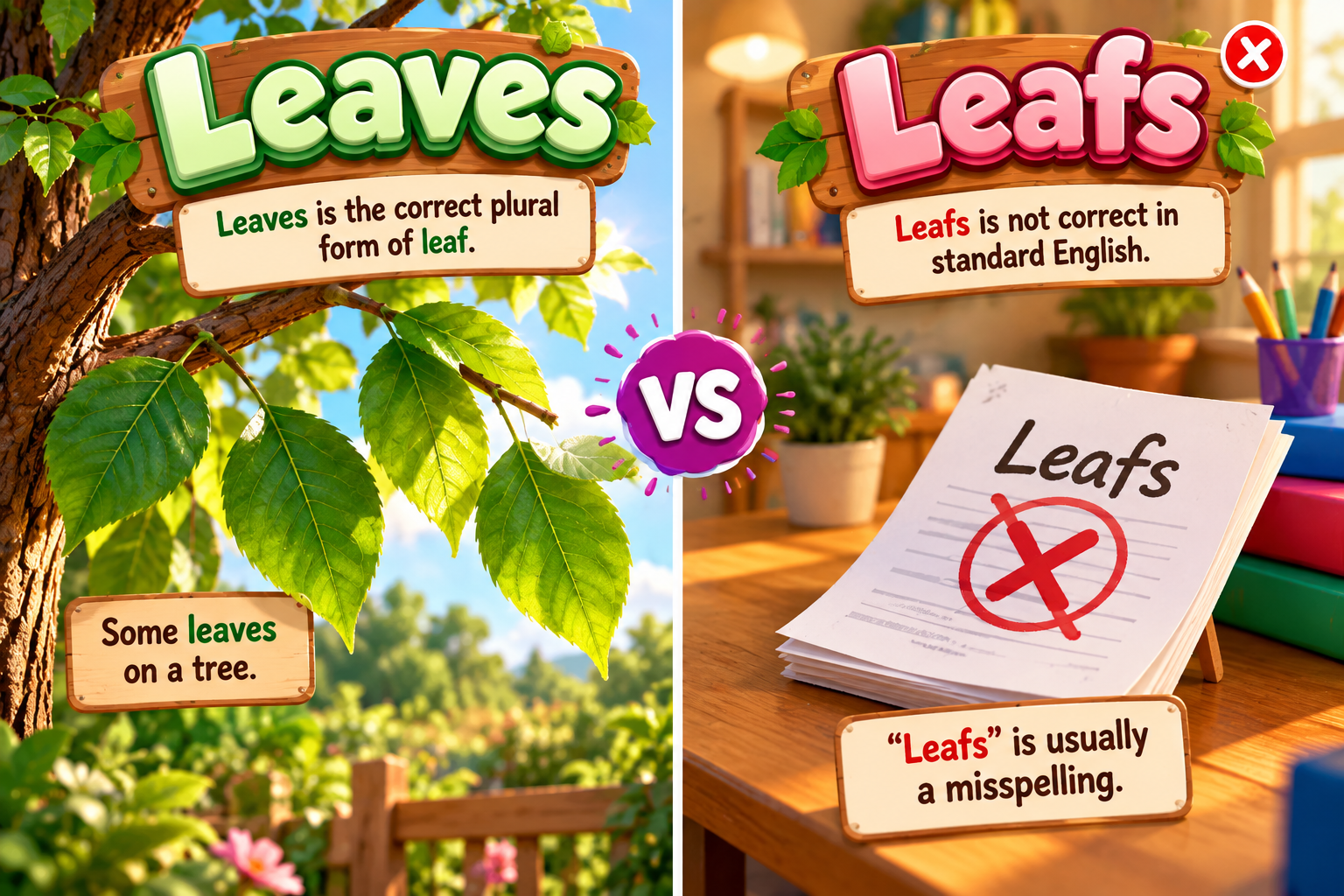
Leaves is the standard plural of leaf when you mean more than one leaf. Leafs is mainly used as a verb, as in “she leafs through a book,” or in a proper name such as the Toronto Maple Leafs.
I remember writing about trees and stopping at a surprisingly simple word: leaf. I knew the singular form, but when I needed the plural, I suddenly wondered, “Is it leaves or leafs?”
At first, leafs seemed logical. Most English nouns simply take -s when they become plural. We say book and books, tree and trees, so why should leaf be different?
That small spelling doubt is easy to understand. English has many irregular plural forms, and leaf → leaves is one of them. The word also has another trick: leafs is a real English word, but it does not normally mean “more than one leaf.”
Once I looked at how the two forms work in real sentences, the difference became much clearer. Leaves is the plural noun. Leafs usually works as a verb or appears in a proper name.
If you have ever paused over this spelling, you are not alone. Let’s make the rule simple.
Leaves or Leafs Quick Answer
When you mean more than one leaf, use leaves.
For example:
- One leaf fell from the tree.
- Several leaves covered the garden path.
Cambridge Dictionary lists leaves as the plural of leaf in both British and American English.
Leafs has different uses. It can be the third-person singular form of the verb leaf, meaning to turn or look through pages.
For example:
She leafs through the magazine while waiting.
So the quick rule is simple:
leaf → leaves when you mean more than one leaf.
leaf → leafs when leafs is being used as a verb, or when it forms part of a proper name.
The Origin and Background of Leaves
The word leaf has a very old history.
Etymonline traces it to Old English leaf, meaning a leaf of a plant, foliage, or a page or sheet of paper. The word is linked to Proto-Germanic lauba-.
That long history helps explain why modern English does not always follow the simple “add -s” rule.
English has many older plural patterns. Some words changed their spelling or sound as the language developed. This is why we have forms such as:
- leaf → leaves
- knife → knives
- wolf → wolves
- life → lives
- shelf → shelves
But there is an important warning: not every word ending in -f changes to -ves. We still write roof → roofs and chief → chiefs.
So it is better to learn leaf → leaves as an established plural form rather than trying to create a universal grammar rule for every word ending in f.
Leaves or Leafs Explained Key Differences
The easiest way to understand these words is to look at their part of speech.
| Term | Meaning | When to Use | Region/Context |
| leaf | One leaf or a single sheet/page | Singular noun | Standard English |
| leaves | More than one leaf | Plural noun | Standard English |
| leafs | Turns pages or looks through pages | Verb | Standard English |
| Leafs | Part of an official name | Proper noun | Toronto Maple Leafs |
When to use leaves
Use leaves when you are talking about two or more plant leaves.
Examples:
- The autumn leaves covered the sidewalk.
- The gardener removed the damaged leaves.
- Bright green leaves grew along the branch.
The same plural can also be used when leaf has another noun meaning.
A book can contain several leaves, for example. A table can also have removable leaves that extend its surface. Cambridge Dictionary includes both the book and table meanings of leaf.
When to use leafs
Leafs can be a verb.
The verb to leaf can mean to turn or look through pages. Its third-person singular present form is leafs.
For example:
He leafs through old newspapers on Sunday mornings.
Collins Dictionary lists leafs as the third-person singular present form of leaf.
There is also a famous proper-name use: Toronto Maple Leafs, the name of the Canadian ice hockey team.
In that name, Leafs is part of the official name. It is not an example of the ordinary plural of the noun leaf.
Which Version Should You Use?
Your choice depends on what you mean.
For school or university writing
Use leaves when you mean more than one leaf.
The leaves of the plant were turning yellow.
This is the normal plural form and is the safest choice for academic writing.
For everyday writing
Use leaves for trees, plants, gardens, seasons, and nature.
The wind blew the leaves across the yard.
You do not need to make the spelling more complicated than it is.
When describing an action
Use leafs when the word is a verb.
She leafs through the recipe book before cooking.
Here, leafs does not mean several leaves. It describes what she does.
When writing a proper name
Keep the official spelling of a name.
For example:
The Toronto Maple Leafs played last night.
Changing Leafs to Leaves would change the team’s name.
Common Mistakes With Leaves or Leafs
Mistake 1: Using “leafs” as the plural noun
❌ The tree has beautiful leafs.
✅ The tree has beautiful leaves.
Why? The standard plural noun is leaves.
Mistake 2: Changing “leafs” to “leaves” when it is a verb
❌ She leaves through the report before the meeting.
✅ She leafs through the report before the meeting.
Why? Here, leafs through means she quickly looks through the pages.
Mistake 3: Confusing “leaves” with “leaf’s”
❌ The leaf’s are turning brown.
✅ The leaves are turning brown.
Why? The apostrophe in leaf’s usually shows possession or belongs to a different grammatical structure. It is not the normal plural marker.
Mistake 4: Changing a proper name
❌ The Toronto Maple Leaves won the game.
✅ The Toronto Maple Leafs won the game.
Why? Proper names keep their official spelling.
Mistake 5: Assuming every “-f” word uses “-ves”
❌ Two rooves were damaged.
✅ Two roofs were damaged.
Why? English plural patterns are not completely regular. Learn the plural form of each word when needed.
Leaves or Leafs in Real-World Examples
Here are four fresh examples showing how the words appear in different types of writing.
Professional email
Please remove the fallen leaves from the entrance before the client arrives.
News headline
Autumn Leaves Cover Streets After Weekend Storm
Social media post
I spent the afternoon collecting colorful leaves from the garden. 🍂
Formal report
The inspection found several damaged leaves on the lower branches of the plant.
And here is a different use of leafs:
Before the meeting begins, he leafs through the report to check the final figures.
The surrounding words make the grammatical role clear.
Leaves or Leafs Data, Trends & Usage
Exact monthly search volumes for “leaves or leafs” are not consistently available from public sources, so it would be misleading to present an invented number as current search data.
Google Trends can show relative search interest, while tools such as Ahrefs and Semrush provide estimated keyword volumes. Those figures can vary by country, database, and date. For that reason, search-volume numbers should always be labeled as estimates.
The linguistic pattern itself is much clearer.
Cambridge Dictionary gives leaves as the plural of leaf. Its English entries use the form in examples involving plants, books, and other meanings of leaf.
Merriam-Webster also records leaves and additionally lists leafs for the noun, showing that dictionary treatment can be more nuanced than the simple school rule.
That is an important detail. For ordinary modern writing about plants, leaves is the form readers expect. Leafs appears mainly in specific grammatical or naming contexts.
The search intent behind “leaves or leafs” is strongly informational. People usually want a quick spelling answer, an explanation of the grammar, or examples that show when each form works.
This also explains why the question remains useful for English learners. Spell-checkers can identify a word as valid without explaining whether it fits the sentence. Knowing the part of speech gives you a better way to make the choice yourself.
A Second Comparison: Leaves, Leafs, and Related Forms
| Term/Variant | Meaning | Region/Context | Best Used When |
| leaf | One leaf; also a page or table section | General English | Referring to one item |
| leaves | Plural noun; more than one leaf | General English | Talking about plants, books, or table sections |
| leafs | Third-person singular verb | General English | Saying someone looks through pages |
| Leafs | Official proper name | Canadian sports | Referring to the Toronto Maple Leafs |
| leafing | Present participle of leaf | General English | Describing the action of looking through pages |
| leafed | Past tense of leaf | General English | Describing an earlier page-turning action |
This comparison shows why simply asking whether leafs is “a real word” does not solve the problem. It is a real form, but its grammatical job can be different.
Related Words That Cause Similar Confusion
Leaves or leafs is one of many English spelling questions where a small change creates a different grammatical form.
You may also come across:
- life or lives
- knife or knives
- wolf or wolves
- shelf or shelves
- loaf or loaves
There is also a useful difference between leaves and leaf’s.
Leaves is normally the plural noun.
Leaf’s can show possession or form part of a contraction in a context where leaf is is intended.
For example:
The leaf’s color has changed.
Here, the color belongs to one leaf.
This is a grammar issue, not a plural spelling choice.
FAQ: Leaves or Leafs
Q: What is the plural of leaf?
A: The standard plural is leaves. Cambridge Dictionary lists leaves as the plural form of leaf in both British and American English.
Q: Is “leafs” ever correct?
A: Yes. Leafs is a correct verb form, as in “She leafs through the book.” It can also appear in proper names, such as the Toronto Maple Leafs.
Q: Is “leafs” acceptable for plants?
A: In ordinary standard writing, use leaves when you mean more than one plant leaf. “Leafs” is not the usual plural form readers expect in that context.
Q: Why does leaf become leaves?
A: Leaf has an irregular plural form. Instead of adding only -s, English uses leaves. The pattern is also found in words such as knife → knives and wolf → wolves, although not every word ending in f follows it.
Q: Is “leaves” correct in formal writing?
A: Yes. Leaves is the normal plural noun in formal, academic, business, and everyday English when referring to multiple leaves.
Q: Is “leafs” a homophone of “leaves”?
A: No. They are pronounced differently. Leaves ends with a /z/ sound, while the verb leafs ends with an /s/ sound.
Q: Can “leaves” refer to things other than plant leaves?
A: Yes. A leaf can also mean a sheet in a book or a removable section of a table. The plural in these noun uses is normally leaves.
Q: Where does the word “leaf” come from?
A: Etymonline traces leaf to Old English leaf, with roots going back to Proto-Germanic. Its early meanings included plant foliage and a page or sheet of paper.
Conclusion
The leaves or leafs question looks harder than it really is.
When you mean more than one leaf, choose leaves. That is the form you need for trees, plants, gardens, books, and most other noun uses.
Leafs has a different role. It can be the third-person singular form of the verb leaf, as in someone who leafs through a magazine. It can also appear as part of an official name, such as the Toronto Maple Leafs.
The key is to look at the job the word is doing in the sentence. If you are naming several leaves, use leaves. If someone is quickly turning pages, leafs may be the right verb.
Once you notice that difference, the spelling becomes much easier to remember. You no longer have to rely on how the word looks. You can use the meaning and grammar to make the choice.
So, the next time you write about autumn, a garden, a book, or a tree, remember the simple pattern: one leaf, many leaves.
Bookmark this guide so you never have to second-guess leaves or leafs again.
Read More:
Rat or Mouse: Easy Ways to Tell the Difference

I’m an English language educator and SEO content writer having experience creating clear, accurate, and engaging English learning content. I specialize in spelling differences, grammar, vocabulary, synonyms, commonly confused words, and English usage. My goal is to publish well-researched, easy-to-understand articles that help students, writers, educators, and professionals improve their English with confidence through practical explanations and real-world examples.










