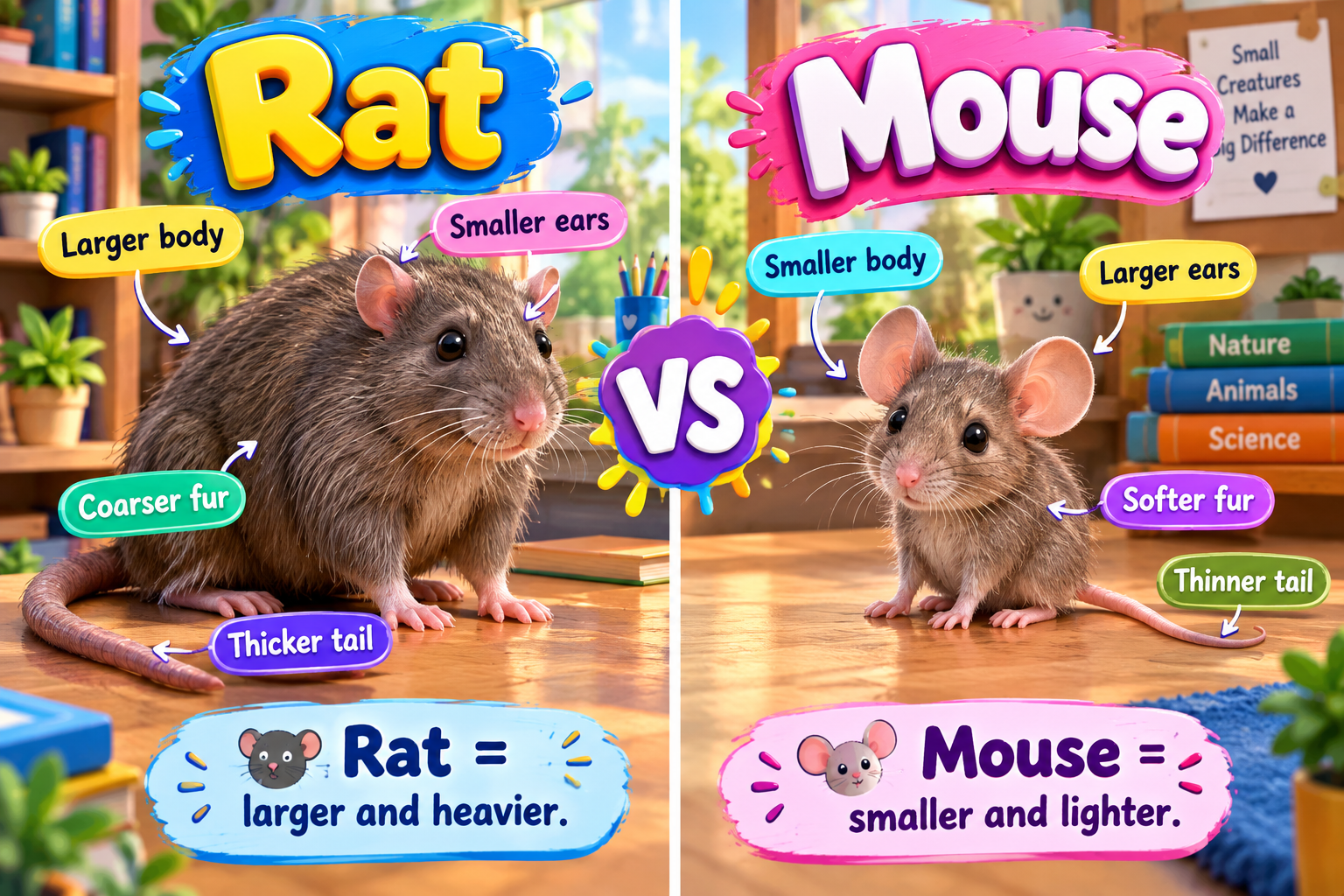
A rat is generally larger, heavier, and more robust than a mouse, while a mouse is smaller, with a pointed face, larger ears, and a thinner tail.
The first time I had to figure out whether I was looking at a rat or a mouse, I was more confused than I expected. I caught a quick glimpse of the animal running across the floor, but it vanished before I could get a good look.
At first, I thought the answer would be easy. Surely, a small animal had to be a mouse, right? But I soon found out that it is not always that simple. A young rat can be surprisingly small and may look very similar to a mouse.
That experience made me start paying closer attention to the little details. I learned to look at the head, ears, tail, feet, and overall body shape instead of judging the animal by size alone. Even droppings and other signs around the house can offer useful clues.
Since then, I’ve been much more careful when trying to identify a rodent. I don’t rely on color or size alone anymore. I look at several features together, which makes it much easier to work out whether I’m dealing with a rat or a mouse.
Rat or Mouse Quick Answer
A rat usually has a larger, heavier body, a blunt nose, smaller-looking ears, and a thick tail.
A mouse is usually much smaller. It has a pointed face, large ears compared with its head, and a thin tail.
For example:
- A large animal with a broad head and thick tail is more likely to be a rat.
- A tiny animal with big ears and a pointed nose is more likely to be a mouse.
The common house mouse is Mus musculus. Common rats found around homes include the Norway rat, Rattus norvegicus, and the roof rat, Rattus rattus. These species can differ in size and shape, so the clues should be used together.
The Origin and Background of Rat and Mouse
The words rat and mouse are both very old.
Etymonline traces rat to Old English ræt. Its deeper origin is uncertain. Similar words appear in several European languages, but linguists do not agree on the ultimate source.
The history of mouse is clearer. Etymonline traces it through Middle English mous to Old English mus. It is related to similar words in other Germanic languages and to much older Indo-European forms.
There is another interesting point here. The old word for mouse is linked to the Latin mus, which is also related to the word muscle. This connection came from an old comparison between the movement of a mouse and the movement of a muscle.
In modern English, rat and mouse are not homophones. They have different sounds and spellings. They are simply closely related names for familiar rodents.
The word rodent is broader. It refers to mammals with strong front teeth adapted for gnawing. Rats and mice are both rodents.
Rat vs Mouse Key Differences
The easiest way to tell a rat from a mouse is to look at several features at the same time.
| Feature | Rat | Mouse |
| Body | Larger and heavier | Smaller and lighter |
| Head | Broad and chunky | Small and triangular |
| Nose | Usually blunt | Usually pointed |
| Ears | Smaller compared with the head | Large compared with the head |
| Tail | Thick and more robust | Thin and delicate |
| Feet | Larger, especially in rats | Small |
| Droppings | Larger | Much smaller |
| Overall look | Heavy and powerful | Small and delicate |
Government identification guides give similar differences. For example, an Alberta government comparison lists the Norway rat at about 30–45 cm from nose to tail and the house mouse at about 15–17 cm. These figures are typical ranges, not rules for every individual animal.
1. Look at the face
A mouse normally has a sharp, pointed muzzle.
A Norway rat usually has a blunter, broader muzzle.
This is one of the best clues when the animal is close enough to see clearly.
2. Check the ears
Mouse ears often look large for the size of the head.
Rat ears usually look smaller and thicker in comparison with the head.
3. Examine the tail
A mouse usually has a thin tail.
A Norway rat has a thicker tail, often shorter than the combined length of its head and body.
Roof rats are different. Their tails can be longer than the head and body, so you should not use tail length alone to identify every rat.
4. Notice the feet
This clue is easy to miss.
A young rat may look similar in size to a mouse. However, the rat often has a more developed head and noticeably larger feet.
That is why a quick glance at body length can sometimes be misleading.
Which One Are You Seeing?
If you are trying to identify a rodent at home, use the clues that are easiest to observe safely.
If you see a small animal
Look for:
- A pointed nose
- Large ears
- A thin tail
- A small body
- Tiny droppings
Those features point toward a mouse.
If you see a larger animal
Look for:
- A broad head
- A blunt nose
- A thick tail
- A heavier body
- Larger droppings
Those features point toward a rat.
If you only hear scratching
Do not assume it is a rat.
Scratching sounds can come from different animals, and sound alone is not a reliable identification method. Look for physical evidence such as droppings, gnaw marks, nests, or tracks.
Common Mistakes With Rat or Mouse Identification
Mistake 1: Judging only by size
Mistake: “It is small, so it must be a mouse.”
Correction: Check the head and feet too.
A young rat can be small enough to confuse you.
Mistake 2: Assuming every long-tailed rodent is a mouse
Mistake: “Its tail is long, so it must be a mouse.”
Correction: Check the tail thickness and the rest of the body.
Some rats, such as roof rats, also have long tails.
Mistake 3: Using color as the main clue
Mistake: “It is gray, so it must be a mouse.”
Correction: Use body shape, ears, nose, and tail first.
Color can vary among species and individuals.
Mistake 4: Looking at one dropping
Mistake: Trying to identify the animal from one piece of waste alone.
Correction: Check the size, shape, location, and other signs together.
The CDC notes that droppings and gnaw marks are useful signs of rodent activity, but they should be interpreted as part of the larger picture.
Mistake 5: Getting too close
Mistake: Trying to catch or handle the animal to identify it.
Correction: Observe from a safe distance.
Wild rodents can carry diseases, and contact with droppings, urine, saliva, or bites can create health risks.
Rat or Mouse in Real-World Examples
Here are fresh examples showing how the terms work naturally.
Professional email
Subject: Possible Mouse Activity in the Storage Room
I noticed small droppings near the storage shelves this morning. Could we arrange an inspection before the problem gets worse?
News headline
Residents Report Increased Rat Activity Near Local Food Markets
Social media post
We found a tiny mouse near the pantry last night. Time to check every food container!
Formal report
The inspection found evidence consistent with mouse activity in the lower kitchen cabinets.
Notice that rat and mouse can describe both the animal itself and a wider problem involving homes, food storage, buildings, and public spaces.
Rat or Mouse Data, Trends & Usage
Search data for exact phrases such as “rat or mouse” and “rat vs mouse” changes over time. Public search tools do not provide a stable, universally verifiable monthly volume figure for these exact phrases, so it would be misleading to invent one.
Google Trends is also a relative-interest tool, not a direct count of searches. It can show how interest changes between terms and locations, but a Trends score of 100 does not mean 100 searches.
For written English, corpus tools such as Google Books Ngram Viewer allow researchers to compare the frequency of words across large collections of books. Published documentation for Ngram tools confirms that researchers can compare terms such as mouse and rat across English-language book corpora.
One published frequency dictionary also lists both mouse and rat among common animal words. This shows that both terms are well established in general English.
There is another reason this topic remains useful. Mouse has a major meaning outside zoology. Cambridge Dictionary also lists mouse as the computer device used to control a cursor. That creates a much larger language context around the word.
For SEO, the practical search intent is mainly informational. People usually want to know what they saw, how to identify it, or what signs can distinguish a rat from a mouse.
Rat vs Mouse: A Second Comparison Table
| Term/Variant | Meaning | Region/Context | Best Used When |
| Rat | A larger type of familiar rodent | General English | Describing a larger rodent |
| Mouse | A smaller rodent with a pointed face | General English | Describing a small rodent |
| Norway rat | A common large rat species | Homes, cities, outdoor areas | More precise identification |
| Roof rat | A slimmer rat with a relatively long tail | Buildings, elevated areas | Species-level identification |
| House mouse | A small mouse species common around people | Homes and buildings | Specific mouse identification |
| Rodent | A broader animal group | Biology and pest control | When the exact animal is unknown |
This table highlights an important point: rat and mouse are common names, while terms such as Norway rat, roof rat, and house mouse give you more precise information.
What Should You Do If You Find One?
If you suspect a rodent inside your home, do not focus only on identifying it.
Check for:
- Droppings in cupboards or hidden spaces
- Gnaw marks on food packaging or materials
- Holes or gaps where an animal could enter
- Nesting material
- Food that has been disturbed
- Greasy marks or travel paths near walls
The CDC recommends removing food, water, and shelter that can support rodents. It also advises checking for and sealing possible entry points.
If traps are needed, the CDC recommends placing them where rodent activity has been observed and keeping traps away from children and pets.
If you find heavy activity, repeated signs, or a large infestation, professional pest control may be appropriate.
FAQ: Rat or Mouse
Q: What is the main difference between a rat and a mouse?
A: The biggest difference is overall build. Rats are generally larger and heavier, while mice are smaller, with more prominent ears and a pointed face.
Q: How can I tell if I saw a mouse?
A: Look for a small body, pointed nose, large ears, and a thin tail. Small droppings can provide another useful clue.
Q: How can I tell if I saw a rat?
A: Look for a broad head, blunt muzzle, heavy body, thick tail, and larger droppings. A clear view of the feet can also help.
Q: Can a young rat look like a mouse?
A: Yes. Size can overlap between a young rat and an adult mouse. Head shape, feet, ears, and tail thickness can help separate them.
Q: Are rats and mice the same animal?
A: No. They are different animals, although both belong to the broader group of rodents. Common house mice belong to Mus, while many familiar rats belong to Rattus.
Q: Is a roof rat the same as a Norway rat?
A: No. They are different rat species with different body shapes and habits. Roof rats tend to be slimmer and have longer tails, while Norway rats are heavier with shorter tails.
Q: Where do the words rat and mouse come from?
A: Both words have very old roots. Rat comes from Old English ræt, while mouse developed through Middle English mous from Old English mus.
Q: Is “rodent” another word for rat or mouse?
A: Rodent is a broader biological term. Rats and mice are both rodents, but the group also includes animals such as squirrels, beavers, and hamsters.
Conclusion
Knowing the difference between a rat or mouse does not have to be difficult. You do not need to rely on one quick glance or one measurement.
Start with the animal’s overall shape. A rat is usually larger, heavier, and broader. A mouse is usually smaller, with a pointed face and relatively large ears. Then check the tail. A thick tail often points toward a rat, while a thin tail is common in mice.
Do not forget the signs around your home. Droppings, gnaw marks, nesting material, and travel paths can tell you a great deal when the animal is hiding. The CDC recommends using these signs when checking for rodent activity.
Most of all, remember that not every rat looks exactly alike, and not every mouse has the same proportions. Use several clues together for a more reliable identification.
Now you know what to look for. The next time you spot a small, fast-moving rodent, you can check the nose, ears, tail, feet, body, and droppings instead of guessing.
Bookmark this guide so you never have to second-guess rat or mouse identification again.
Read More:
Trust or will: Complete Guide to the Difference

I’m Daniel sultan, an English language writer and SEO content specialist with experience researching spelling, grammar, vocabulary, and English usage. Through SpellComparison.com, I create clear, accurate, and well-researched guides that help readers understand commonly confused words, spelling differences, and grammar rules with confidence.
Every article I write is based on trusted language references, established style guides, and real-world usage to ensure it is accurate, practical, and easy to understand. My goal is to make learning English simple and reliable by providing fact-checked content, clear explanations, and real-life examples that students, writers, educators, and professionals can trust.










