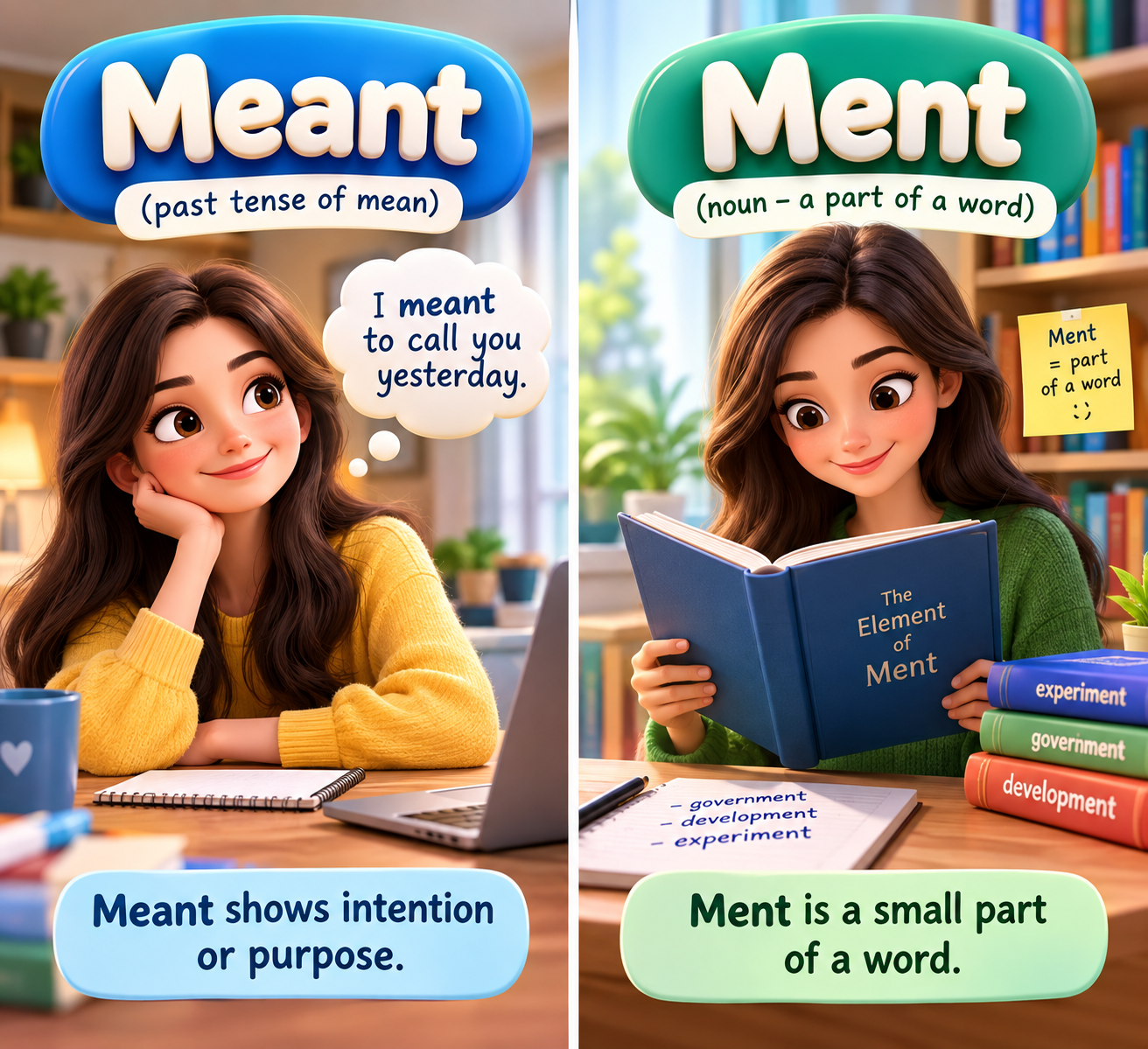
Meant is the correct spelling when you need the past tense or past participle of mean. Ment is not the standard spelling of this verb.
I remember writing sentences with meant and suddenly stopping to wonder whether I had spelled it correctly. The word meant sounds almost exactly like “ment” when I say it, so I used to understand why the spelling could be confusing. That small a is easy to overlook, especially when I am typing quickly.
I have made this kind of mistake in everyday writing too. While sending a quick message or writing an email, I have sometimes typed ment and then gone back to check it. It is one of those tiny spelling doubts that can make you pause, even when you know what the word means.
What helped me was learning the simple grammar pattern behind the word. Meant is the past tense and past participle of mean. I use it when I am talking about something I intended, expressed, or considered important. Once I connected the spelling with the verb mean, it became much easier for me to remember meant and avoid writing ment.
Meant or Ment Quick Answer
If you are choosing between meant and ment, use meant when you are talking about the past form of mean.
The basic verb pattern is:
mean → meant → meant
For example:
- I mean what I say.
- I meant what I said.
- I have meant every word.
Here, meant works as both the simple past form and the past participle.
Consider another example:
She meant to send the file yesterday.
The word meant shows that her intention existed in the past.
By contrast, ment is normally a spelling error when someone is trying to write the past form of mean.
So remember:
Correct: I meant to tell you.
Incorrect: I ment to tell you.
Cambridge also gives /ment/ as the pronunciation of meant. That pronunciation helps explain why the incorrect spelling can feel natural.
The Origin and Background of Meant
The story becomes more interesting when you look at etymology, the study
| Aspect | Personal Experience |
|---|---|
| The confusion | I remember writing sentences with meant and suddenly stopping to wonder whether I had spelled it correctly. |
| Why I hesitated | Meant sounds almost exactly like “ment” when I say it, so I found the spelling easy to question. |
| The spelling issue | The a in meant is easy to overlook, especially when I am typing quickly. |
| My everyday experience | While sending a quick message or writing an email, I have sometimes typed ment and then gone back to check it. |
| What helped me | I learned the simple grammar pattern behind the word and connected meant with the verb mean. |
| The grammar rule | Meant is the past tense and past participle of mean. |
| How I remember it | I remind myself: mean → meant → meant. This makes it easier for me to avoid writing ment. |
.
Meant Explained: Key Meanings and Uses
The word meant has more than one common use. The surrounding sentence tells you which meaning applies.
| Term | Meaning | When to Use | Region/Context |
| mean | Express or intend | Present or base form | Standard English |
| meant | Expressed or intended in the past | Past tense | Standard English |
| meant | Used after have, has, or had | Past participle | Standard English |
| ment | Not the standard past form of mean | Avoid in this use | Common spelling error |
1. Meant can show past intention
Use meant when someone intended to do something.
I meant to reply sooner.
Daniel meant to bring the documents.
In both sentences, the intention happened in the past.
2. Meant can show what something expressed
The word can also describe the meaning or message of something.
The warning meant that the road was closed.
Her silence meant more than an answer.
Here, meant is not about a person’s plan. It describes what something signified.
3. Meant can show importance
Mean can also describe emotional value or importance.
Her kind words meant a lot to him.
The past form is still meant.
4. Meant can describe purpose
You will often see meant for when something has a particular purpose or intended user.
This guide was meant for new learners.
The room was meant for private meetings.
Cambridge includes be meant to among the common grammatical patterns connected with mean.
Which Version Should You Use?
The choice is actually easier than it first appears.
For students
Use meant whenever you need the past form of mean.
A useful study pattern is:
mean — meant — meant
Learn all three forms together.
For professional writing
Use meant in emails, reports, applications, essays, and other formal documents.
For example:
I meant to attach the revised document to my previous email.
For casual messages
The same spelling rule applies.
You might write:
Sorry, I meant Tuesday, not Thursday.
Even in informal writing, ment is not the standard past spelling of mean.
For global English
If you want a form that works across major varieties of English, choose meant.
There is no need to switch between meant and ment based on country or region.
Common Mistakes with Meant
Here are some mistakes worth watching for.
Mistake 1: Writing “ment”
❌ I ment to call you.
✅ I meant to call you.
The incorrect version usually comes from pronunciation. The word sounds like ment, but the spelling retains ea.
Mistake 2: Using “meant” after “did”
❌ What did you meant?
✅ What did you mean?
After did, use the base verb mean.
The auxiliary did already carries the past tense.
Mistake 3: Using “meant” after “didn’t”
❌ I didn’t meant to hurt anyone.
✅ I didn’t mean to hurt anyone.
The same rule applies after didn’t.
Mistake 4: Treating “meant” like a regular verb
❌ I meaned what I said.
✅ I meant what I said.
Mean is an irregular verb, so its past form is meant, not meaned.
Mistake 5: Confusing “mean” with “meant”
❌ Yesterday, I mean something different.
✅ Yesterday, I meant something different.
Use mean for the base or present form. Use meant when the verb refers to the past.
Meant in Real-World Examples
Seeing the word in different settings can make the rule easier to remember.
Professional email
I meant to include the updated invoice with my last email. I have attached it here.
News-style writing
The unexpected delay meant that several services opened later than planned.
Social media post
I meant every word in that thank you message. Your support really helped me.
Formal report
The change in procedure meant that staff members needed additional training.
Notice that the spelling stays the same in every setting.
The word does not become ment because the sentence is casual, professional, academic, or formal.
Meant Data, Trends & Usage
There is an important difference between word frequency data and search-volume data.
Exact monthly search figures for “meant or ment” are not publicly available from the authoritative dictionary sources used here. Without access to a current Ahrefs, Semrush, or Google Keyword Planner account with the relevant database, giving a precise monthly number would be misleading.
Google Trends can be used to compare search interest, but its public interface provides relative interest, not a fixed count of searches.
For written-language frequency, Google Books Ngram Viewer is another useful tool. It measures how often words and phrases occur in its book corpus and allows comparisons across years and language collections. Google explains that its current Ngram system includes an updated dataset and normalized corpus data.
For this topic, the clearest usage insight is not a questionable search-volume estimate. It is grammatical:
- Meant is an established English verb form.
- Ment is not the standard past form of mean.
- The pronunciation of meant is /ment/, which helps explain the spelling confusion.
- The search intent behind “meant or ment” is primarily informational. People are usually trying to confirm spelling, meaning, or grammar.
This also explains why spelling questions remain useful for students, ESL learners, and anyone writing quickly with grammar or spell-check tools.
Meant vs. Ment: A Simple Comparison
| Term/Variant | Meaning | Region/Context | Best Used When |
| meant | Past form of mean | All standard English varieties | Talking about past intention or meaning |
| mean | Base/present form of mean | All standard English varieties | Talking about the present or after did |
| meant | Past participle of mean | All standard English varieties | Used with have, has, or had |
| ment | Not the standard past form of mean | Nonstandard spelling in this context | Avoid when you mean meant |
The extra row for mean matters because many errors are not simply meant versus ment. Writers also use meant where grammar requires mean, especially after did.
FAQ: Meant or Ment
Q: What does meant mean?
A: Meant is the past tense and past participle of mean. It can describe something someone intended, expressed, signified, or considered important.
Q: Is ment a correct spelling of meant?
A: No, not when you are using the past form of mean. Standard English uses meant.
Q: How do you use meant correctly?
A: Use meant for a past situation involving mean. For example, you can say, “She meant to help,” when the intention existed in the past.
Q: Why does meant sound like ment?
A: The pronunciation of meant is /ment/, so the a is not clearly heard. Cambridge lists this pronunciation for both British and American English.
Q: Should I write “I ment to call”?
A: No. Write “I meant to call.” The correct spelling contains ea.
Q: Is meant acceptable in formal writing?
A: Yes. Meant is the standard past form of mean and is suitable for formal and informal writing alike.
Q: Where does meant come from?
A: It comes from the verb mean, which has roots in Old English and Middle English. Etymonline connects Old English mænan with ideas such as intending, planning, and conveying a sense.
Q: Is “meant to” correct?
A: Yes. Meant to is a common construction used to describe something that was intended or expected. Cambridge lists be meant to as a standard grammatical pattern.
Q: Which is correct: “What did you mean?” or “What did you meant?”
A: “What did you mean?” is correct. After did, use the base verb mean, not the past form meant.
Conclusion
The choice between meant and ment looks harder than it really is.
When you need the past tense or past participle of mean, the correct spelling is meant. The form ment is normally a spelling mistake in this context. Cambridge confirms that meant is the past simple and past participle of mean.
There is one more rule worth keeping close. After did or didn’t, use mean, not meant. So write “What did you mean?” rather than “What did you meant?”
The spelling becomes much easier when you learn the complete verb pattern:
mean → meant → meant
Remember that the pronunciation can sound like ment, but the written word keeps the a.
Once this pattern becomes familiar, you will be much less likely to pause over this common spelling question.
Bookmark this guide so you never have to second-guess “meant” again.
Read More:
Camouflage or camoflage: The Complete Guide to Correct Spelling and Usage

I’m Daniel sultan, an English language writer and SEO content specialist with experience researching spelling, grammar, vocabulary, and English usage. Through SpellComparison.com, I create clear, accurate, and well-researched guides that help readers understand commonly confused words, spelling differences, and grammar rules with confidence.
Every article I write is based on trusted language references, established style guides, and real-world usage to ensure it is accurate, practical, and easy to understand. My goal is to make learning English simple and reliable by providing fact-checked content, clear explanations, and real-life examples that students, writers, educators, and professionals can trust.










