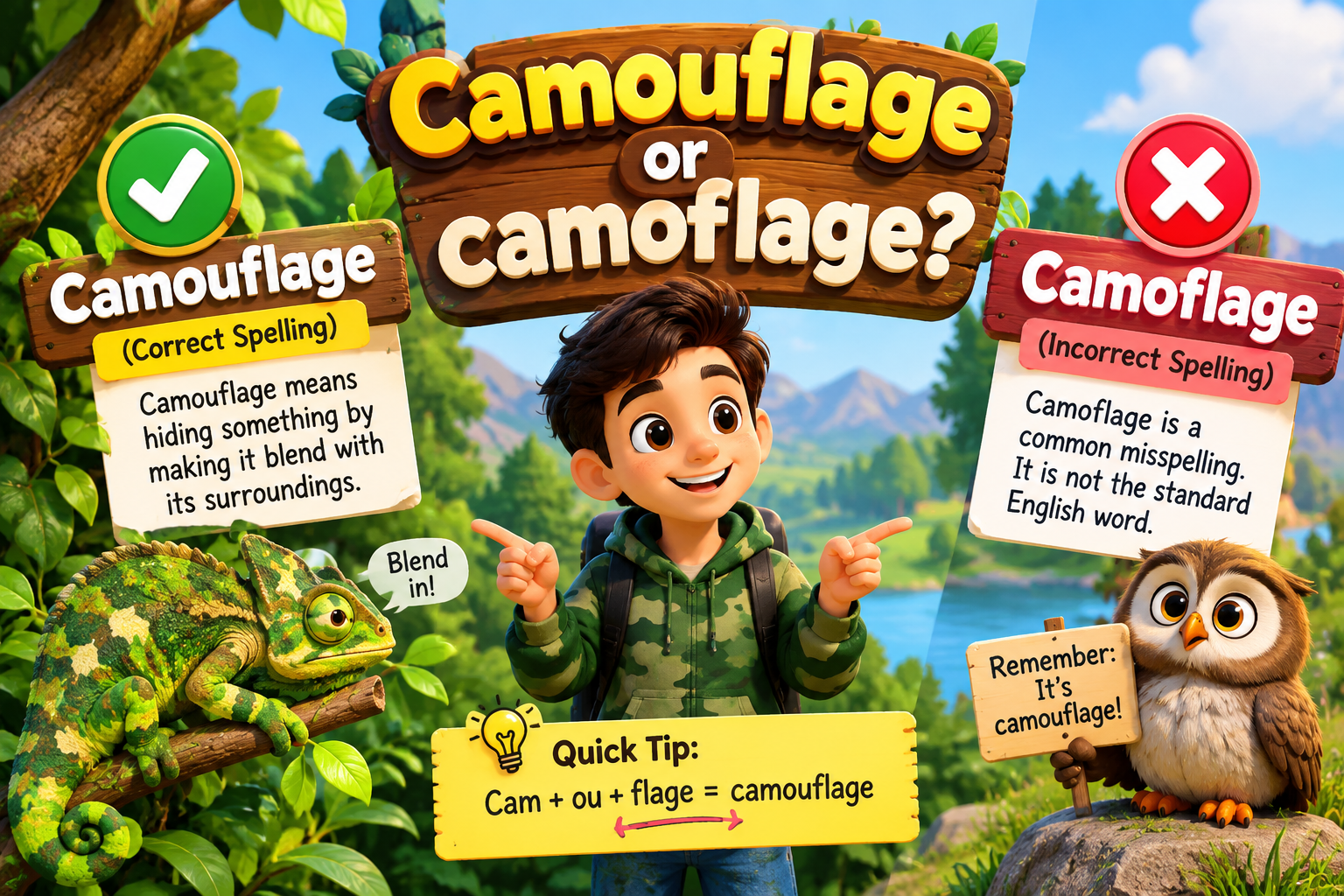
Camouflage is the correct spelling. It means hiding a person, animal, object, or idea by making it difficult to notice or recognize; camoflage is a common misspelling.
Have you ever typed a word, looked at it, and suddenly thought, “That spelling looks wrong”?
Camouflage is one of those words.
I have seen learners write camoflage because that version seems easier to pronounce. The problem is that English spelling does not always follow the way a word sounds. This is especially true with words borrowed from other languages.
That makes camouflage easy to misspell. The letters -ouflage do not look or sound simple to many English learners.
If you are writing a school answer, email, report, article, or exam response, the choice is simple: use camouflage. The spelling camoflage is not the standard English form.
This guide explains the meaning, spelling, pronunciation, history, grammar, and everyday use of camouflage. You will also see common mistakes, fresh examples, and a simple comparison with related words such as disguise, conceal, and camo.
By the end, you should be able to use the word with confidence.
Camouflage Quick Answer
Camouflage is both a noun and a verb.
As a noun, it means a way of hiding something by making it blend with its surroundings. Cambridge gives examples involving military clothing, animals, plants, and even hidden meanings.
As a verb, to camouflage means to hide something by changing its appearance or making it harder to notice.
For example:
- The bird’s feathers provide excellent camouflage.
- The designer used dark shapes to camouflage the equipment.
The key spelling point is easy:
Correct: camouflage
Incorrect: camoflage
The missing u and a make camoflage a common spelling error.
The Origin / Background of Camouflage
The story behind camouflage is more interesting than its spelling suggests.
According to Etymonline, the English word appeared in 1917. It came from French camoufler, meaning “to disguise,” which is linked to Italian camuffare, also meaning “to disguise.” The deeper origin is uncertain.
The word became especially useful during World War I, when armies needed ways to hide soldiers, guns, trains, and other equipment from observation.
Dictionary.com also records the word as entering English around 1915–1920 and traces it to French.
So camouflage is not an Old English or Middle English word. It is a relatively modern borrowing.
That matters because English has borrowed thousands of words from other languages. Their spelling often keeps clues from the original language.
Why is camouflage so easy to misspell?
Pronunciation is one reason.
The word is commonly pronounced roughly like:
KAM-uh-flahzh
The spelling contains letters that are not obvious from the sound.
Learners may therefore write:
- camoflage
- camoflauge
- camouflage ← correct
The word also contains a French-looking spelling pattern. That can make it harder to remember than simpler words such as hide or cover.
Camouflage Explained Key Differences and Variations
The main word is camouflage, but several related forms are useful.
| Term | Meaning | When to Use | Region/Context |
| camouflage | Something that hides or disguises | General English | Global standard English |
| camouflaged | Hidden or disguised | Describing something already hidden | Formal and everyday English |
| camouflaging | The act of hiding or disguising | Ongoing action | Standard English |
| camouflages | Hides or disguises | Third-person singular verb | Standard English |
| camo | Short form of camouflage | Informal speech and writing | Common in casual English |
Cambridge lists camo as an informal noun and adjective. It can describe clothing with a military-style pattern.
For formal writing, camouflage is usually the safer choice.
Camouflage as a noun
You can use it for physical hiding:
The insect uses camouflage to avoid predators.
You can also use it in a figurative sense:
Humor became a camouflage for his nervousness.
The idea is the same: something is made harder to notice or understand.
Camouflage as a verb
The verb describes the action:
Thick curtains camouflaged the storage area.
The verb can also be figurative:
The extra details camouflaged the main problem.
Cambridge recognizes both physical and figurative uses of the verb.
Which Version Should You Use?
If you are deciding between camouflage and camoflage, use camouflage.
There is no standard English rule that makes camoflage an acceptable alternative spelling.
For students
Use camouflage in:
- exams
- essays
- homework
- presentations
- school projects
It is the standard dictionary spelling.
For professional writers
Choose camouflage in reports, articles, emails, and other formal work.
If you need a shorter informal word, camo may work in a casual context. Cambridge labels it informal.
For global English
Camouflage is the clearest choice because it is the standard form across English-language dictionaries and is understood internationally.
A useful memory trick is:
CAM + OU + FLAGE = CAMOUFLAGE
Do not remove the u.
Common Mistakes with Camouflage
1. Mistake: camoflage
Wrong: The soldiers wore camoflage uniforms.
Correct: The soldiers wore camouflage uniforms.
Why it happens: The missing letters are easy to overlook when writing from memory.
2. Mistake: camoflauge
Wrong: The animal has natural camoflauge.
Correct: The animal has natural camouflage.
Why it happens: Writers sometimes move the u and a because of the word’s unusual spelling.
3. Mistake: using “camo” in formal writing
Casual: He bought a new camo jacket.
Formal: He bought a new camouflage jacket.
Why it happens: Camo is widely used in everyday speech, but it is informal.
4. Mistake: using camouflage only for soldiers
Camouflage is not limited to military situations.
Animals can use camouflage. Plants can blend into their surroundings. People can even use the word for an idea or behavior that hides something else. Cambridge records these broader uses.
5. Mistake: confusing camouflage with disguise
The two words are close, but they are not always interchangeable.
A disguise often changes someone’s appearance or identity.
Camouflage usually makes something blend into its surroundings or hides its presence.
Camouflage in Real World Examples
Here are fresh examples showing how the word works in different types of writing.
Professional email
We may need to change the background color because the current design does not provide enough camouflage for the equipment.
News-style headline
Natural Camouflage Helps Desert Species Avoid Detection
Social media post
Nature never stops surprising me. This tiny creature’s camouflage is almost impossible to spot!
Formal report
The study found that the species’ coloring provides effective camouflage in dry grassland environments.
Everyday conversation
I almost missed the cat because its fur gave it excellent camouflage against the wall.
Notice how the word can describe animals, objects, designs, and abstract ideas. Its meaning depends on the context.
Camouflage Data, Trends & Usage
There is a useful lesson in the search behavior around this word: spelling questions often arise because people know the word when they hear it but are unsure how to write it.
However, exact current monthly search volumes for “camouflage” and “camoflage” require access to a live SEO platform such as Ahrefs, Semrush, or Google Keyword Planner. Public web results do not provide a reliable current figure, so it would be misleading to invent a number.
The same caution applies to a precise Google Trends regional ranking. Search interest changes over time and depends on the selected country, date range, and search type.
What can be verified is the language data:
- Camouflage is a standard dictionary entry.
- Camoflage is not the standard spelling.
- Camo is an established informal shortening.
- Dictionary sources show camouflage functioning as both a noun and a verb.
- The word is used beyond military contexts, including animals, plants, design, and figurative writing.
What does this mean for learners?
The spelling issue matters because spell-check tools and AI writing tools do not replace vocabulary knowledge.
If you type camoflage, a writing tool may correct it. But knowing the correct spelling helps you write faster and spot mistakes before submitting your work.
The likely search intent behind “camouflage or camoflage” is therefore simple and informational: the reader wants to know which spelling is correct.
The answer is camouflage.
Standalone Comparison Table
| Term/Variant | Meaning | Region/Context | Best Used When |
| camouflage | Hide or blend into surroundings | Standard English | Essays, reports, speech, everyday writing |
| camouflaged | Already hidden or disguised | Standard English | Describing a hidden object or person |
| camouflaging | Hiding something now | Standard English | Describing an ongoing action |
| camo | Informal short form | Casual English | Conversation, fashion, informal posts |
| disguise | Change appearance to hide identity or purpose | General English | People, identities, intentions |
| conceal | Keep something from being seen or known | Often formal | Reports, explanations, formal writing |
The table shows why these words should not be treated as exact synonyms.
For example, you can conceal a document in a drawer. You can disguise a person’s identity. You can use camouflage to make an object blend into its surroundings.
FAQ: Camouflage or Camoflage?
Q: What does camouflage mean?
A: Camouflage means hiding something by making it difficult to see, recognize, or notice. It can describe physical appearance as well as a figurative way of hiding a truth or idea.
Q: How do you use camouflage correctly?
A: You can use camouflage as a noun or a verb. For example, a bird may have natural camouflage, while a person may camouflage an object by changing its appearance.
Q: Camouflage vs. disguise — what is the difference?
A: A disguise usually changes how someone or something appears so its identity is hidden. Camouflage focuses more on blending in, reducing visibility, or hiding something from view.
Q: Is camouflage acceptable in formal writing?
A: Yes. Camouflage is the standard spelling and is suitable for academic, professional, and formal writing. Camo, by contrast, is informal.
Q: Which spelling is correct: camouflage or camoflage?
A: Camouflage is correct. Camoflage is a misspelling and should be avoided in standard English.
Q: Where does camouflage come from?
A: The English word dates to the early 20th century. Etymonline traces it to French camoufler, with a connection to Italian camuffare; the deeper origin is uncertain.
Q: Can camouflage be used outside military contexts?
A: Yes. The word is common in discussions of animals, plants, fashion, design, and figurative language. Cambridge includes both natural and non-military uses.
Conclusion
The spelling question has a simple answer: camouflage is the correct standard English form, while camoflage is a spelling error.
Remember three things.
First, camouflage can be a noun or a verb. You can talk about an animal’s camouflage or say that something was camouflaged.
Second, the word has a broader meaning than military clothing. It can describe natural patterns, hidden objects, visual design, and even ideas that hide something else.
Third, camo is a real English word, but it is an informal shortening. Use the full word when you want a safe choice for school, work, or formal writing.
If the spelling keeps slipping your mind, remember this simple pattern:
cam + ou + flage = camouflage
You now have the spelling, meaning, grammar, history, and usage covered.
Bookmark this guide so you never have to second-guess “camouflage” again.
Readmore
Nor vs Or: The Easy Grammar Rule

I’m an English language educator and SEO content writer having experience creating clear, accurate, and engaging English learning content. I specialize in spelling differences, grammar, vocabulary, synonyms, commonly confused words, and English usage. My goal is to publish well-researched, easy-to-understand articles that help students, writers, educators, and professionals improve their English with confidence through practical explanations and real-world examples.