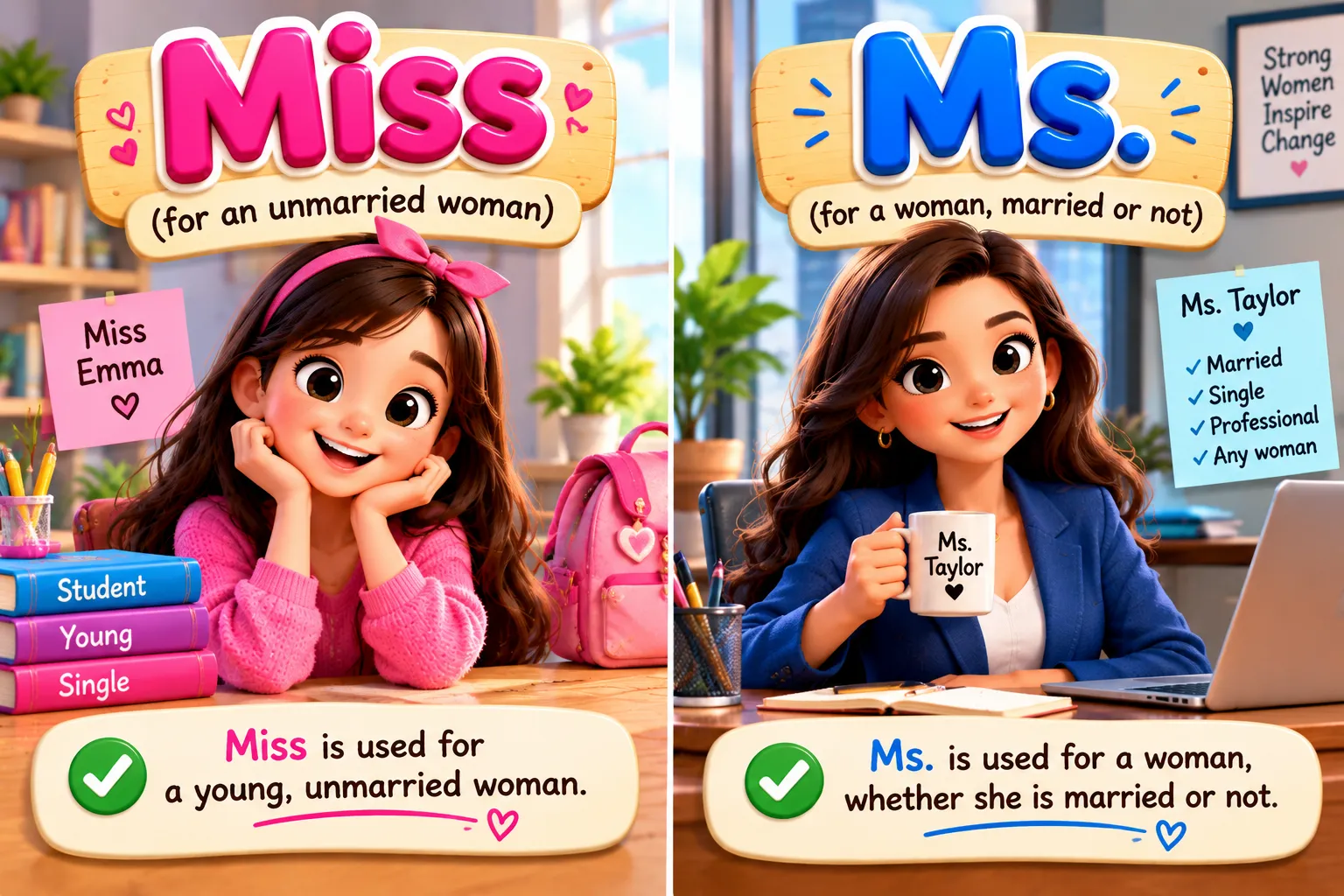
Miss traditionally refers to an unmarried woman or girl, while Ms is a title for a woman that does not state whether she is married.
I have seen people hesitate over Miss and Ms many times when writing emails, letters, invitations, and formal documents. The difference looks tiny, but choosing the right title can feel surprisingly difficult. The problem becomes even clearer when you do not know a woman’s marital status.
For years, English has used titles such as Miss, Mrs, and Ms before a woman’s name. Each one carries a slightly different meaning or social use. That can make a simple greeting feel like a small language test.
I have also noticed that learners sometimes assume Ms is simply a shorter version of Miss. It is not. The two titles have different purposes, and their pronunciations are different too.
Miss is traditionally linked with an unmarried woman or girl. Ms, pronounced roughly like “miz,” avoids stating whether a woman is married. Cambridge Dictionary describes Ms as a title used before a woman’s name when her marital status is not stated.
So, which one should you use?
The answer depends on the person, the context, and what you know about her preferred title.
Miss or Ms Quick Answer
Miss and Ms are both titles placed before a woman’s name, but they do not communicate exactly the same information.
Miss traditionally identifies a woman who is unmarried. Cambridge Dictionary defines it as a title used before the name of a single woman who has no other title.
Ms, however, does not reveal marital status. It can be used whether a woman is married or unmarried.
For example:
Miss Carter will meet you at the reception desk.
This traditionally suggests that Carter is unmarried.
Compare:
Ms Carter will meet you at the reception desk.
This does not tell the reader whether Carter is married.
The pronunciation is different as well:
- Miss → /mɪs/
- Ms → /məz/ or /mɪz/
Cambridge gives both pronunciations for Ms.
The Origin and Background of Miss and Ms
The history of Miss goes back to the older title mistress.
Etymonline traces Miss as a title to the 17th century. It developed as a shortened form of mistress and later became associated with a young, unmarried woman.
This historical connection is important because mistress once had a much broader meaning than it often has today.
Over time, English developed separate forms for women based partly on marital status:
- Miss for an unmarried woman
- Mrs for a married woman
- Ms without specifying marital status
The modern story of Ms is especially interesting.
Smithsonian reports that Ms had appeared in print by at least 1901, but it did not become widely established for decades. Activist Sheila Michaels helped bring attention to the title in the 1960s, and the launch of Ms. magazine in the early 1970s helped make the form much more familiar.
The title was designed to give women an option that did not identify them through marriage.
That is the key idea behind Ms.
Why the distinction matters
Titles are not just grammar.
They can also communicate social information.
Miss tells the reader something traditionally associated with marital status. Ms avoids making that information part of the title.
Cambridge Grammar notes that Ms does not indicate whether a woman is married, while Miss traditionally indicates that she is not married.
Miss vs. Ms: Key Differences
Here is the simplest comparison.
| Term | Meaning | When to Use | Region/Context |
| Miss | Traditional title for an unmarried woman or girl | When the woman uses or prefers Miss | General English |
| Ms | Title that does not state marital status | When marital status is unknown, irrelevant, or the woman prefers Ms | General English |
| Mrs | Traditional title for a married woman | When the woman uses or prefers Mrs | General English |
| Mr | Title traditionally used for a man | Before a man’s name | General English |
When to use Miss
Use Miss when:
- a woman is unmarried and uses this title
- a girl or young woman is being addressed in a context where Miss is traditional
- the person specifically asks to be called Miss
- the title is part of an established name or formal role
For example:
“Please ask Miss Adams to come into the office.”
In some contexts, especially schools, Miss is also used when addressing a female teacher. Cambridge notes that children in the UK sometimes use Miss when speaking to or referring to women teachers.
When to use Ms
Ms is often the safest choice when you do not know a woman’s preferred title or marital status.
For example:
“Dear Ms Khan, thank you for contacting our office.”
You are not making an assumption about whether Khan is married.
Cambridge specifically defines Ms as a title that avoids stating marital status.
Which Version Should You Use?
The best choice depends on the situation.
If the woman prefers Miss
Use Miss.
A person’s stated preference should come before a general language rule.
If you do not know her marital status
Ms is usually a sensible professional choice.
It avoids making an unnecessary assumption.
If she has told you to use Ms
Use Ms, regardless of whether you know she is married.
The title reflects her preference.
If you are writing a formal business email
Ms is often a practical default when you do not know the recipient’s preferred title.
For example:
Dear Ms Ahmed,
This is neutral and professional.
If you are writing to someone who has a professional title
You may not need either Miss or Ms.
If the person is a doctor, professor, judge, or another professional with a relevant title, use that title when appropriate.
For example:
Dear Dr Wilson,
There is no need to write Ms Dr Wilson.
Common Mistakes with Miss and Ms
1. Assuming Ms means unmarried
Incorrect idea:
“Ms means the woman is single.”
Better understanding:
Ms does not reveal marital status.
That is one of its main purposes.
2. Treating Ms and Miss as the same pronunciation
They are not normally pronounced the same.
Miss sounds like mis.
Ms is commonly pronounced miz or məz.
3. Assuming every unmarried woman wants Miss
Marital status does not automatically tell you which title someone prefers.
A woman can be unmarried and still prefer Ms.
4. Assuming every married woman wants Mrs
The same principle applies to married women.
A married woman may prefer Ms rather than Mrs. Cambridge explicitly notes that some married women choose Ms.
5. Writing Ms when the person has another professional title
If someone uses Dr, for example, writing Ms Dr Patel is unnecessary.
Use the relevant professional title instead.
Miss or Ms in Real-World Examples
Professional email
Dear Ms Rahman,
Thank you for your message. We have reviewed the information you provided.
Here, Ms keeps the greeting professional without making a statement about marital status.
News article
Miss Taylor won the national beauty competition on Saturday.
Miss may appear as part of a pageant title, where it is traditionally built into the name of the competition.
Cambridge notes that Miss can be used as part of titles such as Miss World or Miss America.
Social media post
Congratulations to Ms Lee on her new role as director of the organization!
The writer uses Ms without giving information about Lee’s marital status.
Formal document
The application was submitted by Ms Nadia Khan on 14 September.
The title identifies the person without adding marital-status information.
School setting
“May I speak to Miss, please?”
In some British school contexts, pupils traditionally use Miss when addressing a female teacher.
Miss or Ms: Data, Trends & Usage
Exact monthly search-volume figures for “miss or ms” require live keyword data from tools such as Ahrefs, Semrush, or Google Ads. Those figures vary by location and change over time, so unsupported numbers would be misleading.
There is stronger historical evidence for the growing role of Ms.
Smithsonian reports that the title existed in print by at least 1901, but remained relatively obscure for many years. Sheila Michaels helped popularize it in the 1960s, while Ms. magazine brought the form into much wider public attention after its first regular issue in 1972.
Cambridge’s current grammar guidance also treats Ms as an established title and explains that it does not indicate marital status.
Search intent
The search intent for “Miss or Ms” is mainly informational.
People usually want to know:
- whether Miss or Ms is correct
- what Ms means
- how Ms is pronounced
- whether Ms means married or unmarried
- when to use Miss
- whether Ms is formal
- whether a married woman can use Ms
This topic is especially useful for English learners, students, job seekers, office workers, and anyone writing formal correspondence.
Why the topic still matters
Names appear everywhere.
You may need to address someone in a job application, email, invitation, business letter, school document, or official form. A small title choice can affect how respectful and professional the message feels.
The good news is that the modern rule is simple: do not guess a person’s preferred title when you can avoid doing so.
Miss, Ms, and Mrs: A Useful Three-Way Comparison
| Term/Variant | Meaning | Region/Context | Best Used When |
| Miss | Traditionally an unmarried woman or girl | General English | The person uses Miss or the context calls for it |
| Ms | Woman’s title without stating marital status | General English | Marital status is unknown, irrelevant, or the person prefers Ms |
| Mrs | Traditionally a married woman | General English | The person uses Mrs |
| Miss + place | Pageant title | Competitions | Referring to titles such as Miss World |
| Miss + teacher | Traditional form of address | Especially some UK school settings | Speaking to or referring to a female teacher |
This comparison shows why Ms is not simply a shorter version of Miss.
Each title has its own role.
Miss vs. Ms in Formal Writing
If you are writing a formal letter or email and you do not know the woman’s preferred title, Ms is often the safest neutral choice.
For example:
Dear Ms Williams,
This avoids guessing about marital status.
If you know that the recipient prefers Miss, then use Miss.
Dear Miss Williams,
The most respectful approach is to follow the person’s own stated preference whenever you know it.
What about a job application?
A job application is a good example of where Ms can be useful.
You may know the hiring manager’s name but know nothing about their personal life. There is no need to make marital status part of your greeting.
Dear Ms Morgan,
is therefore a straightforward professional option.
What Does Ms Actually Mean?
Many learners ask whether Ms stands for a longer word.
In modern English, it functions as an independent title. It is not simply another spelling of Miss.
The important feature is its neutrality regarding marital status.
Cambridge lists the title as Ms and gives pronunciations including /məz/ and /mɪz/.
That makes it different from:
- Miss → traditionally unmarried
- Mrs → traditionally married
- Ms → marital status not stated
You may also see a period in American writing:
Ms. Johnson
In many styles, especially British English, the form appears without a period:
Ms Johnson
The choice of punctuation can depend on the style guide being followed. The title itself remains Ms.
Frequently Asked Questions
Q: Is Ms for married or unmarried women?
A: Ms can be used for either. The title deliberately avoids stating whether a woman is married.
Q: What is the difference between Miss and Ms?
A: Miss traditionally identifies an unmarried woman or girl. Ms does not communicate marital status.
Q: How do you pronounce Ms?
A: It is commonly pronounced “miz” or with a similar unstressed vowel sound. Cambridge lists /məz/ and /mɪz/.
Q: Can a married woman use Ms?
A: Yes. A married woman may choose Ms. The title is not restricted to unmarried women.
Q: Is Ms more formal than Miss?
A: Both can be formal. Ms is often useful in professional settings because it does not require you to identify or assume the woman’s marital status.
Q: Where did Miss come from?
A: Miss developed as a shortened form of mistress in the 17th century and later became associated with young or unmarried women.
Q: Can I use Ms if I do not know whether a woman is married?
A: Yes. This is one of the main situations where Ms is useful. It lets you address the woman respectfully without making an assumption about her marital status.
Conclusion
Choosing between Miss and Ms does not have to be difficult.
The traditional distinction is simple. Miss is associated with an unmarried woman or girl, while Ms leaves marital status unstated. Cambridge confirms this difference in its current dictionary and grammar guidance.
The biggest lesson is that Ms is not just a shorter form of Miss. It serves a different purpose. It gives women a title that does not define them by whether they are married.
If someone tells you which title they prefer, follow that preference. When you are writing a professional message and do not know the person’s preference, Ms is often a practical and respectful choice.
Remember these three forms:
- Miss → traditionally unmarried
- Ms → marital status not stated
- Mrs → traditionally married
Once you understand that distinction, choosing the right title becomes much easier.
Bookmark this guide so you can quickly check the difference whenever you are writing a formal email, letter, or document.
Read More:
Complement or Compliment: The Easy Difference Guide

I’m an English language educator and SEO content writer having experience creating clear, accurate, and engaging English learning content. I specialize in spelling differences, grammar, vocabulary, synonyms, commonly confused words, and English usage. My goal is to publish well-researched, easy-to-understand articles that help students, writers, educators, and professionals improve their English with confidence through practical explanations and real-world examples.