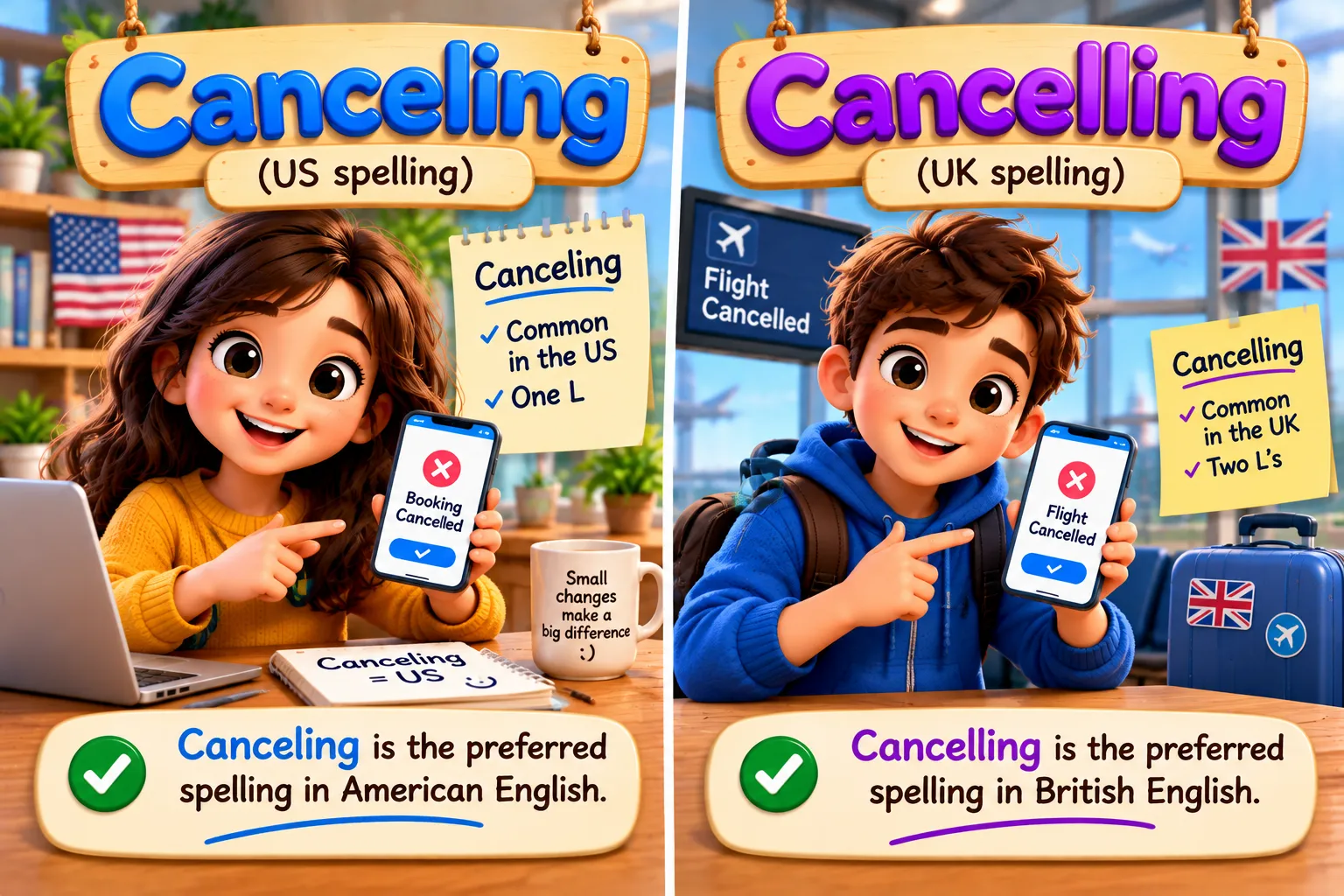
Canceling is the usual American English spelling, while cancelling is the standard British English spelling. Both mean the same thing.
I have often seen writers pause over this word when checking an email or editing an article. They type canceling, then wonder whether that extra l should be there. A moment later, they change it to cancelling and still feel unsure.
I understand the confusion because both spellings look natural. You may see canceling on an American website and cancelling in a British newspaper. Neither one is automatically wrong.
The difference comes mainly from regional spelling conventions. American English usually keeps one l before -ing, while British English usually doubles it. The same pattern appears in related forms such as canceled/cancelled, traveling/travelling, and modeling/modelling.
Once you know which variety of English you are using, the choice becomes much easier. Let’s look at the difference, the history behind it, common mistakes, and the best spelling for your audience.
Canceling or Cancelling Quick Answer
Canceling and cancelling are both correct spellings of the present participle of cancel.
The main difference is regional:
- Canceling → usually American English
- Cancelling → standard British English
For example:
- US: The airline is canceling several flights.
- UK: The airline is cancelling several flights.
The meaning does not change. In both sentences, the word means that the flights are being called off.
Cambridge lists cancelling as the present participle of cancel. Its main entry for cancel also shows the spelling distinction as -ll- or US usually -l-.
A simple rule
🇺🇸 American English → canceling
🇬🇧 British English → cancelling
That is the key difference.
The Origin and Background of Cancel
The word cancel has a much older history than its modern spelling debate suggests.
According to Etymonline, cancel entered English in the late 14th century. It came through Anglo-French and Old French from Latin cancellare, meaning to make something like a lattice. In Late Latin, it developed the sense of crossing out writing with lines.
That original idea is easy to connect with the modern meaning.
When you cancel something, you effectively cross it out or make it no longer valid.
By the mid-15th century, cancel had developed the figurative meaning of making an obligation or arrangement invalid.
The noun cancellation appeared in English in the 1530s. Etymonline also records the spelling cancelation, but cancellation is now the familiar standard form.
The spelling difference between canceling and cancelling developed as American and British English followed different conventions for doubling a final l.
A useful comparison is:
- American English: canceling
- British English: cancelling
This is part of a wider pattern in English orthography.
Canceling vs. Cancelling: Key Differences
The two forms have the same grammatical role and meaning. The spelling changes according to the English variety.
| Term | Meaning | When to Use | Region/Context |
| Canceling | Stopping something that was planned | Use with US spelling | American English |
| Cancelling | Stopping something that was planned | Use with UK spelling | British English |
| Canceled | Past form of cancel | Use with US spelling | American English |
| Cancelled | Past form of cancel | Use with UK spelling | British English |
| Cancellation | The act of stopping something | Common standard noun | Both varieties |
Cambridge defines cancel as deciding that an arranged event will not happen or stopping an order for goods or services. It also lists cancelled and canceled in its examples.
Canceling in American English
American English generally uses one l:
- canceling
- canceled
- canceler
Examples:
I am canceling my appointment.
The company is canceling the subscription.
Cancelling in British English
British English generally doubles the l:
- cancelling
- cancelled
- canceller
Examples:
She is cancelling her booking.
They are cancelling the event.
The spelling does not change the pronunciation or basic meaning.
Which Version Should You Use?
The best choice depends on your audience.
If you write for Americans
Choose canceling.
This is the natural choice for US-focused websites, schoolwork, business writing, and publications.
For example:
We are canceling the meeting scheduled for Friday.
If you write for British readers
Choose cancelling.
It fits British spelling conventions and is also common in other varieties influenced by British English.
For example:
We are cancelling the meeting scheduled for Friday.
If you write for a global audience
Pick one spelling system and stay consistent.
Do not randomly switch between American and British spelling in the same article. Consistency makes your writing look more polished.
If your website mainly uses color, center, traveling, and modeling, then canceling fits that style.
If it uses colour, centre, travelling, and modelling, then cancelling is the better match.
Common Mistakes With Canceling or Cancelling
1. Thinking one spelling is wrong
A common mistake is assuming that cancelling is misspelled because it has an extra l.
It is not.
Cancelling is standard British English.
Likewise, canceling is not a typo. It is the usual American form.
2. Mixing spelling styles
Avoid switching between regional forms without a reason.
For example:
❌ The company is cancelling the event, but the ticket was canceled.
This combines British and American forms.
For American English:
✅ The company is canceling the event, but the ticket was canceled.
For British English:
✅ The company is cancelling the event, but the ticket was cancelled.
3. Adding another L to cancel
The base verb is always:
cancel
Not:
❌ cancell
The extra l appears in forms such as cancelling and cancelled in British English.
4. Assuming cancellation follows the same simple pattern
This is where many learners get caught.
You might expect American English to use cancelation because it uses canceling.
However, cancellation with two ls is the standard and much more common form in both major varieties. Cambridge gives cancelation as a US variant in its Business English entry, but cancellation is the normal dictionary form.
5. Letting your spell checker choose for you
Your spell checker may be set to US or UK English.
If it marks one version as wrong, check your language settings before assuming the word itself is incorrect.
Canceling or Cancelling in Real-World Examples
The easiest way to understand the difference is to see how each form works in everyday writing.
Professional email
American English:
I am canceling our meeting because I have an unexpected appointment.
British English:
I am cancelling our meeting because I have an unexpected appointment.
News headline
American style:
Airline Is Canceling Several Flights After Severe Weather
British style:
Airline Is Cancelling Several Flights After Severe Weather
Social media
American style:
We are canceling tonight’s event because of the storm.
British style:
We are cancelling tonight’s event because of the storm.
Formal document
American style:
The customer is responsible for canceling the service before the renewal date.
British style:
The customer is responsible for cancelling the service before the renewal date.
The meaning stays the same in every example. Only the spelling convention changes.
Canceling or Cancelling Data, Trends & Usage
Usage data supports the idea that these spellings are strongly connected to regional English.
LanguageTool’s review of Google Ngram data notes that canceling is more common in American English, while cancelling is widely used and preferred in British English. Its comparison also shows that the same regional pattern appears in canceled/cancelled.
A corpus-based academic source gives a useful real-world example. In one study of British and American spelling items, cancelled/cancelling appeared more frequently than canceled/canceling in the British-oriented data. The table recorded 17 tokens for the British forms compared with 4 for the American forms in that sample.
These figures should not be treated as a current global percentage. They come from specific datasets and are useful for showing the regional pattern, not for predicting every reader’s preference.
What about search volume?
Exact monthly search-volume figures for canceling vs. cancelling vary by SEO platform, country, database, and date. Without a live Ahrefs, Semrush, or Google Ads keyword dataset, it would be misleading to invent a precise number.
The stronger SEO insight is regional intent.
People checking these spellings are usually trying to answer an informational language question. They may be writing:
- Emails
- School assignments
- Business documents
- Website content
- Reports
- Social media posts
That makes canceling or cancelling a useful topic for English learners and writers who work across American and British English.
Canceling vs. Cancelling: Standalone Comparison
| Term/Variant | Meaning | Region/Context | Best Used When |
| canceling | Stopping something | American English | Writing for a US audience |
| cancelling | Stopping something | British English | Writing for a UK audience |
| canceled | Past form of cancel | American English | Describing a completed cancellation |
| cancelled | Past form of cancel | British English | Describing a completed cancellation |
| cancellation | Act of canceling | US and UK | Formal, business, and general writing |
| cancelation | Variant noun spelling | Mainly US usage | Rare or specialized contexts |
The important point is that canceling and cancelling are not different words. They are different spellings of the same -ing form of cancel.
Related Words You May Also Confuse
Once you understand this pattern, several similar pairs become easier.
Traveling vs. travelling
- US: traveling
- UK: travelling
Modeling vs. modelling
- US: modeling
- UK: modelling
Labeling vs. labelling
- US: labeling
- UK: labelling
Signaling vs. signalling
- US: signaling
- UK: signalling
These examples follow the same broad American/British spelling difference involving a final l before an inflectional ending. A linguistic reference on American and British English lists canceling/canceled alongside travelling/travelled and modeling/modelled as examples of this systematic difference.
FAQs About Canceling or Cancelling
Q: What does canceling mean?
A: Canceling means stopping something that was planned, arranged, or ordered. It is the usual American English spelling of the present participle of cancel.
Q: Is canceling correct English?
A: Yes. Canceling is a standard spelling, especially in American English. It has the same meaning as cancelling.
Q: Is cancelling British English?
A: Yes. Cancelling is the standard British English spelling. Cambridge lists it as the present participle of cancel.
Q: Which is correct, canceling or cancelling?
A: Both are correct. Use canceling for American English and cancelling for British English.
Q: Are canceling and cancelling pronounced differently?
A: No. The extra l changes the spelling, not the basic pronunciation. The two forms carry the same meaning.
Q: Is cancellation spelled with one L or two?
A: Cancellation with two ls is the standard and familiar spelling in both American and British English. Cambridge also records cancelation as a US variant, but it is not the usual choice.
Q: Should I use canceling or cancelling in formal writing?
A: Either can work. Match the spelling to your chosen English variety and keep your style consistent throughout the document.
Conclusion
The choice between canceling and cancelling is much simpler once you know the regional rule.
Canceling is the usual American English spelling. Cancelling is the standard British English spelling. Both forms describe the same action and have the same pronunciation and meaning.
The difference also appears in related forms. American English usually prefers canceled, while British English generally uses cancelled. However, cancellation is normally written with two ls in both varieties.
The safest approach is to think about your reader first. If you are writing for an American audience, choose canceling. If your readers use British English, choose cancelling. For a global audience, pick one spelling system and apply it consistently.
You do not need to worry when you see the other version. It is not necessarily a spelling mistake. It simply reflects a different English convention.
Bookmark this guide so you never have to second-guess canceling or cancelling again.
Read More:
Miss or Ms: The Easy Guide to Choosing the Right Title

I specialize in English grammar, spelling, word choice, and language usage. My content is based on research from grammar references, style guides, dictionaries, and real-world usage to ensure it is accurate and practical.
At Spelling Comparison, I write guides that explain why words are confused, how they are used, and which form is correct in context. I also include proofreading tips, examples, and writing advice readers can apply immediately.
My goal is to publish clear, reliable content that helps readers make better writing decisions. Each guide is written for accuracy, clarity, and usefulness in school, work, business, and everyday communication.










