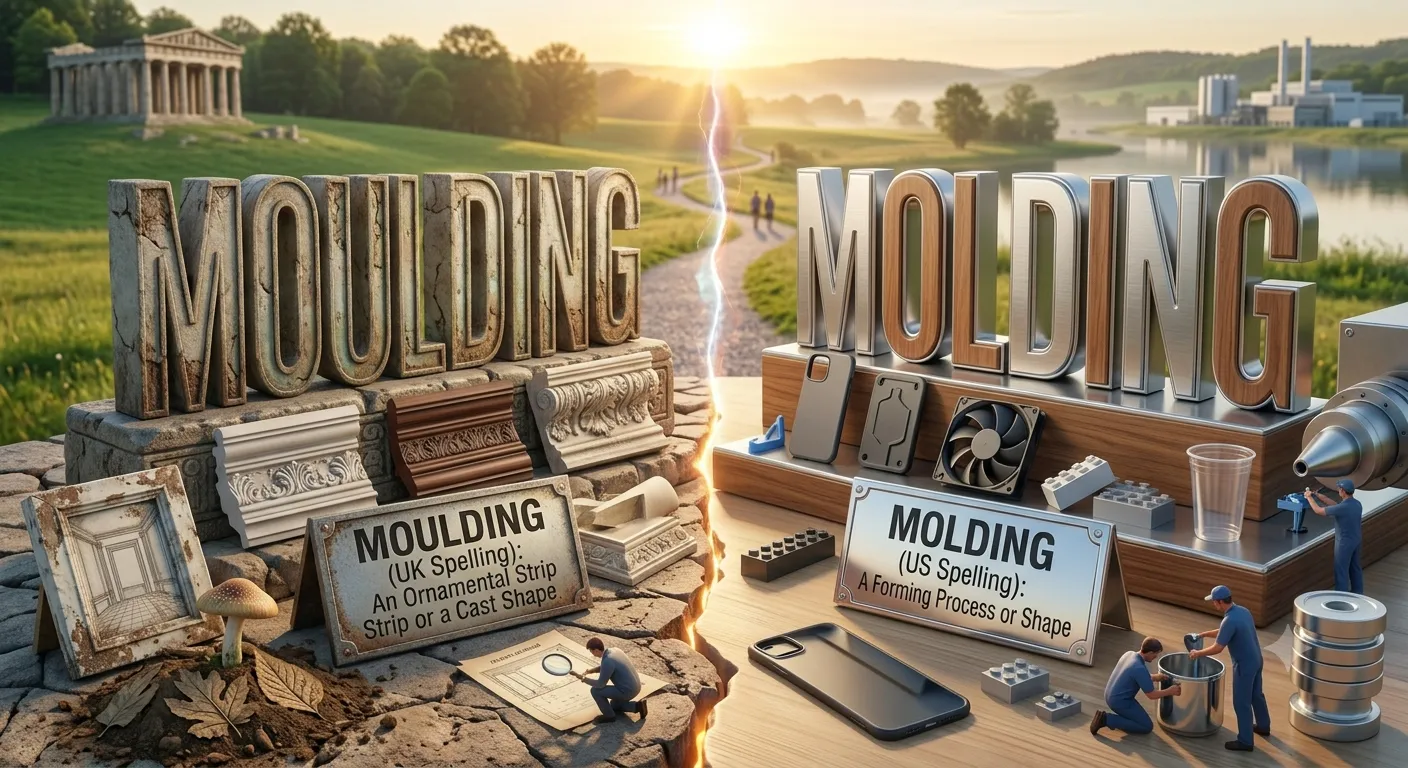
Moulding and molding are both correct. Moulding is the preferred spelling in British English, while molding is the preferred spelling in American English. They mean the same thing.
The first time I edited a home-renovation article, I saw the phrase, “The room was finished with elegant moulding around the ceiling.” A few pages later, another writer used molding for the same feature. The meaning was clear, but the spelling difference made me stop and check the audience.
Many people wonder whether moulding or molding is correct because both spellings appear in books, product listings, interior design articles, and everyday writing. Since English spelling often changes by region, it’s easy to see why this word causes confusion.
The good news is that both forms are standard. Once you understand which variety of English you’re using, you’ll know exactly when to write moulding and when molding is the better choice.
In this guide, you’ll learn the difference between moulding and molding, where the spellings come from, when each version is appropriate, common mistakes to avoid, and real-world examples.
Moulding or Molding Quick Answer
Use moulding in British English.
Use molding in American English.
Simple examples
- The hallway had decorative moulding along the top of the wall.
- The hallway had decorative molding along the top of the wall.
Both sentences mean the same thing. The spelling changes depending on the variety of English.
The Origin and Background of Moulding or Molding
The word comes from the verb mould or mold, meaning to shape something. Over time, it came to describe both the process of shaping material and the decorative trim used in buildings.
British English kept the older spelling mould and moulding, while American English simplified the spelling to mold and molding.
Today, both spellings are widely accepted in their respective regions. In interior design, carpentry, architecture, and manufacturing, the word may refer to:
- Decorative trim on walls, ceilings, or doors
- The process of shaping material
- A form or pattern used to create an object
Moulding or Molding Explained Key Differences
The difference is mainly about regional spelling, not meaning.
| Term | Meaning | When to Use | Region/Context |
| Moulding | Decorative trim or the process of shaping something | When writing in British English | Mostly UK, Commonwealth, and British-influenced writing |
| Molding | Decorative trim or the process of shaping something | When writing in American English | Mostly U.S. spelling and usage |
Examples of Moulding
- The house featured ornate moulding in every room.
- She admired the wooden moulding around the doorway.
- The artisan was moulding clay by hand.
Examples of Molding
- The house featured ornate molding in every room.
- She admired the wooden molding around the doorway.
- The artisan was molding clay by hand.
Which Version Should You Use?
The answer depends on your audience and writing style.
For students
If you’re writing for a class in the United Kingdom or another British English setting, use moulding. If your class uses American English, use molding.
For professionals
Match the spelling to your company, publication, or client.
- British audience → moulding
- American audience → molding
Examples:
- The renovation included new crown moulding.
- The renovation included new crown molding.
For everyday writing
Use the spelling that feels natural for your region. Both are correct, but consistency matters.
For creative writing
Choose the spelling that matches the voice of your story. A British setting may feel more natural with moulding, while an American setting may call for molding.
Common Mistakes with Moulding or Molding
| Mistake | Correct Version | Why It Happens |
| Using molding in British English writing | moulding | British spelling keeps the u. |
| Using moulding in American English writing | molding | American spelling removes the u. |
| Mixing spellings randomly | Stay consistent | Inconsistent spelling looks unpolished. |
| Thinking one spelling is wrong | Both are correct | The difference is regional, not grammatical. |
| Confusing molding with a typo | molding is correct in U.S. English | The spelling depends on the audience. |
Moulding or Molding in Real-World Examples
Professional Email
“The office renovation will include new moulding around the windows.”
News Headline
“Historic Home Restored With Original Molding Preserved”
Social Media Post
“I love the new moulding in our living room—it makes the space feel finished!”
Formal Report
“The contractor recommended replacing the damaged molding before painting the walls.”
Moulding or Molding Data, Trends & Usage
Many people search for moulding or molding because the spelling changes depending on region and industry.
Most common search intent
- Informational
- Spelling help
- British vs American English
- Interior design terminology
- Carpentry and renovation vocabulary
- English usage
Regions with high interest
- United Kingdom
- United States
- Canada
- Australia
- India
Why this topic matters now
Home improvement content, product descriptions, and design blogs often reach international audiences. Knowing when to use moulding or molding helps you write clearly, match your audience, and avoid unnecessary spelling mistakes.
Comparison Table
| Term/Variant | Meaning | Region/Context | Best Used When |
| Moulding | Decorative trim or shaping process | British English | Writing for UK or Commonwealth audiences |
| Molding | Decorative trim or shaping process | American English | Writing for U.S. audiences |
| Mould | Base verb in British English | British English | Talking about shaping or forming |
| Mold | Base verb in American English | American English | Talking about shaping or forming |
| Crown moulding/molding | Decorative trim near the ceiling | Regional spelling varies | Interior design and renovation writing |
Frequently Asked Questions
Q: What does moulding mean?
A: Moulding can refer to decorative trim used in buildings or to the process of shaping material. It is the British English spelling.
Q: What does molding mean?
A: Molding has the same meaning as moulding, but it is the American English spelling.
Q: Moulding vs molding what’s the difference?
A: The meaning is the same. The difference is spelling: moulding is British English, and molding is American English.
Q: Is moulding correct in formal writing?
A: Yes. Moulding is correct in formal British English writing.
Q: Is molding correct in formal writing?
A: Yes. Molding is correct in formal American English writing.
Q: Which version is correct moulding or molding?
A: Both are correct. Use the spelling that matches your audience and style guide.
Q: Can I use moulding and molding interchangeably?
A: Not within the same piece of writing if you want to stay consistent. Choose one spelling style and use it throughout.
Q: Is moulding only used for decoration?
A: No. It can also refer to the act of shaping something, such as clay, plastic, or metal.
Q: What is another word for moulding?
A: Depending on context, you can use trim, crown trim, beading, profile, or beverage? No—sorry, for home design the best alternatives are trim, crown trim, or decorative strip.
Q: Which spelling is better for SEO?
A: If you’re writing online, it can help to mention both moulding and molding because people search for both spellings.
Conclusion
Choosing between moulding or molding is simple once you know the regional rule. Moulding is the standard spelling in British English, while molding is the standard spelling in American English. Both words mean the same thing and are used for decorative trim, shaping materials, and related design contexts.
Remember these key points:
- Moulding is the British spelling.
- Molding is the American spelling.
- Both are correct.
- Use the spelling that matches your audience.
- Stay consistent throughout your writing.
With this simple rule, you’ll never second-guess the spelling again. Bookmark this guide so you always remember the difference between “moulding” and “molding,” and share it with anyone learning English or working in home design.
Read More:
Koozie or Coozie: The Complete Guide to the Correct Spelling

I specialize in English grammar, spelling, word choice, and language usage. My content is based on research from grammar references, style guides, dictionaries, and real-world usage to ensure it is accurate and practical.
At Spelling Comparison, I write guides that explain why words are confused, how they are used, and which form is correct in context. I also include proofreading tips, examples, and writing advice readers can apply immediately.
My goal is to publish clear, reliable content that helps readers make better writing decisions. Each guide is written for accuracy, clarity, and usefulness in school, work, business, and everyday communication.