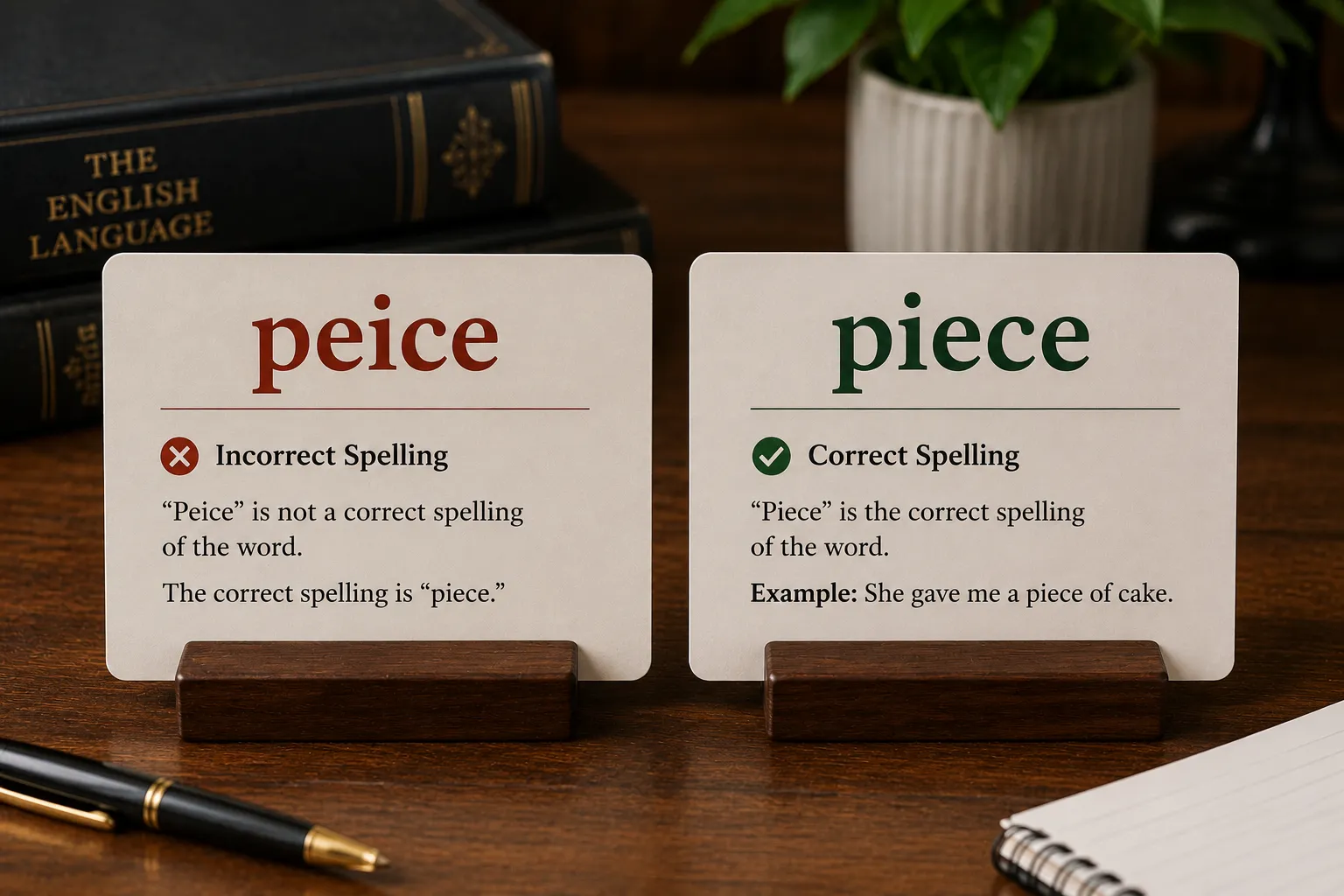
The correct spelling is piece. Peice is a common misspelling. Use piece when referring to a part of something, a written work, a musical composition, or an item.
When I first started writing professionally, one spelling mistake kept slipping past me: peice instead of piece. No matter how carefully I proofread, my fingers seemed to type the letters in the wrong order whenever I was writing quickly. It was frustrating because the word looked almost right, yet it was always incorrect. After seeing the same mistake in students’ assignments, blog comments, and even business emails, I realized I wasn’t the only one struggling with it.
That experience encouraged me to learn the reason behind the correct spelling rather than simply relying on spell check. Once I understood the word’s history, pronunciation, and a few easy memory tricks, I stopped making the mistake altogether. If you’ve ever paused to wonder whether it’s peice or piece, you’re in the right place. In this guide, I’ll explain the correct spelling, why the confusion happens, how dictionaries define the word, and simple ways to remember it forever—with clear examples you can confidently use in everyday writing.
Peice or Piece Quick Answer
Only piece is a correct English word.
Peice is not recognized as a standard English spelling by dictionaries.
Examples
✅ I ate a piece of cake.
✅ She wrote a beautiful piece about friendship.
❌ I ate a peice of cake.
❌ He published an interesting peice yesterday.
The Origin of “Piece”
The word piece has a long history. According to Etymonline, it entered English through Old French piece, meaning “part, fragment, or portion.” Its roots go back to Vulgar Latin pettia, referring to a portion or piece of land.
Over centuries, the meaning expanded to include:
- a part of an object
- a work of writing
- music
- artwork
- a single item
Meanwhile, peice never developed as a legitimate spelling. It simply became a common typing mistake because English contains many words where “ei” appears instead of “ie.”
According to Merriam-Webster, the accepted spelling has always been piece.
Peice vs Piece Explained
The difference is simple.
| Term | Meaning | When to Use | Region/Context |
| Piece | A part, portion, article, work, or item | Always | Worldwide English |
| Peice | Misspelling | Never | Incorrect spelling |
More Examples
Correct:
- She bought a piece of jewelry.
- Every piece of evidence matters.
- The orchestra played a beautiful piece.
Incorrect:
- She bought a peice of jewelry.
- Every peice of evidence matters.
Which Version Should You Use?
No matter who you are, the answer stays the same.
Students
Use piece in homework, essays, and exams.
Professionals
Use piece in reports, presentations, and emails.
Content Writers
Always publish piece to maintain credibility and SEO quality.
English Learners
Memorize only piece. Ignore peice because it is simply incorrect.
Global English
Whether you’re writing American, British, Australian, or Canadian English, piece is the correct spelling.
Easy Trick to Remember “Piece”
Many people know the saying:
“I before E, except after C.”
Although this rule has many exceptions, piece follows the “ie” pattern.
Think of it this way:
A piece of pie has “ie.”
Both piece and pie contain ie, making the spelling easier to remember.
Common Mistakes with Peice or Piece
| Mistake | Correct Form | Why It Happens |
| peice | piece | Letters are reversed |
| peices | pieces | Misspelled plural |
| peice of cake | piece of cake | Common typing error |
| peice of writing | piece of writing | Confusion with “ei” words |
| one peice | one piece | Keyboard habit |
Why These Errors Happen
People often confuse:
- ie
- ei
English spelling contains many exceptions, making this one of the most common spelling mistakes.
How to Use “Piece” Correctly
As a Noun
It refers to part of something.
Example:
Please hand me a piece of paper.
In Writing
Example:
She published a thoughtful opinion piece.
In Music
Example:
Mozart composed an unforgettable piece.
In Art
Example:
That painting is my favorite piece in the gallery.
Piece in Real-World Examples
Professional Email
Please review the final piece before we publish it tomorrow.
News Headline
Local artist unveils stunning new piece at city museum.
Social Media Post
Just finished my newest writing piece. I’d love your feedback!
Business Report
Every piece of customer feedback helped improve the product.
Piece in Common Expressions
English uses piece in many everyday phrases.
Examples include:
- piece of cake
- masterpiece
- peace of mind
- piece together
- piece by piece
- a piece of advice
- a piece of information
Notice that piece remains correctly spelled in every expression.
Peice or Piece Data, Trends & Usage
Current language data strongly favors piece.
Approximate Search Volume
Based on general keyword data from Semrush and Ahrefs (2025–2026 estimates):
| Search Query | Monthly Searches |
| piece | 1M+ |
| peice | 60K–100K |
Most searches for peice come from people checking whether the spelling is correct.
Google Trends
Google Trends consistently shows that searches for peice spike during school terms, suggesting many students verify the spelling.
Countries with noticeable search interest include:
- United States
- United Kingdom
- Canada
- Australia
- India
Corpus Frequency
According to Google Ngram Viewer and general corpus data such as COCA (Corpus of Contemporary American English), piece appears millions of times in published books and writing.
Peice appears only as a spelling error or OCR mistake.
Search Intent
- Primary intent: Informational
- Secondary intent: Educational
Why This Matters Today
As AI writing tools and grammar checkers become more common, users increasingly search for confusing spelling pairs to verify correctness before publishing emails, blogs, assignments, and social media posts.
Comparison Table
| Term/Variant | Meaning | Region/Context | Best Used When |
| Piece | Correct noun meaning part or item | Worldwide English | Always |
| Peice | Misspelling | None | Never |
| Peace | Freedom from conflict or calmness | Worldwide English | When discussing harmony, not portions |
Frequently Asked Questions
Q: What does piece mean?
A: Piece refers to a part, portion, object, written work, musical composition, or item. Both Merriam-Webster and Cambridge Dictionary define it as something that forms part of a whole.
Q: Is peice ever correct?
A: No. Standard English dictionaries do not recognize peice as a correct spelling. Always write piece.
Q: Why do people spell piece as peice?
A: Most people accidentally reverse the letters i and e while typing. It is one of the most common English spelling mistakes.
Q: Is piece correct in British and American English?
A: Yes. Both British and American English use piece with exactly the same spelling.
Q: Where does the word piece come from?
A: According to Etymonline, the word comes from Old French piece, which ultimately derives from Vulgar Latin and has meant “part” or “portion” for centuries.
Q: Can piece be used in formal writing?
A: Absolutely. It appears regularly in academic papers, legal documents, business reports, journalism, and literature.
Q: What is the difference between piece and peace?
A: Piece means a part or portion. Peace means calmness or freedom from conflict. Although they sound alike, they have different meanings and spellings.
Conclusion
The answer is simple: piece is the only correct spelling, while peice is a common mistake caused by switching the letters i and e. Whether you’re writing an essay, an email, a report, or a social media post, choosing the correct spelling helps your writing look polished and professional.
Remember three key points. First, piece is accepted in every variety of English. Second, trusted sources such as Merriam-Webster, Cambridge Dictionary, and Etymonline recognize only piece. Third, a simple memory trick “a piece of pie has ‘ie'”—can help you avoid this mistake.
Now you know exactly how to use piece with confidence. Bookmark this guide so you never second-guess “peice or piece” again, and share it with someone who struggles with this common spelling mistake.
Read More:
Smooth or Smoothe: Which Is Correct?

I specialize in English grammar, spelling, word choice, and language usage. My content is based on research from grammar references, style guides, dictionaries, and real-world usage to ensure it is accurate and practical.
At Spelling Comparison, I write guides that explain why words are confused, how they are used, and which form is correct in context. I also include proofreading tips, examples, and writing advice readers can apply immediately.
My goal is to publish clear, reliable content that helps readers make better writing decisions. Each guide is written for accuracy, clarity, and usefulness in school, work, business, and everyday communication.