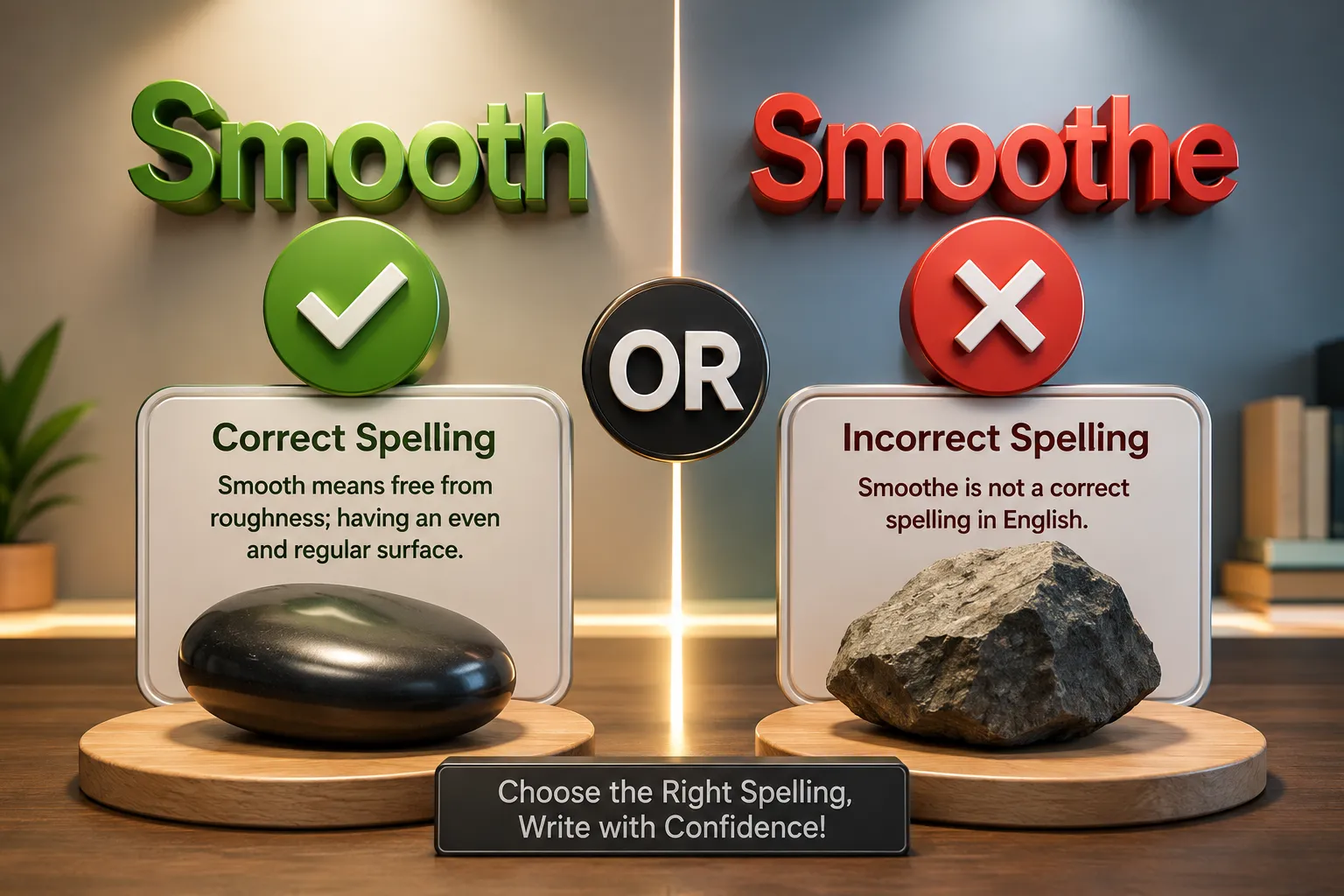
Smooth is the correct spelling in most contexts (adjective and verb), while smoothe is an uncommon variant that’s generally considered nonstandard in modern English.
If you’ve ever wondered whether smooth or smoothe is the correct spelling, you’re not alone. These two words look almost identical, and many writers assume they’re interchangeable. In reality, they have different roles in English, and one is far more common than the other.
Smooth is the standard spelling you’ll find in modern dictionaries. It can be an adjective, a verb, or a noun depending on the context. Smoothe, on the other hand, is an uncommon and largely historical spelling of the verb smooth. Although it still appears occasionally in older books and legal or literary texts, it is rarely used in modern English.
In this guide, you’ll learn the difference between smooth and smoothe, when to use each one, common mistakes to avoid, examples, and what major dictionaries say about these words.
Table of Contents
- Quick Answer
- What Does “Smooth” Mean?
- What Does “Smoothe” Mean?
- Why Are These Words Confused?
- Smooth vs. Smoothe: Key Differences
- When Should You Use Each Word?
- Examples in Sentences
- Common Mistakes to Avoid
- Dictionary Perspective
- Vocabulary Corner
- Frequently Asked Questions
- Key Takeaways
- Conclusion
Quick Answer
Smooth is the correct and standard spelling in modern English.
Smoothe is an older, less common variant of the verb smooth. Most modern style guides and dictionaries recommend using smooth in nearly every situation.
Quick Comparison
| Feature | Smooth | Smoothe |
| Standard English | ✅ Yes | ⚠ Rare |
| Modern Usage | Very common | Uncommon |
| Dictionary Recognition | Yes | Limited/Variant |
| Formal Writing | Recommended | Usually avoided |
| Historical Usage | Yes | Mainly historical |
| Best Choice | Smooth | Only when quoting older texts |
What Does “Smooth” Mean?
The word smooth is one of the most versatile words in English. It functions as an adjective, verb, and occasionally a noun.
As an adjective
It describes something that has an even surface or happens without difficulty.
Examples
- The table has a smooth finish.
- Her skin feels smooth.
- The flight was smooth despite the weather.
- He gave a smooth presentation.
As a verb
It means to make something even, flat, or free from roughness.
Examples
- Smooth the blanket before folding it.
- She smoothed her hair.
- He smoothed the wrinkles from his shirt.
- Smooth the icing over the cake.
What Does “Smoothe” Mean?
Smoothe is an alternative historical spelling of the verb smooth.
Centuries ago, English spelling was less standardized than it is today. Writers often added a silent e to verbs, resulting in spellings such as smoothe.
Today, however, this spelling is considered uncommon and is rarely recommended outside historical writing or direct quotations.
Examples from older usage
- He did smoothe the cloth before sewing.
- The craftsman sought to smoothe the wood.
In modern writing, these examples would simply use smooth.
Why Are These Words Confused?
Several factors contribute to the confusion between smooth and smoothe.
First, English contains many verbs ending in -e, such as:
- breathe
- soothe
- bathe
Because of these familiar patterns, some people assume smoothe follows the same rule.
Second, older books and historical documents occasionally use smoothe, leading readers to believe it remains the preferred spelling.
Finally, spell-checkers sometimes fail to flag uncommon variants, which can reinforce the misconception.
Smooth vs. Smoothe: What’s the Difference?
| Feature | Smooth | Smoothe |
| Part of Speech | Adjective, verb, noun | Verb only |
| Modern English | Yes | Rare |
| Dictionary Status | Standard | Historical variant |
| Formal Writing | Recommended | Usually avoided |
| Informal Writing | Common | Rare |
| Historical Documents | Yes | More common |
| Best Choice Today | Smooth | Only for historical authenticity |
The biggest difference is that smooth is the accepted modern spelling, while smoothe survives mainly as a historical variant.
When Should You Use Each Word?
Use Smooth When
Choose smooth for almost every type of writing.
This includes:
- School assignments
- Business communication
- Academic papers
- Journalism
- Websites
- Blogs
- Emails
- Professional documents
Examples
The road became smooth after repairs.
She smoothed the fabric carefully.
His explanation made the process smooth and simple.
Use Smoothe When
Use smoothe only in very specific situations.
Examples include:
- Quoting historical documents
- Editing older literature
- Studying the history of English
- Preserving original spelling in manuscripts
For everyday writing, smooth is always the safer choice.
Examples in Sentences
Examples with Smooth
The lake looked perfectly smooth at sunrise.
She smoothed the paper before printing.
His calm voice made the conversation smooth.
The marble floor felt smooth underfoot.
The software provides a smooth user experience.
Examples with Smoothe
The editor chose to preserve the original word smoothe in the seventeenth-century manuscript.
Early English texts sometimes spell the verb as smoothe.
The historian explained that smoothe reflects an older spelling convention.
Common Mistakes to Avoid
Mistake 1: Using smoothe in modern writing
❌ Please smoothe the document.
✅ Please smooth the document.
Mistake 2: Assuming smoothe is more formal
Some writers think the extra e makes the word look more sophisticated.
It doesn’t.
Modern English overwhelmingly prefers smooth.
Mistake 3: Believing they are different verbs
Both spellings represent the same basic verb.
The difference lies in historical spelling, not meaning.
Dictionary Perspective
Major English dictionaries recognize smooth as the standard form used in modern English.
Some dictionaries mention smoothe as an obsolete, archaic, or historical variant rather than a preferred spelling.
This means that while smoothe isn’t necessarily “wrong” in historical contexts, it is not recommended for modern writing.
What This Means for Writers
- Use smooth in almost every situation.
- Avoid smoothe unless preserving historical authenticity.
- Follow modern dictionary spellings for clarity.
- If you’re unsure, choose smooth.
Vocabulary Corner
Synonyms
- even
- polished
- sleek
- soft
- silky
- refined
- streamlined
- level
- glossy
- flat
Antonyms
- rough
- uneven
- coarse
- bumpy
- jagged
- rugged
Related Words
- smoothing
- polish
- soften
- flatten
- refine
- buff
- sleekness
- texture
Idioms
Smooth sailing Progress without problems.
Smooth things over Resolve a disagreement peacefully.
A smooth operator Someone skilled in dealing with people.
Smooth as silk Extremely soft or effortless.
Frequently Asked Questions
Is smooth the correct spelling?
Yes. Smooth is the standard spelling used in modern English.
Is smoothe a real word?
Yes, but it is an uncommon historical spelling of the verb smooth. It is rarely used in contemporary English.
Which spelling should I use?
Use smooth unless you are quoting or reproducing historical texts.
Is smoothe considered incorrect?
In modern writing, smoothe is generally avoided because smooth is the accepted standard spelling.
Why do older books use smoothe?
English spelling was less standardized in earlier centuries, and many words appeared in multiple forms.
Can I use smoothe in academic writing?
Only if you are quoting historical material or discussing historical spellings.
Do smooth and smoothe have different meanings?
No. They express the same basic idea, but smooth is the modern standard spelling.
Which spelling do dictionaries recommend?
Modern dictionaries recommend smooth for contemporary writing.
Key Takeaways
- Smooth is the standard modern English spelling.
- Smoothe is an uncommon historical variant.
- Use smooth in school, business, and professional writing.
- Reserve smoothe for historical quotations or discussions of older English.
- When in doubt, smooth is always the safest and most widely accepted choice.
Conclusion
Although smooth and smoothe share the same origin and basic meaning, they are not equally appropriate in modern English. Smooth is the standard spelling recognized by dictionaries and style guides, making it the right choice for everyday writing, academic work, professional communication, and online content. Smoothe, by contrast, survives mainly as a historical or archaic variant and is rarely used outside quotations or discussions of older texts.
Understanding this distinction helps you write with greater confidence and accuracy. If your goal is clear, modern, and professional English, smooth should be your default choice. Reserve smoothe only for contexts where preserving historical spelling is important. By choosing the appropriate form, you’ll ensure your writing is both correct and easy for today’s readers to understand.
Read More:
Advisor or Adviser: The Complete Guide

I’m **Rubab Naaz**, an English language content writer with over 10 years of experience creating educational and SEO-focused articles. I specialize in spelling comparisons, grammar, vocabulary, synonyms, commonly confused words, and English usage. My passion is helping students, writers, and professionals improve their language skills through accurate, well-researched, and easy-to-understand content. Every article I write is designed to make learning English simple, practical, and engaging.