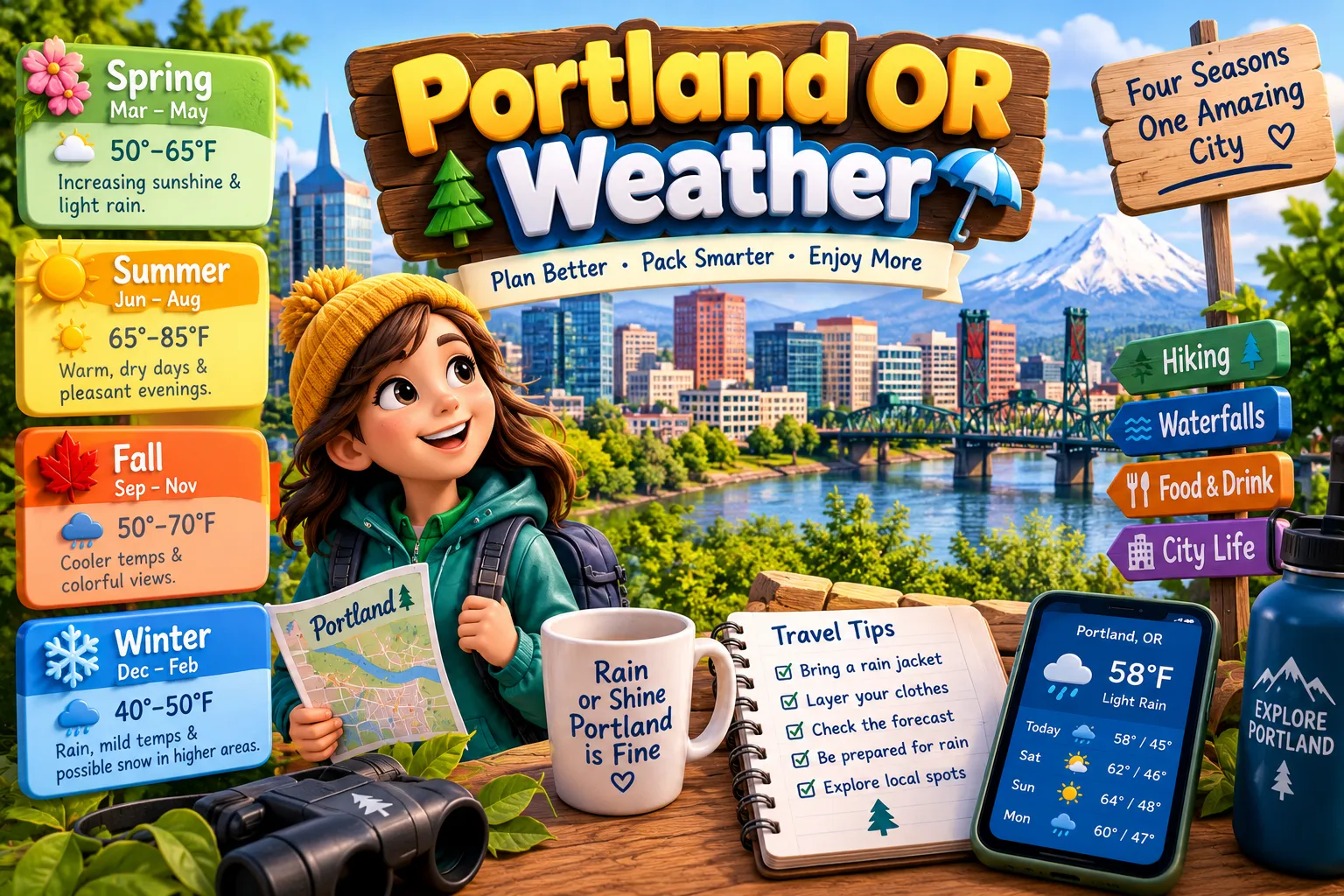
Portland OR weather means the weather conditions in Portland, Oregon, including its temperatures, rain, sunshine, wind, and seasonal patterns.
Have you ever searched “Portland OR weather” and wondered why the phrase looks more like a grammar question than a weather search?
I have seen this kind of confusion often when helping readers understand location-based search terms. The problem usually comes from the two letters OR. In normal English, or is a conjunction used to show a choice. In Portland OR weather, however, OR is the official two-letter abbreviation for Oregon.
That small difference changes everything.
Instead of asking whether “Portland” and “weather” are two competing words, the search is normally asking about weather in Portland, Oregon. This can include today’s forecast, rainfall, temperature, seasonal climate, or travel conditions.
Portland’s weather also has an interesting pattern. The city is famous for rain, but its summers are much drier than many visitors expect. The official tourism guide notes that Portland has four distinct seasons and that its reputation for constant rain can be misleading.
So, what does Portland OR weather really mean, and what should you expect?
Let’s break it down in simple terms.
Portland OR Weather Quick Answer
Portland OR weather is a location-based phrase used to find weather information for Portland, Oregon.
Here, Portland is the city, OR identifies the state of Oregon, and weather refers to current or expected atmospheric conditions.
For example:
- “I’m checking Portland OR weather before my flight.”
- “The Portland OR weather forecast looks good for our weekend trip.”
The phrase is especially common in search engines and weather websites because the short form quickly identifies the location.
In a normal sentence, however, you may write:
“What is the weather like in Portland, Oregon?”
That sentence sounds more natural in everyday conversation.
The search phrase is simply a shorter version of the same idea.
The Origin / Background of Portland OR Weather
The phrase Portland OR weather is not a traditional English word pair. It is a combination of a place name, a state abbreviation, and a weather term.
What does Portland mean?
Portland is the name of a city in Oregon. The city’s name has an unusual history.
According to the official Portland tourism guide, the city was founded in 1843, while the name became official after a coin toss in 1845. Asa Lovejoy favored the name Boston, while Francis Pettygrove favored Portland. Pettygrove won the toss.
The city was later officially incorporated in 1851. Portland’s own city information also identifies the city as Portland, Oregon.
Why does OR mean Oregon?
This is where the confusion often begins.
The U.S. Postal Service lists OR as the official two-letter abbreviation for Oregon.
So:
Portland + OR = Portland, Oregon
Compare that with ordinary English:
- Portland or Seattle → “or” means a choice.
- Portland OR → “OR” identifies Oregon.
Capitalization helps show the difference.
What does weather mean?
Weather is the condition of the atmosphere at a particular time or over a short period.
It includes things such as:
- Temperature
- Rain
- Snow
- Wind
- Cloud cover
- Humidity
- Sunshine
- Storms
This differs from climate.
Weather describes what is happening now or soon. Climate describes the usual pattern over a much longer period.
That distinction matters when someone searches for Portland OR weather versus Portland OR climate.
Portland OR Weather Explained Key Differences and Variations
The phrase can appear in several forms. They may have similar search intent, but they are not always equally natural in normal writing.
| Term | Meaning | When to Use | Region/Context |
| Portland OR weather | Weather in Portland, Oregon | Search queries and weather searches | U.S. / online search |
| Portland, Oregon weather | Weather conditions in Portland, Oregon | Clear writing and travel content | Global |
| Portland weather | Weather in a place called Portland | When the location is already clear | General |
| Portland OR forecast | Weather forecast for Portland, Oregon | Short-term weather checking | Search / weather sites |
| Portland Oregon climate | Long-term weather pattern | Climate and travel research | Formal / informational |
The key difference is context.
Portland OR weather
This is compact and search-friendly.
Someone typing it into Google probably wants a forecast, current conditions, or seasonal information.
Portland, Oregon weather
This is clearer in regular prose.
For example:
“Portland, Oregon weather is often mild compared with many colder U.S. cities.”
Portland weather
This works when there is no risk of confusion.
Portland, Oregon and Portland, Maine are both real places. Adding Oregon or OR can make the intended city clear.
Portland OR forecast
This usually points toward short-term weather.
A forecast may cover today, tomorrow, the next several days, or longer periods.
Portland Oregon climate
This is different from a daily forecast.
Climate information looks at long-term patterns such as average temperatures, precipitation, and seasonal conditions.
What Is Portland OR Weather Usually Like?
Portland has a reputation for being rainy. That reputation is not completely wrong, but it leaves out an important part of the story.
The Oregon government’s hazard-mitigation information describes Portland’s climate as mild and notes that rainfall is concentrated heavily in the cooler part of the year. It reports that nearly 90% of annual rainfall occurs from mid-October through mid-May, while only about 3% occurs in July and August.
That creates a clear seasonal pattern.
Winter
Winter is generally cool, cloudy, and wet.
Rain is much more common than snow. Cold conditions can occur, but severe cold is unusual compared with many inland U.S. cities.
Spring
Spring can be changeable.
You may get clouds and rain one day and brighter weather soon after. Temperatures gradually become more comfortable as summer approaches.
Summer
Summer is the big surprise for many first-time visitors.
Portland often has warm, dry, and sunny summers. The official Portland tourism guide also describes the city as having four distinct seasons and notes that summer conditions can be quite different from its rainy reputation.
July is typically one of the warmest and driest months. Historical climate data show an average July high of about 82°F (28°C).
Fall
Fall brings cooler temperatures and a gradual return of wetter weather.
By late autumn, rain becomes much more common.
Which Version Should You Use?
Your best choice depends on what you are writing.
For a search engine
Use:
Portland OR weather
It is short and clearly signals a location-based weather search.
For a normal sentence
Use:
Portland, Oregon weather
or:
the weather in Portland, Oregon
These forms are easier for readers to understand.
For formal writing
Prefer the complete location:
“The weather in Portland, Oregon, changes considerably between winter and summer.”
This removes any possible confusion about the abbreviation.
For travel content
You can use both.
For example, a travel page can use Portland OR weather as a search-focused heading while using Portland, Oregon naturally throughout the text.
For international readers
Write Portland, Oregon at least once.
Not every reader will know that OR means Oregon.
Common Mistakes with Portland OR Weather
The biggest errors come from confusing OR with the English word or.
| Mistake | Better Version | Why |
| Portland or weather | Portland OR weather | OR identifies Oregon |
| Portland, OR weather | Portland, OR, weather | Punctuation can improve readability in formal prose |
| Portland Oregon whether | Portland Oregon weather | Weather relates to atmospheric conditions |
| Portland OR climate today | Portland OR weather today | “Weather” fits short-term conditions |
| Portland Or Weather | Portland OR weather | State abbreviations use capital letters |
Mistake 1: Reading OR as “or”
A lowercase or normally connects alternatives.
For example:
“Should we visit Portland or Seattle?”
Here, or is a conjunction.
In Portland OR weather, the uppercase OR is a location abbreviation.
Mistake 2: Confusing weather and whether
This is a classic English spelling problem.
- Weather = atmospheric conditions.
- Whether = introduces alternatives or uncertainty.
Example:
“I don’t know whether it will rain.”
Here, whether has nothing to do with rain itself.
Mistake 3: Confusing weather and climate
A forecast for tomorrow describes weather.
A discussion of Portland’s typical rainfall over decades describes climate.
Mistake 4: Assuming Portland always has rain
Portland gets substantial rainfall, especially during the cooler months. But summer is much drier. Official regional information shows that July and August account for only a small share of the city’s yearly rainfall.
Portland OR Weather in Real World Examples
The phrase appears differently depending on where you use it.
Professional email
“Could you check the Portland, Oregon weather before confirming the outdoor meeting?”
This is better for a professional message because the full location is immediately clear.
News headline
Portland OR Weather Alert: Rain Expected Across the Region
A headline may use the abbreviation because space is limited.
Social media post
“Checking the Portland OR weather before heading out for a weekend hike.”
This sounds like a natural search or social-media phrase.
Formal report
“The report examines seasonal weather patterns in Portland, Oregon, with particular attention to winter precipitation.”
Here, the full place name is clearer than the abbreviated search term.
Travel website
“Portland OR weather can vary by season, so visitors should check the forecast before planning outdoor activities.”
This combines the search phrase with reader-friendly writing.
Portland OR Weather Data, Trends & Usage
Weather searches are highly practical. People usually search them because they need an answer right now, not because they want a grammar lesson.
Search volume
There is no reliable public source in the research reviewed here that provides a verified monthly search-volume number for the exact phrase “Portland OR weather.”
That means it would be misleading to invent an Ahrefs, Semrush, or Google Keyword Planner figure.
Google Trends is useful for comparing relative search interest, but it does not provide an absolute monthly search count. Search interest can also rise when people plan trips, prepare for unusual weather, or need a local forecast.
Several current pages discussing the phrase identify common search purposes such as travel planning, relocation research, daily forecasts, and outdoor activities.
Regional search intent
The strongest intent is likely informational.
Typical searches include:
- Current weather
- Seven-day forecast
- Rain chances
- Temperature
- Seasonal climate
- Travel conditions
- Outdoor planning
The query can also have a travel-planning intent when someone is deciding what to pack or when to visit.
Why the phrase matters
Location-based searches have become more direct.
Instead of typing:
“What is the weather going to be like in Portland, Oregon tomorrow?”
A user may simply type:
Portland OR weather
Search engines can understand the shortened request.
That makes the phrase useful for both users and weather platforms.
A useful climate fact
The National Weather Service maintains a dedicated historical climate record for Portland, including data from downtown and Portland International Airport. Its climate book contains long-term normals, records, and historical temperature information.
The National Weather Service’s 2025 annual climate report gives a 1991–2020 normal annual mean temperature of 55.1°F for Portland and a normal annual precipitation total of 36.92 inches.
Those figures show why Portland is often described as having a relatively mild climate with a strong wet-season/dry-season pattern.
Portland OR Weather: What to Expect by Season
| Season | Typical Pattern | Rain | Practical Tip |
| Winter | Cool, cloudy, wet | High | Carry waterproof outerwear |
| Spring | Mild but changeable | Moderate to high | Dress in layers |
| Summer | Warm, sunny, dry | Low | Prepare for sun and heat |
| Fall | Cooler with increasing rain | Rising | Keep rain protection nearby |
The exact conditions can change from year to year.
A seasonal table tells you what is typical, not what will happen on a particular day.
For an actual trip, use a current forecast close to your travel date.
Portland OR Weather vs. Related Terms
| Term/Variant | Meaning | Region/Context | Best Used When |
| Portland OR weather | Weather in Portland, Oregon | Search / U.S. location | Looking for a local forecast |
| Portland, Oregon weather | Weather conditions in the Oregon city | General English | Writing clearly for broad readers |
| Portland climate | Long-term weather pattern | Climate research | Discussing averages and trends |
| Portland forecast | Predicted future weather | Weather reporting | Checking upcoming conditions |
| Portland, Maine weather | Weather in Portland, Maine | U.S. location | Avoiding confusion between cities |
This last distinction matters.
There is more than one Portland in the United States. Adding Oregon or OR tells the reader which Portland you mean.
FAQs About Portland OR Weather
Q: What does Portland OR weather mean?
A: It means weather information for Portland, Oregon. OR is the official two-letter U.S. Postal Service abbreviation for Oregon.
Q: Is “Portland OR weather” grammatically correct?
A: It works well as a search query or heading. In a normal sentence, “the weather in Portland, Oregon” is usually more natural.
Q: Is OR the same as the word “or”?
A: No. Lowercase or is a conjunction used to show alternatives. Uppercase OR in this location phrase identifies Oregon.
Q: What is the difference between Portland OR weather and Portland OR climate?
A: Weather describes short-term atmospheric conditions. Climate describes long-term patterns and averages. A forecast for tomorrow concerns weather, while decades of rainfall records concern climate.
Q: Does Portland, Oregon, have rainy weather all year?
A: No. Portland has a much wetter cool season and a comparatively dry summer. Regional government information reports that most annual rainfall occurs between mid-October and mid-May.
Q: Is Portland OR weather usually cold?
A: Portland has generally mild conditions, although winter can feel cool and wet. The city can experience cold snaps, but extreme cold is uncommon.
Q: When is Portland usually warmest and driest?
A: Summer is normally the warmest and driest period. Historical climate data place July’s average high at about 82°F (28°C).
Q: Should I write Portland OR or Portland, Oregon?
A: Use Portland OR for a compact search phrase or location label. For formal and general writing, Portland, Oregon is clearer for readers around the world.
Conclusion
Portland OR weather is a simple location-based phrase once you understand what OR means. It is not a comparison between “Portland” and “or.” It identifies Portland, Oregon, while weather tells you that the search concerns atmospheric conditions.
The city’s weather has a strong seasonal rhythm. Winters are wetter and often cloudy. Summers are warmer, sunnier, and much drier. Spring and fall can change quickly, so layers are useful during those seasons. Official climate records from the National Weather Service support the long-term pattern and provide detailed historical data.
For search engines, Portland OR weather is short and useful. For ordinary writing, Portland, Oregon weather or the weather in Portland, Oregon is usually clearer.
Now you know exactly what the phrase means and why it appears in weather searches. Bookmark this guide before your next Portland trip, and always check the latest forecast before making outdoor plans.
Readmore

I’m **Rubab Naaz**, an English language content writer with over 10 years of experience creating educational and SEO-focused articles. I specialize in spelling comparisons, grammar, vocabulary, synonyms, commonly confused words, and English usage. My passion is helping students, writers, and professionals improve their language skills through accurate, well-researched, and easy-to-understand content. Every article I write is designed to make learning English simple, practical, and engaging.










