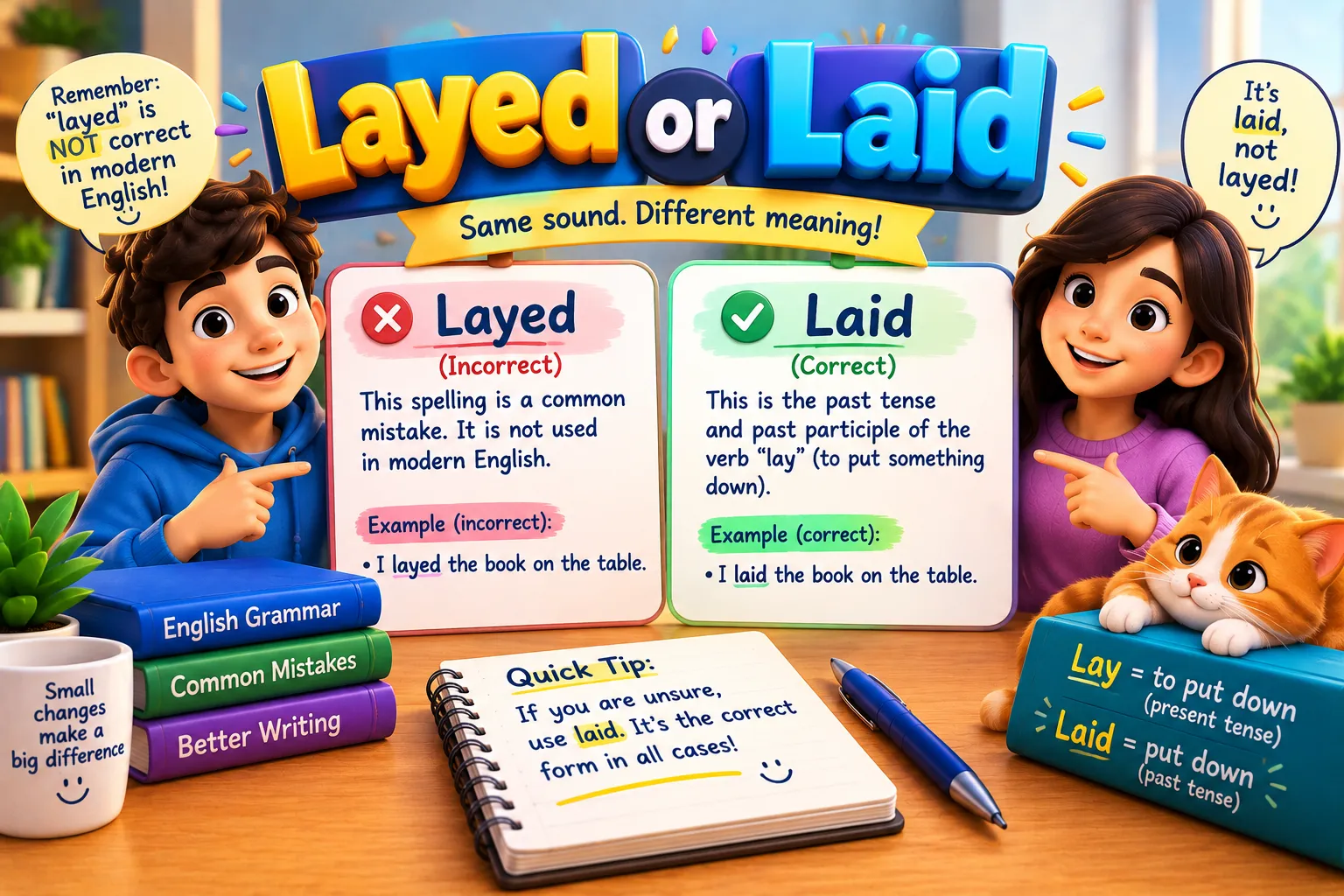
Laid is the standard past tense and past participle of lay, meaning to put or place something down. Layed is not the normal modern form, although historical English records contain older uses of it.
Have you ever typed “layed”, looked at it twice, and thought, “That looks right”?
It is an easy mistake to make.
English often forms past-tense verbs by adding -ed. We have play → played, stay → stayed, and clean → cleaned. So lay → layed may seem perfectly logical.
But English does not always follow that pattern.
The correct modern form is laid:
“She laid the book on the desk.”
The confusion becomes even harder when lay and lie enter the picture. These verbs are closely related, but they follow different patterns. The past tense of lay is laid, while the past tense of lie is lay. The past participle of lie is lain. Cambridge specifically warns learners about this pattern and states that the past form of lay is laid, not layed.
That gives you three forms worth remembering:
lay → laid → laid
lie → lay → lain
Once you see the pattern, layed or laid becomes much easier.
Layed or Laid Quick Answer
If you are choosing between layed and laid in modern standard English, choose laid.
Laid is the past simple and past participle of the verb lay. The verb means to put, place, or set someone or something in a particular position. Oxford lists laid as both the past simple and past participle form.
| Word | Correct in Modern Standard English? | Meaning |
| Laid | ✅ Yes | Past form of lay |
| Layed | ❌ Normally no | Usually a mistaken regularized form of lay |
For example:
- Present: “I lay the documents on the table.”
- Past: “I laid the documents on the table.”
- Perfect: “I have laid the documents on the table.”
The main rule is simple:
Never change “lay” to “layed” when you need its normal past form. Use “laid.”
The Origin and Background of Layed or Laid
The story behind laid goes back much further than modern spelling rules.
Etymonline traces lay to Middle English forms such as leien and ultimately to Old English lecgan, meaning to place something on the ground or another surface. It is connected to an old Germanic verb family.
The modern past form laid developed from this older verb system.
English did not always have today’s fixed spelling. Historical sources show forms such as layed, layd, laide, and other variants in earlier stages of the language. The World English Historical Dictionary records layed among historical past-tense forms of lay.
The Dictionary of the Older Scottish Tongue also records historical forms related to layed and laid.
So there is an interesting detail here:
“Layed” has existed historically, but that does not make it the standard modern past form.
Modern English has settled on laid.
This is one reason online explanations can sometimes become confusing. You may find layed in old texts, historical dictionaries, or unusual sources. That is different from saying it is the normal form for present-day formal English.
Why does “layed” look so natural?
The answer is regular spelling.
Many English verbs simply add -ed:
- play → played
- call → called
- open → opened
- walk → walked
Your brain may apply that same pattern to lay.
But lay has an irregular past form:
lay → laid
The same kind of irregular pattern appears in many common verbs:
- go → went
- take → took
- write → wrote
- bring → brought
- buy → bought
English grammar contains many forms that must be learned rather than created by simply adding -ed.
Layed or Laid Explained Key Differences
The biggest difference is simple: laid is the standard modern form; layed is generally not.
But understanding lay itself is even more useful.
| Term | Meaning | When to Use | Region/Context |
| Lay | Put or place something somewhere | Present tense | Standard English |
| Laid | Put or placed something somewhere | Past tense or past participle | Standard English |
| Laying | Putting or placing something | -ing form | Standard English |
| Layed | Historical/archaic variant; usually incorrect in modern usage | Avoid in normal modern writing | Historical or nonstandard contexts |
| Lie | Rest or be in a flat position | When there is no object | Standard English |
| Lay | Past tense of lie | Describing a past resting position | Standard English |
| Lain | Past participle of lie | Perfect constructions | Standard English |
Laid = past form of lay
When lay means put or place, its past form is laid.
“Yesterday, I laid the clothes on the chair.”
There is an object after the verb: the clothes.
Cambridge explains that lay takes an object and gives laid as its past simple and -ed form.
Layed = usually incorrect today
In ordinary modern English, avoid layed.
❌ “She layed the blanket on the floor.”
Use:
✅ “She laid the blanket on the floor.”
The spelling layed may appear in historical material, but it is not the standard choice for modern school, business, academic, or professional writing.
The bigger problem: lay vs. lie
Many people who search for layed or laid are actually dealing with the wider lay vs. lie problem.
Compare:
| Verb | Present | Past | Past Participle |
| Lay = put/place | lay | laid | laid |
| Lie = rest/recline | lie | lay | lain |
| Lie = tell an untruth | lie | lied | lied |
Cambridge gives the same basic distinction: lay requires an object, while lie does not.
That is why these sentences are different:
“I laid the phone on the table.”
“I lay on the sofa yesterday.”
The first sentence means I put something somewhere.
The second means I rested on the sofa.
Which Version Should You Use?
For students
Use laid.
If you are writing an essay, answering an exam question, or completing homework, laid is the safe standard form.
For professional writers
Choose laid in emails, reports, articles, proposals, and business documents.
Avoid layed unless you are deliberately discussing historical language.
For ESL learners
Learn the complete pattern instead of memorizing only one word:
lay → laid → laid
Then separately learn:
lie → lay → lain
This prevents one mistake from creating another.
For global English
Laid is the clearest choice across standard varieties of English, including British and American English.
The grammar rule does not change simply because the audience changes.
Common Mistakes With Layed or Laid
Mistake 1: Adding -ed automatically
❌ “He layed the papers on my desk.”
✅ “He laid the papers on my desk.”
Why? Lay has the irregular past form laid.
Mistake 2: Using “laid” when you mean “lie”
❌ “I laid on the bed for an hour.”
✅ “I lay on the bed for an hour.”
Why? Here, you mean rested, so the verb is lie. Its past tense is lay.
Mistake 3: Using “layed” in “laid down”
❌ “She layed down after lunch.”
✅ “She lay down after lunch.”
Why? If she rested herself, you need the past tense of lie: lay.
This is a particularly common trap because lay down and laid down can both be correct in different meanings.
Compare:
“She lay down to rest.”
“She laid down the rules.”
The first means rested.
The second means put or stated something clearly.
Mistake 4: Using “lain” for the wrong verb
❌ “He has lain the keys on the counter.”
✅ “He has laid the keys on the counter.”
Why? The verb is lay because he placed the keys somewhere.
Lain belongs to the verb lie.
Mistake 5: Assuming “layed” is always historically impossible
❌ “Layed has never existed in English.”
✅ “Layed appears in historical English, but laid is the standard modern form.”
Why? Historical spelling and modern standard usage are not the same thing. Historical dictionaries record older forms of the verb.
Layed or Laid in Real World Examples
Professional email
“I have laid the revised documents on your desk for review.”
The writer is describing something that was placed there.
News-style writing
“The committee laid out its plans for the next stage of the project.”
Here, laid out means presented or explained a plan.
Social media post
“I finally laid all my study notes in one folder.”
The word describes placing or arranging something.
Formal report
“The study laid the groundwork for further research.”
This is a common formal expression using the past form of lay.
Everyday conversation
“She laid her keys beside the door before going upstairs.”
The object keys makes the meaning clear: she put them there.
Layed or Laid Data, Trends & Usage
Exact current monthly search volumes for “layed or laid” are not reliably exposed by the public Google Trends page without running a specific comparison inside the Trends interface. Google Trends reports relative search interest, not a simple universal count of monthly searches.
That means it would be misleading to claim an exact number such as “10,000 searches per month” without a verified SEO database such as Ahrefs, Semrush, or Google Keyword Planner.
The search pattern itself is easy to understand.
People looking up layed or laid are often trying to solve one of several related questions:
- Is layed a word?
- Is it laid down or layed down?
- What is the past tense of lay?
- What is the difference between lay and lie?
- Should I write laid off or layed off?
- Is laid the same as lain?
This makes the topic strongly informational.
There is also a wider grammar issue behind the search. Cambridge and Oxford both devote specific guidance to lay vs. lie, because their forms overlap in ways that confuse learners. Oxford notes that lay has an object while lie does not, and specifically warns about incorrect use of laid for forms belonging to lie.
The practical lesson is more useful than an isolated search number:
Learning the whole verb pattern is more effective than memorizing “laid = correct.”
When you know lay → laid → laid, you can handle sentences such as laid down, laid out, laid off, laid aside, and laid the foundation with much greater confidence.
Standalone Layed or Laid Comparison Table
| Term/Variant | Meaning | Region/Context | Best Used When |
| lay | Put or place | Standard English | Present-tense action |
| laid | Put or placed | British and American English | Past or perfect forms of lay |
| laying | Putting or placing | Standard English | Continuous forms of lay |
| layed | Older/historical form; usually nonstandard today | Historical texts | Historical language discussion |
| lie | Rest or recline | Standard English | Present-tense position |
| lay | Rested or reclined | Standard English | Past tense of lie |
| lain | Been in a resting position | Standard English | Perfect forms of lie |
The table shows why layed or laid cannot be understood fully without learning lie too.
FAQ: Layed or Laid
Q: Is “layed” a correct word?
A: Layed is not the standard modern past form of lay. Historical sources do record layed as an older variant, but modern standard English uses laid.
Q: Is it “layed” or “laid”?
A: Use laid when you need the past tense or past participle of lay. For example, “She laid the book on the shelf.”
Q: What is the past tense of “lay”?
A: The past tense is laid. The past participle is also laid, giving the pattern lay → laid → laid. Oxford lists these forms explicitly.
Q: Is “laid” the past tense of “lie”?
A: No. The past tense of lie, when it means to rest or recline, is lay. Its past participle is lain.
Q: Should I write “layed down” or “laid down”?
A: It depends on the meaning. Laid down is correct when someone puts something down, such as “She laid down the book.” If someone rested their body, use lay down, as in “She lay down for a nap.”
Q: Where does “laid” come from?
A: Laid comes from the historical verb lay, which traces through Middle English to Old English lecgan, meaning to put or place something. Etymonline connects the verb to an older Germanic word family.
Q: Can “layed” be used in formal writing?
A: Generally, no. Use laid in modern formal English. You may encounter layed in historical quotations or older texts, but that does not make it the normal modern form.
Conclusion
The choice between layed or laid is much easier once you understand the verb behind it.
For modern standard English, laid is the correct past tense and past participle of lay. The basic pattern is:
lay → laid → laid
The word lay means to put, place, or set something somewhere. It normally takes an object, such as book, keys, clothes, or foundation. Cambridge and Oxford both use this object-based rule to distinguish lay from lie.
The bigger trap is lie. When lie means to rest or recline, its forms are:
lie → lay → lain
That is why “I lay on the sofa” can be correct, while “I layed the book down” is not.
You may find layed in historical English. Older records show that the form existed. But for modern school, work, academic, and professional writing, laid is the clear choice.
Bookmark this guide so you never second-guess layed or laid again.
Readmore

I’m an English language educator and SEO content writer having experience creating clear, accurate, and engaging English learning content. I specialize in spelling differences, grammar, vocabulary, synonyms, commonly confused words, and English usage. My goal is to publish well-researched, easy-to-understand articles that help students, writers, educators, and professionals improve their English with confidence through practical explanations and real-world examples.










