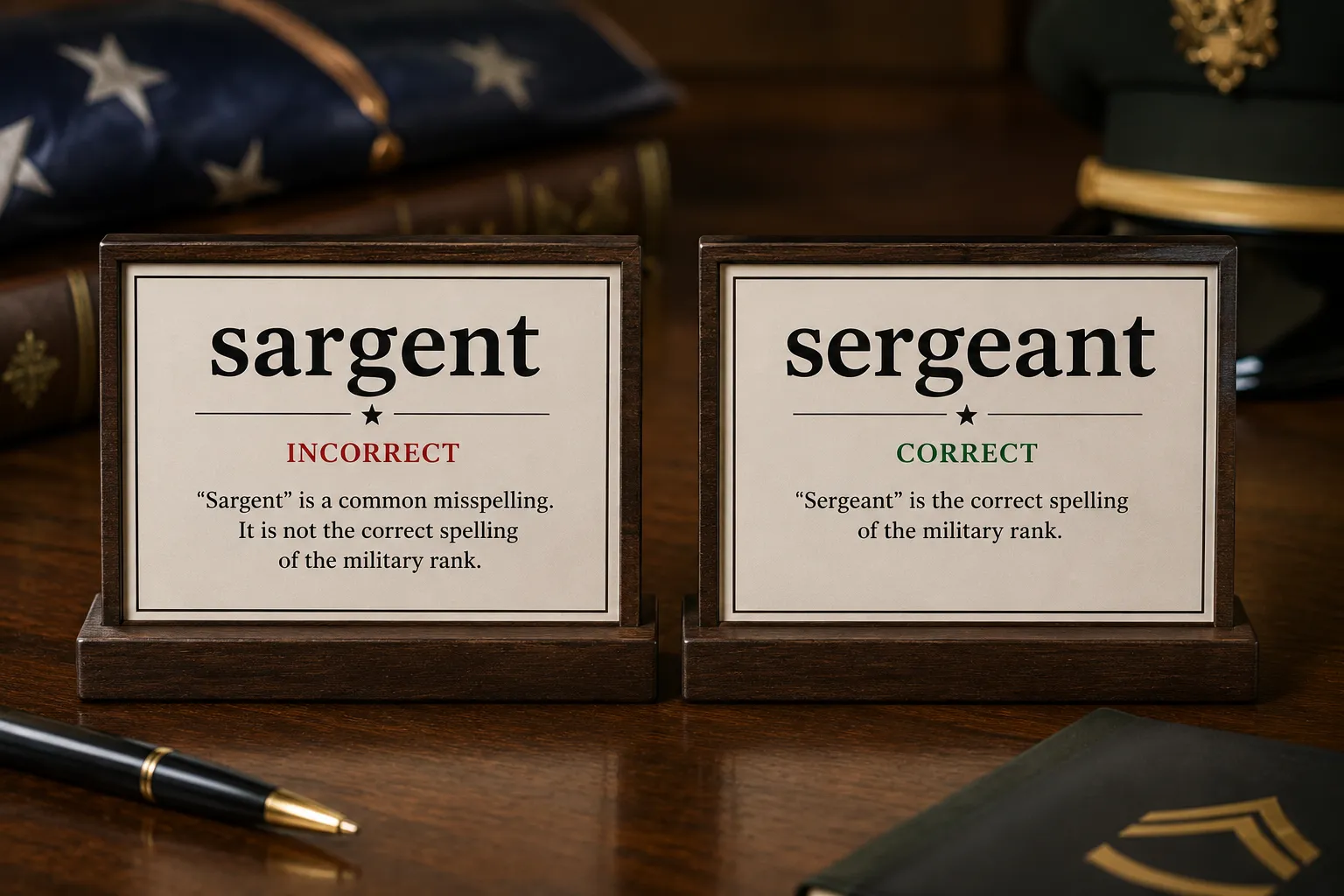
Sergeant is the correct English word for a military or police rank. Sargent is a misspelling in standard English, although Sargent can also appear as a surname.
I once edited a school newsletter that referred to a local police sargent. The writer clearly meant sergeant, but the spelling was off. That small mistake made the sentence look less polished and less professional.
People often search for sargent or sergeant because the words sound similar and the spelling is easy to mix up. Since English has many tricky letter combinations, it’s common to second-guess words that don’t follow a simple phonetic pattern.
The good news is that the rule is straightforward. Sergeant is the standard English spelling for the rank, while sargent is not correct in standard usage.
In this guide, you’ll learn the difference between sargent and sergeant, where the word comes from, common mistakes to avoid, and real-world examples.
Sargent or Sergeant Quick Answer
The correct English spelling is sergeant.
Sargent is not the correct spelling for the rank of a military or police officer.
Simple examples
- The sergeant gave clear instructions.
- The police sergeant arrived at the scene.
The Origin and Background of Sargent or Sergeant
The word sergeant has a long history in English and comes from Old French and Latin roots. It originally referred to a servant or attendant and later developed into a title for a person holding authority, especially in the military and police.
The spelling is not phonetic, which is one reason many people misspell it as sargent. English borrowed the word through older forms, and the spelling remained fixed even though pronunciation changed over time.
The surname Sargent also exists in English, which can add to the confusion. For example, John Singer Sargent was a famous painter. But when you’re referring to a rank, the correct spelling is always sergeant.
Sargent or Sergeant Explained Key Differences
The difference is mainly about correct spelling and word meaning.
| Term | Meaning | When to Use | Region/Context |
| Sergeant | Military or police rank | In standard English | Worldwide |
| Sargent | Misspelling of the rank, or a surname | Only as a family name | English surname usage |
Examples of Sergeant
- The sergeant inspected the troops.
- A police sergeant reviewed the report.
- The sergeant led the training exercise.
Examples of Sargent
- Sargent is a common surname.
- John Singer Sargent was an American artist.
Notice that sargent is not the correct spelling for the rank.
Which Version Should You Use?
The answer depends on what you mean.
For students
If you’re writing about a military or police rank, always use sergeant.
For professionals
Use sergeant in reports, articles, legal documents, and official communication.
- Army sergeant → sergeant
- Police sergeant → sergeant
- Drill sergeant → sergeant
Use Sargent only when referring to a person’s surname.
For everyday writing
Ask yourself:
Am I talking about a rank, or am I using a family name?
- Rank → sergeant
- Surname → Sargent
For international readers
If you’re writing in English, sergeant is the only correct spelling for the rank and is widely recognized in military, police, and general writing.
Common Mistakes with Sargent or Sergeant
| Mistake | Correct Version | Why It Happens |
| The sargent gave orders. | The sergeant gave orders. | The spelling is often confused with the surname Sargent. |
| Police sargent | Police sergeant | The rank is spelled with -eant, not -ant. |
| Army sargent | Army sergeant | The correct English spelling is irregular. |
| Many sargents | Many sergeants | The plural of sergeant adds -s. |
| Sergeant spelled as sargent in formal writing | Sergeant | Standard English requires the correct spelling. |
Sargent or Sergeant in Real-World Examples
Professional Email
“The sergeant will review the incident report before the meeting.”
News Headline
“Local Sergeant Commended for Quick Response During Rescue”
Social Media Post
“My cousin just got promoted to sergeant in the army!”
Formal Report
“The sergeant supervised the team throughout the training exercise.”
Sargent or Sergeant Data, Trends & Usage
Many people search for sargent or sergeant because the spelling is not intuitive and the word is often heard more than it is written.
Most common search intent
- Informational
- Spelling help
- English grammar
- Military rank
- Police terminology
Regions with high interest
- United States
- United Kingdom
- Canada
- Australia
- India
Why this topic matters now
Because sergeant appears in military, law enforcement, and official writing, using the correct spelling is important for clarity and professionalism. A small spelling error can make formal writing look careless.
Comparison Table
| Term/Variant | Meaning | Region/Context | Best Used When |
| Sergeant | Military or police rank | Worldwide English | Referring to the rank |
| Sergeants | More than one sergeant | Worldwide English | Talking about multiple people |
| Sergeant’s | Belonging to one sergeant | Worldwide English | Singular possessive |
| Sergeants’ | Belonging to multiple sergeants | Worldwide English | Plural possessive |
| Sargent | Surname or misspelling | English surname usage | Referring to a family name |
Frequently Asked Questions
Q: What does sergeant mean?
A: Sergeant is a military or police rank used for a person in a position of authority.
Q: What does sargent mean?
A: Sargent is usually a surname. It is not the correct spelling of the rank.
Q: Sargent vs sergeant what’s the difference?
A: Sergeant is the correct spelling for the rank. Sargent is either a surname or a misspelling.
Q: Is sargent correct in formal writing?
A: No, not when referring to the rank. In formal English, the correct spelling is sergeant.
Q: Which version is correct sargent or sergeant?
A: Sergeant is correct for the rank. Sargent is only correct as a surname.
Q: Why is sergeant so hard to spell?
A: The word comes from older French and Latin forms, so its spelling does not match its pronunciation exactly.
Q: What is the plural of sergeant?
A: The plural is sergeants.
Q: Is sergeant used in both the military and police?
A: Yes. Sergeant is used in both military and law enforcement contexts.
Q: Should Sargent be capitalized?
A: Yes, if it is a surname. For example, Mr. Sargent. But the rank sergeant is usually lowercase unless it begins a sentence or is part of a formal title.
Q: Can I use sergeant in everyday writing?
A: Yes. Sergeant is the standard word in everyday, professional, and official English.
Conclusion
Choosing between sargent or sergeant is simple once you know the rule. If you’re referring to a military or police rank, the correct spelling is sergeant. Sargent is not the standard English spelling for the rank, though it can be used as a surname.
Remember these key points:
- Sergeant is the correct spelling for the rank.
- Sargent is usually a surname or a misspelling.
- Sergeants is the plural form.
- Use sergeant in military, police, and formal writing.
- Do not confuse the rank with the surname Sargent.
With this simple rule, you’ll never confuse sargent and sergeant again. Bookmark this guide so you always remember the correct usage, and share it with anyone learning English spelling or writing about military and police ranks.
READ MORE:
Swiftie or Swifty: The Complete Guide to the Correct Spelling

I’m Daniel sultan, an English language writer and SEO content specialist with experience researching spelling, grammar, vocabulary, and English usage. Through SpellComparison.com, I create clear, accurate, and well-researched guides that help readers understand commonly confused words, spelling differences, and grammar rules with confidence.
Every article I write is based on trusted language references, established style guides, and real-world usage to ensure it is accurate, practical, and easy to understand. My goal is to make learning English simple and reliable by providing fact-checked content, clear explanations, and real-life examples that students, writers, educators, and professionals can trust.