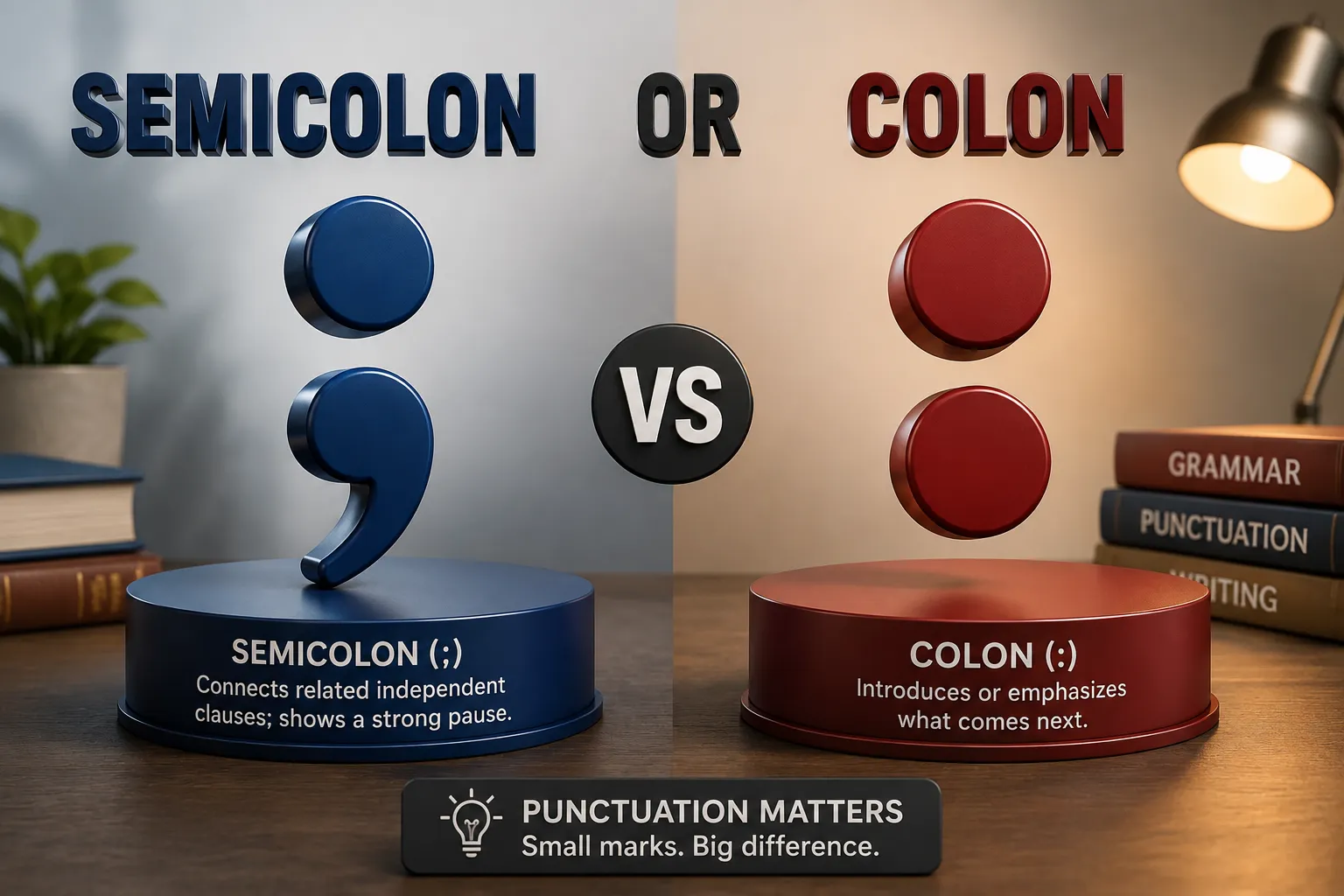
Semicolon or colon depends on the job you want the punctuation mark to do: use a semicolon (;) to link closely related independent clauses or separate complex list items, and use a colon (:) to introduce a list, explanation, example, or emphasis.
Have you ever reached a sentence like this and stopped: Should I use a semicolon or a colon here?
You are not alone. I have seen this question many times when helping English learners improve their writing. The two marks look similar because both can create a strong break in a sentence. Yet they do different jobs.
A semicolon (;) often connects two complete thoughts that belong closely together. A colon (:), on the other hand, often tells the reader that something is coming next. That “something” may be a list, explanation, example, or quotation.
This small difference can make a big change in your writing. The right punctuation makes your meaning easier to follow. The wrong mark can make an otherwise good sentence look awkward.
In this guide, you will learn when to use each mark, how they differ, which mistakes to avoid, and how they work in real writing. By the end, you should have a simple rule you can remember whenever you face the choice.
Semicolon or Colon Quick Answer
Think of the two marks this way:
- Semicolon (;) = connects
- Colon (:) = introduces
A semicolon can join two closely related independent clauses:
The rain finally stopped; the children went outside.
Both sides can stand as complete sentences.
A colon can introduce a list:
I packed three things: water, snacks, and a map.
Cambridge defines a semicolon as a mark used between parts of a sentence, usually when both parts could form grammatical sentences on their own. It also notes that semicolons can separate items in a list.
Cambridge defines a colon as the mark : used especially to introduce a list or a sentence or phrase taken from somewhere else.
So, when you are unsure, ask:
Am I connecting two complete thoughts, or am I introducing something?
That question solves many punctuation problems.
The Origin / Background of Semicolon or Colon
The history of these marks is older than modern English grammar books.
The word semicolon appeared in English in the 1640s. Etymonline describes it as a combination of semi-, meaning “half,” and colon,” a Greek-based term connected with a part or clause of a sentence.
The colon has an even older linguistic history. Oxford gives its punctuation sense as dating from the mid-16th century. It came through Latin from Greek kōlon, meaning a “limb” or “clause.”
These origins help explain the basic idea behind the marks.
A colon signals a relationship in which the second part expands, explains, or presents what the first part points toward.
A semicolon sits between a comma and a full stop in strength. It lets two independent clauses remain separate while showing that they are closely connected. Oxford describes it as a mark that separates parts of a complicated sentence or detailed list, with a break longer than a comma but shorter than a full stop.
This is why punctuation is more than decoration. In linguistics and grammar, punctuation helps readers understand the structure of written language.
Semicolon or Colon Explained Key Differences
The easiest way to understand the difference is to look at what comes after the mark.
| Term | Meaning | When to Use | Region/Context |
| Semicolon (;) | Connects closely related ideas | Between independent clauses or complex list items | Standard English |
| Colon (:) | Introduces what follows | Before lists, explanations, examples, or quotations | Standard English |
| Comma (,) | Creates a lighter pause | Separates basic items or sentence parts | Standard English |
| Full stop (.) | Ends a complete thought | Between separate sentences | Standard English |
When to Use a Semicolon
Use a semicolon when two complete sentences are strongly connected.
The store was closing; we hurried to the checkout.
You could write these as two sentences:
The store was closing. We hurried to the checkout.
The semicolon keeps the ideas closer together.
You can also use a semicolon with linking words such as however, therefore, nevertheless, and meanwhile:
The plan looked simple; however, the final step was difficult.
Notice the structure. The words on both sides of the semicolon are complete clauses.
When to Use a Colon
A colon often prepares the reader for information.
She had one goal: to finish the project today.
The second part explains the first.
Colons are also useful before lists:
We need four supplies: paper, pens, folders, and labels.
They can introduce explanations:
There was one problem: nobody had the key.
They can also introduce quotations in suitable formal contexts:
The teacher gave one clear instruction: “Read the question carefully.”
Oxford lists introducing a list, summary, explanation, or reported words among the main uses of the colon.
A Simple Memory Trick
Remember:
Semicolon = side by side.
Colon = here comes more.
If the second part is another complete thought closely linked to the first, a semicolon may be right.
If the second part explains, identifies, lists, or expands on the first, a colon may be right.
Which Version / Approach Should You Use?
There is no British-versus-American spelling battle here. Both punctuation marks are standard in English. The choice depends on grammar and meaning, not geography.
For beginners
Use the colon when you are introducing a list or explanation.
Bring these items: a notebook and a pen.
Use the semicolon when you have two complete, related sentences.
I finished my homework; I watched a movie.
For students
First check whether both sides of the punctuation mark can stand alone.
If yes, a semicolon may work.
If the second part gives details about the first, a colon may work better.
For professional writers
Choose the mark that shows the relationship most clearly.
A semicolon can create a smooth connection between related ideas. A colon can create focus or anticipation.
For global or neutral English
Follow the same basic grammar rules in formal American, British, Canadian, Australian, and other varieties of English. Style guides may differ on small details, but the core distinction remains useful.
Common Mistakes with Semicolon or Colon
Even strong writers can misuse these marks. Here are five common errors.
| Mistake | Correction | Why |
| I bought three items; bread, milk, and eggs. | I bought three items: bread, milk, and eggs. | The second part is a list introduced by the first. |
| The meeting ended: everyone went home. | The meeting ended; everyone went home. | Both sides are complete, related clauses. |
| She had one wish; to travel abroad. | She had one wish: to travel abroad. | The second part explains the wish. |
| I was tired: but I kept working. | I was tired, but I kept working. | A colon is not needed before but. |
| We faced one issue; the server was down. | We faced one issue: the server was down. | The second part identifies the issue. |
Mistake 1: Using a Semicolon Before a Simple List
A semicolon is not the normal choice for introducing an ordinary list.
Wrong:
My favorite colors are; blue, green, and white.
Better:
My favorite colors are: blue, green, and white.
In some style systems, a colon may also be omitted after a verb such as are. The key point is that the semicolon is not appropriate there.
Mistake 2: Using a Colon Like a Semicolon
A colon can sometimes appear between two independent clauses, but its relationship is different. The second clause should normally explain, illustrate, or expand on the first.
Compare:
The weather changed suddenly; we canceled the picnic.
Here, the clauses are closely related.
Now:
The weather changed suddenly: heavy rain covered the park.
The second part explains what the change involved.
Mistake 3: Forgetting the Complete Clause Rule
A semicolon should not normally join a sentence fragment to a complete sentence.
Wrong:
Although I was tired; I finished the work.
Better:
Although I was tired, I finished the work.
The first part is dependent. It cannot stand alone as a complete sentence.
Mistake 4: Adding Extra Punctuation
Avoid stacking punctuation without a reason.
Wrong:
Here is the answer:; use the semicolon.
Better:
Here is the answer: use the semicolon.
Mistake 5: Using Punctuation by Pause Alone
Many learners are taught to choose punctuation based on how long they pause while reading. That can help, but it is not enough.
Grammar matters more than the length of the pause.
Ask what the parts of the sentence are doing. That gives you a more reliable answer.
Semicolon or Colon in Real-World Examples
Punctuation becomes easier when you see it in normal writing.
Professional Email
I have reviewed the report; I will send my final comments this afternoon.
The two clauses are complete and closely connected.
News Headline or Article
The city faces a major challenge: finding enough housing for new residents.
The colon introduces an explanation of the challenge.
Social Media Post
I finally reached my goal; the hard work was worth it.
The semicolon links two related thoughts.
Formal Document
The committee reached one conclusion: the current policy needs revision.
The second part explains the conclusion.
Academic Writing
The study raises an important question: how does sleep affect student performance?
The colon introduces the question.
Business Report
Sales improved in three areas; online orders, repeat customers, and international purchases all increased.
Here, the semicolon can help separate a complex series when the items themselves contain internal punctuation or are otherwise long.
The important point is that punctuation should help the reader understand structure. It should not simply make writing look more formal.
Semicolon or Colon Data, Trends & Usage
Exact monthly search volumes for “semicolon or colon” are not publicly provided by Google in a fixed number. Tools such as Ahrefs, Semrush, and Google Keyword Planner can show estimates, but those figures change by country, database, and date. It would be misleading to present an unverified number as an exact current search volume.
The search intent, however, is clear: informational. People searching this phrase usually want to know which punctuation mark is correct and how to use it.
There is also useful evidence about punctuation trends.
A 2025 report on semicolon use found a marked decline in English books. One cited analysis reported that semicolons appeared about once every 205 words in 2000, compared with about once every 390 words more recently.
Google Books Ngram Viewer is another useful research tool for studying language patterns over time. Google explains that its system analyzes word and phrase occurrences across book corpora and applies specific tokenization rules to punctuation and text.
This matters because modern writing is often shorter and more direct. Emails, websites, social posts, and mobile messages favor simple sentence structures. That does not make the semicolon wrong. It simply means writers may choose a full stop more often.
For English learners, the topic is especially useful because punctuation errors can change sentence structure even when every word is spelled correctly.
Standalone Comparison Table
| Term/Variant | Meaning | Region/Context | Best Used When |
| Semicolon (;) | Joins closely related independent clauses | Formal and general English | Two complete thoughts belong together |
| Colon (:) | Introduces information | Formal and general English | A list, reason, explanation, example, or quotation follows |
| Comma (,) | Creates a lighter separation | All English varieties | Separating simple items or clauses where grammar permits |
| Full stop (.) | Ends a sentence | British and many international varieties | You want two thoughts to stand as separate sentences |
| Em dash (—) | Creates a strong break or interruption | Modern formal and informal writing | You want emphasis, interruption, or an aside |
One useful lesson is that you do not have to choose between a colon and semicolon every time. Sometimes a comma or full stop is the better option.
FAQ: Semicolon or Colon
Q: What does semicolon or colon mean?
A: The phrase refers to choosing between two punctuation marks. A semicolon (;) usually links closely related independent clauses, while a colon (:) commonly introduces a list, explanation, example, or quotation.
Q: How do you use a semicolon correctly?
A: Use a semicolon between two closely related independent clauses when you want them to remain connected. You can also use semicolons to separate complex list items, especially when those items already contain commas.
Q: How do you use a colon correctly?
A: Use a colon when the material after it explains, identifies, summarizes, or lists something introduced before it. Common examples include lists, explanations, and quotations.
Q: Is a semicolon stronger than a colon?
A: Not exactly. They perform different grammatical jobs. A semicolon usually separates two related independent clauses, while a colon signals that the next material develops or identifies what came before.
Q: Which is correct: “The answer is; yes” or “The answer is: yes”?
A: “The answer is: yes” is the better choice when the colon is being used to introduce the answer. The semicolon does not perform that function.
Q: Can a colon come before a full sentence?
A: Yes. A colon can introduce an independent clause when that clause explains or expands on the preceding statement. The exact style can depend on the writing context and style guide.
Q: Where does the word semicolon come from?
A: Etymonline dates the English word semicolon to the 1640s. It combines semi- with colon, a Greek-based term connected with a part or clause.
Q: Where does the word colon come from?
A: Oxford traces the punctuation sense of colon to the mid-16th century, through Latin from Greek kōlon, meaning “limb” or “clause.”
Q: Is the semicolon acceptable in formal writing?
A: Yes. Semicolons are fully standard punctuation and can be useful in academic, professional, and formal writing. Oxford specifically notes their use in formal writing.
Q: Can I replace a semicolon with a full stop?
A: Often, yes, when the two sides are independent sentences. The difference is style and connection: a semicolon keeps related thoughts together, while a full stop gives each thought more separation.
Conclusion
Choosing between a semicolon and a colon becomes much easier once you focus on the relationship between the parts of your sentence.
Use a semicolon (;) when you want to connect two closely related independent clauses. It can also help organize a complicated list. Use a colon (:) when the words that follow introduce, explain, identify, or expand on what came before.
The best test is not simply to listen for a pause. Look at the grammar. Ask whether you have two complete thoughts or whether the second part is giving more information about the first.
Remember this simple rule:
Semicolon connects. Colon introduces.
You do not need to use either mark just to make your writing sound sophisticated. Clear punctuation is better than fancy punctuation. When a full stop or comma works more naturally, use it.
With a little practice, the choice will start to feel automatic. Bookmark this guide so you never second-guess a semicolon or colon again.
Read More:
Send or Sent: The Easy Guide to Correct Usage

I’m **Rubab Naaz**, an English language content writer with over 10 years of experience creating educational and SEO-focused articles. I specialize in spelling comparisons, grammar, vocabulary, synonyms, commonly confused words, and English usage. My passion is helping students, writers, and professionals improve their language skills through accurate, well-researched, and easy-to-understand content. Every article I write is designed to make learning English simple, practical, and engaging.