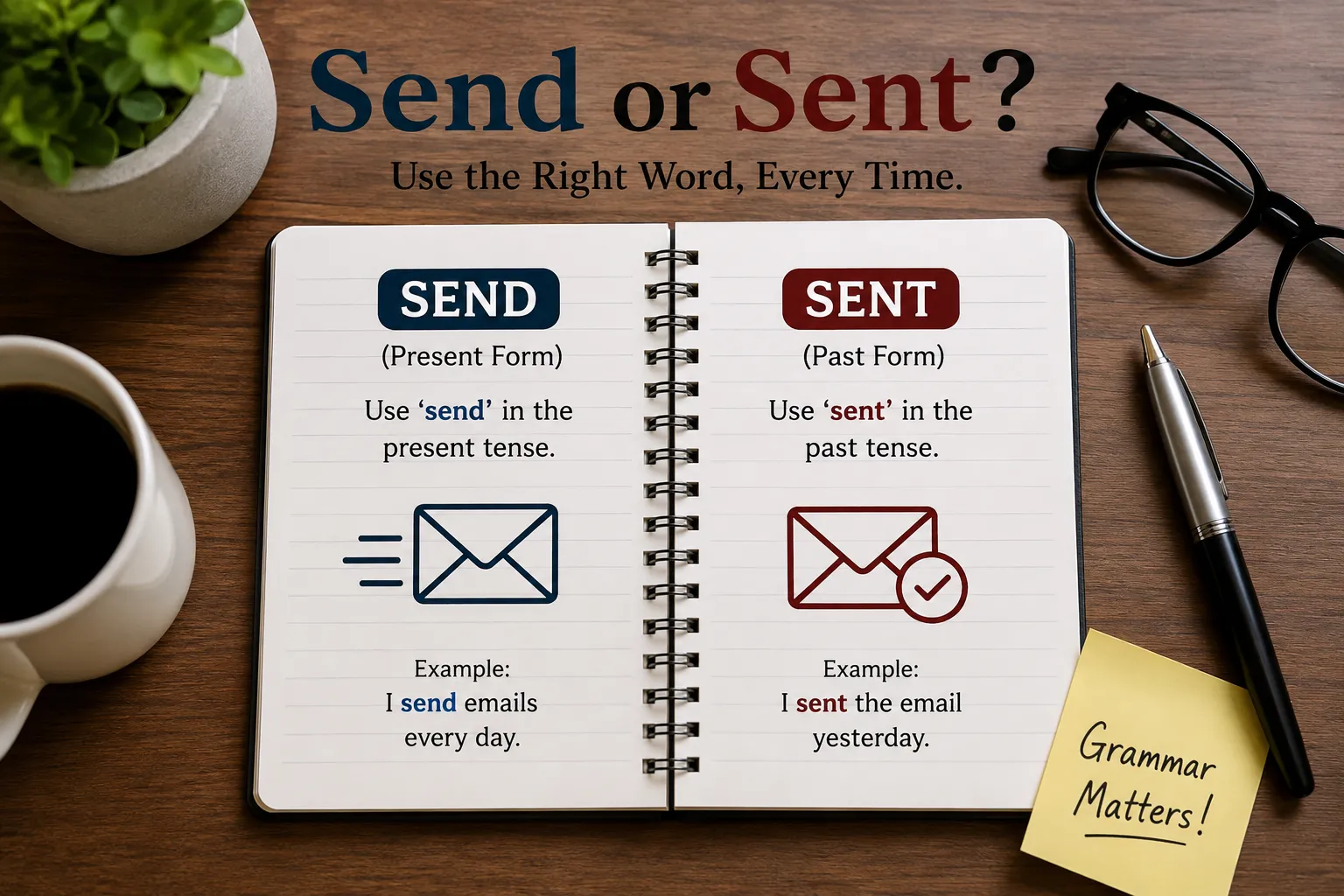
Send is the present or base form of the verb, while sent is its past tense and past participle. Use send for actions happening now or later, and sent for actions that already happened.
I still remember a small mistake I made while helping a learner write an important email. She had written, “I will sent the documents tomorrow.” The sentence looked almost right, but one little word was wrong. I changed sent to send and explained why.
That simple question led to a useful grammar lesson: Why do we say “I will send” but “I sent”?
I have come across this confusion many times while helping English learners improve their writing. It is easy to understand why. Send and sent come from the same verb, but they have different grammatical roles.
You might say, “I send emails every morning.” But if the email was already delivered, you would say, “I sent the email this morning.”
The difference becomes even clearer when words such as will, have, and did appear in a sentence. One small change can make an otherwise good sentence incorrect.
In this guide, you will learn exactly when to use send and sent, with simple rules, examples, common mistakes, and easy memory tips.
Send or Sent Quick Answer
Send is the base form and present-tense form of the verb. It means to cause something or someone to go somewhere, or to deliver something.
- “Please send me the file.”
- “I send my report every Friday.”
Sent is both the past tense and past participle of send. Merriam-Webster lists sent as the past tense and past participle of send.
- “I sent the file yesterday.”
- “She has sent the invitation.”
Cambridge Dictionary also identifies sent as the past tense and past participle of send.
The easiest rule
Think about time:
| If the action… | Use |
| Happens now or regularly | send |
| Happens after now | send |
| Happened in the past | sent |
| Follows have/has/had | sent |
| Follows will/can/should/must | send |
So:
I send the documents every Monday.
But:
I sent the documents yesterday.
And:
I will send the documents tomorrow.
The Origin and Background of Send
The history of send goes back much further than email, phones, or even modern English.
Etymonline traces the verb to Old English sendan, which meant to dispatch someone, cause something to go, or cause something to be delivered. The word later appeared in Middle English as senden.
This old meaning still fits modern English surprisingly well.
When you send an email, you cause the message to go to another person.
When you send a package, you arrange for it to travel to another place.
When you send someone a message, you cause information to reach that person.
The word has also developed many related uses. Merriam-Webster includes meanings such as deliver, dispatch, transmit, and cause to go.
That is why send appears in many everyday expressions:
- send an email
- send a letter
- send a message
- send a package
- send an invitation
- send someone home
- send information
- send a signal
The past form sent developed as the irregular past form of this common verb. English has many irregular verbs that do not form the past tense by simply adding -ed.
For example:
- go → went
- buy → bought
- write → wrote
- send → sent
This is one reason learners need to memorize send → sent rather than trying to create a form such as “sended.”
Send vs. Sent Explained: Key Differences
The main difference is grammar and time.
1. Send = base form
Use send after modal verbs and auxiliary structures that require the base form.
Examples:
- I will send the contract tonight.
- You should send the application today.
- Can you send me the address?
- They may send another message.
You can also use send for regular actions:
I send my parents photos every week.
Here, the action happens repeatedly.
2. Sent = past tense
Use sent when the action happened before now.
Examples:
- We sent the package last Tuesday.
- Maria sent her application yesterday.
- He sent me a reminder earlier.
- They sent the documents before lunch.
The time word often gives you a useful clue.
Look for words such as:
- yesterday
- last night
- last week
- earlier
- this morning
- two days ago
- in 2025
3. Sent = past participle
Sent is also the past participle. It commonly appears with have, has, or had.
Examples:
- I have sent the invoice.
- She has sent the details.
- They had sent the notice before the meeting.
Cambridge confirms that sent functions as both the past tense and past participle of send.
Comparison Table
| Term | Meaning | When to Use | Region/Context |
| send | Base/present verb | Now, regularly, or future actions | All major English varieties |
| sent | Past tense | Completed past actions | All major English varieties |
| sent | Past participle | With have/has/had | All major English varieties |
| sending | Present participle/gerund | Ongoing actions or noun-like use | All major English varieties |
Notice something important: British English and American English do not normally differ here. Both use send → sent.
This is not like spelling pairs such as colour/color or organise/organize. The form sent is standard across English varieties.
Which Version Should You Use?
Your choice depends on the grammar around the verb.
For a present or regular action → use send
I send invoices every Friday.
The action happens regularly.
For a completed past action → use sent
I sent the invoice yesterday.
The action is finished.
For a future action → use send
After will, use the base form:
I will send the information tomorrow.
Not:
I will sent the information tomorrow. ❌
After have, has, or had → use sent
She has sent the report.
Not:
She has send the report. ❌
For global or formal writing
There is no regional choice between send and sent. Both are standard English forms.
The key is not geography. The key is sentence structure and time.
Common Mistakes With Send and Sent
These errors are common because English uses irregular verb forms.
Mistake 1: Using “sent” after will
❌ I will sent the email tonight.
✅ I will send the email tonight.
Why?
After will, use the base form of the verb.
Mistake 2: Using “send” for a finished action
❌ I send the document yesterday.
✅ I sent the document yesterday.
Why?
“Yesterday” clearly places the action in the past.
Mistake 3: Using “send” after has
❌ She has send the file.
✅ She has sent the file.
Why?
The present perfect uses has/have + past participle.
Mistake 4: Creating “sended”
❌ He sended the message.
✅ He sent the message.
Why?
Send is an irregular verb. Its past form is sent, not “sended.”
Mistake 5: Using “sent” after can
❌ Can you sent me the link?
✅ Can you send me the link?
Why?
After a modal verb such as can, could, should, or must, use the base verb.
Send and Sent in Real-World Examples
Seeing these forms in everyday writing makes the grammar easier to remember.
Professional email
I will send the revised proposal after the final review.
The action has not happened yet, so send is correct.
News headline
Company sent emergency supplies to flood-hit areas
The headline describes an action that already happened, so sent works as the past form.
Social media post
Just sent my application! Now I can finally relax.
The application has already gone, so sent is appropriate.
Formal report
The research team sent the completed data set to the review committee on Monday.
The report describes a completed past event, so sent is correct.
Workplace conversation
“Can you send me the updated spreadsheet?”
The speaker is asking for an action to happen now or soon.
Customer service message
“We have sent your confirmation to the email address on file.”
The company says the action has already been completed.
These examples show why context matters more than the word alone.
Send and Sent Data, Trends & Usage
The search intent behind send or sent is mainly informational. People usually search the pair because they want to check grammar, especially before writing an email, message, application, or professional document.
There is no meaningful regional spelling split between these two forms. Unlike learnt/learned or dreamt/dreamed, send/sent is not a British-versus-American spelling issue.
What about word frequency?
Both forms are extremely common because send is a basic English verb used in communication, transport, instructions, and everyday conversation.
Large language corpora, including Google Books Ngram, can be used to study how often words appear in published writing. Research using Google Books Ngram data also shows how corpus data can be used to examine changes in word frequency over time.
However, a simple frequency comparison needs care. Send and sent do not perform the same grammatical job. One is the base form, while the other is a past form. Comparing their raw counts does not tell you that one is “more correct.”
Search-volume note
Exact monthly search volumes for phrases such as “send or sent” change by country, search platform, and keyword tool. Without a current Ahrefs or Semrush account dataset, it would be misleading to present a precise monthly number as fact.
The stronger SEO insight is clear: this is an educational grammar query. Searchers want a fast answer, examples, and a rule they can apply immediately.
Why does this matter now?
Digital communication makes this distinction especially useful.
You may use send and sent several times in one workday:
- sending an email
- sending a file
- sending a payment
- sending a message
- confirming something was sent
- asking someone to send information
For students, professionals, and ESL learners, knowing the difference helps make everyday writing more accurate.
Send vs. Sent: Standalone Comparison
| Term/Variant | Meaning | Region/Context | Best Used When |
| send | Base form of the verb | Standard English | After modals or for present/future actions |
| sent | Simple past form | Standard English | A completed action happened in the past |
| sent | Past participle | Standard English | Used with have, has, or had |
| sending | -ing form | Standard English | Describing an action in progress |
| sender | Person or system that sends something | Formal and everyday English | Naming the person or system doing the sending |
This table also shows why sending should not be confused with sent.
For example:
She is sending the documents.
But:
She sent the documents.
The first describes an action in progress. The second describes a completed action.
FAQs About Send and Sent
Q: What does send mean?
A: Send is a verb meaning to cause something or someone to go somewhere or to deliver something. Cambridge Dictionary includes meanings such as arranging for something to go somewhere and causing someone to go somewhere.
Q: What is the past tense of send?
A: The past tense is sent. It is an irregular verb form, so you should not write “sended.” Merriam-Webster lists sent as the past tense and past participle of send.
Q: Should I say “I send it yesterday” or “I sent it yesterday”?
A: Say “I sent it yesterday.” The word “yesterday” places the action in the past, so the past form is needed.
Q: Should I use send after will?
A: Yes. Use the base verb after will: “I will send the document.” Do not use “will sent.”
Q: Is “sent” a past participle?
A: Yes. Sent works as both the simple past form and the past participle of send. You can use it after have, has, or had, such as “They have sent the package.”
Q: Is send or sent correct in formal writing?
A: Both are correct. The choice depends on the grammar and timing of the sentence. Neither form is more formal than the other.
Q: Where does the word send come from?
A: Etymonline traces send to Old English sendan, with meanings connected to dispatching or causing something to go. It later appeared in Middle English as senden.
Q: Can I say “Please sent me the file”?
A: No. Write “Please send me the file.” The word “please” introduces a request, and requests use the base verb.
Q: What is the easiest way to remember send and sent?
A: Remember this simple pattern: send = now/future/base form; sent = past/completed form. Also remember will send and have sent.
Final Thoughts: Send or Sent?
The difference between send and sent is small, but it matters.
Send is the base form. Use it for present habits, requests, instructions, and future actions. It also follows modal verbs such as will, can, should, and must.
Sent is the past tense and past participle. Use it when an action happened before now or when it follows have, has, or had.
The word itself has a long history. Etymonline traces it back to Old English, while modern dictionaries such as Cambridge and Merriam-Webster confirm its current grammatical forms.
The best memory trick is simple:
I send it today.
I sent it yesterday.
I will send it tomorrow.
I have sent it already.
Once you connect the verb to the time and the helping verb around it, the choice becomes much easier.
Bookmark this guide so you never second-guess send and sent again.
Read More:
Analyse or Analyze: Which Spelling Is Correct?

I specialize in English grammar, spelling, word choice, and language usage. My content is based on research from grammar references, style guides, dictionaries, and real-world usage to ensure it is accurate and practical.
At Spelling Comparison, I write guides that explain why words are confused, how they are used, and which form is correct in context. I also include proofreading tips, examples, and writing advice readers can apply immediately.
My goal is to publish clear, reliable content that helps readers make better writing decisions. Each guide is written for accuracy, clarity, and usefulness in school, work, business, and everyday communication.