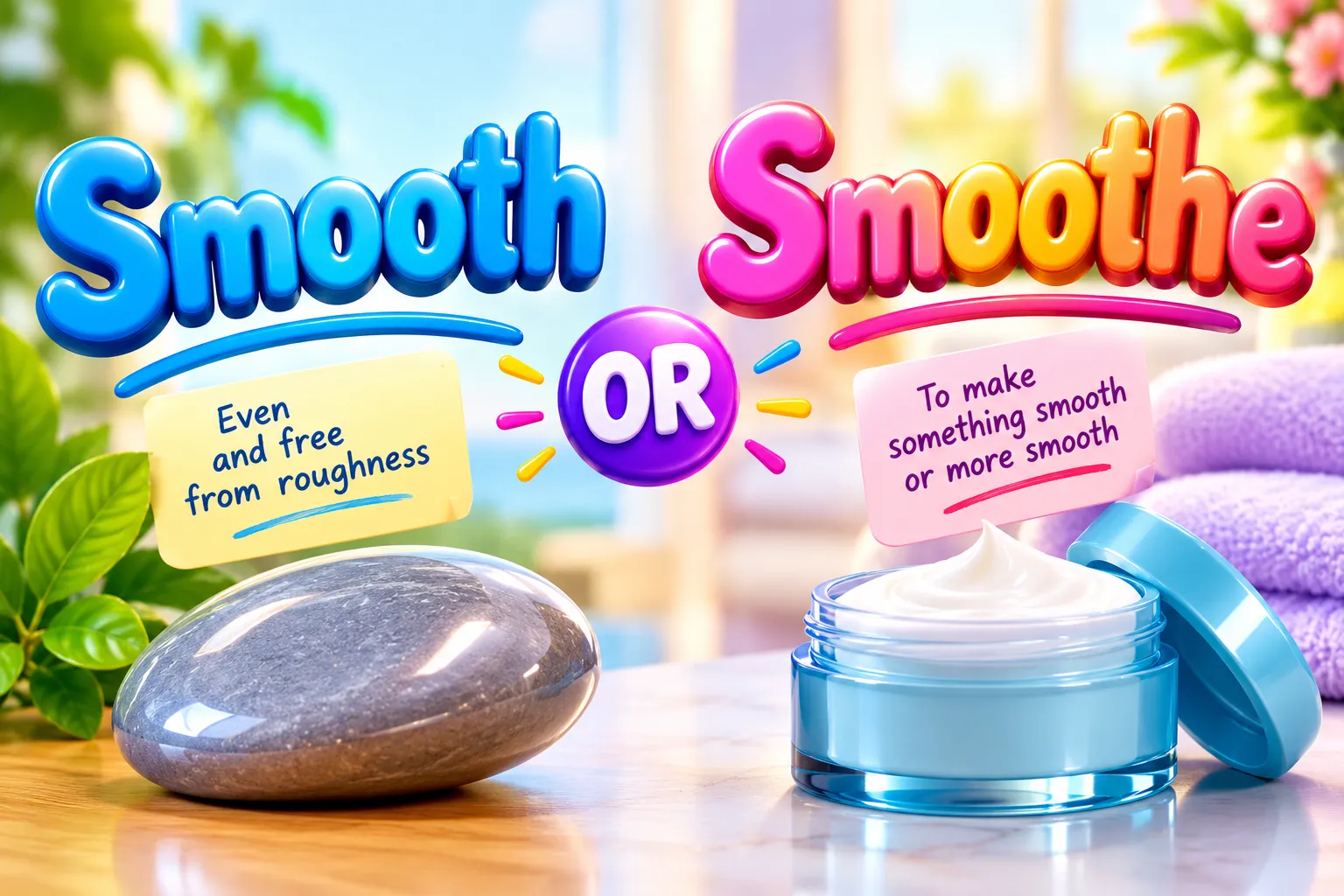
Smooth is the correct and standard spelling for the adjective and verb, while smoothe is an uncommon variant that is generally avoided in modern English.
Have you ever typed smooth and then paused because smoothe suddenly looked right too? I have had that moment while editing English text. A word can look strange after you stare at it for a few seconds, even when you have used it many times before.
This pair causes confusion because smooth already works in several ways. It can describe a soft surface, calm movement, easy progress, or a pleasant manner. It can also work as a verb, as in smooth the paper. That wide range of uses can make the less common spelling smoothe seem possible.
The good news is simple: you usually do not need to think twice.
Smooth is the normal modern spelling. It is the form you should use in everyday English, schoolwork, business writing, websites, and formal documents. Smoothe does appear in historical and occasional modern usage, but it is not the standard choice for most writing.
Let us look at the meaning, history, grammar, examples, and common mistakes so you can use smooth with confidence.
Smooth or Smoothe Quick Answer
Smooth is the standard spelling in modern English. It can be an adjective, verb, noun, and, in some uses, an adverb.
For example:
The table has a smooth surface.
Here, smooth is an adjective.
You can also use it as a verb:
Please smooth the paper before you write on it.
Smoothe is much less common. If you are writing for a general audience, smooth is the clear choice.
The Origin and Background of Smooth
The history of smooth is older than its modern spelling may suggest.
According to Merriam-Webster, smooth has been used in English for a very long time and can describe something free from roughness or irregularity. The word also developed wider meanings related to ease, calmness, and polished behavior.
The Online Etymology Dictionary traces smooth to Old English smōth, with the basic sense connected to something even or free from roughness. Its meaning later expanded into ideas such as being easy, gentle, and polished.
That history helps explain why smooth has so many meanings today.
English spelling has changed over centuries. Older texts can contain forms that are rare or unusual in modern writing. Smoothe is one form that readers may encounter, but its presence does not make it the preferred modern spelling.
This is also a useful lesson in etymology. A word’s historical forms do not always tell you which spelling is best today.
Smooth Explained: Meaning, Grammar, and Usage
Smooth has several common meanings. Its part of speech depends on how you use it.
1. Smooth as an adjective
As an adjective, smooth can describe something that has an even surface.
The stone feels smooth in my hand.
It can also describe movement or progress that happens without problems.
The meeting went smoothly.
Here, the adjective is smooth, while smoothly is the adverb.
2. Smooth as a verb
Smooth can also mean to make something even or less rough.
She used a cloth to smooth the fabric.
It can also mean to make a situation easier or less difficult.
He tried to smooth the disagreement.
3. Smooth as a noun
In some contexts, smooth can be used as a noun.
For example, in surfing, a smooth may refer to smooth water or a smooth condition, depending on context. This use is much less common than the adjective and verb.
4. Smooth in informal descriptions
You may also hear smooth used to describe someone who acts in a confident or polished way.
She gave a smooth presentation.
The exact meaning depends on the context.
Smooth vs. Smoothe: Key Difference
The main difference is modern spelling and usage, not meaning.
| Term | Meaning | When to Use | Region/Context |
| Smooth | Even, gentle, easy, polished, or free from roughness | Standard modern English | General English |
| Smoothe | Variant form related to smooth | Rare or historical contexts | Uncommon modern usage |
If your goal is clear communication, smooth should be your default.
Examples with Smooth
- The road became smooth after the repairs.
- She gave a smooth and confident speech.
- Use your hand to smooth the paper.
- The project had a smooth start.
These examples show how the same spelling can serve different grammatical roles.
Which Version Should You Use?
For most writers, the choice is easy.
For students
Use smooth in essays, homework, exams, and academic assignments. It is the standard spelling and will be understood without confusion.
For professional writers
Choose smooth in emails, reports, articles, product descriptions, and business documents. It fits both formal and everyday English.
For English learners
Learn smooth as the main spelling. There is little practical benefit in using smoothe in ordinary modern writing.
For historical or literary research
You may encounter smoothe in older texts or unusual sources. In that case, keep the original spelling when quoting historical material, but do not assume that it is the normal modern form.
For global English
Smooth is the safest option for readers from different English-speaking regions.
Common Mistakes with Smooth
Because smooth has several meanings, learners can make different kinds of errors.
| Mistake | Correct Form | Why? |
| The surface is smoothe. | The surface is smooth. | Smooth is the standard spelling. |
| She moved smooth across the floor. | She moved smoothly across the floor. | An adverb is needed to describe the verb. |
| He smoothedly fixed the issue. | He smoothly fixed the issue. | Smoothly is the standard adverb. |
| Please smoothe the paper. | Please smooth the paper. | Smooth is the standard verb. |
| The process was smoothly. | The process was smooth. | An adjective follows the linking verb was. |
Why do these mistakes happen?
The first problem comes from treating smoothe as if it were a regular spelling variant.
Other errors happen because English learners confuse adjectives and adverbs. Compare:
- smooth process → adjective
- smoothly completed → adverb
- smooth the surface → verb
Learning the grammar around a word is often more useful than memorizing its spelling alone.
Smooth in Real-World Examples
Seeing a word in different settings can make its usage easier to remember.
Professional email
“Thank you for your help. Your quick response made the transition smooth and simple.”
News headline
New System Aims to Make Airport Travel Smoother
Here, smoother is the comparative form of smooth.
Social media post
“A quiet morning, a warm cup of coffee, and a smooth start to the day.”
Formal report
“The revised process was designed to ensure a smooth transfer of information between departments.”
Notice that smooth works naturally in casual, professional, and formal contexts.
Smooth: Data, Trends, and Usage
Exact monthly search volumes for “smooth or smoothe” can change by country, language, and SEO platform. Google Trends, Semrush, and Ahrefs also use different datasets and methods, so a single search-volume number should not be treated as a universal fact.
However, dictionary evidence gives us a clear usage signal.
Cambridge Dictionary lists smooth as a standard English word with meanings connected to surfaces, movement, behavior, and progress.
Merriam-Webster also provides extensive modern definitions and examples for smooth, covering both adjective and verb uses.
This makes the practical search intent behind smooth or smoothe quite clear: readers are usually trying to determine which spelling they should use.
For SEO writers, students, and English learners, the useful takeaway is not a questionable search-volume estimate. It is the strong dictionary distinction between a standard modern form and a rare variant.
The topic also connects with other spelling questions such as advice or advise, practice or practise, and licence or license. In each case, context and regional English can affect the answer.
Smooth or Smoothe: Standalone Comparison
| Term/Variant | Meaning | Region/Context | Best Used When |
| Smooth | Even, gentle, easy, or polished | Modern English | Almost all normal writing |
| Smoothe | Rare variant of smooth | Historical or uncommon usage | Mainly when preserving an original form |
| Smoother | More smooth or more even | Modern English | Comparing two things |
| Smoothest | Most smooth or even | Modern English | Comparing three or more things |
| Smoothly | In a smooth manner | Modern English | When describing an action |
This table shows an important point: smooth also forms common words such as smoother, smoothest, and smoothly.
Frequently Asked Questions
Q: What does smooth mean?
A: Smooth can mean even and free from roughness. It can also describe something calm, easy, gentle, or well-managed, depending on the context.
Q: Is smooth the correct spelling?
A: Yes. Smooth is the standard modern spelling. It is the form you should normally use in everyday, academic, and professional English.
Q: Is smoothe a word?
A: Smoothe can be found as a rare variant, but it is not the normal spelling in modern English. For general writing, choose smooth.
Q: What is the difference between smooth and smoothly?
A: Smooth is commonly an adjective, while smoothly is an adverb. For example, you can describe a smooth process but say that the process worked smoothly.
Q: Can smooth be used as a verb?
A: Yes. As a verb, smooth can mean to make something even or less rough. It can also mean to make a difficult situation easier.
Q: Where does the word smooth come from?
A: The word has roots in Old English smōth. The basic idea was connected with something even or free from roughness, and its meanings expanded over time.
Q: Should I use smoothe in formal writing?
A: Usually, no. Smooth is the safer and more widely recognized spelling for formal writing. A historical quotation may preserve an older or unusual spelling.
Final Thoughts: Smooth or Smoothe?
When you see smooth and smoothe side by side, the choice may look harder than it really is.
Smooth is the standard spelling used in modern English. It can describe a surface, movement, process, person, or experience. It can also work as a verb when you mean to make something even or easier.
Smoothe is much less common. You may encounter it in older material or unusual usage, but it is not the spelling most readers expect today.
For school assignments, websites, business writing, emails, and everyday communication, stick with smooth. It is simple, clear, and widely understood.
The bigger lesson is useful, too. When two spellings look possible, check how modern dictionaries treat them before choosing one. A quick check can prevent an avoidable spelling mistake.
Bookmark this guide so you never have to second-guess “smooth or smoothe” again
Read More:
Psoriasis or Eczema: Easy Ways to Tell the Difference

I’m **James Whitmore**, a professional editor and English language content writer with more than 10 years of experience creating educational content. I specialize in spelling comparisons, grammar, vocabulary, synonyms, commonly confused words, proofreading, and English usage. My goal is to help readers write with confidence by providing clear, accurate, and well-researched articles that make complex language topics easy to understand.










