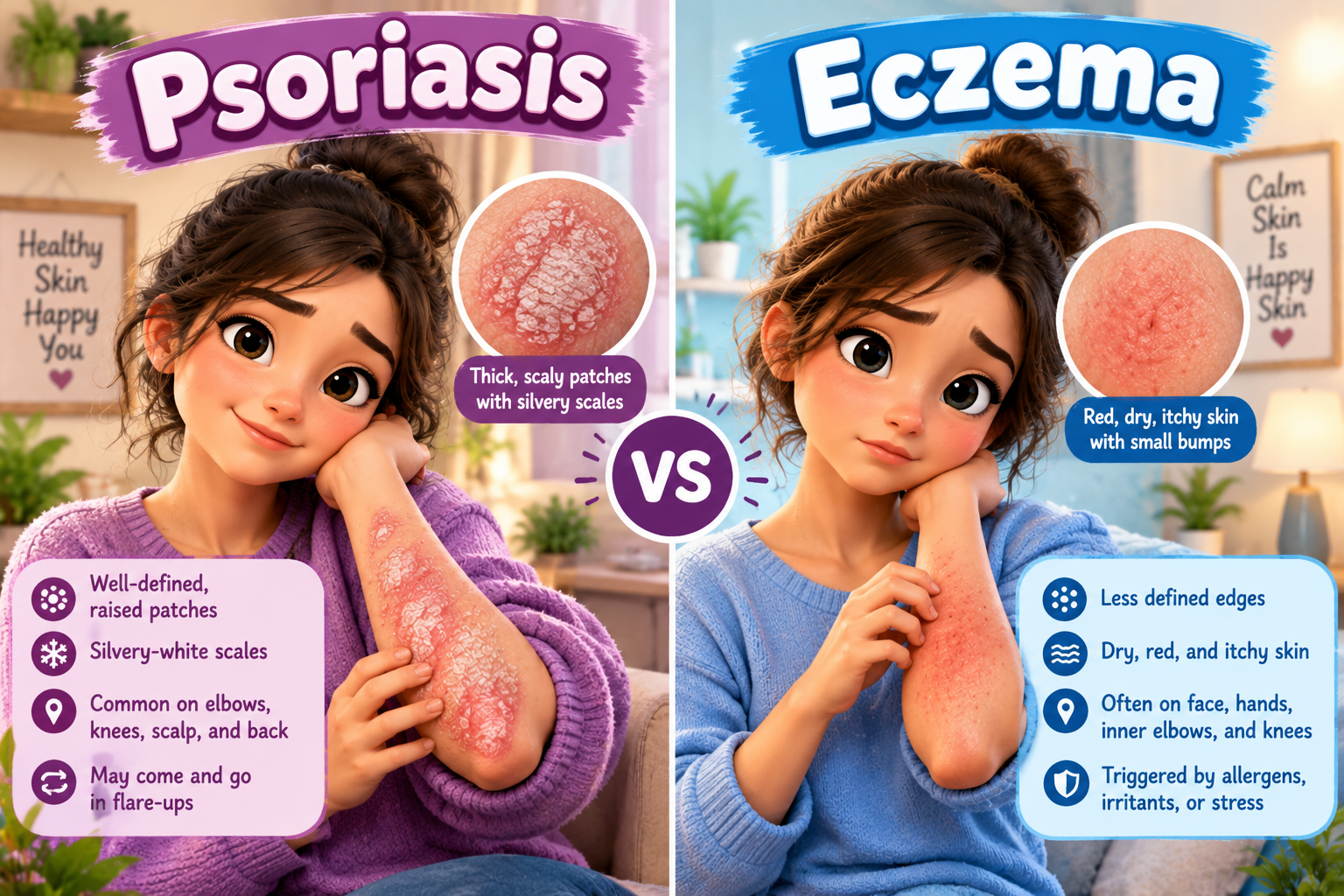
Psoriasis or eczema refers to two different inflammatory skin conditions that can both cause dry, itchy, irritated skin. Psoriasis often causes thicker, well-defined scaly patches, while eczema is usually linked with intense itching, dryness, and inflammation
Have you ever looked at a red, dry patch of skin and wondered, “Is this psoriasis or eczema?” I’ve seen how easy it is to confuse the two. At first glance, both can look like nothing more than dry or irritated skin. The real difference often becomes clearer when you look at where the rash appears, how it feels, and what the skin looks like.
I used to think the main clue was simply redness. But that is not enough. Skin tone can change how these conditions appear, and some people can even have both conditions at the same time. The American Academy of Dermatology notes that psoriasis and eczema can overlap, which can make self-identification difficult.
That is why the question “psoriasis or eczema?” is so common.
In this guide, I’ll break down the key differences in simple language. You’ll learn how each condition typically looks, where it appears, what can trigger it, how doctors diagnose it, and when it is time to seek medical advice.
Psoriasis or Eczema Quick Answer
Psoriasis and eczema are both inflammatory skin conditions, but they are not the same disease.
Psoriasis happens when the body makes new skin cells too quickly. The extra cells build up and create thick, raised patches. Plaque psoriasis often appears on the elbows, knees, scalp, and lower back.
Eczema is a broader term for several conditions that cause itchy, dry, inflamed skin. Atopic dermatitis is the most common type. It often affects the folds of the elbows and knees, hands, face, or other areas depending on age.
A simple way to remember the difference is:
- Psoriasis: often thicker, raised, and clearly defined.
- Eczema: often very itchy, dry, and irritated.
- Both: can cause itching, inflammation, scaling, and flare-ups.
These are useful clues, but they are not a diagnosis.
The Background of Psoriasis and Eczema
The two conditions can look similar because both involve inflammation in the skin. But the processes behind them are different.
What causes psoriasis?
Psoriasis is associated with an immune-system problem that causes skin cells to develop much faster than normal. Those cells then build up on the surface of the skin.
The result can be thick, raised plaques covered with scale. The American Academy of Dermatology says plaque psoriasis accounts for about 80% to 90% of psoriasis cases.
Psoriasis is also not contagious. You cannot catch it from touching someone who has it.
What causes eczema?
Eczema is a group of skin conditions. Atopic dermatitis, often simply called eczema, is the most common type.
It can cause very itchy and dry skin. Scratching can make the skin raw, cracked, thickened, or damaged. Flare-ups can come and go over time.
Eczema can be affected by different triggers. These may include soaps, detergents, some fabrics, heat, allergens, infections, stress, and changes in temperature.
Like psoriasis, atopic eczema is not contagious.
Psoriasis or Eczema Explained Key Differences
The easiest way to compare the two is to look at several features together.
| Term | Meaning | When to Consider It | Region/Context |
| Psoriasis | Chronic inflammatory skin condition that can cause thick, raised, scaly patches | Thick plaques with clear edges are present | Often elbows, knees, scalp, and lower back |
| Eczema | Group of conditions that cause itchy, dry, inflamed skin | Severe itching and dry, irritated skin are prominent | Often skin folds, hands, face, or other areas |
| Atopic dermatitis | The most common type of eczema | Long-term itchy, dry, inflamed skin | Common in children but can affect adults |
| Plaque psoriasis | The most common type of psoriasis | Raised plaques with scale develop | Commonly knees, elbows, scalp, and lower back |
1. How the skin looks
Psoriasis often creates thick, raised patches with visible scale. Plaque psoriasis may have a fairly clear border around the affected area.
Eczema can look different from person to person. The skin may become dry, cracked, scaly, swollen, or discolored. On darker skin tones, eczema may appear brown, purple, gray, or darker than the surrounding skin rather than bright red.
2. How much it itches
Both conditions can itch.
However, eczema often causes intense itching. Scratching can then damage the skin and create another cycle of irritation.
Psoriasis can also be itchy, but the appearance of the plaques, their thickness, and their location can provide additional clues.
3. Where it appears
Location can be helpful, although it is not a perfect rule.
Psoriasis commonly affects the scalp, elbows, knees, and lower back.
Atopic eczema commonly affects the folds of the elbows and knees. In babies, it may appear on the face and scalp. Adults may also develop it on the hands, face, neck, or around the eyes.
4. Can you have both?
Yes.
The American Academy of Dermatology explains that psoriasis and eczema can overlap, and some people can have both conditions.
That is one reason a picture on the internet cannot reliably tell you what your rash is.
Which One Should You Use?
If you are trying to decide whether a skin problem is psoriasis or eczema, focus on the symptoms rather than trying to label the condition yourself.
If you notice very thick, raised plaques
Psoriasis may be one possibility, especially when the patches have clear edges and visible scale.
If severe itching is the main problem
Eczema may be one possibility, particularly when the skin is very dry, irritated, cracked, or repeatedly affected by flare-ups.
If the rash keeps returning
Do not assume that it is simply dry skin. Recurring rashes can have several causes, and different skin conditions can require different treatments.
If you are unsure
A dermatologist can examine the skin and consider your symptoms, medical history, and where the rash appears. In some cases, a skin biopsy may be needed.
The safest approach is to get a diagnosis instead of treating an unknown rash based only on appearance.
Common Mistakes With Psoriasis and Eczema
Here are some mistakes people often make when comparing the two.
Mistake 1: Assuming every itchy rash is eczema
Wrong: “It itches, so it must be eczema.”
Better: Itching occurs with both eczema and psoriasis, as well as other skin conditions.
Mistake 2: Assuming every scaly patch is psoriasis
Wrong: “There are scales, so it has to be psoriasis.”
Better: Scaling can occur with several skin conditions. A healthcare professional may need to examine the skin.
Mistake 3: Treating psoriasis and eczema as the same disease
Wrong: Using the terms as if they mean exactly the same thing.
Better: Remember that eczema describes a group of conditions, while psoriasis is a distinct inflammatory skin disease.
Mistake 4: Ignoring skin tone
Wrong: Expecting every case to look bright red.
Better: Skin conditions can look different across skin tones. Eczema and psoriasis may appear brown, purple, gray, darker, or lighter depending on the person.
Mistake 5: Diagnosing yourself from one photograph
Wrong: Matching your rash to a single online picture.
Better: Use online information to learn, but see a clinician if you need an actual diagnosis.
Psoriasis or Eczema in Real-World Examples
Understanding the words in context can make the difference easier to remember.
Professional email
“I have developed a persistent skin rash and would like to schedule an appointment to determine whether it could be eczema or psoriasis.”
News-style headline
New Research Examines Better Ways to Manage Psoriasis and Eczema
Social media post
“My skin has been unusually itchy this week, so I’m going to speak with a dermatologist rather than guessing whether it’s eczema.”
Formal medical report
“The patient reported recurring itchy patches and was referred for dermatological assessment.”
These examples show an important point: psoriasis and eczema are medical terms, not interchangeable labels for every skin rash.
Psoriasis or Eczema Data, Trends & Usage
People searching “psoriasis or eczema” usually have an informational search intent. They want to understand a rash, compare symptoms, or learn what separates the two conditions.
Exact monthly search volumes change by country, language, and month. I would not treat an unverified SEO-tool estimate as a medical fact, so this guide does not invent a search-volume number.
There is, however, a clear reason the comparison remains useful. The American Academy of Dermatology specifically notes that psoriasis and eczema can look alike, and that distinguishing them may require looking at the skin, the amount of itching, and where the condition appears.
Another useful insight is that skin appearance alone is not always enough. Eczema can vary by age and skin tone, while psoriasis can also look different across skin tones.
For readers, the practical takeaway is simple: online information can help you understand the difference, but it should not replace a professional diagnosis.
A Simple Comparison to Remember
| Term/Variant | Meaning | Region/Context | Best Used When |
| Psoriasis | A distinct inflammatory skin condition | Used worldwide in medical care | Talking about a confirmed or suspected psoriasis diagnosis |
| Eczema | A group of inflammatory skin conditions | Used widely in everyday and medical language | Describing eczema generally |
| Atopic dermatitis | A specific type of eczema | Common medical term | Discussing the most common form of eczema |
| Plaque psoriasis | The most common type of psoriasis | Medical context | Describing raised, scaly plaques |
| Dermatitis | A general term for skin inflammation | Medical context | Discussing inflammation when the exact condition is not yet established |
One useful distinction is that “eczema” is broader than “atopic dermatitis.” The American Academy of Dermatology explains that atopic dermatitis is one type of eczema.
FAQ: Psoriasis or Eczema
Q: What is the main difference between psoriasis and eczema?
A: Psoriasis commonly causes thicker, raised, well-defined scaly patches. Eczema often causes very itchy, dry, inflamed skin. However, symptoms can overlap, so appearance alone cannot always identify the condition.
Q: Is eczema the same as atopic dermatitis?
A: Not exactly. Eczema is a broad term for a group of skin conditions, while atopic dermatitis is one specific type of eczema. It is also the type most people mean when they use “eczema” in everyday conversation.
Q: Can psoriasis and eczema occur together?
A: Yes. Some people can have both conditions. Because their symptoms can overlap, a dermatologist may be needed to determine what is affecting the skin.
Q: Is psoriasis contagious?
A: No. Psoriasis cannot be spread through ordinary contact such as touching or swimming with someone who has the condition.
Q: Is eczema contagious?
A: Atopic eczema is not contagious. You cannot catch it from another person through normal contact.
Q: Can I tell whether I have psoriasis or eczema at home?
A: You can learn about common signs, but you cannot reliably diagnose yourself from symptoms alone. A dermatologist may examine your skin and ask about your symptoms, family history, and triggers.
Q: When should I see a doctor about a rash?
A: Consider medical advice when a rash keeps returning, becomes painful, spreads, affects your daily life, or does not improve with basic skin care. Seek urgent medical help if eczema becomes painful, swollen, warm, blistered, crusted, or starts leaking fluid, especially with a fever or feeling unwell.
Conclusion
When you are looking at an unfamiliar rash, psoriasis or eczema can seem like a difficult choice. Both conditions can cause dry, irritated, itchy, or scaly skin. That is where the confusion begins.
The biggest clues are the appearance, location, thickness, and level of itching. Psoriasis often produces thick, raised plaques with scale. Eczema is often marked by intense itching, dryness, and inflammation. But these patterns are clues, not a substitute for diagnosis.
It also helps to remember that eczema is a broad term, while atopic dermatitis is one type of eczema. Psoriasis is a separate condition, and some people may have both.
If you are dealing with a persistent or unexplained rash, getting the right diagnosis matters because treatment depends on the condition and the individual. A dermatologist can help identify the cause and create an appropriate treatment plan.
Save this guide for reference, and share it with someone who is trying to understand the difference between psoriasis and eczema.
Read More:
Hoody or Hoodie: The Easy Spelling Guide

I specialize in English grammar, spelling, word choice, and language usage. My content is based on research from grammar references, style guides, dictionaries, and real-world usage to ensure it is accurate and practical.
At Spelling Comparison, I write guides that explain why words are confused, how they are used, and which form is correct in context. I also include proofreading tips, examples, and writing advice readers can apply immediately.
My goal is to publish clear, reliable content that helps readers make better writing decisions. Each guide is written for accuracy, clarity, and usefulness in school, work, business, and everyday communication.










