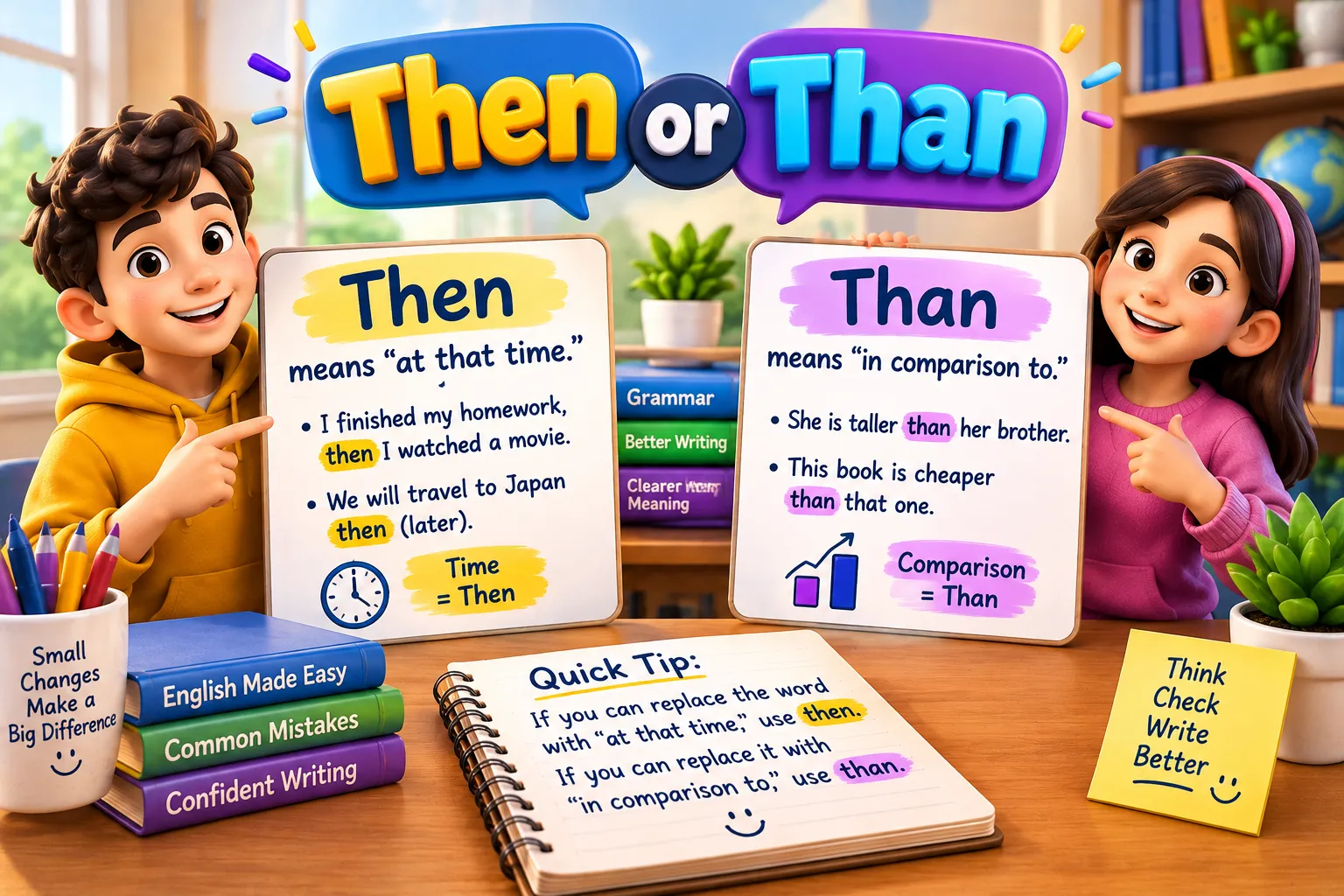
Then or than depends on the meaning: use then for time, order, or results, and use than for comparisons
Have you ever typed a sentence, stopped, and wondered: “Is it then or than?”
You are not alone. I have seen this small spelling choice cause problems in school essays, emails, social posts, and even polished business writing. The words differ by only one letter, and they can sound very similar in fast speech.
But their jobs are different.
Than, on the other hand, is mainly used for comparison. It helps you compare people, things, amounts, actions, or ideas.
That gives you a simple starting point:
Then = time or order.
Than = comparison.
Still, a few sentences can make the choice less obvious. What about “rather than”? What about “if…then”? And why did these two words become so easy to confuse?
Let’s break it down.
Then or Than Quick Answer
Use then when your sentence talks about when something happens, what happens next, or what follows as a result.
Use than when your sentence compares two things.
| Word | Main Job | Simple Memory |
| Then | Time, order, or result | Then = when / next |
| Than | Comparison | Than = compare |
For example:
- “We finished the meeting, then we went home.”
- “This route is shorter than the other one.”
Cambridge Dictionary lists then as an adverb with meanings such as “at that time,” “next,” and “in that case.” Than is used to join parts of a comparison.
The trick is to ask yourself one question:
Am I talking about time or comparing something?
If it is time or sequence, choose then.
If it is a comparison, choose than.
The Origin and Background of Then or Than
The history of then and than explains why they can be so confusing.
These words are closely related. Etymonline traces then to Old English forms such as þanne, þænne, and þonne. The word originally carried meanings connected with that time and that situation.
Than has an even more interesting story.
Etymonline explains that than came from Old English þan and developed from the same word family as then. The two spellings were not clearly separated until around 1700.
So the confusion has deep linguistic roots.
In older English, the distinction between the two forms was not as firm as it is today. Over time, spelling and grammatical use separated.
Today, their functions are much easier to define:
- Then is mainly an adverb.
- Than functions as a conjunction and preposition.
- Then can relate to time, sequence, or consequence.
- Than introduces the second part of a comparison.
This is a useful example of language change. Words can begin with closely related forms and later develop different roles.
Why do they still cause mistakes?
There are several reasons.
First, the spelling is almost identical.
Second, their pronunciation can be close, especially in quick speech.
Third, both appear in very common phrases.
Compare:
- better than
- finish, then
- more than
- back then
- rather than
- if…then
A writer who focuses only on sound can easily choose the wrong spelling.
Then or Than Explained Key Differences
The clearest way to understand the difference is to look at the job each word performs.
| Term | Meaning | When to Use | Region/Context |
| Then | At that time | Talking about a past or future point | Standard English |
| Then | Next or afterward | Showing sequence | Standard English |
| Then | In that case / as a result | Showing a result or consequence | Standard English |
| Than | Used in comparisons | Comparing two or more things | Standard English |
| Than | Used after phrases such as “rather than” | Showing preference or alternative | Standard English |
1. Then for time
Use then when you mean at that time.
“I was living in Lahore then.”
The word points to a particular period.
Cambridge gives then this time-related meaning for both past and future situations.
2. Then for sequence
Use then when one event follows another.
“Open the file, then check the final page.”
Here, then means something like next.
This use is common in instructions, stories, recipes, and everyday conversation. Cambridge specifically identifies “next” as one of the main meanings of then.
3. Then for a result
You can also use then to show a consequence.
“If the weather improves, then we can continue the match.”
This is the familiar if…then structure.
The first part gives the condition. The second part gives the result.
4. Than for comparison
Use than when comparing two things.
“This laptop is lighter than my old one.”
The sentence compares two laptops.
Cambridge describes than as a word used to join two parts of a comparison. It also appears with more and less when comparing amounts or numbers.
5. Than with preferences
Than also appears in structures such as:
- rather than
- more than
- less than
- better than
- worse than
For example:
“I would rather walk than wait for the bus.”
There is a comparison between two choices.
Which Version Should You Use?
Your decision can be very quick.
For time
Choose then.
“We lived there then.”
Think: When?
For order
Choose then.
“First read the question, then write your answer.”
Think: What happens next?
For a result
Choose then.
“If you finish early, then you can leave.”
Think: What happens because of this?
For comparisons
Choose than.
“Your new design looks better than the old one.”
Think: What am I comparing?
For formal or academic writing
Use the same rule. There is no special formal version.
The correct choice depends on meaning, not on whether your writing is formal or informal.
A useful shortcut is:
Time → THEN
Comparison → THAN
You can also remember the spelling:
ThAn = compArison
It is a memory trick, not a grammar rule, but it can help.
Common Mistakes With Then or Than
Mistake 1: “Better then”
❌ “This version is better then the first one.”
✅ “This version is better than the first one.”
Why? You are comparing two versions.
Mistake 2: “First this, than that”
❌ “First save the file, than close the program.”
✅ “First save the file, then close the program.”
Why? The sentence shows sequence. Closing comes next.
Mistake 3: “More then”
❌ “The box weighs more then five kilograms.”
✅ “The box weighs more than five kilograms.”
Why? More than is a comparison of amount.
Mistake 4: “Back than”
❌ “Things were different back than.”
✅ “Things were different back then.”
Why? Then refers to a past time.
Mistake 5: “Rather then”
❌ “I would stay home rather then drive.”
✅ “I would stay home rather than drive.”
Why? Rather than is a standard comparison or preference structure.
Then or Than in Real World Examples
Seeing the words in different settings can make the distinction easier to remember.
Professional email
“Please review the attached figures, then send your comments before Friday.”
Here, then shows the order of two actions.
News headline
“Food prices rose faster than household incomes last year.”
Here, than introduces a comparison.
Social media post
“I thought the trip would be tiring, but it was more fun than I expected.”
The word than connects two levels of expectation.
Formal report
“The second test produced better results than the initial trial.”
Again, than connects the two items being compared.
Everyday conversation
“Finish your coffee, then we can leave.”
The action of leaving comes after finishing the coffee.
Then or Than Data, Trends & Usage
Exact current monthly search-volume figures for “then or than” are not publicly verified in the sources reviewed here. It would be misleading to present an invented number as an Ahrefs, Semrush, or Google figure.
Search results do show that then vs. than remains an active grammar topic in 2026, with recent educational guides focused on the same confusion.
There is also useful corpus evidence for the phrases in which the distinction matters.
For example, Google Books’ Ngram Viewer can track words and phrases across large collections of published books and compare their frequency over time. Its data can also be searched for specific phrases and grammatical patterns.
A practical corpus comparison is especially useful with phrases such as “better than” and the incorrect “better then.” Google Books provides an Ngram comparison for those two phrases across its English corpus.
The broader usage pattern is clear:
- Then appears in descriptions of time and sequence.
- Than appears in comparisons.
- Grammar searches are largely informational.
- Students, ESL learners, writers, and professionals all have reasons to check the distinction.
- Digital writing makes quick spelling errors easier to publish.
This last point matters. A one-letter mistake can change a correct comparison into a grammar error.
That is why learning the function of each word is more useful than memorizing dozens of sentences.
Standalone Then or Than Comparison Table
| Term/Variant | Meaning | Region/Context | Best Used When |
| Then | At a particular time | Past or future | You mean “at that time” |
| Then | Next or afterward | Instructions and sequences | One action follows another |
| Then | In that case | Conditional statements | You want to show a result |
| Than | Comparison | General English | You compare people, things, or ideas |
| Than | Alternative or preference | “Rather than” structures | You choose one option over another |
| Then in “okay then” | In that case | Informal conversation | You accept or respond to a situation |
| Than in “more than” | Greater amount or degree | Numbers and quantities | You compare amounts |
The key is not the position of the word. The key is its job.
FAQ: Then or Than
Q: What does “then” mean?
A: Then can refer to a particular time, the next event, or a result. It can mean “at that time,” “next,” or “in that case,” depending on the sentence.
Q: What does “than” mean?
A: Than is mainly used to introduce the second part of a comparison. It commonly appears after words such as more, less, better, faster, taller, and rather.
Q: Is it “better then” or “better than”?
A: The correct form is better than. The sentence compares two things, so than is required.
Q: Is it “more then” or “more than”?
A: Use more than. For example, “The building has more than ten floors.” The phrase compares an amount with a reference point.
Q: Is “okay then” correct?
A: Yes. Okay then is correct because then can mean “in that case.” Than would not fit because no comparison is being made.
Q: Where do then and than come from?
A: Both have roots in Old English and were historically closely related. Etymonline explains that than developed from the same word family as then, and the spellings became distinct much later.
Q: Can “than” be used without comparing two people?
A: Yes. A comparison can involve things, amounts, actions, or ideas. For example, “more than expected” compares the actual amount with an expectation. Cambridge lists this type of use with numbers and amounts as well.
Conclusion
The difference between then or than becomes simple once you focus on meaning rather than spelling.
Use then when your sentence deals with time, sequence, or a result. It can point to a past moment, show what happens next, or connect a condition with its outcome.
Use than when you are comparing. It appears in common structures such as better than, more than, less than, faster than, and rather than.
The history also explains why the words feel so similar. They share an old linguistic connection, and their spellings were not always separated as clearly as they are today.
When you are unsure, stop and ask:
Am I talking about time or making a comparison?
If it is time or order, choose then. If it is a comparison, choose than.
That one question can prevent most mistakes.
Bookmark this guide so you never second-guess then or than again.
Readmore

I’m an English language educator and content writer with more than 10 years of experience helping learners improve their English skills. I specialize in spelling differences, grammar, vocabulary, synonyms, commonly confused words, and English usage. My goal is to create accurate, easy-to-understand articles that make learning English simple, practical, and enjoyable for students, writers, and professionals around the world.










