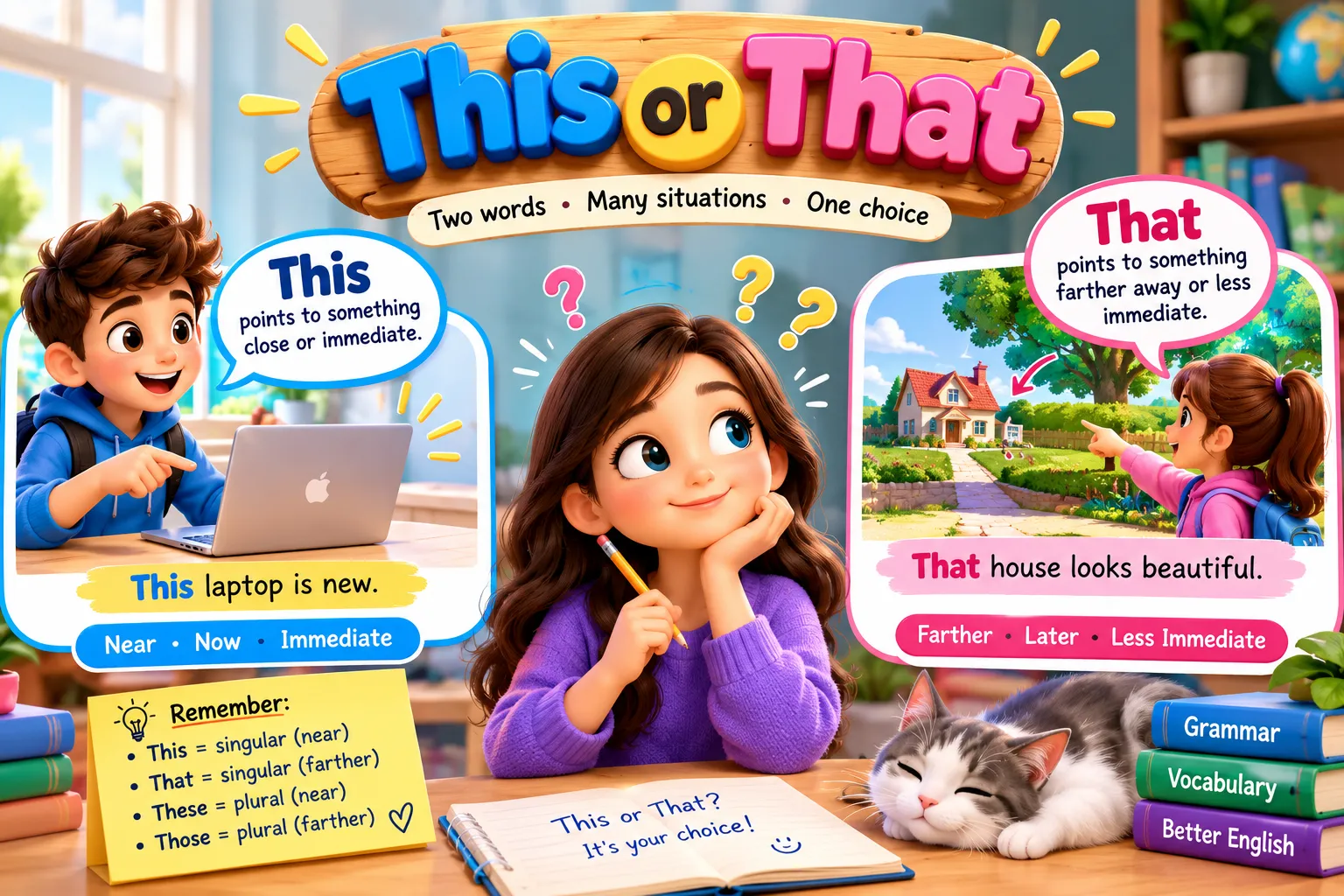
This or that means a choice between two things, people, ideas, or options. This usually points to something closer or more immediate, while that often points to something farther away or less immediate.
Have you ever paused before a simple sentence and wondered, “Should I say this or that?” You are not alone. These two tiny words cause a surprising number of mistakes.
I have seen this confusion often when helping English learners improve everyday writing. A student may know both words but still hesitate when choosing between them. The problem is that this and that do not depend only on physical distance. They can also show time, attention, context, and even emotional distance.
That makes the phrase this or that more interesting than it first appears.
You may see it in a casual conversation, a classroom question, a shopping choice, a social media post, or a formal document. Sometimes it simply asks you to choose between two alternatives. In other cases, this and that point to ideas that are already part of the conversation.
This guide makes the difference easy. You will learn what this or that means, where the words come from, how to use them, common mistakes to avoid, and how the phrase works in real writing.
This or That Quick Answer
This or that is normally used when two alternatives are being presented.
For example:
- Would you choose this or that?
- Which design do you prefer, this or that?
Here, or connects two alternatives.
The individual words have their own grammar rules. Cambridge explains that this and that are demonstratives. Both can work as determiners or pronouns, and they are singular forms.
This often refers to something close to the speaker, writer, or current situation. That commonly points to something farther away or less immediate.
So, if you hold one phone in your hand and point to another across the room, you might say:
Do you want this or that?
The exact meaning still depends on context.
The Origin / Background of This or That
The words this and that have very old roots.
According to Etymonline, this comes from Old English þis, a demonstrative pronoun and adjective meaning something present or at hand. Its history is linked to other Germanic forms.
That also goes back to Old English. Etymonline traces it to Old English þæt, which served as a demonstrative pronoun and adjective. It later developed several grammatical uses in English.
Over time, English changed from the complex system found in Old English and Middle English to the simpler system used today.
The basic idea, however, stayed familiar:
- this → something nearer or more immediate
- that → something farther or less immediate
Distance does not always mean physical distance.
You can also use this for something happening now or something closely connected to the current discussion. That can refer to something earlier, less immediate, or already known.
This is why this and that are important in linguistics. They are called demonstratives because they help point to people, things, ideas, or situations.
This or That Explained Key Differences
The easiest way to understand the two words is to look at what they point toward.
| Term | Meaning | When to Use | Region/Context |
| This | A nearby or immediate person, thing, or idea | For something close or current | Standard English |
| That | A more distant or less immediate person, thing, or idea | For something farther away or previously discussed | Standard English |
| This or that | Two alternatives | When presenting a choice | Everyday and formal English |
| This and that | Various things | When referring to several topics or things | Usually informal |
Cambridge and Oxford both describe this/these as forms commonly used for things close to the speaker, while that/those generally refer to things farther away.
When to use “this”
Use this for something close, current, or strongly connected to the present situation.
Examples:
- This laptop works much faster.
- I like this idea.
- This is the file we need.
When to use “that”
Use that for something farther away or less immediate.
Examples:
- That building looks very old.
- I remember that story.
- That was a difficult exam.
When to use “this or that”
Use the full phrase when you want to present alternatives.
Examples:
- Should we take this route or that route?
- Would you rather read this book or that one?
- Which color should I choose, this or that?
Which Version or Approach Should You Use?
Your choice depends on what you are trying to express.
For beginners
Start with the simple distance rule:
- This = near
- That = farther away
It is not perfect for every sentence, but it gives you a strong starting point.
For students and ESL learners
Pay attention to time and context, not just physical distance.
For example:
This week has been busy.
The word this connects the sentence to the current week.
Compare it with:
That week was very stressful.
Here, that points to a week in the past.
For professional writing
Use this and that carefully when referring to ideas.
A vague sentence such as:
That caused problems.
may leave the reader wondering what that means.
A clearer version might be:
The late delivery caused problems for the team.
In formal writing, clarity matters more than simply choosing one demonstrative over another.
For global or neutral English
Use the words according to their context rather than assuming that this always means physically close and that always means physically far away.
English speakers can use demonstratives to show time, focus, shared knowledge, and emotional distance, too. Cambridge Grammar documents these broader uses.
Common Mistakes with This or That
1. Using “this” with a plural noun
Mistake:
This books are expensive.
Correction:
These books are expensive.
Why?
This is singular. These is its plural partner.
2. Using “that” with a plural noun
Mistake:
That shoes look nice.
Correction:
Those shoes look nice.
Why?
Use that with singular nouns and those with plural nouns.
3. Confusing “this or that” with “this and that”
These phrases are not interchangeable.
This or that presents alternatives:
You can pick this or that.
This and that refers to different things:
We talked about this and that.
Cambridge defines this and that as an informal expression meaning various things.
4. Making “this” too vague
Weak:
This is a problem.
What is this?
Clearer:
The missing payment is a problem.
A demonstrative should have a clear reference when clarity matters.
5. Using “this’s”
A common learner error is trying to shorten this is to this’s.
Do not do this.
Use:
This is my desk.
For that, the normal contraction is:
That’s my desk.
Oxford specifically notes the difference in these contraction patterns.
This or That in Real World Examples
Professional email
Could you confirm whether this or that version of the report should be sent to the client?
This works because the writer is asking the reader to choose between two versions.
News headline
This or That? Voters Face a Major Policy Choice
The phrase creates a short, direct choice for the reader.
Social media post
Weekend plan: this or that? Beach day or movie night?
This is casual and natural.
Formal report
The two proposed methods differ in cost and timing; management must decide whether this or that approach better meets the project goals.
Here, the phrase refers to two previously identified alternatives.
This or That Data, Trends & Usage
There is an important SEO point here: exact monthly search volume for “this or that” is not consistently available from public dictionary sources. Search-volume platforms such as Ahrefs, Semrush, and Google Keyword Planner use proprietary datasets, and their figures can change by country and month.
Google Trends also does not report absolute search counts. It uses a relative scale, where the highest point in a selected period and region is indexed to 100.
So it would be misleading to invent an exact monthly number for “this or that.”
What can we say with confidence?
1. Search intent is mainly informational.
People searching this or that may want its meaning, grammar, examples, or the difference between this and that.
2. The phrase has more than one use.
The grammar topic is different from the informal expression this and that, which means various things. Cambridge lists the latter as an informal idiom.
3. Corpus-style evidence supports broad everyday use.
Cambridge includes numerous authentic examples showing this and that functioning as determiners, pronouns, and in time expressions.
4. The topic matters for English learners.
Demonstratives are basic grammar words, but their meaning can shift with context. That makes them especially useful for ESL students who want more natural English.
5. AI writing tools make clarity even more important.
Grammar checkers can flag some errors, but they may not understand exactly what a vague this or that refers to. Human judgment still matters when the reference is unclear.
Standalone This or That Comparison Table
| Term/Variant | Meaning | Region/Context | Best Used When |
| This | Near or immediate | Standard English | Referring to a current or nearby thing |
| That | Farther or less immediate | Standard English | Referring to a distant or earlier thing |
| These | Plural form of this | Standard English | Referring to multiple nearby things |
| Those | Plural form of that | Standard English | Referring to multiple distant things |
| This or that | Two alternatives | Casual to formal | Asking someone to choose |
| This and that | Various things | Mostly informal | Talking about different topics |
Oxford confirms the singular/plural pattern: this/that are used with singular or uncountable nouns, while these/those are used with plural nouns.
FAQ: This or That
Q: What does “this or that” mean?
A: It normally introduces two alternatives. The listener is being asked to select one possibility rather than the other.
Q: How do you use “this or that” correctly?
A: Use it when two options are clear from the context. For example, you might ask someone to select between two designs, plans, or objects.
Q: What is the difference between “this” and “that”?
A: This usually points to something closer or more immediate, while that often points to something farther away or less immediate. The distinction can also involve time and context.
Q: Is “this or that” acceptable in formal writing?
A: Yes. The phrase is grammatically acceptable. However, formal writing often benefits from naming the two alternatives instead of leaving them vague.
Q: Which is correct, “this” or “that”?
A: Both are correct. The right word depends on what you are pointing to or referring back to.
Q: Where does “this” come from?
A: This comes from Old English þis. Etymonline traces its history through older Germanic forms.
Q: Where does “that” come from?
A: That comes from Old English þæt and has developed several roles over the history of English.
Q: Can “this or that” refer to ideas instead of objects?
A: Yes. The two options can be physical objects, actions, plans, opinions, or abstract ideas. Context tells the reader what each word represents.
Conclusion
The phrase this or that is simple, but its grammar has more depth than it first seems.
The key is to understand the role of each word. This normally brings something closer to the speaker, writer, or current situation. That often creates more distance. The distance can be physical, but it can also relate to time, context, or focus.
Remember the larger pattern:
- This → singular and usually near or immediate
- That → singular and usually farther or less immediate
- These → plural partner of this
- Those → plural partner of that
- This or that → presents alternatives
- This and that → refers to various things
Also watch for vague references. If your reader cannot tell what this or that means, name the subject directly.
Once you understand these small distinctions, your English becomes clearer and more natural. You will also find it easier to handle related grammar topics such as demonstratives, pronouns, determiners, conjunctions, and reference words.
Bookmark this guide so you never second-guess “this or that” again.
Readmore

I’m **Rubab Naaz**, an English language content writer with over 10 years of experience creating educational and SEO-focused articles. I specialize in spelling comparisons, grammar, vocabulary, synonyms, commonly confused words, and English usage. My passion is helping students, writers, and professionals improve their language skills through accurate, well-researched, and easy-to-understand content. Every article I write is designed to make learning English simple, practical, and engaging.










