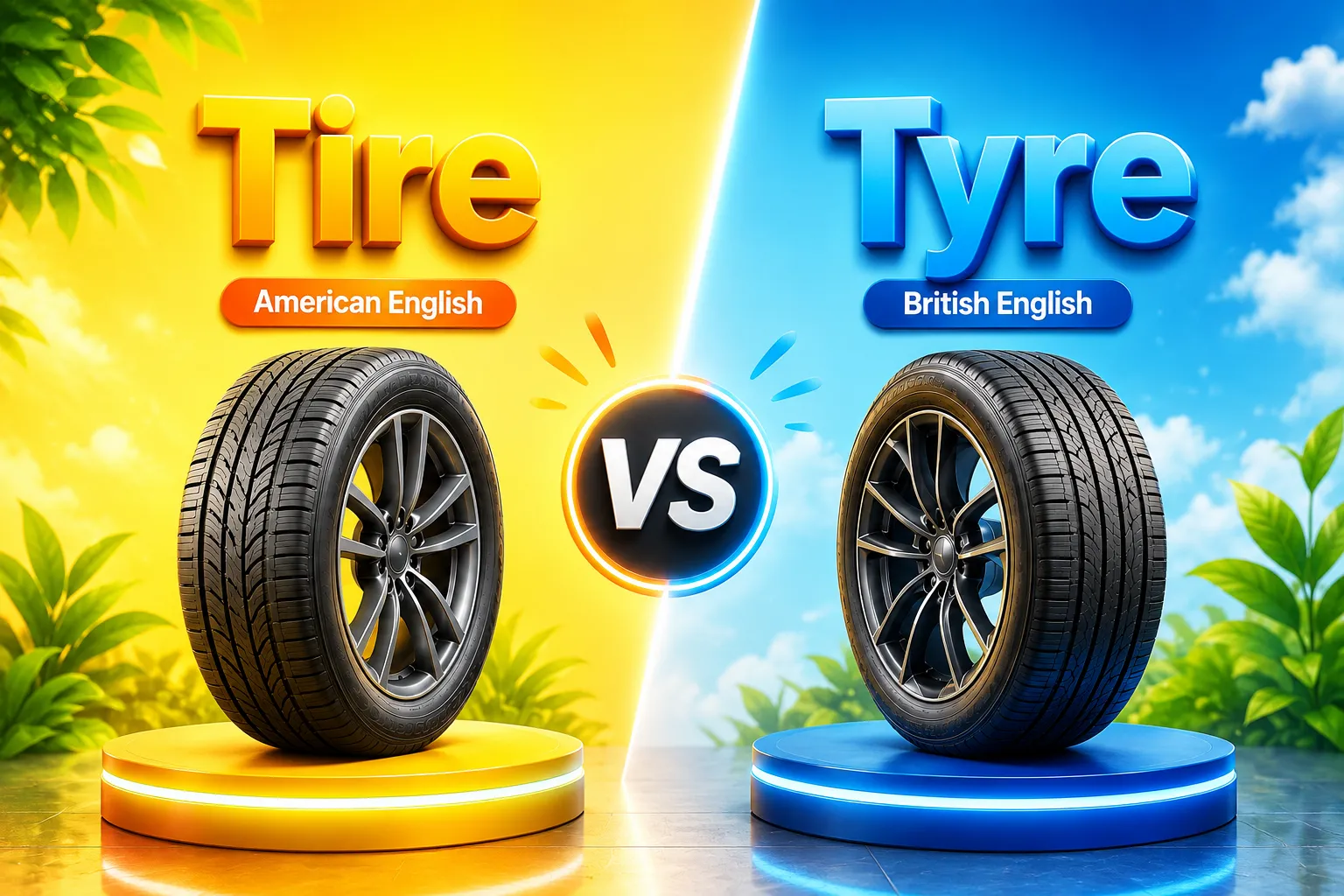
Both tire and tyre are correct. They have the same meaning but are used in different varieties of English:
- Tire → American English
- Tyre → British English and many Commonwealth varieties
Example:
- The car has a flat tire. ✅
- The car has a flat tyre. ✅
Use tire for American readers and tyre for British readers. The main difference is spelling, not meaning.
I remember seeing the word “tyre” for the first time and wondering if it was simply a spelling mistake for “tire.” Later, I noticed both spellings in different articles, books, and websites. That made me curious: Which one is actually correct?
The answer is simple: both tire and tyre are correct. They have the same meaning, but they belong to different varieties of English. Tire is the standard spelling in American English, while tyre is the usual spelling in British English and many other English-speaking regions.
So, there is no need to worry when you see either form. The right choice depends mainly on where your audience is and which style of English you are using.
In this guide, we will look at the meaning, history, regional use, examples, and common mistakes involving tire and tyre.
Tire or Tyre: Quick Answer
Both tire and tyre are correct spellings when referring to the rubber covering around a wheel.
- Tire → American English
- Tyre → British English and many Commonwealth varieties
For example:
- The car has a flat tire. ✅
- The car has a flat tyre. ✅
Both sentences mean exactly the same thing.
The difference is spelling, not meaning.
A Simple Rule to Remember
If you are writing in American English, use tire.
If you are writing in British English, use tyre.
The same rule generally applies to related words:
- tire pressure → American English
- tyre pressure → British English
- tires → American English
- tyres → British English
What Does Tire Mean?
Tire is a noun that refers to the rubber covering fitted around a wheel. Tires are found on cars, bicycles, motorcycles, trucks, buses, and many other vehicles.
For example:
- My car has a flat tire.
- The mechanic replaced the front tire.
- Check your tire pressure before driving.
- His bicycle tire needs more air.
In American English, tire is the normal spelling for this meaning.
Interestingly, tire is also a verb. As a verb, it means to become tired or to make someone tired.
For example:
- The long walk began to tire me.
- The children were tired after the trip.
- She never seems to tire of reading.
This second meaning is not a spelling difference. Both American and British English use tire as the verb.
What Does Tyre Mean?
Tyre is the British English spelling of the same noun.
It refers to the rubber covering around a wheel and has the same meaning as American tire.
Examples include:
- The car needs a new tyre.
- My rear tyre has lost air.
- The mechanic checked all four tyres.
- You should check your tyre pressure regularly.
You will commonly see tyre in British English and in countries where British spelling conventions are widely used.
However, there is an important point to remember: tyre is normally used only as the noun for the wheel covering.
When the word means “to become tired,” the spelling remains tire:
- The long journey began to tire him. ✅
- The long journey began to tyre him. ❌
This is an easy detail to remember.
Tire vs. Tyre: Key Difference
The difference can be summarized in a simple table:
| Word | Meaning | Main Usage |
|---|---|---|
| tire | Rubber covering around a wheel | American English |
| tyre | Rubber covering around a wheel | British English |
There is no difference in pronunciation or basic meaning.
For example:
American English:
I need to buy new tires for my car.
British English:
I need to buy new tyres for my car.
Both sentences communicate the same idea.
Where Is “Tire” Used?
Tire is the standard spelling in American English.
You will see it in:
- American newspapers
- US websites
- American books
- Vehicle manuals
- Automotive advertisements
- US product descriptions
- Everyday conversations
Examples:
The tire pressure is too low.
I need to replace my front tire.
The mechanic repaired the damaged tire.
If your audience is mainly in the United States, tire is the best choice.
Where Is “Tyre” Used?
Tyre is the standard spelling in British English.
It is also commonly found in several countries and regions that use British-based spelling conventions, including the United Kingdom, Australia, and New Zealand.
Examples:
The front tyre needs more air.
He bought four new tyres.
The mechanic inspected the tyre before the journey.
If you are writing for a British audience, tyre is usually the preferred form.
Why Are There Two Spellings?
The difference between tire and tyre is mainly the result of the development of American and British English.
English spelling has changed over hundreds of years. Different regions sometimes kept different spellings, while dictionaries, publishers, schools, and style guides helped establish local standards.
The spelling tyre became associated with British English, while tire became the standard form in American English.
American English also developed several spelling preferences that differ from British English, such as:
- colour → color
- centre → center
- favourite → favorite
- tyre → tire
These differences do not mean that one variety is more correct than the other. They simply show how English developed differently in different regions.
Tire or Tyre: Which One Should You Use?
The best spelling depends on your audience.
Use “Tire” for American English
Choose tire if you are writing for readers in the United States.
For example:
Check your tire pressure before a long trip.
Use “Tyre” for British English
Choose tyre if you are following British English.
For example:
Check your tyre pressure before a long journey.
Keep Your Spelling Consistent
The most important rule is consistency.
If you start an article using tire, do not suddenly switch to tyre unless you are discussing the spelling difference.
Likewise, if your article follows British English, use tyre throughout.
Consistent spelling makes your writing look more polished and professional.
Common Mistakes With Tire and Tyre
Mistake 1: Thinking “Tyre” Is Wrong
Some American readers may see tyre and assume it is misspelled.
It is not.
Tyre is the standard British spelling for the rubber covering around a wheel.
Mistake 2: Thinking “Tire” Is Wrong
British readers may be more familiar with tyre, but tire is not incorrect. It is the standard American spelling.
Mistake 3: Mixing Both Forms
Using both forms in the same article can make your writing inconsistent.
For example:
The car has new tyres, but the spare tire is old.
This may be acceptable if you are discussing different sources or regional usage, but in normal writing, it is better to choose one spelling and stay consistent.
Mistake 4: Using “Tyre” as a Verb
Remember that the verb is tire in both American and British English.
Correct:
The long walk began to tire us.
Incorrect:
The long walk began to tyre us.
Tire or Tyre in Real-World Examples
American English
- My tire is flat.
- The mechanic replaced the tire.
- Check your tire pressure.
- These tires are designed for winter driving.
British English
- My tyre is flat.
- The mechanic replaced the tyre.
- Check your tyre pressure.
- These tyres are designed for winter driving.
The meaning remains the same. Only the regional spelling changes.
Tire and Tyre in Different Contexts
The two spellings appear in many areas of everyday life.
Cars
American websites may advertise car tires, while British websites may advertise car tyres.
Bicycles
You may see:
- bicycle tire
- bicycle tyre
Both refer to the same part.
Motorcycles
The same regional difference applies:
- motorcycle tire → American English
- motorcycle tyre → British English
Automotive Businesses
Automotive companies often change the spelling of their websites, manuals, and advertisements depending on the market they serve.
This is why an international brand may use tire on its US website and tyre on its UK website.
Are Tire and Tyre Pronounced the Same?
Yes. When referring to the wheel covering, tire and tyre are normally pronounced the same way.
They are homophones: words that have the same pronunciation but different spellings.
This is one reason the difference can be confusing. When speaking, you cannot hear which spelling someone has chosen. The difference only becomes visible in writing.
For example, whether someone says:
“I need a new tire.”
or
“I need a new tyre.”
the pronunciation is essentially the same.
Frequently Asked Questions
Is tire or tyre correct?
Both are correct. Tire is the standard American English spelling, while tyre is the standard British English spelling.
Is tyre British or American?
Tyre is British English. It is also widely used in countries that follow British spelling conventions.
Is tire American English?
Yes. Tire is the standard American English spelling when referring to the rubber covering around a wheel.
Are tire and tyre pronounced the same?
Yes. When used as nouns for a wheel covering, they are pronounced the same way.
Can I use tyre in American English?
You can, and American readers will usually understand it, but tire is the standard spelling in American English.
Can I use tire in British English?
British readers will understand tire, but tyre is the standard British spelling for the wheel covering.
Is “tyre” a spelling mistake?
No. Tyre is not a spelling mistake. It is the standard British spelling of the word.
Is “tire” only used for cars?
No. A tire can be part of many types of vehicles, including bicycles, motorcycles, trucks, and other wheeled vehicles.
Final Verdict: Tire or Tyre?
The difference between tire and tyre is easy to understand once you remember that it is a regional spelling difference.
- Tire = American English
- Tyre = British English
- Both = correct when used in the appropriate English variety
If you are writing for an American audience, choose tire. If you are following British English, choose tyre.
Most importantly, be consistent. Do not switch between the two spellings without a reason.
So, the next time you see tyre in a British article or tire on an American website, you will know that neither one is wrong. They are simply two regional spellings of the same word.

I’m an English language educator and content writer with more than 10 years of experience helping learners improve their English skills. I specialize in spelling differences, grammar, vocabulary, synonyms, commonly confused words, and English usage. My goal is to create accurate, easy-to-understand articles that make learning English simple, practical, and enjoyable for students, writers, and professionals around the world.