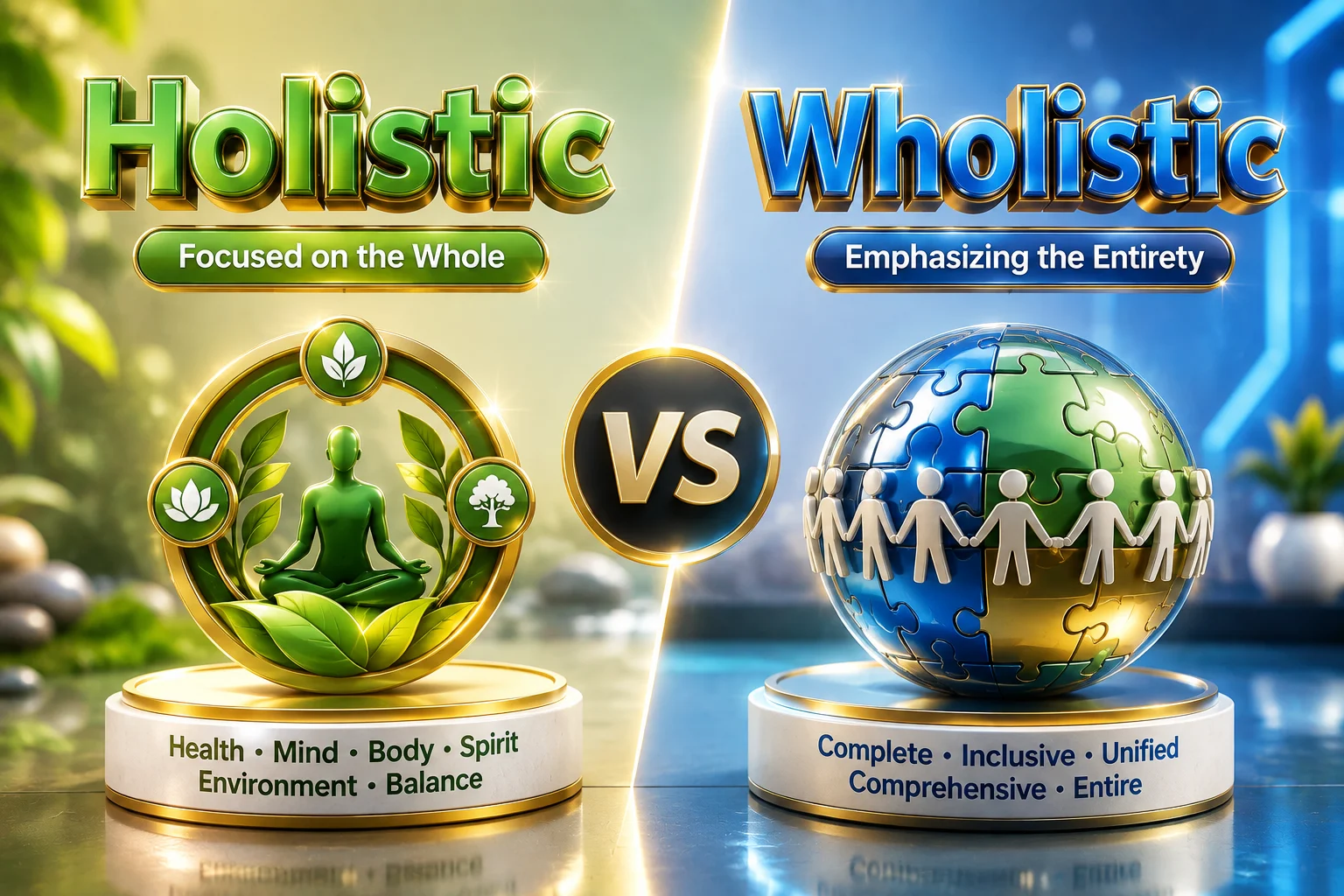
Both holistic and wholistic can describe an approach that considers something as a complete whole. However, holistic is the standard, more common, and generally preferred spelling.
Use holistic in most writing, especially in formal, academic, professional, medical, and online content. Use wholistic only when it appears in a specific name, brand, quotation, or established terminology.
Example:
- The doctor takes a holistic approach to patient care.
In short, holistic is usually the best choice.
I remember coming across the word “wholistic” and wondering if it was simply a mistake for “holistic.” At first, I assumed that one of the spellings had to be wrong. Then I started noticing both forms in articles, wellness discussions, and other types of writing.
That made me curious about the real difference between them.
After looking more closely at their meanings and usage, I found that both “holistic” and “wholistic” are used in English, but they do not have the same level of acceptance. Holistic is the standard and much more common spelling, while wholistic is a less common variant.
Both words express the idea of looking at something as a complete whole rather than focusing only on individual parts. However, if you are writing an academic, professional, medical, or general English article, holistic is usually the better choice.
In this guide, I’ll explain the difference between wholistic and holistic, their meanings, origins, examples, common mistakes, and when to use each form.
Wholistic or Holistic: Quick Answer
Both holistic and wholistic can be found in English, but holistic is the standard spelling.
Here is the simple rule:
- Holistic → standard, common, and preferred
- Wholistic → less common variant
- Meaning → considering something as a whole system
For example:
- The doctor takes a holistic approach to patient care. ✅
- The doctor takes a wholistic approach to patient care. ✓
The second sentence is understandable, but holistic is the form most readers and professional writers expect.
If you are unsure which spelling to use, choose holistic.
What Does Holistic Mean?
Holistic means considering a person, problem, system, or situation as a whole instead of looking at only one part.
The word is common in many areas, including:
- healthcare
- psychology
- education
- business
- wellness
- personal development
- environmental studies
For example:
The school takes a holistic approach to education.
This means the school considers more than just academic grades. It may also consider a student’s emotional, social, physical, and personal development.
Another example is:
The doctor takes a holistic view of the patient’s health.
Here, the doctor considers the person’s overall well-being rather than focusing only on one symptom.
What Does Wholistic Mean?
Wholistic generally carries the same meaning as holistic. It describes an approach that considers something in its entirety.
The spelling includes “whole,” which makes the connection to the idea of completeness more obvious.
For example:
The program offers a wholistic approach to personal growth.
The writer is emphasizing the idea of looking at the person’s life as a complete whole.
Although wholistic is a real variant, it is much less common than holistic. It may appear in wellness writing, personal development, educational material, or other contexts where the writer wants to highlight the concept of “whole.”
Holistic vs. Wholistic: Key Difference
The easiest way to understand the difference is to compare their usage.
| Word | Meaning | Usage | Preference |
|---|---|---|---|
| holistic | Considering something as a whole | General, academic, professional | Preferred |
| wholistic | Considering something as a whole | Less common, often informal or specialized | Variant |
The meanings are very similar. The main difference is frequency and standard usage.
If you are writing a formal report, research paper, business article, or general educational content, holistic is the safer choice.
Where Does Holistic Come From?
The word holistic has an interesting history.
It comes from the Greek word holos, meaning “whole” or “entire.” The modern concept of holism was developed and popularized in the early 20th century by Jan Smuts, a South African philosopher, statesman, and writer.
Smuts used the concept of holism to describe the idea that a whole system can be more than simply the sum of its individual parts.
The word eventually became widely used in English.
Today, holistic is firmly established in dictionaries and professional writing.
How Did Wholistic Develop?
The spelling wholistic is easier to understand if you look at the English word whole.
Because “whole” is a familiar English word, some writers began using wholistic to make the connection more obvious.
In other words:
whole → wholistic
This spelling can help readers immediately see the connection between the word and the idea of completeness.
However, wholistic did not replace holistic. Instead, it remained a less common variant.
That is why you may occasionally see it, but holistic remains the dominant form.
Why Are There Two Spellings?
There are several reasons why both forms appear.
1. Different Word Associations
The spelling holistic comes from the Greek root holos. The spelling wholistic looks more directly connected to the English word whole.
2. Natural English Spelling Patterns
English speakers sometimes change unfamiliar words to make their meaning or pronunciation easier to understand.
Adding the w in wholistic can make the word look more familiar to someone who already knows the word “whole.”
3. Different Writing Traditions
Some writers and organizations have continued to use wholistic, especially in wellness and alternative health contexts.
However, this does not make it the preferred spelling in standard English.
When Should You Use Holistic?
In most situations, holistic is the best choice.
Use it when writing:
- academic papers
- professional reports
- educational articles
- business content
- healthcare content
- psychology articles
- general English content
Examples:
We need a holistic approach to the problem.
The teacher takes a holistic view of student development.
The company created a holistic business strategy.
The therapist uses a holistic approach to care.
If your goal is clear, standard English, holistic is the safest option.
When Might You See Wholistic?
You may encounter wholistic in certain types of writing, particularly when the author wants to stress the idea of wholeness.
It may appear in:
- wellness content
- personal development
- alternative health writing
- lifestyle articles
- informal educational material
For example:
She follows a wholistic approach to wellness.
This spelling is understandable, but holistic would still be the more widely accepted choice.
If you are editing content for a professional audience, it is usually better to use holistic unless there is a specific reason to preserve wholistic.
Common Mistakes With Holistic and Wholistic
Mistake 1: Assuming Wholistic Is Always Wrong
Although holistic is preferred, it would be too strong to say that every use of wholistic is simply a spelling mistake.
Wholistic is an established variant. It is less common, but readers can understand it.
Mistake 2: Assuming Both Forms Are Equally Common
They are not.
Holistic is much more common and is the form most readers expect.
Mistake 3: Mixing the Spellings
Avoid switching between holistic and wholistic within the same article.
For example, using holistic approach in one paragraph and wholistic approach in the next can make your writing look inconsistent.
Choose one form and use it consistently.
Mistake 4: Using Wholistic in Formal Writing Without a Reason
In academic and professional writing, holistic is usually the better choice.
If a style guide, organization, or source specifically uses wholistic, you can follow that preference. Otherwise, holistic is safer.
Holistic and Wholistic: Real-World Examples
Healthcare
- The doctor takes a holistic approach to patient care.
- The clinic promotes a holistic view of health.
Education
- The school uses a holistic approach to student development.
- Teachers should consider the holistic needs of learners.
Business
- The company developed a holistic marketing strategy.
- Leaders need a holistic understanding of the market.
Wellness
- She follows a holistic approach to well-being.
- The program promotes a wholistic view of personal growth.
Notice that holistic works naturally in all of these areas, while wholistic is less common.
Is Holistic or Wholistic More Common?
Holistic is far more common.
It is widely recognized in general English and is frequently used in professional, academic, medical, and educational writing.
Wholistic appears much less often. When it does appear, it is usually understood as a variant rather than a completely different word.
So, if you are writing an article and simply want to know which form your readers are more likely to recognize, choose holistic.
Frequently Asked Questions
Is wholistic a real word?
Yes. Wholistic is a recognized variant of holistic, although it is much less common.
Is holistic or wholistic correct?
Both forms are used, but holistic is the standard and preferred spelling in most formal and general English writing.
Why do some people spell holistic as wholistic?
Some writers use wholistic because the spelling makes a direct visual connection to the English word whole.
Which is more common, holistic or wholistic?
Holistic is much more common and widely accepted.
Can I use wholistic in formal writing?
You can, but holistic is usually the better choice in formal, academic, medical, and professional writing.
Do holistic and wholistic mean the same thing?
Yes. Both generally describe an approach that considers something as a complete whole rather than focusing only on separate parts.
Are holistic and wholistic pronounced the same?
They are generally pronounced the same or very similarly, which can make the spelling difference easy to miss in conversation.
Final Verdict: Wholistic or Holistic?
When I first saw wholistic, I thought it might simply be a misspelling of holistic. After looking at how both forms are used, the distinction became much clearer.
Holistic is the standard spelling and the best choice for most situations. It is widely used in general, academic, medical, educational, and professional English.
Wholistic is a less common variant that emphasizes the connection with the word “whole.” It is understandable and still appears in some types of writing, especially wellness and personal development content.
The easiest rule to remember is:
Holistic = standard and preferred
Wholistic = less common variant
So, if you are unsure which one to use, choose holistic. It is the form your readers are most likely to expect, and it works well in almost every formal and everyday context.
Read More:
Tire or Tyre: Which Spelling Is Correct? Meaning & Differences

I’m **Rubab Naaz**, an English language content writer with over 10 years of experience creating educational and SEO-focused articles. I specialize in spelling comparisons, grammar, vocabulary, synonyms, commonly confused words, and English usage. My passion is helping students, writers, and professionals improve their language skills through accurate, well-researched, and easy-to-understand content. Every article I write is designed to make learning English simple, practical, and engaging.