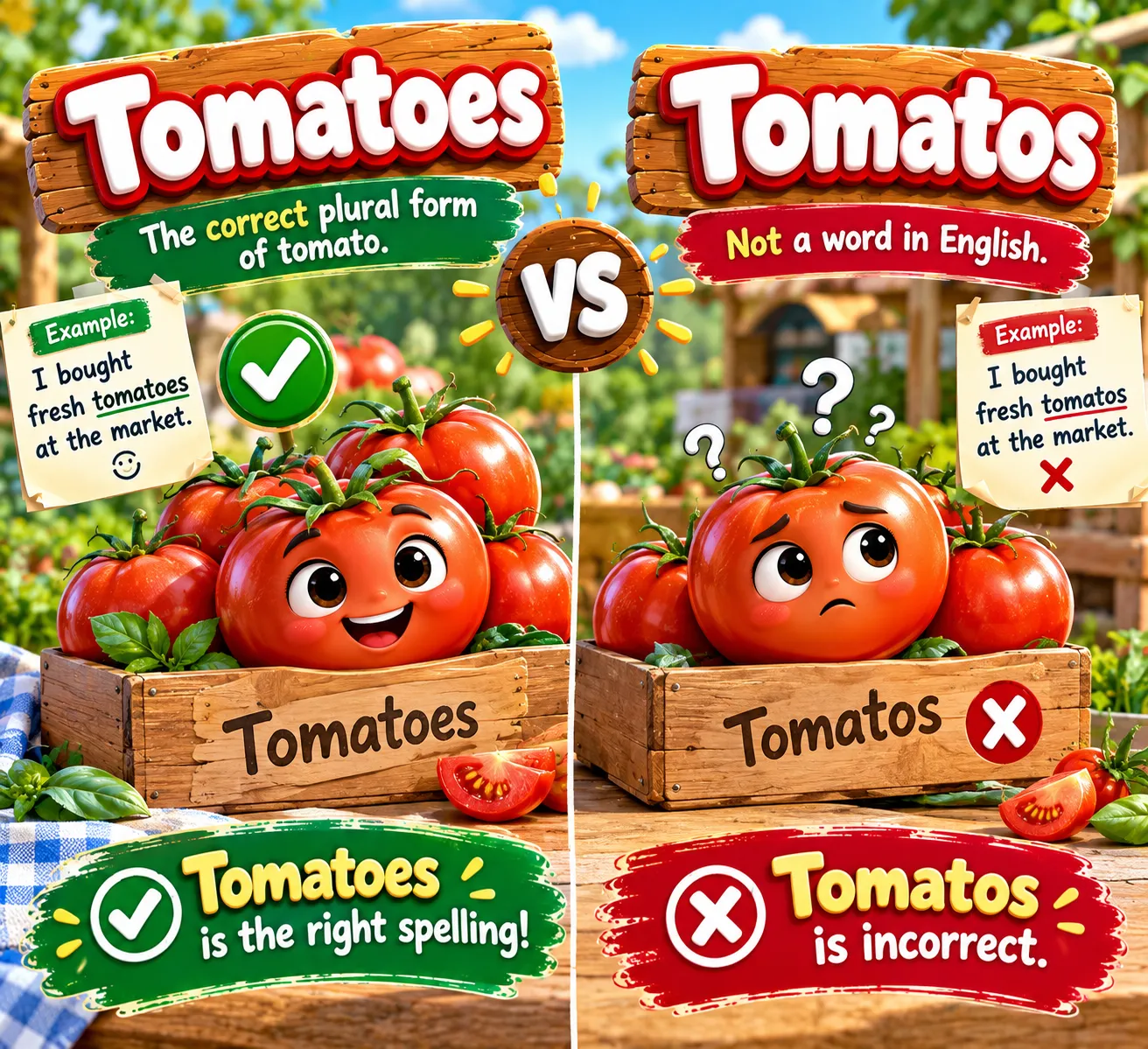
Tomatoes is the correct plural of tomato. Tomatos is a common spelling mistake and is not the standard plural form.
I have seen this spelling mistake many times, especially when people write quickly. Someone types tomatos, looks at the word, and suddenly wonders if it should have an extra e. It is an easy mistake to make because many English nouns form their plural by simply adding -s.
For example, book becomes books, and car becomes cars. So it seems natural to think tomato should become tomatos. But English has other plural patterns too.
The correct form is tomatoes. The extra e is not optional. It is part of the standard spelling.
I have also noticed that this confusion appears in grocery lists, recipes, school assignments, social media posts, and even professional writing. The good news is that once you understand the pattern, this spelling becomes much easier to remember.
In this guide, I will explain tomatoes vs. tomatos, show why the spelling changes, explore the history of tomato, and give you simple examples you can use in everyday English.
Tomatoes or Tomatos Quick Answer
When you mean more than one tomato, write tomatoes.
- Tomato = one
- Tomatoes = more than one
- Tomatos = incorrect spelling
Cambridge Dictionary lists tomatoes as the plural form of tomato. It defines tomato as a round, seed-filled fruit commonly eaten raw or cooked.
Simple examples
- Correct: We need five tomatoes for the salad.
- Incorrect: We need five tomatos for the salad.
The difference is only one letter, but that letter matters.
Remember:
tomato → tomatoes
The Origin and Background of Tomato
The word tomato has a long journey behind it.
According to Etymonline, the English noun tomato dates to the 18th century, while the earlier English form tomate appeared around 1600. The word came through Spanish tomate from Nahuatl, an Indigenous language of Mexico, where tomatl referred to the fruit. Etymonline also notes that the English spelling may have been influenced by potato.
That history helps explain why tomato does not behave exactly like every other English noun.
English has borrowed thousands of words from other languages. Their spelling and plural patterns sometimes fit existing English rules, while others develop their own accepted forms.
The word tomato became established as a standard English noun. Its plural became tomatoes, not tomatos.
This is an example of linguistics in everyday life. A word can enter English from another language and then become part of English grammar and spelling.
Why does the extra “e” appear?
A useful English spelling pattern is that some nouns ending in -o form their plural with -es.
For example:
- tomato → tomatoes
- potato → potatoes
- hero → heroes
- echo → echoes
Cambridge’s grammar guidance specifically lists tomato → tomatoes among nouns ending in -o that take -es in the plural. It also points out that this rule has exceptions, such as photo → photos and piano → pianos.
So you should not assume that every word ending in -o automatically takes -es. English spelling has patterns, but it also has exceptions.
Tomatoes Explained Key Differences and Variations
The main difference is simple: tomatoes is correct, while tomatos is not standard English spelling.
| Term | Meaning | When to Use | Region/Context |
| tomato | One tomato | When referring to a single item | All major English varieties |
| tomatoes | More than one tomato | When referring to two or more | American, British, and international English |
| tomatos | Intended plural of tomato | Avoid it | Common spelling mistake |
| tomato’s | Something belonging to one tomato | Use only for singular possession | Standard English |
1. Tomato
Use tomato when you are talking about one.
I sliced one tomato for my sandwich.
Here, the noun is singular.
2. Tomatoes
Use tomatoes when you are talking about more than one.
The farmer grows several tomatoes each season.
This is the standard plural form.
3. Tomatos
Tomatos is not the accepted plural spelling.
You may see it in online searches, comments, messages, or informal writing. That does not make it a valid spelling.
If you are writing an essay, email, recipe, article, report, or school assignment, use tomatoes.
4. Tomato’s
Be careful with the apostrophe.
Tomato’s usually shows possession.
The tomato’s skin was very thin.
It does not mean more than one tomato.
For a simple plural, write:
The tomatoes were ripe.
Which Version Should You Use?
The answer is easy because there is no American-versus-British spelling issue here.
For students
Use tomatoes in assignments, exams, and academic writing.
It is the standard plural form listed by major dictionaries.
For professional writers
Use tomatoes in reports, emails, articles, product descriptions, menus, and business documents.
Correct spelling makes your writing easier to trust and understand.
For casual writing
Use tomatoes in texts, social media posts, grocery lists, and recipes too.
There is no reason to switch to tomatos in informal English.
For global English
Tomatoes is the safest choice for an international audience.
Both American and British English use tomatoes. The pronunciation differs slightly between the varieties, but the spelling does not. Cambridge gives both UK and US pronunciations while listing the same plural: tomatoes.
Common Mistakes with Tomatoes
Small spelling errors can happen quickly. Here are some of the most common ones.
| Mistake | Correction | Why? |
| ❌ tomatos | ✅ tomatoes | The standard plural uses -es |
| ❌ tomato’s | ✅ tomatoes | An apostrophe is not needed for a simple plural |
| ❌ tomatoe | ✅ tomato | The singular does not contain an extra e |
| ❌ tomatoes’s | ✅ tomatoes | The plural does not take another -s |
| ❌ two tomato | ✅ two tomatoes | A countable noun needs a plural form here |
Mistake 1: Writing “tomatos”
This usually happens because the writer expects a simple -s plural.
Wrong: She bought fresh tomatos.
Right: She bought fresh tomatoes.
Mistake 2: Adding an apostrophe
Apostrophes often confuse learners.
Wrong: I washed three tomato’s.
Right: I washed three tomatoes.
Mistake 3: Writing “tomatoe”
The extra e belongs in the plural ending, not in the singular word.
Wrong: I bought one tomatoe.
Right: I bought one tomato.
Mistake 4: Adding too much
Do not write tomatoes’s when you simply mean more than one tomato.
Tomatoes is already plural.
Tomatoes in Real-World Examples
Seeing the word in different settings can make the spelling easier to remember.
Professional Email
Please include fresh tomatoes in the order for Friday’s event.
Here, tomatoes refers to multiple items being ordered.
News Headline
Local Farmers Expect a Strong Harvest of Tomatoes
A news headline uses the standard plural spelling because it refers to many tomatoes.
Social Media Post
Fresh tomatoes from the garden always make summer meals better. 🍅
The same spelling works in casual online writing.
Formal Report
The research compared the growth of tomatoes under different soil conditions.
Formal writing still uses the same plural form.
Recipe
Add two chopped tomatoes and cook for five minutes.
Recipes often use the plural because several tomatoes are needed.
Tomatoes Data, Trends & Usage
This topic is mainly informational search intent. People searching for tomatoes or tomatos usually want one thing: confirmation of the correct spelling.
Exact monthly search-volume numbers for tomatoes and tomatos vary by country, language, device, and SEO tool. I would not treat an unsupported number as a reliable fact. Public search-trend sources can also show relative interest rather than exact monthly searches.
Current search results consistently show the same spelling distinction: tomatoes is the standard form, while tomatos appears as a spelling question or error.
There is also useful evidence from grammar references. Cambridge explicitly lists tomato → tomatoes as a plural spelling pattern.
What the usage pattern tells us
The confusion exists because English plural rules are not completely uniform.
Compare:
- tomato → tomatoes
- potato → potatoes
- hero → heroes
- photo → photos
- piano → pianos
That last group shows why learners can hesitate. Some nouns ending in -o take -es, while others take only -s. Cambridge documents both patterns.
This is also why spelling-check questions remain useful for learners. A quick question about one letter can reveal a larger grammar pattern.
Tomatoes vs. Tomatos: Standalone Comparison Table
| Term/Variant | Meaning | Region/Context | Best Used When |
| Tomato | Singular noun | All English varieties | You mean one fruit |
| Tomatoes | Standard plural noun | US, UK, and global English | You mean two or more |
| Tomato’s | Singular possessive | Standard English | Something belongs to one tomato |
| Tomatoes’ | Plural possessive | Standard English | Something belongs to several tomatoes |
| Tomatos | Misspelled plural | Nonstandard | Avoid in normal English writing |
The possessive forms are worth learning because they create another common source of confusion.
For example:
The tomato’s color was unusual.
This refers to one tomato.
The tomatoes’ color varied by variety.
This refers to several tomatoes.
Related Plural Spelling Questions
If tomatoes has confused you, other words ending in -o may cause similar problems.
Here are some useful pairs:
- potato → potatoes
- hero → heroes
- echo → echoes
- photo → photos
- piano → pianos
- video → videos
This shows an important point about English grammar: you cannot always predict the plural from the final letter alone.
It is better to learn common word patterns and check a dictionary when you are unsure.
This topic is also different from homophones, such as there, their, and they’re. Those words sound alike but have different meanings. Tomatoes and tomatos are not homophones in the usual sense. They are competing spellings, with only one accepted in standard English.
FAQs About Tomatoes or Tomatos
Q: What is the plural of tomato?
A: The standard plural is tomatoes. Tomatos is a misspelling. Cambridge Dictionary lists tomatoes as the plural form.
Q: Is “tomatos” ever correct?
A: No, not in standard English. If you mean more than one tomato, write tomatoes.
Q: Why is tomato pluralized as tomatoes?
A: Some nouns ending in -o take -es when pluralized. Tomato follows this pattern, although other -o words use only -s.
Q: Is “tomatoes” correct in British English?
A: Yes. British English uses tomatoes. American English uses the same spelling, although the pronunciation of tomato differs between the varieties.
Q: Where does the word tomato come from?
A: The English word came through Spanish tomate from Nahuatl tomatl. Etymonline records the English noun tomato from the 18th century.
Q: Is “tomato’s” the plural of tomato?
A: No. Tomato’s is normally a singular possessive form. The ordinary plural is tomatoes.
Q: How can I remember the spelling of tomatoes?
A: Remember the pair potato → potatoes and tomato → tomatoes. Both use -es in their standard plural forms.
Conclusion: Tomatoes or Tomatos?
The choice between tomatoes and tomatos is simple once you know the rule. Tomatoes is the correct plural spelling. Tomatos is a common spelling mistake.
The key points are easy to remember:
- Tomato means one.
- Tomatoes means more than one.
- Tomatos is not standard English.
- Tomato’s shows possession, not a simple plural.
- Both British and American English use tomatoes.
The spelling also fits a wider English pattern. Some nouns ending in -o take -es, while others take only -s. That is why it is useful to learn each common word rather than rely on one rule for every noun.
If you are writing a recipe, school assignment, email, report, or social post, choose tomatoes. Once you connect tomato → tomatoes, you will be much less likely to hesitate over the spelling.
Bookmark this guide and share it with someone who still writes “tomatos.”
Read More:
Chose vs Choose: Meaning, Grammar & Examples

I’m an English language educator and content writer with more than 10 years of experience helping learners improve their English skills. I specialize in spelling differences, grammar, vocabulary, synonyms, commonly confused words, and English usage. My goal is to create accurate, easy-to-understand articles that make learning English simple, practical, and enjoyable for students, writers, and professionals around the world.










