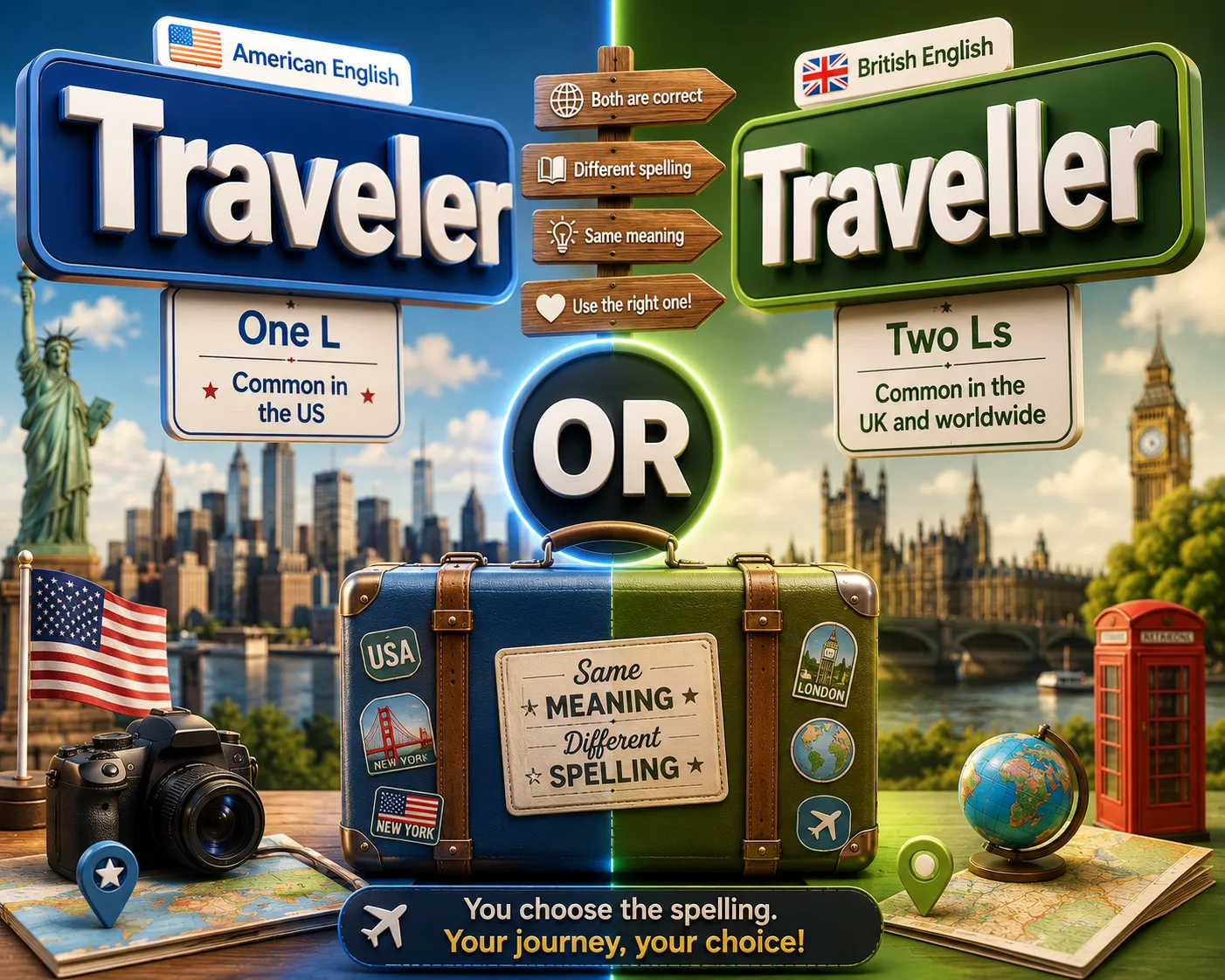
Traveler and traveller have the same meaning. Traveler is the standard American English spelling, while traveller is the standard British English spelling.
I remember the first time I noticed “traveler” and “traveller” used in different articles. I wondered whether one was a spelling mistake or if the two words had different meanings. Later, while reading travel blogs, books, and websites from different English-speaking countries, I realized that this is a common spelling difference between varieties of English.
The good news is that both spellings are correct. The difference is mainly regional. American English usually uses traveler, while British English uses traveller. Both words describe a person who travels from one place to another.
In this guide, you will learn the difference between traveler and traveller, where each spelling is used, why the extra l appears, and which form you should choose for your writing.
Traveler or Traveller: Quick Answer
Both traveler and traveller are correct spellings.
- Traveler = American English 🇺🇸
- Traveller = British English 🇬🇧
For example:
- The traveler packed a small suitcase for the trip.
- The traveller packed a small suitcase for the trip.
The meaning is exactly the same. The only major difference is the spelling convention.
If you are writing for an American audience, traveler is usually the better choice. If your audience uses British English, traveller is the preferred form.
What Does Traveler Mean?
Traveler means a person who travels from one place to another. The person may travel for work, business, vacation, education, or personal reasons.
For example:
- The traveler arrived at the airport early.
- Every traveler needs a valid passport for an international trip.
- The young traveler visited several countries.
The spelling traveler is especially common in American English.
You may see it in American newspapers, books, travel websites, airline information, and tourism content.
Examples of Traveler
Here are a few natural examples:
The traveler booked a hotel near the airport.
The experienced traveler always carries a map.
The website offers useful advice for every traveler.
In each example, traveler refers to someone who travels.
What Does Traveller Mean?
Traveller has exactly the same basic meaning. It refers to a person who travels.
The difference is that traveller is the traditional British spelling and is also common in other varieties of English influenced by British spelling.
Examples include:
- The traveller arrived in London yesterday.
- The traveller explored the Scottish Highlands.
- Every traveller should check the weather before leaving.
You will commonly find traveller in British publications and writing that follows British spelling conventions.
Why Is There an Extra L in Traveller?
The main difference comes from spelling conventions.
In many British English words, a final consonant is doubled before certain suffixes are added. American English often uses a simplified spelling in similar cases.
This creates differences such as:
| British English | American English |
| traveller | traveler |
| travelling | traveling |
| travelled | traveled |
| travelling | traveling |
The same general spelling pattern explains why traveller has two ls while traveler has one.
However, it is important to remember that spelling rules can vary depending on the word and the English variety. Do not assume that every British word automatically doubles its consonant.
Traveler vs Traveller: Key Differences
| Feature | Traveler | Traveller |
| Meaning | A person who travels | A person who travels |
| Spelling | One l | Two ls |
| Main variety | American English | British English |
| Common in | US writing | UK writing |
| Pronunciation | Usually the same | Usually the same |
| Correct? | Yes | Yes |
The easiest way to understand the difference is this:
Traveler = US spelling
Traveller = UK spelling
Neither spelling is inherently more correct.
Where Is “Traveler” Used?
Traveler is the standard spelling in American English.
You are likely to see it in:
- American travel blogs
- US newspapers
- American books
- US airline websites
- American tourism advertisements
- Content written for US readers
For example:
The traveler visited New York, Boston, and Chicago.
If your website mainly targets readers in the United States, using traveler throughout your content will usually provide better spelling consistency.
Where Is “Traveller” Used?
Traveller is the standard British spelling.
It is common in:
- British newspapers
- UK travel guides
- British books
- UK tourism websites
- Writing that follows British English conventions
For example:
The traveller visited London, Edinburgh, and Manchester.
Other varieties of English may also use traveller, although usage can vary by country and publication style.
Traveler or Traveller in Australia and Canada
The choice becomes slightly more interesting outside the United States and United Kingdom.
English spelling varies across countries, and individual style guides may differ. Traveller is widely used in British-influenced varieties, including Australian English.
Canadian English can show both British and American influences, so you may encounter different spellings depending on the publication or style guide.
The most important rule is consistency.
If your article uses British spelling throughout, use traveller. If it follows American English, use traveler.
Avoid switching between the two forms without a reason.
Common Mistakes
One common mistake is thinking that one spelling is wrong.
Mistake 1: Calling “traveller” incorrect
Incorrect assumption: “Traveller is misspelled.”
Better understanding: Traveller is the standard British spelling.
Mistake 2: Calling “traveler” incorrect
Incorrect assumption: “Traveler is missing an l.”
Better understanding: Traveler is the standard American spelling.
Mistake 3: Mixing spelling styles
For example, a writer might use:
- traveller
- traveling
- traveled
This may create an inconsistent style because these forms can reflect different spelling conventions.
Choose one English variety and follow it consistently.
An Easy Trick to Remember
Use this simple memory trick:
US = Traveler → one L
UK = Traveller → two Ls
Think of traveller as the spelling with the extra letter commonly associated with British English.
You can also remember:
- travel + er = traveler 🇺🇸
- travel + ler = traveller 🇬🇧
This is not a complete rule for every English word, but it is a useful way to remember this particular spelling difference.
Traveler and Traveller in Everyday Sentences
Here are some examples showing how the words work in sentences.
American English
- The traveler missed the early train.
- The traveler carried a backpack and a camera.
- The hotel offers special services for international travelers.
- Every traveler should keep important documents safe.
British English
- The traveller missed the early train.
- The traveller carried a backpack and a camera.
- The hotel offers special services for international travellers.
- Every traveller should keep important documents safe.
Notice that the meaning and grammar remain the same. Only the spelling changes.
Traveler or Traveller: Which One Should You Use?
The best spelling depends on your audience.
Choose traveler if:
- You are writing in American English.
- Your main readers are in the United States.
- Your website follows American spelling.
- You want consistency with other American spellings.
Choose traveller if:
- You are writing in British English.
- Your main readers are in the United Kingdom.
- Your publication follows British spelling.
- Your existing content uses British spelling.
If you are writing for an international audience, either spelling can be understood. However, maintaining one spelling style throughout the article makes your writing look more polished and professional.
Traveler vs Traveller: A Simple Comparison
| Question | Traveler | Traveller |
| Is it correct? | Yes | Yes |
| Does it mean a person who travels? | Yes | Yes |
| Is it American English? | Yes | No |
| Is it British English? | No | Yes |
| Does the pronunciation change? | Usually no | Usually no |
| Main difference | One l | Two ls |
Frequently Asked Questions
Is “traveler” or “traveller” correct?
Both are correct. Traveler is the standard American English spelling, while traveller is the standard British English spelling.
What is the difference between traveler and traveller?
There is no significant difference in meaning. Both words refer to a person who travels. The difference is the regional spelling.
Is “traveler” used in British English?
British English normally uses traveller. American-style spelling may still appear in international or American-influenced content.
Is “traveller” used in American English?
American English normally uses traveler. You may encounter traveller in names, quotations, imported material, or content following another spelling system.
Which spelling should I use for a US website?
Use traveler if your website follows American English.
Which spelling should I use for a UK website?
Use traveller if your website follows British English.
Are traveler and traveller pronounced differently?
They are generally pronounced the same. The difference is primarily in spelling, not pronunciation.
Final Verdict
So, traveler or traveller—which one is correct?
The answer is both.
Traveler is the standard American English spelling, while traveller is the standard British English spelling. Both words have the same meaning and are used to describe someone who travels.
If you write for American readers, choose traveler. If you follow British English, choose traveller. For international writing, either form can work, but consistency matters.
The easiest rule to remember is:
Traveler = American English
Traveller = British English
Once you know this simple regional difference, you will never have to wonder about the extra l again.
Read More:
Arial or Aerial: The Correct Meaning Made Easy

I’m **Rubab Naaz**, an English language content writer with over 10 years of experience creating educational and SEO-focused articles. I specialize in spelling comparisons, grammar, vocabulary, synonyms, commonly confused words, and English usage. My passion is helping students, writers, and professionals improve their language skills through accurate, well-researched, and easy-to-understand content. Every article I write is designed to make learning English simple, practical, and engaging.