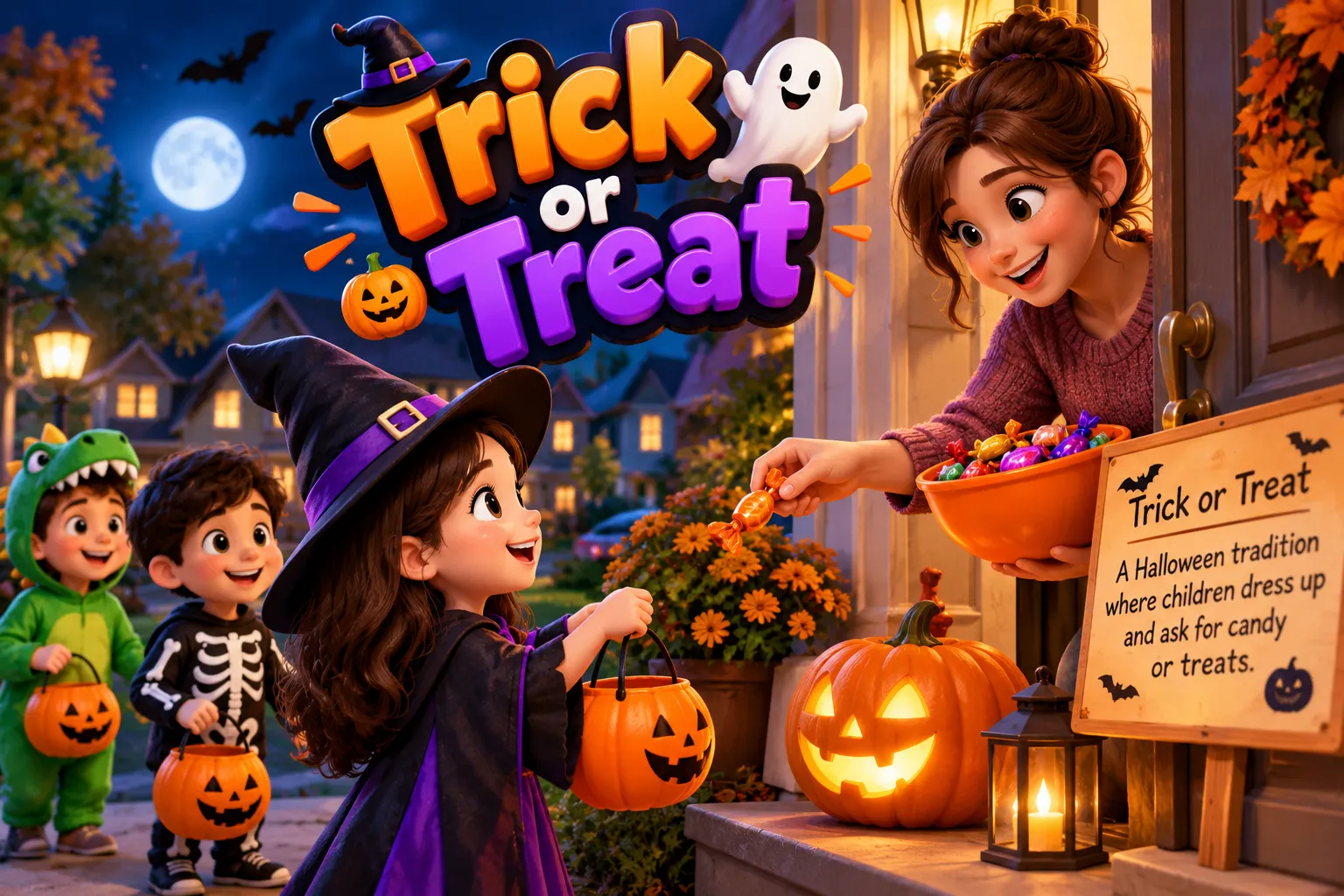
Trick or treat is a Halloween phrase children say when asking for candy or other treats, usually while visiting homes in costume.
Halloween has a special sound. Doors open. Costumes appear. Children carry bright bags. Then comes the familiar phrase: “Trick or treat!”
I still remember how easily this phrase could confuse a new English learner. At first, it sounds like a simple choice between two things. Is someone asking for a trick? Is someone offering a treat? The real meaning is more playful.
Trick or treat is closely linked to Halloween. It can describe the phrase children say, the activity itself, or the wider tradition of going from home to home for candy. Cambridge Dictionary defines trick or treat as the phrase children use when they go trick-or-treating at Halloween. The related noun trick-or-treating refers to the activity of visiting homes to ask for sweets or candy.
There is another phrase that can cause confusion: trunk or treat. It sounds almost the same, but it describes a different Halloween activity.
This guide explains the meaning, history, grammar, spelling, usage, and common mistakes surrounding trick or treat. By the end, you will know exactly when to use each form.
Trick or Treat Quick Answer
Trick or treat is a traditional Halloween expression. Children often say it when they visit homes in costumes and ask for candy or another small treat.
For example:
“The children knocked on the door and shouted, ‘Trick or treat!’”
The phrase can also refer to the activity more generally.
“We took the kids trick-or-treating after dinner.”
The first example uses the phrase as something children say. The second uses trick-or-treating as the name of the activity.
That small difference matters when you are writing about Halloween.
The Origin and Background of Trick or Treat
The history of trick or treat is older than the modern Halloween image of children carrying candy buckets.
The exact path into modern English is not completely simple. Historical sources connect the phrase with earlier Halloween customs involving treats, pranks, and asking for gifts.
The Oxford English Dictionary records trick or treat as an expression and noun from the early 20th century. Its entry gives 1927 as an early recorded date for the phrase.
Etymonline gives a slightly different picture. It records “tricks or treats” from 1917 and says “trick-or-treat” as a children’s Halloween pastime is recorded from 1926 in Canada.
This difference is useful. It shows why word history should not always be reduced to one exact date. Earlier related expressions may appear before the modern form becomes established.
The history of the individual words is even older.
Where does “trick” come from?
Trick has been used in English for centuries. It developed meanings connected with deception, clever actions, amusement, and pranks.
In the Halloween phrase, trick suggests a playful prank.
Where does “treat” come from?
The word treat has a much older history too. Etymonline traces the verb through Old French traitier and Latin tractare. Over time, English developed the noun sense of a pleasant gift, food, or enjoyable experience.
That gives the Halloween phrase a simple contrast:
- Trick → a prank
- Treat → something pleasant, such as candy
The phrase therefore creates a playful bargain: give me a treat, or there may be a trick.
Trick or Treat Explained Key Differences and Variations
Several related forms appear in English. They are connected, but they do not work in exactly the same way.
| Term | Meaning | When to Use | Region/Context |
| trick or treat | The Halloween expression | When quoting what children say | Halloween |
| trick-or-treating | The activity of visiting homes for treats | When describing the activity | Mainly North American English |
| trick-or-treater | A person who goes trick-or-treating | When talking about a child or participant | Halloween |
| trick-or-treat | The activity in some dictionary usage | When discussing the custom generally | Informal |
| trunk or treat | A Halloween event centered on decorated car trunks | When describing organized events | Especially North America |
“Trick or treat” vs. “trick-or-treating”
This is one of the most useful distinctions.
Trick or treat is often the phrase spoken at the door.
“The children called out, ‘Trick or treat!’”
Trick-or-treating is the activity.
“They went trick-or-treating around the neighborhood.”
The difference is similar to the difference between an action someone says and the name of the activity itself.
Trick or Treat vs. Trunk or Treat
These phrases are easy to mix up.
Trick or treat
Children usually travel from house to house. They knock on doors and ask for candy.
Trunk or treat
Children usually gather at one location, such as a school, church, community center, or parking lot. Adults decorate the trunks of their cars and give out treats from them.
So:
Trick or treat = house-to-house Halloween activity.
Trunk or treat = organized event using decorated car trunks.
“Trunk or treat” is therefore not a spelling variation of “trick or treat.” It describes a different format.
Which Version Should You Use?
The best form depends on what you want to say.
For the phrase children say
Use:
“Trick or treat!”
This is the natural choice when quoting the traditional Halloween expression.
For the activity
Use:
trick-or-treating
This is the clearest choice when describing children visiting homes for candy.
For a person
Use:
trick-or-treater
This refers to someone taking part in the activity.
For a community parking-lot event
Use:
trunk or treat
This makes it clear that the event involves decorated vehicles rather than traditional door-to-door visits.
For global or beginner-friendly writing
Explain the phrase the first time you use it.
For example:
“Trick-or-treating is a Halloween activity in which children visit homes to ask for candy.”
That removes confusion for readers who may know Halloween but not the English expression.
Common Mistakes With Trick or Treat
1. Writing “trick and treat”
Incorrect:
“Children shouted trick and treat.”
Correct:
“Children shouted, ‘Trick or treat!’”
The word or is important because it presents an alternative.
2. Calling “trunk or treat” another spelling
Incorrect:
“Trunk or treat is the American spelling of trick or treat.”
Correct:
“Trunk or treat is a different Halloween event.”
The two phrases describe different activities.
3. Confusing the phrase with the activity
Less natural:
“Children went trick or treat yesterday.”
Better:
“Children went trick-or-treating yesterday.”
The -ing form names the activity.
4. Forgetting quotation marks when reporting speech
When you are showing exactly what someone says, quotation marks can make the meaning clearer.
The children shouted, “Trick or treat!”
5. Assuming every Halloween event is traditional trick-or-treating
Some communities use organized events instead of door-to-door visits. These may be called trunk or treat, Halloween festivals, or other local names.
Trick or Treat in Real World Examples
Professional email
“The community center will host a family trick-or-treating event on October 31.”
Although Halloween language is informal, it can appear in a professional email when the subject is a community event.
News headline
“Local Families Prepare for a Safe Night of Trick-or-Treating”
The noun form works naturally in a headline because the article is discussing the activity.
Social media post
“Costumes are ready, candy bags are packed, and we are ready for trick or treat!”
Social media often uses the phrase in a relaxed and playful way.
Formal report
“The school organized a supervised trick-or-treating activity for younger students.”
Here, trick-or-treating clearly identifies the type of activity.
Trick or Treat Data, Trends & Usage
Exact monthly search volume for “trick or treat” changes by country, month, and SEO platform. Without a current Ahrefs or Semrush account dataset, it would be misleading to invent a fixed monthly number.
There is, however, useful public search data.
Google reported that Halloween-related searches show strong seasonal behavior. Its Halloween search coverage has repeatedly highlighted searches that rise around October.
A particularly useful regional example comes from Google’s 2022 report on Halloween searches in the Middle East and North Africa. Google said search interest for “trick or treat” increased by 110% year over year across the UAE, Saudi Arabia, and Egypt, based on Google Trends data comparing October 2020 with October 2021. This is historical data, not a current 2026 search-volume estimate.
The same Google report found strong growth in related Halloween searches, including Halloween candy, decorations, and costumes.
This tells us something important for SEO: trick or treat is strongly seasonal.
Search intent around the phrase can include:
- Informational: “What does trick or treat mean?”
- Educational: “How do you spell trick or treat?”
- Cultural: “Why do children say trick or treat?”
- Practical: “When do kids go trick-or-treating?”
- Comparison: “Trick or treat vs. trunk or treat”
- Ideas: “Trick-or-treating costume ideas”
The phrase is especially useful for English learners because it combines vocabulary, grammar, punctuation, culture, and pronunciation in only three words.
Standalone Trick or Treat Comparison Table
| Term/Variant | Meaning | Region/Context | Best Used When |
| Trick or treat | Halloween phrase used when asking for treats | General Halloween English | Quoting the expression |
| Trick-or-treating | Going from place to place to receive treats | Common in North American English | Describing the activity |
| Trick-or-treater | A participant in the activity | Common Halloween term | Describing a person |
| Tricks or treats | An older related wording | Historical/older usage | Discussing language history |
| Trunk or treat | Organized Halloween event at decorated vehicles | Mainly North American context | Describing a parking-lot event |
Why Is “Trick or Treat” Hyphenated Sometimes?
This is a useful grammar point.
When children actually say the phrase, you normally write:
“Trick or treat!”
No hyphens are needed because it is a spoken expression.
But related compound forms often use hyphens:
trick-or-treating
trick-or-treater
The hyphens help show that the words work together as a compound expression.
This is a punctuation issue, not a change in meaning.
Is Trick or Treat Formal English?
Trick or treat is mainly an informal cultural expression. It is perfectly natural when discussing Halloween.
You would not normally use it in a formal business sentence unless Halloween or a related event is the subject.
For example:
“The company will host a trick-or-treating event for employees’ children.”
That sentence is formal in structure while still using an informal cultural term.
Frequently Asked Questions
Q: What does trick or treat mean?
A: It is a Halloween expression traditionally used by children when asking for candy or other treats. It can also refer more broadly to the Halloween custom associated with the phrase.
Q: How do you use trick or treat correctly?
A: Use “trick or treat!” when representing the words someone says. Use trick-or-treating when referring to the activity.
Q: Is trick or treat one word?
A: No. The spoken expression is written as three separate words: trick or treat. Related forms such as trick-or-treating are commonly hyphenated.
Q: What is the difference between trick or treat and trunk or treat?
A: Traditional trick-or-treating usually involves visiting homes. Trunk or treat usually takes place at a central location where people give candy from decorated vehicle trunks.
Q: Is trick or treat acceptable in formal writing?
A: Yes, when the subject requires it. For example, a school report, event announcement, or news story about Halloween can use the phrase naturally.
Q: Where did trick or treat come from?
A: The modern phrase is documented in the early 20th century. The Oxford English Dictionary records an entry from 1927, while Etymonline records related forms even earlier.
Q: What is a trick-or-treater?
A: A trick-or-treater is someone who takes part in trick-or-treating. The term is usually used for children or young people dressed in Halloween costumes.
Conclusion
Trick or treat is one of the best-known Halloween expressions in English. Its meaning is simple, but its usage has several useful details.
The phrase refers to the traditional call made by children when asking for Halloween treats. Trick-or-treating names the activity itself, while a trick-or-treater is a person taking part in it.
The history is also worth remembering. The modern phrase became established in North American Halloween culture during the early 20th century, although related customs and expressions are older. Historical sources do not all give the same first date, so it is better to describe its development as a gradual process rather than attach the entire tradition to one year.
One more distinction can save you from a common mistake: trunk or treat is different from trick or treat. The first usually involves decorated cars at a central event, while the second traditionally involves going from home to home.
Now you can use trick or treat, trick-or-treating, and trunk or treat with confidence. Bookmark this guide before Halloween and share it with someone who is still unsure about the difference.
Readmore

I’m Daniel sultan, an English language writer and SEO content specialist with experience researching spelling, grammar, vocabulary, and English usage. Through SpellComparison.com, I create clear, accurate, and well-researched guides that help readers understand commonly confused words, spelling differences, and grammar rules with confidence.
Every article I write is based on trusted language references, established style guides, and real-world usage to ensure it is accurate, practical, and easy to understand. My goal is to make learning English simple and reliable by providing fact-checked content, clear explanations, and real-life examples that students, writers, educators, and professionals can trust.