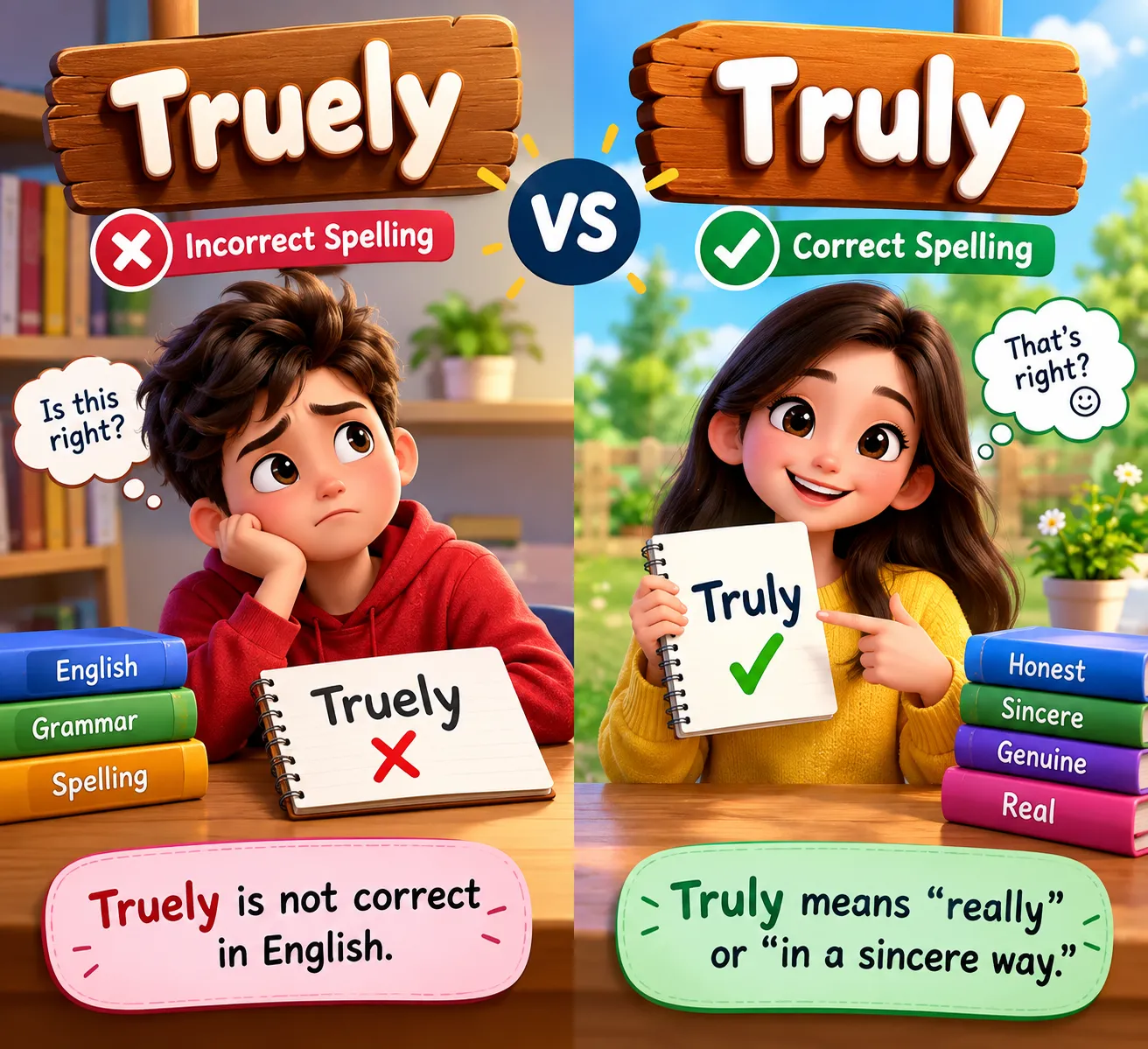
Truly is the correct spelling. Truely is a common misspelling of the adverb formed from true, so use truly in standard English.
I have often seen people hesitate over the spelling of truly, especially when they are writing quickly. I have even come across sentences like, “I truely appreciate your help,” where the writer clearly knows the word but is unsure about its spelling. The confusion is understandable. The base word is true, so it seems natural to think that adding -ly should give us truely.
But English has a different rule here.
The correct spelling is truly. The final e in true is dropped before -ly is added. It is a small spelling change, but it can easily cause mistakes in emails, essays, social media posts, and other forms of writing.
If you have ever wondered whether truely or truly is correct, you are not alone. In this guide, I will explain the difference, show you how to use truly correctly, and share an easy way to remember the spelling. Let’s make this common spelling problem simple.
Truely or Truly Quick Answer
Truly is the correct form, while truely is not the standard spelling of the word.
Truly is an adverb. It can express truth, sincerity, certainty, or strong emphasis. Cambridge Dictionary defines it as an adverb used to emphasize that something is true and also gives meanings such as “certainly,” “actually,” and “sincerely.”
For example:
- I truly appreciate your support.
- The view was truly beautiful.
- She truly believed his story.
The incorrect form is:
- ❌ I truely appreciate your support.
The spelling may look logical, but standard English uses truly.
The Origin and Background of Truly
The story becomes more interesting when you look at etymology, the study of word origins.
The adjective true has a long history in English. Etymonline traces it through Middle English treu to Old English forms including triewe and treowe, with early senses connected to being faithful, trustworthy, and honest.
The Oxford English Dictionary records truly from around 1225, with an early meaning connected to acting in accordance with fact or reality, truthfully, or correctly. It also records the word with senses such as genuinely, really, and sincerely.
So truly is not a recent invention. It has been part of English for centuries.
The spelling that causes trouble today comes from the relationship between true and truly:
true → truly
Not:
true → truely
This is one reason English spelling can feel unpredictable. The normal pattern of adding -ly does not always produce the spelling you might expect.
Truly Explained Key Difference and Spelling
The main difference between truly and truely is simple:
| Term | Meaning | When to Use | Region/Context |
| Truly | Really, sincerely, genuinely, or truthfully | Use when you need the adverb | Standard English worldwide |
| Truely | Nonstandard misspelling of truly | Avoid it | Not a standard regional variant |
According to Cambridge Dictionary, truly is an adverb. It can emphasize truth or describe something as sincere, actual, certain, or exact.
Why does true become truly?
A common mistake is to think:
true + ly = truely
But the standard spelling is:
true − e + ly = truly
That gives you:
T-R-U-L-Y
There is no e after the u.
This is similar to another familiar spelling change:
- due → duly
- true → truly
However, you should not assume every adjective ending in e behaves in exactly the same way. English spelling contains many patterns and exceptions.
What part of speech is truly?
Truly is an adverb.
Compare:
- The statement is true.
Here, true is an adjective. - I truly believe the statement.
Here, truly modifies the verb believe.
This distinction is useful because true and truly do different jobs in a sentence.
Which Version Should You Use?
The answer is the same whether you are writing for American, British, or international readers.
For students
Use truly in essays, assignments, exams, and other academic work.
For professional writers
Use truly in reports, articles, emails, applications, and business communication.
For British English
Use truly.
For American English
Use truly.
For global English
Use truly. It is the safest and clearest choice.
There is no need to treat truely as a British or American spelling difference. The standard form is truly.
Common Mistakes with Truely or Truly
1. Adding the final e
❌ truely
✅ truly
This happens because writers start with true and add -ly without changing the spelling.
2. Using truely in formal writing
❌ We are truely grateful for your assistance.
✅ We are truly grateful for your assistance.
A spelling checker may catch the error, but it is better to know the correct form yourself.
3. Confusing true and truly
❌ She is truly to her promise.
✅ She is true to her promise.
Here, true is an adjective.
By contrast:
✅ She truly kept her promise.
Here, truly is an adverb.
4. Assuming pronunciation gives you the spelling
The spoken form does not clearly reveal whether an e belongs in the written word. That is why relying only on pronunciation can lead to truely.
5. Treating truely as an alternative spelling
Truely should not be treated like legitimate spelling pairs such as colour/color or cheque/check.
Those have recognized regional forms. Truely is simply the wrong spelling in modern standard English.
Truly in Real-World Examples
Seeing the word in different situations makes its use easier to remember.
Professional email
I truly appreciate the time you spent reviewing my proposal.
Here, truly expresses sincere gratitude.
News article
The discovery could truly change how researchers understand the region.
Here, truly adds emphasis to the claim.
Social media post
I truly enjoyed every moment of the trip!
The word adds strong personal emphasis.
Formal report
The findings truly reflect the concerns raised by participants.
In this sentence, truly modifies reflect and strengthens the statement.
Personal message
I am truly happy to see you reach this goal.
Here, the word emphasizes genuine feeling.
Notice that truly can work naturally in casual, professional, academic, and formal contexts.
Truly Data, Trends & Usage
The most useful usage evidence comes from dictionaries and language corpora rather than unsupported estimates of monthly search volume.
Cambridge lists truly as an established English adverb with several meanings and examples. The Oxford English Dictionary records the word from about 1225, showing that its use has a very long history in English.
Corpus research also shows that truly is a well-established adverb with several functions. A study using the 400+ million-word Corpus of Contemporary American English (COCA) examined truly alongside actually, genuinely, and really, finding meaningful differences in how these near-synonymous adverbs behave in sentences.
One published corpus analysis reported 16,427 occurrences of truly in its analyzed dataset, compared with much higher totals for really and actually.
For truely, exact monthly search-volume figures are not reliably established by the authoritative sources reviewed for this article. It is therefore better not to present an invented number as fact.
The search itself, however, makes sense. People often type the incorrect form because true + ly looks as if it should produce truely.
That makes this a useful spelling topic for:
- English learners
- Students
- ESL writers
- Bloggers
- Professional writers
- People checking emails and documents
The key lesson is simple: search frequency does not make a spelling correct. A misspelling can attract searches precisely because people are unsure about it.
Standalone Comparison Table
| Term/Variant | Meaning | Region/Context | Best Used When |
| Truly | Really, genuinely, sincerely, truthfully | Standard British and American English | Almost all normal uses |
| Truely | Common misspelling of truly | Nonstandard | Avoid in standard writing |
| True | Correct, real, or faithful | Standard English | When an adjective is needed |
| Truthfully | In an honest or truthful manner | Standard English | When focusing on how something is said or done |
This table highlights an important point: true is not simply another spelling of truly. The two words have different grammatical roles.
Easy Memory Trick for Truly
If you often forget the spelling, use this formula:
TRUE − E + LY = TRULY
Or remember:
Truly has no E after U.
Write it several times:
truly
truly
truly
The pattern will soon feel natural.
You can also connect the word to true without carrying its final e:
true → tru → truly
That is often easier than trying to remember a long grammar rule.
Frequently Asked Questions
Q: Is “truly” or “truely” correct?
A: Truly is correct in standard English. Truely is a common misspelling and should be avoided.
Q: What does truly mean?
A: Truly is an adverb that can mean really, genuinely, sincerely, truthfully, or certainly, depending on the sentence. Cambridge lists several of these uses.
Q: Why is truly spelled without an e?
A: The standard spelling changes true to truly when the adverb is formed. The final e is not retained before -ly.
Q: Is truely ever correct?
A: Truely is not the standard modern spelling you should use in normal English writing. Historical English contains spelling variation, but that does not make truely an appropriate modern form.
Q: Is truly used in both British and American English?
A: Yes. Truly is used in both varieties. You do not need a different spelling based on whether your audience uses British or American English.
Q: Is truly an adverb?
A: Yes. Truly is an adverb. It can modify verbs, adjectives, and other parts of a sentence depending on its meaning and position.
Q: Is “Yours truly” correct?
A: Yes. Yours truly is a standard expression. Cambridge also lists truly in letter-closing usage such as “Yours truly.”
Conclusion
The truely or truly question has a very simple answer once you know the spelling pattern.
Truly is the correct form. Truely is a common misspelling. The word is an adverb related to true, and it can express sincerity, truth, certainty, or strong emphasis.
The easiest spelling rule is:
true − e + ly = truly
Do not write truely just because it looks like the natural result of adding -ly to true. English spelling does not always follow that simple pattern.
It also helps to separate true from truly. True is commonly an adjective, while truly is an adverb.
The good news is that you do not need to remember a complicated British-versus-American distinction. Truly works across standard varieties of English.
Now that you know the difference, make the correct form automatic. Bookmark this guide so you never second-guess “truly” again.
Read More:
Forgo or Forego: Which One Is Correct?

I’m **Rubab Naaz**, an English language content writer with over 10 years of experience creating educational and SEO-focused articles. I specialize in spelling comparisons, grammar, vocabulary, synonyms, commonly confused words, and English usage. My passion is helping students, writers, and professionals improve their language skills through accurate, well-researched, and easy-to-understand content. Every article I write is designed to make learning English simple, practical, and engaging.










