Trunk or treat means a Halloween event where children collect candy from decorated car trunks instead of going door to door.
Have you ever seen a Halloween flyer that says “Trunk or Treat” and wondered what it means? I remember the first time I came across the phrase. It sounded like a playful twist on “trick or treat,” but the idea was not obvious from the words alone.
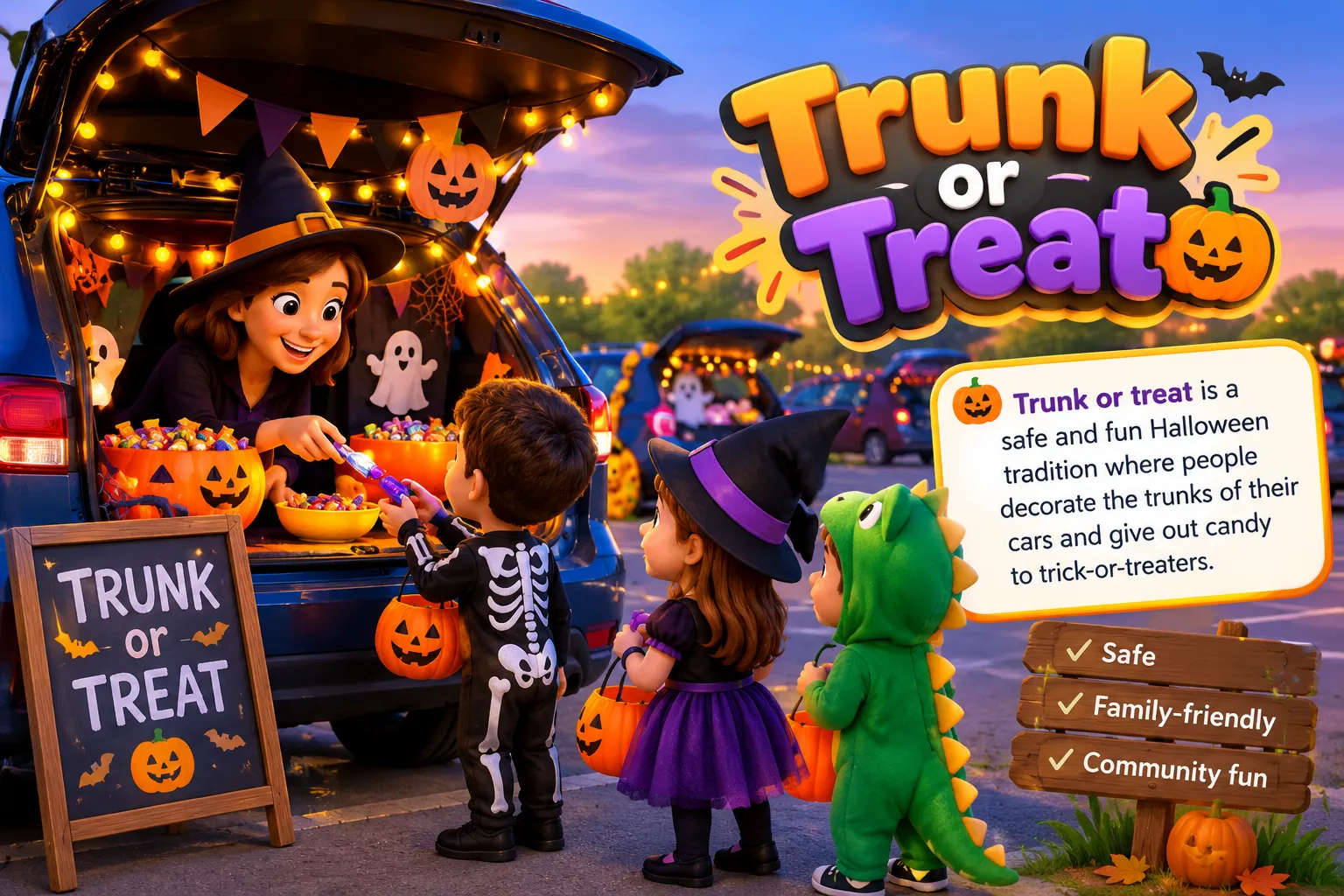
Then the picture made sense: rows of parked cars, open trunks covered in Halloween decorations, children in costumes, and adults handing out candy.
That simple setup has become a popular Halloween activity, especially in the United States. It can happen at a school, church, community center, or large parking lot. Children still dress up and collect treats. The big change is the setting.
Instead of walking from house to house, they walk from car to car.
This guide explains what trunk or treat means, where the phrase came from, how it differs from traditional trick-or-treating, and how to use it correctly in writing. You will also learn which spelling works best, common mistakes to avoid, and what current usage patterns tell us about the term.
Trunk or Treat Quick Answer
Trunk or treat is a Halloween event in which people decorate parked vehicles and give candy to children from their trunks.
The event is usually held in one central place, such as a school or church parking lot. Children move between the cars rather than visiting separate homes. NPR describes trunk-or-treating in much the same way: families gather vehicles in one place, open their trunks, and hand out candy as children walk from car to car.
For example:
- Our school is hosting a trunk or treat this Friday.
- The children dressed up for the community trunk-or-treat event.
The phrase is closely linked to Halloween, trick-or-treating, costumes, candy, decorated vehicles, and community events.
The Origin and Background of Trunk or Treat
Unlike very old Halloween traditions, trunk or treat is a modern expression.
Its exact starting point is not completely settled. Several sources place its development in the 1990s, with early events often connected to churches and community groups.
NPR reported that trunk-or-treat events had become associated with churches and described the tradition as an alternative to normal trick-or-treating. A 2013 public-radio report, citing Halloween historian Lesley Bannatyne, also connected the early growth of trunk-or-treat events with churches seeking a controlled, family-friendly alternative to Halloween celebrations.
The name itself is easy to understand.
Trunk + or + treat = trunk or treat
Here, trunk means the storage compartment at the back of a car. Treat refers to the candy or other small gifts children receive.
The phrase was modeled on the much older expression trick or treat.
Traditional trick-or-treating has a much longer history. Smithsonian Magazine explains that modern Halloween customs developed from several older traditions, including Scottish and Irish guising and earlier European practices of going from house to house for food or treats.
So, trunk or treat did not create a new Halloween tradition from nothing. It adapted an existing tradition to a new setting.
That is why the phrase feels so familiar.
Trunk or Treat Explained Key Differences and Variations
The biggest difference is simple:
Trick-or-treating happens from house to house. Trunk or treat happens from car to car.
Here is a quick comparison:
| Term | Meaning | When to Use | Region/Context |
| Trunk or treat | A Halloween event using decorated car trunks | Naming the event | Mainly U.S. and Canada |
| Trunk-or-treat | Hyphenated form of the event name | Before another noun | “Trunk-or-treat event” |
| Trunk-or-treating | Taking part in the activity | Describing the action | Casual and general use |
| Trick or treat | Traditional Halloween activity | House-to-house candy collecting | Widely recognized |
| Trick-or-treating | The activity of going house to house | Describing the action | Common Halloween usage |
For example, you could write:
The town is holding a trunk or treat for local families.
Or:
The children will be trunk-or-treating after sunset.
When the phrase acts as a compound adjective before another noun, hyphens can make the relationship easier to read:
The church organized a trunk-or-treat event.
This follows a common principle in English punctuation: multiword expressions used together before a noun are often hyphenated for clarity.
Why Is It Called “Trunk or Treat”?
The name is a playful modification of trick or treat.
The word trunk replaces trick because the candy comes from a vehicle trunk.
That makes the phrase a form of wordplay rather than a completely separate linguistic construction.
It is also an example of how language changes with culture. A familiar phrase can be reshaped when people create a new activity around it.
Which Version Should You Use?
The best form depends on what you are trying to say.
If You Mean the Event
Use trunk or treat.
The neighborhood is planning a trunk or treat for October 31.
This is the clearest choice when naming the event.
If You Mean the Activity
Use trunk-or-treating.
We are going trunk-or-treating with the kids this weekend.
This form describes what people are doing.
If It Comes Before a Noun
Use trunk-or-treat as a compound modifier.
We attended a trunk-or-treat celebration.
The hyphens help show that the three words work together to describe the celebration.
For American Readers
Trunk or treat is the most natural wording because the tradition is strongly associated with American Halloween culture.
For British or International Readers
Add a short explanation the first time you use it.
For example:
Trunk or treat is an American Halloween event where children collect sweets from decorated cars.
This helps readers who may associate trunk with something different or may not know the tradition.
Common Mistakes With Trunk or Treat
The phrase is easy once you understand it, but a few errors appear often.
1. Confusing It With Trick or Treat
Mistake:
The children went from house to house at a trunk or treat.
Better:
The children went from car to car at a trunk or treat.
The location is the key difference.
2. Writing “Trunk of Treat”
Mistake:
Our school is having a trunk of treat.
Correct:
Our school is having a trunk or treat.
The expression copies the structure of trick or treat, not “trunk of treats.”
3. Using “Trunk or Treats” as the Main Event Name
You may see trunk or treats in casual posts, but trunk or treat is the clearer standard name for the event.
Think of it like trick or treat. The phrase keeps the singular form treat.
4. Treating “Trunk-or-Treating” and “Trunk or Treat” as Identical
They are closely related, but they serve different grammatical roles.
- Trunk or treat → the event
- Trunk-or-treating → the activity
- Trunk-or-treat event → a compound modifier
5. Assuming Every Trunk or Treat Is on October 31
Not necessarily.
Many events take place on Halloween, but schools, churches, and community groups may schedule them on another evening or weekend. NPR notes that trunk-or-treat events can be organized by different community institutions and are not limited to one type of venue.
Trunk or Treat in Real World Examples
Seeing the phrase in different settings makes its use much easier to understand.
Professional Email
We are pleased to invite families to our annual trunk or treat event. Please arrive early if you plan to decorate a vehicle.
News Headline
Local Schools Host Trunk-or-Treat Events for Halloween
Social Media Post
🎃 Our car is ready! We cannot wait to see all the costumes and creative trunks at tonight’s trunk or treat.
Formal Document
The community center will organize a trunk-or-treat program for children and families during the Halloween season.
Notice how the wording changes with the context.
The event name can stay trunk or treat, while trunk-or-treating works naturally when talking about the activity.
Trunk or Treat Data, Trends & Usage
There is one important SEO point here: Google Trends measures relative search interest, not exact monthly search volume.
Public sources do not provide a reliable, fixed monthly search-volume figure for “trunk or treat” that should be presented as a universal number. Search volume also changes sharply with the season, country, and keyword variation.
What can be supported more confidently is the seasonal pattern.
Searches for phrases such as:
- “trunk or treat”
- “trunk or treat ideas”
- “trunk or treat decorations”
- “trunk or treat near me”
- “trunk or treat themes”
- “trunk or treat games”
are strongly tied to Halloween planning.
The term is also especially associated with the United States and Canada. NPR describes trunk-or-treating as an alternative to traditional trick-or-treating and notes that events can take place at schools, churches, YMCAs, courthouses, and car dealerships.
What Is the Search Intent?
For the keyword “trunk or treat,” the main search intent is informational.
A person searching the phrase may want to know:
- What does trunk or treat mean?
- How does it work?
- Where did it come from?
- Is it different from trick-or-treating?
- How should I spell it?
- How can I find or organize an event?
There is also a strong local and event-based intent around searches such as “trunk or treat near me.”
Why Does the Topic Matter Now?
The phrase matters because Halloween events have become more varied.
Traditional trick-or-treating is still familiar, but schools, churches, nonprofits, and community groups can use centralized events to bring families together.
Smithsonian Magazine notes that trunk or treat is now one of the newer forms of trick-or-treating, with children moving from car to car rather than house to house.
For SEO writers, this also creates several useful long-tail topics, such as trunk or treat ideas, trunk or treat themes, and trunk or treat decorations.
Trunk or Treat vs. Related Halloween Terms
Here is another useful comparison that includes an edge case:
| Term/Variant | Meaning | Region/Context | Best Used When |
| Trunk or treat | Centralized Halloween candy event | Mainly North America | Naming the event |
| Trunk-or-treating | Taking part in the car-to-car activity | Mainly North America | Describing the action |
| Trick or treat | Asking for Halloween treats | Broadly recognized | Talking about the traditional phrase |
| Trick-or-treating | Going from home to home for treats | Common in North America | Describing traditional Halloween activity |
| Fall festival | Broader autumn community event | General | When Halloween is not the main focus |
| Halloween party | A wider Halloween celebration | International | Describing parties with games, food, or costumes |
The key distinction is location.
A trunk or treat moves the candy stops into one shared area. A traditional trick-or-treat route spreads those stops across a neighborhood.
FAQ About Trunk or Treat
Q: What does trunk or treat mean?
A: Trunk or treat is a Halloween event where children collect candy from decorated vehicles. Cars are usually parked together in one central location.
Q: How do you use trunk or treat correctly?
A: Use trunk or treat when naming the event. Use trunk-or-treating when describing the activity, such as children moving from car to car.
Q: What is the difference between trunk or treat and trick or treat?
A: Traditional trick-or-treating usually involves visiting homes. Trunk or treat places the participating vehicles together, so children collect candy from car trunks instead.
Q: Is trunk or treat acceptable in formal writing?
A: Yes. The phrase can be used in formal writing when you are discussing an actual event. If your audience may not know the term, define it the first time you use it.
Q: Which is correct: trunk or treat or trunk or treats?
A: Trunk or treat is the clearest standard form for the event name. “Trunk or treats” may appear informally, but it is not the preferred wording.
Q: Where did trunk or treat come from?
A: The modern practice developed in the United States during the 1990s, with churches and community groups playing an important role in its early growth. The exact first event is not firmly established.
Q: Can you say trunk-or-treating?
A: Yes. Trunk-or-treating is useful when you mean the act of taking part in the event. For example, you can say that a family is going trunk-or-treating.
Conclusion
Trunk or treat is a simple phrase with a fun idea behind it. It takes the familiar Halloween tradition of trick-or-treating and moves it into a shared parking area filled with decorated cars.
The most useful points are easy to remember. Trunk or treat names the event. Trunk-or-treating describes the activity. A trunk-or-treat event uses the hyphenated form because the words work together before another noun.
The tradition is relatively modern. Sources place its development in the 1990s, with churches and community groups helping it grow as an alternative to traditional door-to-door Halloween activities
If you are writing for a broad audience, explain the term once. That small step removes confusion for readers who have never attended one.
Now you know exactly what trunk or treat means, how it works, where it came from, and how to use the phrase naturally. Bookmark this guide so you never have to second-guess the term again.
Readmore

I’m **Rubab Naaz**, an English language content writer with over 10 years of experience creating educational and SEO-focused articles. I specialize in spelling comparisons, grammar, vocabulary, synonyms, commonly confused words, and English usage. My passion is helping students, writers, and professionals improve their language skills through accurate, well-researched, and easy-to-understand content. Every article I write is designed to make learning English simple, practical, and engaging.