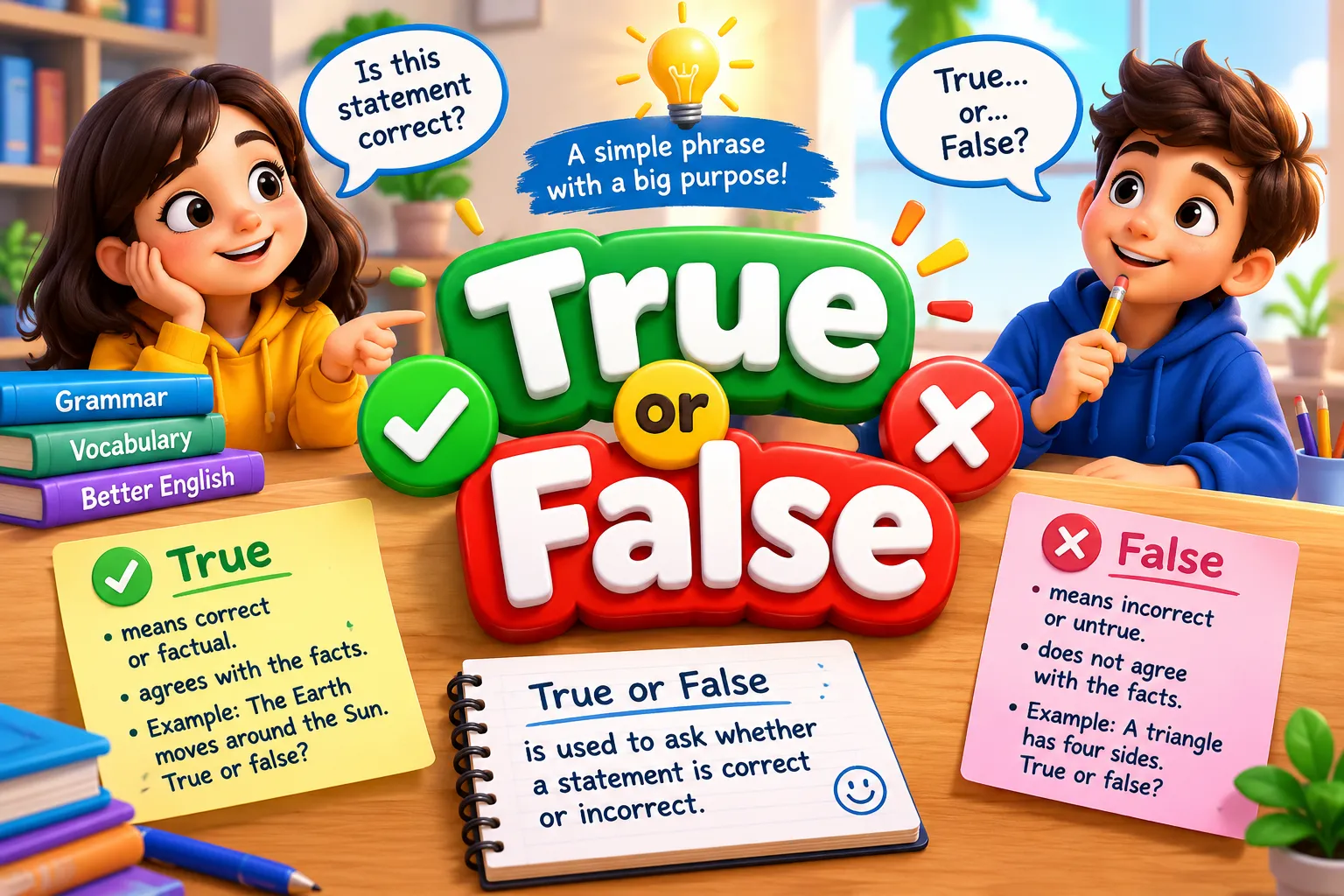
True or false is used to ask whether a statement is correct or incorrect. True means the statement agrees with the facts, while false means it does not.
Have you ever read a question and stopped at the words “true or false”?
You probably have. You see them in school tests, online quizzes, news articles, surveys, games, and even everyday conversations. The phrase looks simple, but learners sometimes wonder what it really means, how to use it, and whether “true or false” is the right form in formal English.
The confusion often comes from the fact that true and false can have several meanings. True can describe a fact, a person, a story, or something that is real. False can describe an incorrect statement, a fake object, or information that is not true.
There is also a small grammar point worth knowing. True or false uses or, a conjunction that connects two choices. The phrase is now strongly linked with quiz and test questions, but it can also appear in normal writing.
This guide explains the meaning, grammar, history, differences, common mistakes, and real-world use of true or false in simple English.
True or False Quick Answer
True or false asks you to choose between two possible answers.
- True = the statement is correct or agrees with the facts.
- False = the statement is incorrect or does not agree with the facts.
For example:
The Earth moves around the Sun. True or false?
The answer is true.
Another example:
A triangle has four sides. True or false?
The answer is false.
Cambridge Dictionary defines true as describing something that is right and not wrong, especially when talking about facts or statements. It defines false as something that is not correct or true.
So, when someone asks “Is this true or false?”, they are asking you to judge the statement against the facts.
The Origin and Background of True or False
The two words have very old histories.
According to the Oxford English Dictionary, true dates back to the Old English period, before 1150. The word developed from Germanic forms connected with ideas such as being faithful, trustworthy, and reliable.
The meaning later expanded. True came to describe something that agrees with fact or reality. Etymonline records this sense from around 1200.
The history of false is different. Etymonline traces it through Old French fals/faus to Latin falsus. Its meanings included ideas such as deceptive, mistaken, and incorrect.
The combined expression true-false has a more specific history. Etymonline records it as a type of test question with only these two possible answers from 1923.
That history explains why the phrase feels so natural in education today. True or false became closely connected with testing, quizzes, and statements that can be judged as correct or incorrect.
A useful language point
The phrase also shows how English can pair opposite words:
- true / false
- right / wrong
- correct / incorrect
- real / fake
- yes / no
These pairs are not always exact synonyms. Context matters.
True or False Explained: Key Differences
The words true and false are opposites when you are talking about whether information agrees with facts.
| Term | Meaning | When to Use | Region/Context |
| True | Correct or factual | When a statement agrees with reality | Standard English |
| False | Incorrect or untrue | When a statement does not agree with reality | Standard English |
| True or false | A choice between the two | Questions, quizzes, tests, discussions | Global English |
| True-false | Relating to a two-choice test format | Before a noun, such as “true-false question” | Formal/educational |
Cambridge also shows that true has other meanings. It can mean real, sincere, loyal, or accurate, depending on the sentence.
For example:
- That statement is true. → It agrees with the facts.
- She is a true friend. → She is loyal and sincere.
- This is a true story. → The story is based on real events.
- The answer is false. → The answer is not correct.
This is why you should always look at the context before deciding what true means.
True or false vs. right or wrong
These expressions are similar, but they are not always identical.
True or false usually focuses on whether something agrees with facts.
The statement about the moon is true.
Right or wrong can refer to facts, answers, choices, actions, or opinions.
You were right about the meeting time.
So, use true or false when the main issue is whether a statement is factually correct.
Which Version Should You Use?
For most learners, the best choice is simple:
For students
Use true or false when a teacher or test asks you to judge a statement.
Decide whether each statement is true or false.
For teachers
Use true or false question or true-or-false question when describing this kind of test item.
The exam contains ten true-or-false questions.
In normal prose, true or false is often written without hyphens.
For professional writing
Use clear wording such as:
Please confirm whether the information is true or false.
Or:
We need to determine whether this claim is true or false.
For global English
True or false is a clear and widely understood expression. You do not need to replace it with a more complex phrase.
Common Mistakes with True or False
1. Treating “false” as only meaning “a lie”
Mistake:
The answer is false because the student lied.
Better:
The answer is false because it is incorrect.
A statement can be false without the speaker deliberately lying. Someone may simply have the wrong information.
2. Confusing “true” with “right” in every situation
Mistake:
My friend is true about the answer.
Better:
My friend is right about the answer.
True normally describes the statement or information itself. Right can describe the person who gives the correct answer.
3. Using “truth” instead of “true”
Mistake:
Is this truth or false?
Correction:
Is this true or false?
Truth is a noun. True is an adjective.
4. Writing “trues or falses”
Mistake:
Mark all the trues and falses.
Better:
Mark each statement true or false.
The natural test instruction uses the adjectives true and false.
5. Adding unnecessary words
Mistake:
Is this statement true or false or not?
Better:
Is this statement true or false?
The shorter version is clearer.
True or False in Real World Examples
The phrase is not limited to school tests. You can find it in many settings.
Professional email
Please check the figures and confirm whether the information is true or false.
This wording is direct and professional.
News writing
Officials are investigating whether the online claim is true or false.
Here, the phrase signals that the claim has not yet been confirmed.
Social media
True or false: Drinking more water always improves your skin.
This format is popular because it creates curiosity and encourages people to respond.
Formal report
The research team evaluated each statement as true or false according to the available evidence.
This use is suitable when a report describes a classification process.
Classroom instruction
Read each sentence and decide whether it is true or false.
This is one of the most common uses.
True or False Data, Trends & Usage
There is an important difference between language frequency and search volume.
Google Books Ngram Viewer lets users examine how words and phrases appear across books over time. Its current interface provides English corpora extending through 2022, so it can be useful for studying long-term written usage.
However, Ngram data is not the same as Google Search volume. It measures occurrences in the Google Books corpus rather than monthly searches.
That means it would be misleading to claim an exact monthly search volume for “true or false” without access to a current SEO platform such as Ahrefs, Semrush, or Google Keyword Planner.
What the available evidence tells us
- “True or false” is an established English expression, not a modern internet invention.
- The compound true-false is recorded as a test format from 1923.
- True has been part of English since the Old English period.
- False also has a long history and developed through French and Latin sources.
- Google Ngram Viewer can be used to examine the phrase’s appearance in published books over time.
Search intent
The search intent behind true or false can vary.
A person may want:
- A definition of the phrase.
- Help answering a true-or-false question.
- An explanation of the difference between true and false.
- Grammar or usage advice.
- A quiz or educational activity.
For an English learner, the strongest intent is usually informational.
The phrase also matters more in an age of online quizzes, fact-checking, AI-generated information, and fast-moving social media claims. Knowing how to judge a statement is useful, but knowing the English expression makes that process easier to discuss.
Standalone Comparison Table
| Term/Variant | Meaning | Region/Context | Best Used When |
| True | Correct or factual | Standard English | Describing a factual statement |
| False | Incorrect or untrue | Standard English | Rejecting a factual statement |
| True or false | Two possible judgments | Tests, quizzes, everyday English | Asking someone to judge a claim |
| True-false | Related to a two-answer test | Education | Describing a test or question |
| Right or wrong | Correct/incorrect or acceptable/unacceptable | General English | Judging answers, actions, or choices |
| Fact or fiction | Real information or invented material | Media, books, quizzes | Comparing reality with made-up content |
Notice the edge case: fact or fiction is not always the same as true or false.
A fictional story can contain true facts. A factual article can also contain a false claim. Context changes the meaning.
Frequently Asked Questions
Q: What does true or false mean?
A: It asks whether a statement is correct or incorrect. True means it agrees with the facts, while false means it does not.
Q: How do you use true or false correctly?
A: Use the phrase when asking someone to judge a statement. For example, you can say, “Is this claim true or false?”
Q: Is true or false grammatically correct?
A: Yes. It is a standard phrase in English. The conjunction or connects the two alternatives, true and false.
Q: What is the difference between true or false and right or wrong?
A: True or false usually concerns facts or statements. Right or wrong has a wider range and can describe answers, actions, decisions, or moral choices.
Q: Is true or false acceptable in formal writing?
A: Yes. It is suitable for reports, academic work, instructions, and professional communication when you need to discuss whether a statement is factually correct.
Q: Where does true come from?
A: The word true has Old English roots and is related to older Germanic words connected with trust and faithfulness. Its factual sense developed in Middle English.
Q: Where does false come from?
A: False entered English through Old French and ultimately comes from Latin falsus. Its history includes meanings related to deception, error, and incorrectness.
Q: Should I write true-false or true or false?
A: Use true or false when giving the two choices. Use true-false when it works as a modifier before a noun, such as a true-false question.
Conclusion
True or false is a simple phrase, but it has an important job in English. It lets you ask whether a statement agrees with the facts.
Remember these key points:
- True means correct, factual, or in agreement with reality.
- False means incorrect or not in agreement with reality.
- True or false is the natural phrase for presenting these two choices.
- True-false can describe the type of question or test.
The two words also have long histories. True goes back to Old English, while false entered English through Old French and Latin. The combined test term true-false has been recorded since the early 20th century.
The easiest way to remember the difference is to focus on the claim. If it agrees with the facts, it is true. If it does not, it is false.
Now you know exactly how true or false works. Use the phrase confidently in your next quiz, email, report, or conversation and bookmark this guide if you ever second-guess it again.
Readmore

I’m Daniel sultan, an English language writer and SEO content specialist with experience researching spelling, grammar, vocabulary, and English usage. Through SpellComparison.com, I create clear, accurate, and well-researched guides that help readers understand commonly confused words, spelling differences, and grammar rules with confidence.
Every article I write is based on trusted language references, established style guides, and real-world usage to ensure it is accurate, practical, and easy to understand. My goal is to make learning English simple and reliable by providing fact-checked content, clear explanations, and real-life examples that students, writers, educators, and professionals can trust.










