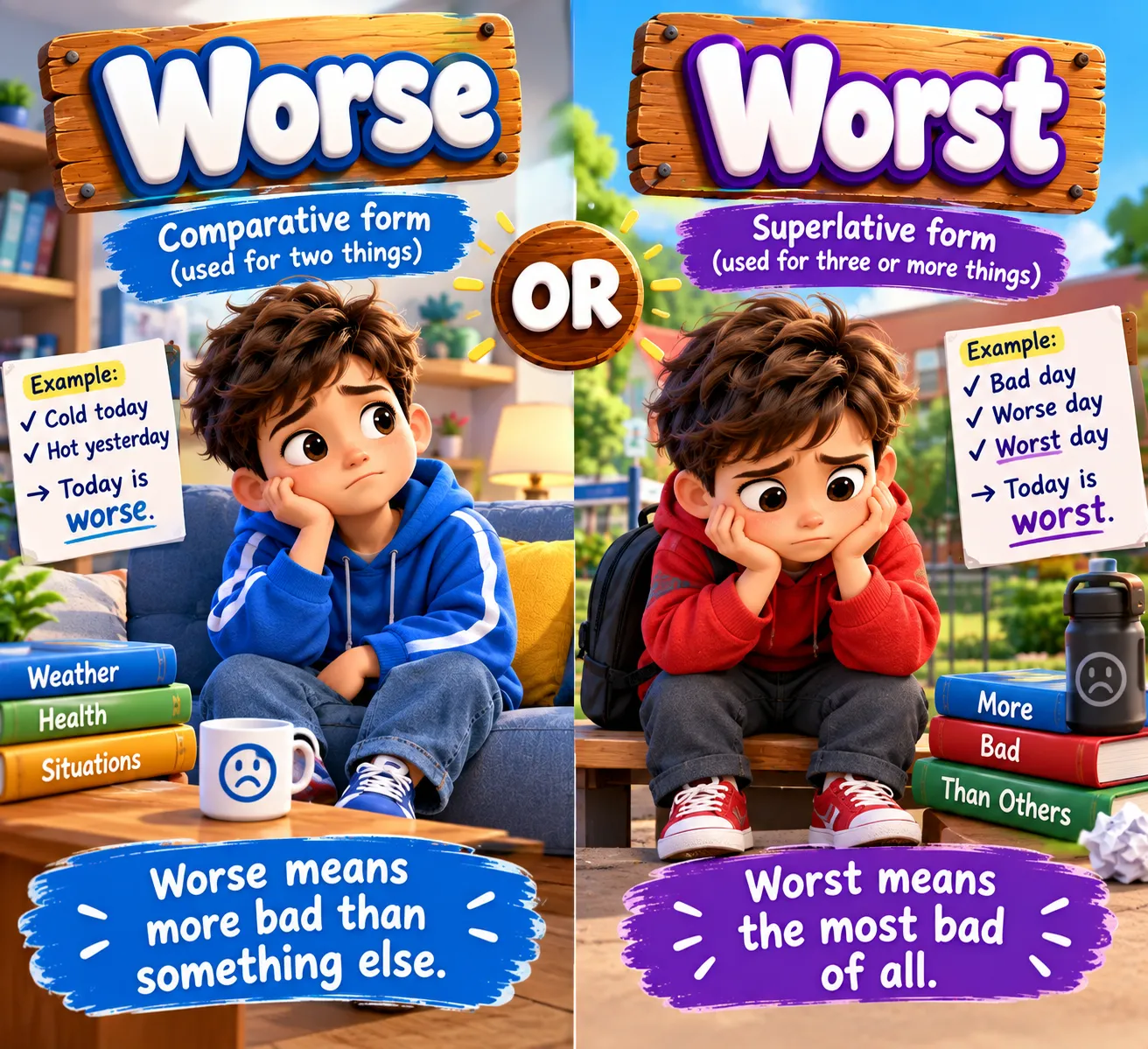
Worse compares two things or shows a decline, while worst describes the lowest, most unpleasant, or most serious level among three or more things.
I have often caught myself checking worse and worst twice, especially when writing quickly. The two words look almost the same, sound very similar, and both come from bad and badly. That makes them easy to mix up.
I have also seen this mistake in emails, school assignments, social posts, and even polished business writing. A sentence such as “This is the worse day of my life” may look harmless, but it needs worst, not worse.
The good news is that the difference is much easier than it first appears. Worse is the comparative form. It normally compares one thing with another. Worst is the superlative form. It identifies the lowest or most negative level in a group or situation.
Once you understand this simple comparison rule, choosing the right word becomes much easier. Let’s look at the meanings, grammar, history, common mistakes, and practical examples so you can use worse or worst with confidence.
Worse or Worst Quick Answer
The easiest way to remember the difference is to think about levels of comparison.
Use worse when you compare two things, people, situations, or conditions.
- The second plan is worse than the first.
- My headache feels worse today.
Use worst when something is at the lowest or most negative level in a group or situation.
- That was the worst meal I have ever had.
- Monday was the worst day of the week.
According to Cambridge Dictionary, worse is the comparative form of bad and badly. It can mean more unpleasant, difficult, severe, or less successful than something else.
Cambridge defines worst as the superlative form of bad and badly. It refers to the lowest quality or the most unpleasant, difficult, or severe level.
A quick memory rule is:
Bad → worse → worst
Think:
- bad = basic form
- worse = comparison
- worst = highest degree of something bad
The Origin and Background of Worse and Worst
The history of these words is more interesting than it may seem.
Both worse and worst belong to an old family of comparison words connected with bad and ill. Their forms developed over many centuries rather than simply being created as modern grammar rules.
Etymonline explains that the comparative worse and superlative worst eventually became the standard comparative and superlative forms associated with bad and ill. Older forms such as badder and baddest existed in earlier English, but they did not become the standard forms used in modern English.
This is an example of how linguistics and etymology can explain an unusual grammar pattern.
For many adjectives, English forms comparisons by adding -er and -est:
- fast → faster → fastest
- small → smaller → smallest
- bright → brighter → brightest
But bad does not follow that simple pattern.
Instead:
- bad → worse → worst
The same pattern applies to badly:
- badly → worse → worst
That makes worse and worst irregular comparison forms.
Their long history is one reason learners should memorize the three-word sequence rather than trying to build the forms themselves.
Worse or Worst Explained: Key Differences
The main difference is comparison.
Worse: the comparative form
Use worse when you compare one thing with another.
Usually, you will see than nearby:
This problem is worse than the first one.
However, than is not always necessary. The comparison can be understood from the context.
The weather became worse overnight.
Here, the implied comparison is between the earlier weather and the later weather.
Cambridge also lists worse as an adverb, meaning more badly.
For example:
She performed worse in the second round.
Worst: the superlative form
Use worst when something reaches the lowest or most negative point.
Often, the comparison involves three or more things.
This is the worst option of the three.
You can also use worst when there is no clearly stated group.
That was the worst experience of my life.
The meaning is still superlative. You are identifying the most unpleasant experience among all relevant experiences.
Cambridge also lists worst as an adjective, adverb, and noun.
Comparison Table
| Term | Meaning | When to Use | Region/Context |
| bad | Not good; unpleasant or poor | Basic description | Standard English |
| worse | More bad, unpleasant, difficult, or severe | Comparing two things or stages | Standard English |
| worst | Most bad, unpleasant, difficult, or severe | Identifying the lowest level | Standard English |
| better | More good or satisfactory | Positive comparison | Standard English |
| best | Most good or satisfactory | Positive superlative | Standard English |
Compare the three forms
Consider these sentences:
- The food is bad.
- The food today is worse than yesterday.
- This is the worst meal I have had all month.
The first sentence gives a basic description.
The second compares two situations.
The third identifies one experience as the lowest in a larger group.
That is the key grammar rule.
Which Word Should You Use?
When you are unsure between worse or worst, ask yourself how many things or levels you are comparing.
If you are comparing two things, use “worse”
Use worse when one thing is more negative than another.
Examples:
- This route is worse than the other route.
- Her second attempt was worse than her first.
- The traffic is getting worse.
The comparison may be direct or understood from context.
If you are identifying the lowest level, use “worst”
Choose worst when something stands at the bottom of a group, range, or experience.
Examples:
- He received the worst score in the class.
- That was the worst storm of the season.
- This is the worst mistake I have made.
For students and English learners
Memorize this pattern:
bad → worse → worst
It works better than trying to remember a complicated grammar rule every time.
For formal writing
Both words are completely acceptable in formal English.
You can use worse to compare results:
The revised figures were worse than the original estimates.
You can use worst to identify the most serious result:
The report examined the worst effects of the policy.
The choice depends on meaning, not formality.
For global English
There is no major British-versus-American spelling difference here.
Worse and worst are standard in both British and American English.
Common Mistakes with Worse or Worst
1. Using “worse” before a superlative idea
Incorrect: This is the worse restaurant in town.
Correct: This is the worst restaurant in town.
You are identifying one restaurant as the lowest in the group, so worst is needed.
2. Using “worst” for a simple two way comparison
Incorrect: My second test score was worst than my first.
Correct: My second test score was worse than my first.
The sentence compares two scores. Therefore, use the comparative form worse.
3. Writing “more worse”
Incorrect: The situation became more worse.
Correct: The situation became worse.
The word worse already carries the comparative meaning. Adding more is unnecessary.
4. Writing “most worst”
Incorrect: That was the most worst result.
Correct: That was the worst result.
Like worse, worst already expresses the required degree.
5. Confusing “worst” with “bad”
Incorrect: This is a worse problem I have ever faced.
Correct: This is the worst problem I have ever faced.
The phrase “I have ever faced” usually signals that you are identifying the most extreme example within your experience.
Worse or Worst in Real-World Examples
The words appear in many kinds of everyday and professional writing.
Professional email
The revised schedule creates worse delays than the original plan, so we recommend keeping the earlier timeline.
Here, worse compares the revised schedule with the original one.
News headline
Heavy Rain Creates Worst Flooding of the Year
Here, worst identifies the flooding as the most severe of the year.
Social media post
I thought the first episode was difficult to watch, but the second one was even worse.
The writer compares two episodes, so worse is appropriate.
Formal report
The final assessment found that the northern region experienced the worst disruption during the review period.
The report identifies one region as having the greatest level of disruption.
Everyday conversation
If the pain gets worse, you should seek professional advice.
Here, worse describes a change from the current condition to a more severe one.
Worse or Worst Data, Trends & Usage
The exact phrase “worse or worst” has clear informational search intent. People usually search it because they want to know which word is grammatically correct and when to use each form.
Search-volume data
Reliable current monthly search-volume figures from tools such as Ahrefs, Semrush, or Google Keyword Planner are not publicly available in the sources I could verify for this article. Rather than inventing a number, it is safer to describe the keyword as an informational English-usage query.
Related searches include:
- worse or worst
- worse vs worst
- worse or worst grammar
- difference between worse and worst
- when to use worse
- when to use worst
- worse meaning
- worst meaning
This broader semantic group gives an SEO article more value than focusing only on the exact phrase.
Corpus usage
Google Books Ngram Viewer measures how often words and phrases occur in a large book corpus over time. Its current system includes datasets extending through recent years, and Google explains that the tool normalizes frequencies by the number of books published in each year.
That makes Ngram useful for studying written-language frequency, but it should not be confused with Google search volume.
Search intent
The primary intent is informational.
A reader usually wants to:
- understand the grammar rule
- choose the correct word
- see examples
- improve English writing
- avoid a common comparison mistake
This makes the topic especially useful for students, ESL learners, writers, editors, and anyone checking a sentence before publishing it.
Why this topic still matters
Words such as worse and worst are small, but they can change the accuracy of a sentence. Grammar tools can flag errors, but understanding the comparison yourself helps you make better choices.
A simple rule is more useful than blindly accepting a correction:
Two things → worse.
Lowest in a group → worst.
Worse or Worst: Standalone Comparison
| Term/Variant | Meaning | Region/Context | Best Used When |
| Bad | Negative or poor quality | British and American English | Giving a basic description |
| Worse | More negative or severe | British and American English | Comparing two things or conditions |
| Worst | Most negative or severe | British and American English | Identifying the lowest level |
| Worse than | Shows a direct comparison | Formal and informal English | Comparing A with B |
| The worst | Identifies the most negative example | Formal and informal English | Selecting the lowest example in a group |
| Worse off | In a less favorable situation | Common English expression | Describing a decline in circumstances |
One useful edge case is “worse off.” It does not simply mean that something is bad. It usually means that a person or group is in a less favorable position than before or compared with someone else.
Frequently Asked Questions
Q: What does “worse” mean?
A: Worse means more unpleasant, difficult, severe, or poor than another thing or an earlier condition. It is the comparative form of bad and badly.
Q: What does “worst” mean?
A: Worst means the most unpleasant, difficult, severe, or poor. It is the superlative form of bad and badly.
Q: Which is correct, “worse” or “worst”?
A: Both are correct words, but they have different grammatical uses. Choose worse for comparison and worst for the most extreme or lowest level.
Q: Is “worse than” correct?
A: Yes. Worse than is a standard comparative construction. It is used when one person, thing, condition, or result is compared with another.
Q: Can “worst” be used without “the”?
A: Yes. Worst can appear without the in some constructions, especially as an adverb or in fixed expressions. For example, “The roads were worst affected” uses worst as an adverb.
Q: Where do “worse” and “worst” come from?
A: They developed from older English comparison forms related to bad, evil, and ill. Etymonline notes that worse and worst became the standard comparative and superlative forms associated with bad, replacing older patterns such as badder and baddest.
Q: Can “worse” be used as an adverb?
A: Yes. Worse can describe how an action is performed. For example, “He performed worse in the second round.” Cambridge lists this as the comparative form of badly.
Final Thoughts on Worse or Worst
I find that worse or worst becomes much easier once you stop focusing on the similar spelling and focus on the level of comparison.
Worse is the comparative form. Use it when one thing is more negative than another, or when a condition becomes more severe. You will often see than with it, but the comparison can also be understood from context.
Worst is the superlative form. Use it when you identify the lowest, most unpleasant, or most serious example in a group or situation.
The complete pattern is simple:
bad → worse → worst
Remembering those three forms will prevent many common mistakes. You should also avoid combinations such as “more worse” and “most worst.” The words already contain the comparative and superlative meaning.
Both worse and worst are standard in British and American English. They are not spelling variants. They serve different grammatical purposes.
So, before choosing one, ask yourself: Am I comparing two things, or am I identifying the lowest level?
If you are comparing, choose worse. If you mean the most negative example, choose worst.
Bookmark this guide so you never have to second-guess worse or worst again.
Read More:
Sit or Start: Easy Guide to Correct Usage

I’m an English language educator and content writer with more than 10 years of experience helping learners improve their English skills. I specialize in spelling differences, grammar, vocabulary, synonyms, commonly confused words, and English usage. My goal is to create accurate, easy-to-understand articles that make learning English simple, practical, and enjoyable for students, writers, and professionals around the world.










