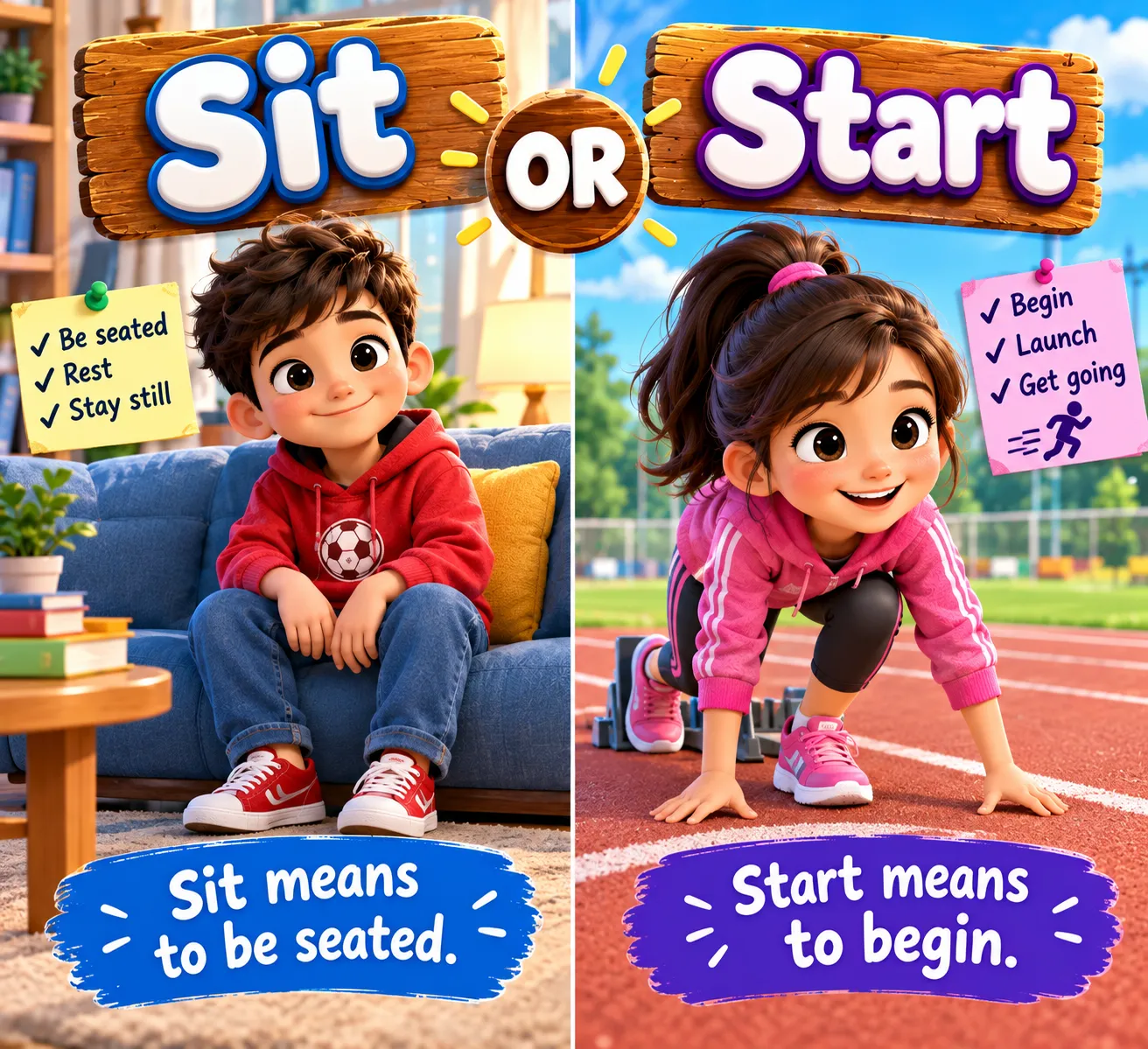
Sit means to be or move into a seated position, while start means to begin an action, event, process, or activity.
I have seen many English learners pause when they come across short verbs that seem easy but work in very different ways. Sit and start are a good example. They are both common verbs, but they do not describe the same action.
Imagine telling someone, “Please sit down,” when you really mean “Please begin.” The sentence would sound completely wrong. The same problem can happen in writing. A single verb can change the meaning of an entire sentence.
I have also noticed another reason this pair can cause confusion. The phrase “sit or start” appears in more than one context. In ordinary English, it asks you to understand two different verbs. In fantasy football, however, “sit or start” can mean whether a player should remain on the bench or be placed in the lineup.
For English learners, the basic rule is simple. Sit relates to being seated or staying in a position. Start relates to beginning something. This guide explains their meanings, grammar, history, common mistakes, examples, and useful alternatives.
Sit or Start Quick Answer
Sit and start are completely different English verbs.
You use sit when someone rests on a chair, floor, bench, or another surface. You can also use it for remaining in a particular place or position.
For example:
- Please sit beside me.
- The dog sat near the door.
You use start when something begins or when you cause something to begin.
For example:
- The movie will start soon.
- She started writing her report.
Cambridge Dictionary defines sit as being in a position where the lower part of the body rests on a seat or other support. It also gives wider meanings, such as being in a particular position.
Cambridge defines start as beginning to do something. It can also describe something beginning to happen or beginning to operate.
So, the easiest memory trick is:
Sit = position.
Start = beginning.
The Origin and Background of Sit and Start
Although sit and start are both old English verbs, they have different histories.
Where does “sit” come from?
Etymonline traces sit to Middle English sitten and Old English sittan. The older verb had meanings connected with being seated, occupying a seat, remaining, settling, and even waiting in a particular position. Its deeper history reaches back through Proto-Germanic to the Proto-Indo-European root sed-, meaning “to sit.”
The word developed many related uses over time.
Today, you can:
- sit on a chair
- sit at a desk
- sit beside someone
- sit quietly
- sit for a portrait
- sit on a committee
Cambridge also records special uses of sit, including official meetings and courts.
Where does “start” come from?
Start has a different path.
Etymonline traces the verb to Middle English sterten, meaning “leap” or “jump,” with an earlier connection to Old English forms meaning “to leap up.” Its meanings later expanded. By the 1600s, start had developed the sense of causing something to begin or operate.
This history helps explain why start has more than one modern meaning.
You can:
- start a meeting
- start a business
- start the car
- start reading
- start a conversation
- start suddenly when frightened
The history of these words shows that they are not spelling variants. They are separate words with separate meanings.
Sit or Start Explained: Key Differences
The biggest difference is the action or idea each verb expresses.
| Term | Meaning | When to Use | Region/Context |
| sit | To be in a seated position | When someone rests on a surface | Standard English |
| sit down | To move into a seated position | When someone changes from standing to sitting | Everyday English |
| start | To begin something | When an activity or event begins | Standard English |
| start up | To begin operating | Often used for machines, systems, or businesses | Standard English |
| startle | To react suddenly to surprise | When someone makes a sudden movement | Standard English |
Cambridge lists sit down as the act of moving your body into a sitting position after standing.
For start, Cambridge gives patterns such as start + -ing and start + to-infinitive. Both can be used to show the beginning of an activity.
Examples with “sit”
- We sat near the window during lunch.
- He likes to sit in the garden after work.
- The children sat quietly during the story.
- She sat at her desk for two hours.
Examples with “start”
- The teacher started the lesson with a short quiz.
- They started building the house in spring.
- The train started moving slowly.
- I need to start my assignment tonight.
Notice the difference. Sit tells you about a position or state. Start tells you about a beginning.
Which Word Should You Use?
You do not need to choose between sit and start based on spelling or pronunciation. Choose according to the meaning you want.
For beginners
Use sit when you mean take a seated position or remain seated.
Please sit here.
Use start when you mean begin.
Please start the lesson.
For students
Pay close attention to the verb that follows start.
You can say:
- start reading
- start studying
- start working
- start to read
- start to study
- start to work
Cambridge confirms that start can be followed by an -ing form or a to-infinitive.
For formal writing
Both sit and start are perfectly acceptable in formal English when they express the correct meaning.
However, begin can sometimes replace start in formal writing. Cambridge notes that begin and start can have the same meaning, while begin is more formal.
For global English
Keep the basic meanings clear:
- sit = be seated
- start = begin
- begin = a more formal alternative to start
- be seated = a more formal alternative to sit
Common Mistakes with Sit or Start
These verbs are easy to separate once you understand the meaning. Still, learners sometimes mix them up.
1. Using “start” for a seated position
Wrong: Please start on the chair.
Better: Please sit on the chair.
Here, the speaker wants someone to take a seated position.
2. Using “sit” for beginning an activity
Wrong: Let’s sit the meeting at nine.
Better: Let’s start the meeting at nine.
The meeting begins at nine, so start is the correct verb.
3. Confusing “sit down” with “start”
Wrong: Everyone, start down.
Better: Everyone, sit down.
Sit down describes movement into a seated position.
4. Forgetting the correct past form of “sit”
The past tense of sit is sat, not sitted.
- Present: I sit here.
- Past: I sat here.
- -ing form: I am sitting here.
Cambridge lists the forms as sit, sitting, sat.
5. Using “started” incorrectly
The past tense and past participle of start is started.
- I start work at eight.
- I started work at eight yesterday.
- She has started the project.
Cambridge confirms started as the past simple and past participle of start.
Sit or Start in Real-World Examples
The two words appear naturally in many types of writing.
Professional email
Please sit in the conference room until the manager arrives. The meeting will start at 10:00 a.m.
This example shows both verbs in one context. One describes a position. The other describes the beginning of an event.
News headline
New Training Program Starts Monday for Local Workers
Here, starts means the program begins.
Social media post
I finally found a quiet place to sit and read after a busy week.
Here, sit describes the person’s position.
Formal report
The committee will sit tomorrow to review the submitted proposals. The public session will start at 9:30 a.m.
This example also shows a less common but important meaning of sit. Cambridge records sit as a verb for an official court or committee meeting.
Sit or Start Data, Trends & Usage
There is an important SEO point about this keyword.
The exact phrase “sit or start” has more than one search intent. In English-learning content, readers may be comparing the meanings of sit and start. In fantasy football, sit or start is a lineup question about whether a player should remain on the bench or be used in the starting lineup. Current sports content continues to use the phrase in this sense.
That means the keyword can attract two very different audiences.
Search-volume note
I could not verify a trustworthy, current public monthly search-volume figure for the exact phrase “sit or start” from Google Keyword Planner, Ahrefs, or Semrush in the sources available for this article. It would be misleading to invent a number.
For SEO purposes, the safer approach is to target the broader semantic cluster:
- sit or start
- sit meaning
- start meaning
- sit vs start
- difference between sit and start
- sit down meaning
- start meaning in English
- sit grammar
- start grammar
- sit past tense
- start past tense
Corpus and frequency insight
Both sit and start are common English verbs. Google Books Ngram Viewer is designed to show how often words appear in its book corpus over time, but Ngram frequency is not the same as Google search volume.
This distinction matters for SEO. A word can be very common in books while having a different search pattern online.
Why the topic matters
Short verbs often create problems for English learners because they carry many meanings. Sit can refer to position, official meetings, or other contexts. Start can mean begin, operate, create, or move suddenly.
Clear explanations help learners choose the right verb instead of relying only on spelling or translation.
Standalone Comparison: Sit vs Start
| Term/Variant | Meaning | Region/Context | Best Used When |
| Sit | Be in a seated position | All major varieties of English | Talking about position or rest |
| Sit down | Move into a seated position | Everyday English | Someone is standing and needs to sit |
| Start | Begin something | All major varieties of English | An activity, event, or process begins |
| Start up | Begin operating | Machines, businesses, systems | Something begins to operate |
| Begin | Start or commence | Formal and general English | You want a slightly more formal alternative |
One useful point is that sit and start can appear in the same sentence without competing with each other.
Please sit down before the presentation starts.
The first verb describes position. The second describes time or beginning.
Frequently Asked Questions
Q: What does “sit” mean?
A: Sit usually means to be in a position where your body is supported while you are seated. Cambridge also records wider uses, including being in a particular position and taking part in an official meeting.
Q: What does “start” mean?
A: Start commonly means to begin doing something or to begin happening. It can also mean causing a machine, business, activity, or process to begin.
Q: Are “sit” and “start” interchangeable?
A: No. They have different meanings. Sit normally relates to position or being seated, while start normally relates to beginning.
Q: Is “start” acceptable in formal writing?
A: Yes. Start is a standard English verb and is suitable for formal writing. Begin can be used when you want a slightly more formal tone.
Q: What is the past tense of “sit”?
A: The past tense of sit is sat. For example, you can say, “She sat near the window.” Its present participle is sitting.
Q: What is the past tense of “start”?
A: The past tense of start is started. The same form is used as its past participle. For example, “They started the project yesterday.”
Q: Can “sit” and “start” be used together?
A: Yes. They often work naturally in the same sentence. For example, “We sat quietly while the movie started.” Each verb performs a different grammatical job.
Q: Why do people search for “sit or start”?
A: The phrase can refer to an English-usage question, but it is also widely used in fantasy football. In fantasy sports, “sit or start” asks whether a player should be left on the bench or placed in the lineup.
Final Thoughts on Sit or Start
I find that the easiest way to remember sit or start is to focus on the action rather than the spelling.
If you are talking about being seated, taking a seat, or remaining in a position, choose sit. Its forms include sit, sat, and sitting. Its history goes back through Middle English and Old English.
If you are talking about beginning something, choose start. You can start a task, start a meeting, start a journey, or start a machine. The word also has older meanings linked to sudden movement.
The two verbs can even appear side by side. You might sit while waiting for an event to start. That simple contrast captures the main rule.
You do not need a complicated grammar trick. Ask yourself one question: Am I describing a position, or am I describing a beginning?
For a position, use sit. For a beginning, use start.
Bookmark this guide so you can quickly check the difference whenever these two common verbs cause confusion.
Read More:
Boy or Girl: Complete Meaning and Usage Guide

I’m an English language educator and SEO content writer having experience creating clear, accurate, and engaging English learning content. I specialize in spelling differences, grammar, vocabulary, synonyms, commonly confused words, and English usage. My goal is to publish well-researched, easy-to-understand articles that help students, writers, educators, and professionals improve their English with confidence through practical explanations and real-world examples.










