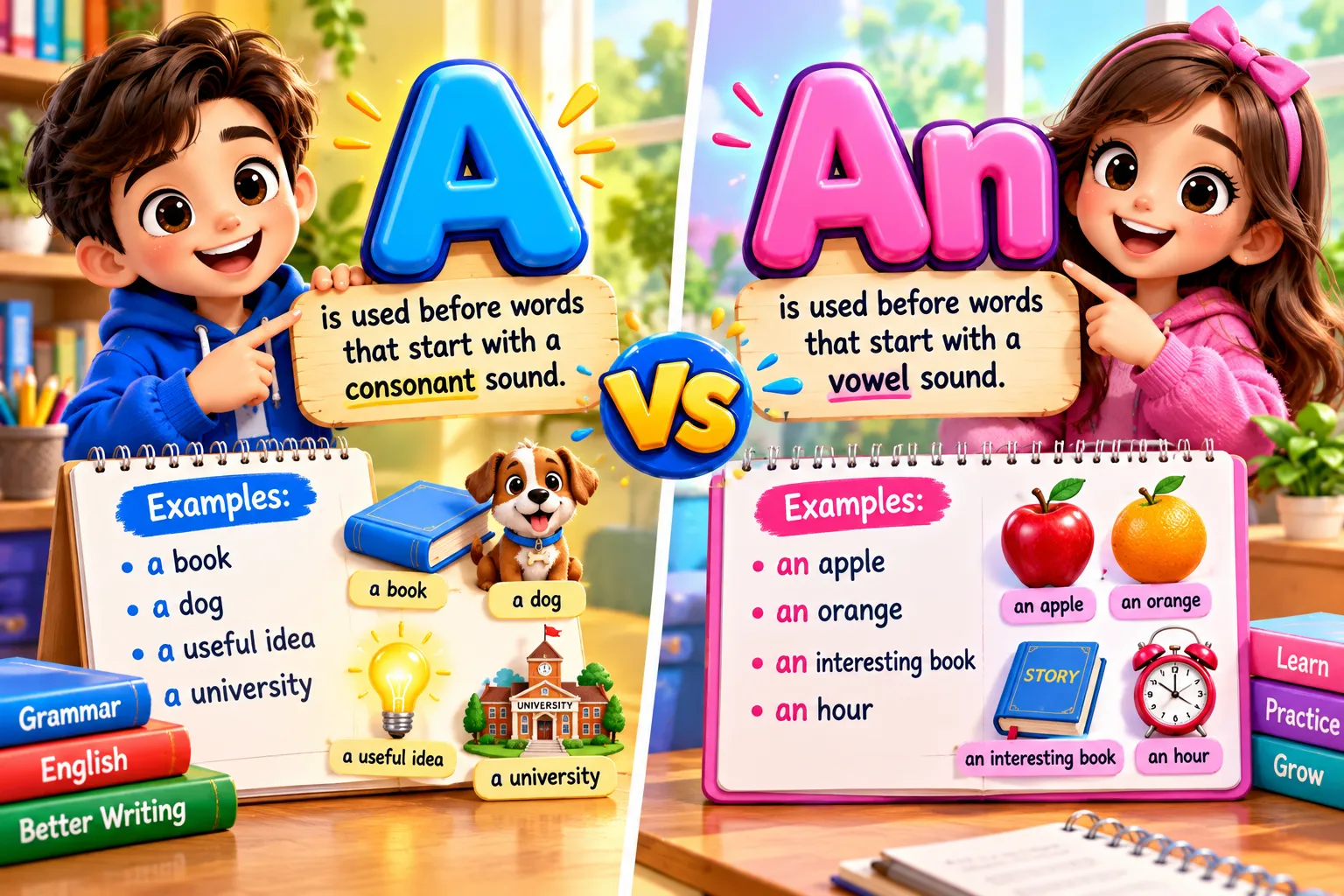
Use a before a consonant sound and an before a vowel sound. For example, write “a university” but “an umbrella.” The rule depends on pronunciation, not just spelling.
I have often seen people pause while writing a simple sentence because they are unsure whether to use a or an. It may seem like a small grammar choice, but one wrong article can make a sentence sound awkward.
I have noticed this confusion in schoolwork, emails, and everyday English writing. Many learners think the rule depends on the first letter of a word. That seems easy at first. Words that start with A, E, I, O, or U often take an, while words that start with other letters usually take a.
However, English has a small twist. We say “a university” but “an umbrella.” We also write “a European country” but “an hour.” Why? The answer is in the first sound of each word, not simply its first letter.
Learning this rule can help you write more clearly and speak with confidence. In this guide, I will explain the difference between a and an, show common exceptions, and share easy examples to help you choose the correct article every time.
A or An Quick Answer
A vs. An: Rules and Examples
| Article | When to Use | Example | Explanation |
|---|---|---|---|
| A | Before a consonant sound | A teacher | Refers to one teacher without specifying which one. |
| An | Before a vowel sound | An artist | Refers to one artist without specifying which one. |
| A | Before a word that begins with a consonant sound | A bicycle | “My brother bought a bicycle.” |
| An | Before a word that begins with a vowel sound | An interesting film | “We watched an interesting film.” |
Key Rule: A and an are indefinite articles. They come before singular countable nouns when referring to a person or thing that is not specific. The choice depends on the first sound of the next word, not its spelling. The British Council also explains this sound-based rule.ences refer to one thing without identifying it as something the reader already knows.
The Origin and Background of A and An
The words a and an have a long history in English. They developed from one, an old word used to express the number 1. Over time, the shorter forms became common before nouns.
Today, a and an are known as indefinite articles. In grammar, an article is a type of determiner. It helps show whether a noun refers to something general or something specific.
According to Cambridge Dictionary, a and an introduce something that is not yet known or identified to the reader or listener.
For example:
- “I saw a bird in the garden.”
- “The bird was sitting on a branch.”
The first sentence introduces the bird. The second refers to the bird already mentioned.
Why do people confuse a and an?
Many learners are taught to use a before consonants and an before vowels. This rule is useful, but it can be misleading if you focus only on letters.
English spelling and pronunciation do not always match. The word university begins with a vowel letter but starts with a “y” sound. The word hour begins with a consonant letter, but its h is silent.
That is why we write a university and an hour. Once you learn to listen for the first sound, the rule becomes much easier.
A vs. An Explained: Key Differences
The difference between a and an is simple once you focus on pronunciation.
1. When to use A
Use a before a word that begins with a consonant sound.
Examples:
- a dog
- a table
- a yellow flower
- a useful tool
- a European city
- a one-time offer
Notice that useful and European begin with vowel letters. However, both start with a “y” sound, so they take a.
The same rule applies to one. It starts with a “w” sound, so we say a one-time offer.
2. When to use An
Use an before a word that begins with a vowel sound.
Examples:
- an apple
- an engine
- an orange
- an unusual event
- an honest person
- an hour
In honest and hour, the letter h is silent. The first spoken sound is a vowel sound, so an is correct.
Purdue University’s Online Writing Lab explains that the choice depends on the sound at the start of the word, not its written form.
Comparison table
| Term | Meaning | When to Use | Example |
| A | Indefinite article | Before a consonant sound | a school |
| An | Indefinite article | Before a vowel sound | an exam |
| The | Definite article | Before a specific or known noun | the school near my home |
| No article | No article is needed | With many plural or uncountable nouns used generally | Books can teach us a lot. |
Remember that a and an have the same basic job. The sound of the next word decides which form you need.
Which Version Should You Use?
Choosing between a and an depends on the first sound of the word that follows. Your audience does not change this grammar rule, but the context may affect how you pronounce a word.
- For students: Learn the sound rule first. Then practise with common exceptions such as a uniform and an hour.
- For professional writers: Check the first spoken sound, especially in words such as honor, European, and MBA.
- For English learners: Read the phrase aloud. Hearing the first sound often makes the right choice clear.
- For formal and academic writing: Follow the same sound rule. There is no separate rule for essays, reports, or business emails.
A helpful tip is to look at the whole word or phrase immediately after the article, not just the noun.
For example:
- A small orange
- An old bicycle
In the first phrase, small comes immediately after the article. In the second, old comes first. That first word determines whether you use a or an.
Common Mistakes with A and An
Even experienced writers can make mistakes with articles. Here are five common errors and how to fix them.
1. Choosing an article by the first letter
- Incorrect: an university
- Correct: a university
The word starts with a “y” sound, which acts as a consonant sound.
2. Forgetting the silent H
- Incorrect: a hour
- Correct: an hour
The h is silent, so the word begins with a vowel sound.
3. Using an before every word that starts with a vowel letter
- Incorrect: an useful book
- Correct: a useful book
The word useful begins with a “y” sound, not a vowel sound.
4. Using a or an with a plural noun
- Incorrect: She bought a shoes.
- Correct: She bought a pair of shoes.
Use a or an with a singular countable noun, not directly with a plural noun. The British Council explains that indefinite articles are not used directly with plural or uncountable nouns.
5. Adding an article before an uncountable noun
- Incorrect: He gave me an advice.
- Correct: He gave me some advice.
The noun advice is usually uncountable in English. You can also say “a piece of advice.”
These errors happen because English articles depend on both sound and noun type. Check both before deciding which form to use.
A or An in Real-World Examples
Here is how you can use the rule in different types of writing. Each example uses a new situation.
1. In a professional email
I have attached a updated schedule for your review.
Correction: “I have attached an updated schedule for your review.”
The word updated begins with a vowel sound, so an is correct.
2. In a news headline
Local School Opens a Innovative Science Lab
Correction: “Local School Opens an Innovative Science Lab.”
The word innovative begins with a vowel sound. The article must match that sound.
3. In a social media post
Just adopted an adorable puppy! 🐶
This sentence is correct because adorable starts with a vowel sound.
4. In a formal report
The project requires a unique approach to reduce costs.
This sentence is correct. Although unique starts with the vowel letter u, its first sound is “y.”
These examples show why reading a sentence aloud can be useful. It helps you hear the sound that determines the correct article.
A or An Data, Trends, and Usage
The words a and an are basic parts of English grammar. They matter in school assignments, workplace messages, online content, and everyday conversation.
What do grammar resources show?
The British Council and Cambridge Dictionary both teach the same core rule: use a before a consonant sound and an before a vowel sound.
Here is what we can say with confidence:
- Search intent: People searching “a or an” usually want a grammar rule, examples, or help with a specific word.
- Common problem: The main challenge is the difference between spelling and pronunciation.
- Learning value: Examples such as a university, an hour, and an MBA help learners understand the rule.
- Writing impact: Correct articles make sentences sound more natural and easier to read.
I could not verify current monthly search volumes or regional search rankings for “a or an.” Giving exact numbers without reliable data would be misleading. You can compare search interest through Google Trends or use a keyword research tool for estimated monthly volumes.
For learners, the most useful approach is to practise common words and unusual cases rather than memorize search statistics.
A vs. An: Quick Reference Table
This second table focuses on tricky cases that are useful when editing your writing.
| Term or Example | First Sound | Correct Form | Best Used When |
| University | “Y” sound | a university | The written U sounds like “you” |
| Hour | Vowel sound | an hour | The H is silent |
| European | “Y” sound | a European trip | The word starts with a consonant sound |
| MBA | “E” sound when spoken | an MBA | The letter M is pronounced “em” |
| One-time | “W” sound | a one-time offer | The word one begins with a “w” sound |
| Honest | Vowel sound | an honest answer | The H is silent |
| Umbrella | Vowel sound | an umbrella | The word starts with a vowel sound |
This table also shows why abbreviations need care. For example, write an MBA because the letter M is spoken as “em.” If an abbreviation is pronounced as a word, choose the article based on its actual first sound.
Frequently Asked Questions
Q1: What is the difference between a and an?
A: Both are indefinite articles used before singular countable nouns. The difference is pronunciation: a comes before a consonant sound, while an comes before a vowel sound.
Q2: Is it a apple or an apple?
A: The correct phrase is an apple. The word apple begins with a vowel sound, so an is needed.
Q3: Is it a university or an university?
A: The correct phrase is a university. Although the word begins with the letter U, its first sound is “y,” which is a consonant sound.
Q4: Should I write a hour or an hour?
A: Write an hour. The H in hour is silent, so the word begins with a vowel sound.
Q5: Can I use a or an in formal writing?
A: Yes. Both are standard parts of English grammar and are used in formal and informal writing. Choose the correct form based on pronunciation.
Q6: Do a and an have different meanings?
A: No. They perform the same grammatical function. The choice between them depends on the first sound of the next word, not a difference in meaning.
Q7: Can I use a or an before plural nouns?
A: No, not directly. Write “a book” for one book and “books” for more than one. You can use phrases such as “a few books,” where a few works as a separate expression.
Q8: Is it an MBA or a MBA?
A: An MBA is correct when you pronounce the letters M-B-A separately. The letter M begins with a vowel sound, “em,” so it takes an.
Conclusion: Master A or An with One Simple Rule
I believe the easiest way to master a and an is to stop focusing only on the letters you see. Instead, listen to the first sound you hear. This small change can help you avoid many common grammar mistakes.
Keep these points in mind:
- Use a before a consonant sound.
- Use an before a vowel sound.
- Check the first word after the article, even when an adjective comes before the noun.
- Remember that silent letters and unusual pronunciations can change your choice.
You do not need to memorize hundreds of rules to get this right. Start with familiar examples, then practise tricky words such as university, hour, European, and MBA. Read your sentences aloud when you are unsure.
With a little practice, choosing the right article will become much easier. The rule is simple, but using it well can make your English clearer and more natural.
Bookmark this guide and share it with someone learning English. The next time you pause between “a” and “an,” remember to trust the sound, not just the spelling.
Read More:
Bougie or Boujee: Easy Guide to Meaning and Usage

I specialize in English grammar, spelling, word choice, and language usage. My content is based on research from grammar references, style guides, dictionaries, and real-world usage to ensure it is accurate and practical.
At Spelling Comparison, I write guides that explain why words are confused, how they are used, and which form is correct in context. I also include proofreading tips, examples, and writing advice readers can apply immediately.
My goal is to publish clear, reliable content that helps readers make better writing decisions. Each guide is written for accuracy, clarity, and usefulness in school, work, business, and everyday communication.










