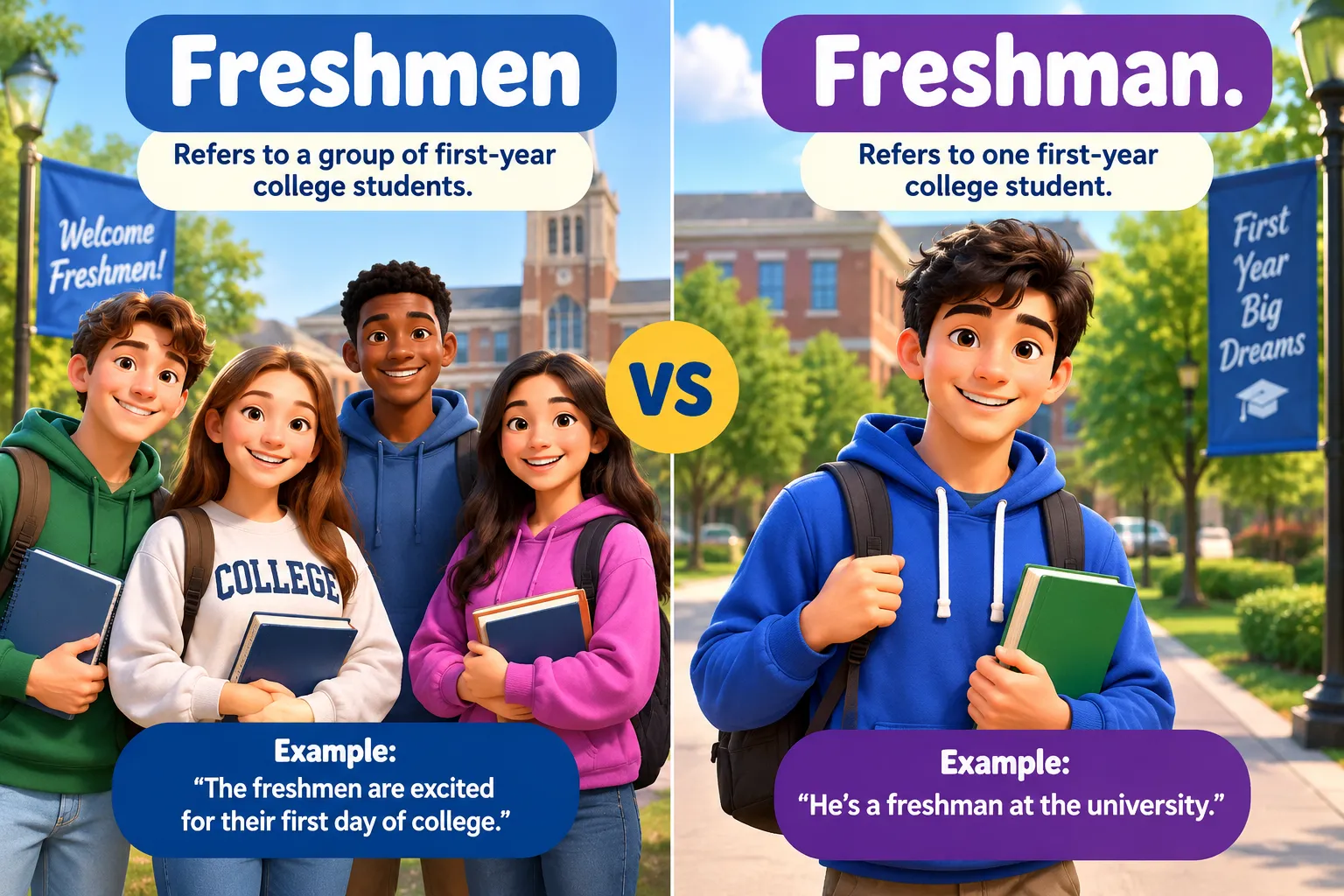
Freshman is the singular form for one first year student, while freshmen is the plural form for two or more first year students. Use freshman for one person and freshmen for a group
I have often come across the question, “Should I use freshman or freshmen?” when writing about new college students. I understand why people get confused because these two words look almost identical and sound very similar.
I have learned that the difference comes down to one simple grammar rule. Freshman refers to one first-year student, while freshmen refers to two or more students. Using the wrong form can make an essay, email, or school report look less polished.
I have also noticed that this mistake often happens when people write quickly. They may know what they want to say but still struggle to choose the correct word. The key is to check whether the sentence refers to one student or a whole group.
In this guide, I explain the meanings of freshman and freshmen, their origins, and the grammar rules that help you use them correctly. I also share common mistakes, practical examples, and simple tips to make the difference easier to remember. By the end, you will feel more confident choosing the right word in your writing.
Freshman or Freshmen: Quick Answer
Both freshman and freshmen refer to a person or people in the first year of high school, college, or university. The main difference is number: freshman is singular, while freshmen is plural.
Use freshman when you mean one student:
- My cousin is a freshman at college.
- The freshman joined the student club.
Use freshmen when you mean two or more students:
- The freshmen attended an introduction session.
- Several freshmen joined the science team.
The same rule applies when the words describe people who are new to another role or activity. For example, you might read about a freshman member of Congress or a group of freshmen athletes.
The Origin and Background of Freshman and Freshmen
The word freshman has been part of English for centuries. According to the etymology, it appeared in the 1550s with the meaning of a newcomer or beginner. Its use for a first-year university student dates to the 1590s.
The word combines fresh, meaning new or inexperienced in this context, with man. Over time, it became a common term for a student in the first year of a school or college program.
The plural form, freshmen, follows an older English pattern. Some nouns ending in -man change to -men in the plural. For example:
- Man → men
- Woman → women
- Freshman → freshmen
This is why freshmans is not the standard plural form.
The cambridge dictionary defines a freshman as a student in the first year of high school, college, or university. It also notes that the word can describe someone who is new to a job or activity.
Usage varies by region, too. In American English, freshman is common for a first-year student. In the United Kingdom, people often use fresher for a new university student. The university of cambridge glossary also notes this difference.
Freshman vs. Freshmen: Key Differences
The most important grammar rule is simple: use the singular form for one person and the plural form for more than one.
| Term | Meaning | When to Use | Region/Context |
| Freshman | One first-year student | When discussing one person | Common in American English |
| Freshmen | Two or more first-year students | When discussing a group | Common in American English |
| Freshman year | The first year of a school or college program | When describing a period of study | Common in the United States |
| Freshmen class | A group of first-year students; often written as “freshman class” in US usage | When referring to the group as a class | School and college contexts |
| Fresher | A new student, often at university | When following common British English usage | United Kingdom and some other regions |
1. Freshman: Singular Form
Use freshman when the sentence refers to one person. It is a singular count noun, so it can follow words such as a, one, or each.
Examples:
- A freshman asked the teacher for help.
- Each freshman received a campus map.
- My brother is a freshman this year.
The word can also act as an adjective. In phrases such as freshman course or freshman year, it describes something linked to first-year students.
2. Freshmen: Plural Form
Use freshmen when the sentence refers to more than one student. It can follow words such as many, several, some, and these.
Examples:
- Many freshmen live in the residence halls.
- Several freshmen signed up for the debate club.
- These freshmen are taking the same course.
Do not add another s to make the word plural. Freshmen is already plural.
3. Is “Freshman” Always About School?
No. The word can also describe a person who is new to a role or activity. For instance, a newly elected member of Congress may be called a freshman member. A new athlete may also be called a freshman player in American sports.
In these cases, the core idea remains the same: the person is new to that role or stage.
Which Version Should You Use?
Choose the form based on how many people you mean and the kind of English you are writing.
- For one student: Use freshman. Example: “A freshman gave a speech at the event.”
- For a group of students: Use freshmen. Example: “The freshmen took part in campus activities.”
- For a school year or course: Use freshman as a describing word. Example: “She signed up for a freshman course.”
- For British English: Consider first-year student or fresher, depending on the audience and context.
- For international readers: First-year student is often the clearest and most inclusive choice.
If you are unsure, count the people in your sentence. One person takes freshman. More than one takes freshmen.
Common Mistakes with Freshman and Freshmen
These are frequent errors to watch for when writing about first-year students.
Mistake 1: Using “Freshmen” for One Person
Incorrect: “My sister is a freshmen.”
Correct: “My sister is a freshman.”
Why? The sentence describes one person, so the singular noun is needed.
Mistake 2: Adding “-s” to “Freshmen”
Incorrect: “The freshmens attended the meeting.”
Correct: “The freshmen attended the meeting.”
Why? Freshmen is already the plural form. It does not need another ending.
Mistake 3: Using “Freshman” for a Group
Incorrect: “The freshman were asked to wait.”
Correct: “The freshmen were asked to wait.”
Why? The sentence refers to several students. The plural form matches the group.
Mistake 4: Confusing the Noun with the Adjective
Incorrect: “She is in her freshmen year.”
Correct: “She is in her freshman year.”
Why? In this phrase, freshman describes the year. It does not change to freshmen.
Mistake 5: Using “Freshman” as a Standard Plural
Incorrect: “The freshman are meeting after class.”
Correct: “The freshmen are meeting after class.”
Why? Although freshman can be used before another noun, it is not the standard plural noun form.
A quick editing tip: look for words such as a, one, many, several, and these. They often help you decide whether the noun should be singular or plural.
Freshman and Freshmen in Real-World Examples
The right form depends on the meaning of the sentence. Here are examples from common writing situations.
1. Professional Email
Subject: Welcome Meeting for First-Year Students
“Hello everyone, we will hold a welcome meeting for all freshmen on Monday. Each freshman will receive a schedule and a campus guide.”
The first sentence refers to a group, so freshmen is correct. The second refers to each person one at a time, so freshman is correct.
2. News Headline
Headline: “Local College Offers New Support Program for Freshmen”
The headline discusses a program for a group of first-year students. The plural form fits the meaning.
3. Social Media Post
“Starting college can feel like a big step! Every freshman deserves a chance to meet new people and find their place.”
Here, freshman follows every, which refers to each individual student.
4. Formal Report
“The survey included 250 freshmen from three academic departments. Each freshman completed a questionnaire about study habits.”
The first sentence describes a group. The second focuses on each participant individually.
Freshman or Freshmen: Data, Trends, and Usage
People often search for freshman or freshmen because the difference is not obvious from spelling alone. The two forms share almost all their letters, and their pronunciation is very similar.
What Does Search Intent Tell Us?
The search intent for freshman or freshmen is mainly informational. People usually want to know:
- Which form is singular and which is plural.
- Whether freshmans is correct.
- How to use each word in a sentence.
- Whether the terms differ between American and British English.
Exact monthly search-volume figures require access to a keyword research service such as Ahrefs, Semrush, or Google Keyword Planner. Without verified figures from one of these tools, it would be misleading to provide a specific monthly number.
Likewise, Google Trends reports relative search interest over a selected time and region. It does not directly provide exact search counts. A reliable regional comparison would need a defined date range, location, and search term.
What About Word Frequency?
Both forms appear in English, but they serve different grammatical roles. Freshman appears as a singular noun and in adjective phrases such as freshman year. Freshmen appears when the writer means multiple people.
A tool such as the Google Books Ngram Viewer can help compare how often the two forms appear in books over time. However, a fair comparison must account for context because freshman is used in more than one way.
Why Does This Difference Matter?
Students often write essays, applications, emails, and reports about school life. A small grammar error can make otherwise clear writing look less polished. Grammar tools may flag some errors, but understanding singular and plural forms helps you correct them yourself.
The most useful habit is to check the meaning before checking the spelling. Ask whether you mean one student, a group, or a period of study. That simple step usually gives you the answer.
Standalone Comparison Table: Freshman, Freshmen, and Related Terms
Use this table when choosing between the two forms or deciding whether another term fits your audience better.
| Term/Variant | Meaning | Region/Context | Best Used When |
| Freshman | One first-year student; also used as a describing word | Mainly American English | Referring to one student or a first-year program |
| Freshmen | More than one first-year student | Mainly American English | Referring to a group of new students |
| First-year student | A student in the first year of a program | Broad international use | Writing for readers from different English-speaking regions |
| Fresher | A new university student | Common in British English | Writing for a UK audience where the term is familiar |
| Sophomore | A second-year student in the US school or college system | American English | Describing a student in the second year, not the first |
Remember that freshman and freshmen are not interchangeable. The other terms may be useful alternatives, but they do not all mean exactly the same thing in every school system.
FAQs About Freshman or Freshmen
Q1: What does “freshman” mean?
A: A freshman is a student in the first year of high school, college, or university. The word can also refer to someone who is new to a role or activity. The Cambridge Dictionary includes both educational and broader uses.
Q2: Is “freshmen” singular or plural?
A: Freshmen is plural. Use it when you are talking about two or more first-year students. For one student, use freshman.
Q3: Is “freshmans” a correct word?
A: Freshmans is not the standard plural of freshman. The correct plural is freshmen, following the same pattern as man and men.
Q4: Should I write “freshman year” or “freshmen year”?
A: Write freshman year. Here, freshman describes the year of study, so it stays in the singular form. The phrase is common in American English.
Q5: Is “freshman” acceptable in formal writing?
A: Yes. It is a standard term in school materials, college publications, reports, and other formal writing. If your readers come from many regions, first-year student may be clearer.
Q6: Where does the word “freshman” come from?
A: The word dates back to the 1500s and first referred to a newcomer or beginner. The meaning linked to first-year university students appeared later, according to the Online Etymology Dictionary.
Q7: What is the difference between a freshman and a fresher?
A: Both terms can refer to a new student. Freshman is common in American English, while fresher is often used for a new university student in British English. Follow the wording preferred by your school or intended audience.
Conclusion: Freshman or Freshmen?
Choosing between freshman and freshmen is easy once you know the basic rule. The singular form refers to one first-year student, while the plural form refers to a group. Both words are correct, but they cannot be swapped freely.
Remember these key points:
- Use freshman when you mean one student.
- Use freshmen when you mean more than one student.
- Write freshman year, not freshmen year.
- Consider first-year student when writing for an international audience.
You do not need to memorize a long list of grammar rules to get this right. Just look at the sentence and decide whether you mean one person or several people. Then choose the matching form.
This small check can help you write clearer school assignments, college applications, emails, and reports. It can also help you spot errors when proofreading your own work.
Now you know the difference between freshman and freshmen. Bookmark this guide or share it with a student who wants to improve their English grammar.
Read More:
A or An: Easy Grammar Rules and Examples

I’m an English language educator and SEO content writer having experience creating clear, accurate, and engaging English learning content. I specialize in spelling differences, grammar, vocabulary, synonyms, commonly confused words, and English usage. My goal is to publish well-researched, easy-to-understand articles that help students, writers, educators, and professionals improve their English with confidence through practical explanations and real-world examples.










