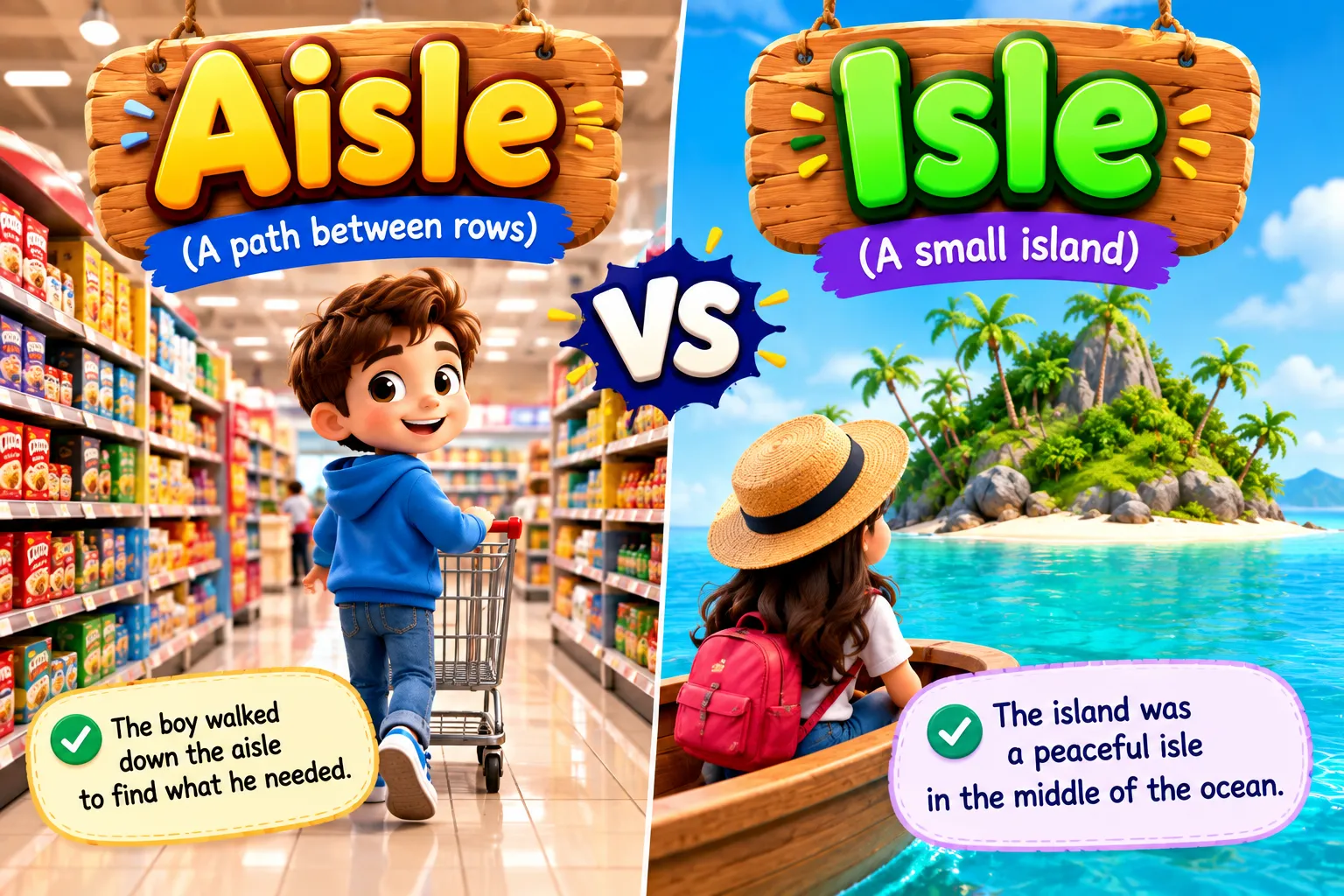
Aisle means a passage between rows of seats or shelves, while isle means an island. They sound the same but have different meanings and spellings.
I have noticed that aisle and isle can make even simple sentences feel uncertain. They sound exactly the same when spoken, yet the meaning changes completely when you write them down. I have seen this confusion appear in emails, travel writing, school assignments, and even quick notes about shopping or flights.
The problem is easy to understand. Both words are pronounced /aɪl/, so you cannot rely on sound to choose the spelling. You have to look at the meaning of the sentence.
If you are talking about the space between supermarket shelves, you need aisle. If you are describing a small island surrounded by water, you need isle.
The good news is that the difference is simple once you connect each word with a clear image. Aisle = a passage you walk through. Isle = an island.
There is also an interesting twist in their history. Although the words look and sound related, their etymologies are different. Understanding that history makes this common homophone pair much easier to remember.
Aisle or Isle Quick Answer
Aisle is a noun for a passage between rows of seats, shelves, or similar spaces. You might walk down an aisle in a plane, church, theater, or supermarket.
Isle is a noun meaning an island, especially in literary language or in names such as the Isle of Skye.
For example:
- Please leave the bags in the aisle.
- The small isle was surrounded by clear water.
The pronunciation is the same, but the spelling tells you which meaning you intend.
The Origin and Background of Aisle and Isle
The history of these two words is one reason their spelling can seem strange.
Where Does Aisle Come From?
According to Etymonline, aisle appeared in English in the late 14th century as ele, referring to a side section of a church. It came through Old French from Latin ala, meaning a wing or side.
The modern spelling developed later. Etymonline explains that aisle became confused with the unrelated Middle English word ile, meaning “island.” This helped lead to the addition of the s and eventually the modern spelling aisle.
That means the s in aisle is not simply a clue to its original pronunciation.
Where Does Isle Come From?
Isle has a different history. Etymonline traces it to late 13th-century ile, from Old French ile and ultimately Latin insula, meaning “island.”
The s was restored in French and then in English during the late 1500s.
So, although aisle and isle eventually became homophones, their etymology is different.
Why Do They Sound the Same?
English contains many homophones. These are words that sound alike but have different meanings or spellings.
Examples include:
- aisle / isle
- sea / see
- right / write
- flower / flour
With aisle and isle, pronunciation cannot tell you which word to choose. Context has to do the job.
Aisle or Isle Explained Key Differences
The easiest way to remember the difference is to connect each word with a place.
| Term | Meaning | When to Use | Region/Context |
| aisle | A passage between rows of seats or shelves | When describing a walkway or passage | Standard English |
| isle | An island | When referring to land surrounded by water | Standard English, often literary or in place names |
Aisle
Use aisle when people can walk along a passage.
Common examples include:
- airplane aisle
- supermarket aisle
- church aisle
- theater aisle
- train aisle
Cambridge Dictionary defines an aisle as a long, narrow space between rows of seats or shelves.
Example:
The passengers waited in the aisle while the crew prepared the cabin.
Isle
Use isle when you mean an island.
Cambridge Dictionary describes isle as an island and notes that it is especially used in place names.
Example:
They spent the summer exploring a quiet isle.
The word often sounds more literary than the everyday word island.
Which Version Should You Use?
You do not need to choose between aisle and isle based on British or American English. Both forms are standard in both varieties. The meaning decides the spelling.
For students
Choose aisle when you mean a walkway.
The students walked down the aisle to their seats.
Choose isle when you mean an island.
The travelers visited a remote isle.
For professional writers
Check the meaning before choosing the spelling. A business report might discuss an aisle in a retail store, while a travel article might describe an isle in the ocean.
For global English
Use the simple memory rule:
Aisle = passage
Isle = island
This works across standard British and American English.
Common Mistakes with Aisle or Isle
1. Using “isle” for a supermarket passage
❌ The cereal is in the fourth isle.
✅ The cereal is in the fourth aisle.
A supermarket has shelves and walking spaces. Therefore, the correct word is aisle.
2. Using “aisle” for an island
❌ They stayed on a beautiful aisle.
✅ They stayed on a beautiful isle.
Here, the meaning is an island, so isle is correct.
3. Confusing an aisle with a seat
An aisle is the passage. An aisle seat is a seat next to that passage.
Cambridge defines an aisle seat as a seat beside the space people walk along between rows.
4. Assuming the spelling follows pronunciation
Both words are pronounced /aɪl/. Cambridge gives the same pronunciation for aisle in both UK and US English.
That means listening alone will not help you choose the spelling.
5. Treating isle as the everyday word for every island
Isle means island, but it can have a literary feel and is especially common in certain names.
For ordinary writing, island is often the more natural word.
Aisle or Isle in Real-World Examples
Professional Email
“Could you please make sure the boxes are removed from the main aisle before customers arrive?”
News Headline
Residents Celebrate New Ferry Service to Remote Isle
Social Media Post
“Waking up on a tiny isle with nothing but blue water around us was unforgettable.”
Formal Report
“The inspection found that several store aisles did not provide enough space for easy customer movement.”
Travel Writing
“The small isle is known for its quiet beaches and historic villages.”
These examples show why context matters more than pronunciation.
Aisle or Isle Data, Trends & Usage
The search intent for aisle or isle is mainly informational. People usually search the pair because they want to understand the spelling and meaning difference.
Reliable public sources do not provide a stable, universal monthly search-volume figure for this exact keyword pair. SEO platforms such as Ahrefs and Semrush may show different estimates based on their databases, countries, and update schedules, so unsupported monthly numbers should not be presented as exact facts.
Dictionary and corpus evidence gives a more useful picture of actual language use.
Cambridge includes corpus examples for aisle across contexts such as churches, stores, theaters, and other public spaces. Cambridge also gives examples of isle in literary and geographical contexts.
Search Intent Breakdown
| Search Query | Likely Intent |
| aisle or isle | Informational |
| aisle vs isle | Informational |
| aisle meaning | Definition |
| isle meaning | Definition |
| aisle pronunciation | Pronunciation |
| isle pronunciation | Pronunciation |
| aisle seat meaning | Travel vocabulary |
One useful insight is that aisle appears in many everyday settings. People encounter it while shopping, traveling, attending events, or using public transport. Isle, by contrast, is strongly linked with islands, geography, literature, and place names.
Aisle vs Isle: A Simple Comparison
| Term/Variant | Meaning | Region/Context | Best Used When |
| aisle | Passage between rows | Shops, planes, churches, theaters, trains | You mean a walkway |
| isle | Island | Geography, literature, place names | You mean an island |
| island | Land surrounded by water | Everyday English | You want the common general term |
| aisle seat | Seat next to a passage | Travel and entertainment | You are discussing seating |
| aisles | Plural of aisle | Standard English | You mean more than one passage |
| isles | Plural of isle | Standard English | You mean more than one island |
This comparison adds an important point: island is usually the everyday alternative to isle, while aisle has no connection to walking on an island.
How to Remember Aisle and Isle
A short memory trick can save you from many spelling errors.
Think: Aisle = Access
An aisle gives you a way to access seats, shelves, or other rows.
Aisle → Access → Walkway
Think: Isle = Island
Both isle and island begin with the idea of land surrounded by water.
Isle → Island
You can also remember the visual difference:
Aisle: 🚶 → rows → 🚶
Isle: 🌊 → 🏝️
The first is a passage. The second is land surrounded by water.
Frequently Asked Questions
Q: What does “aisle” mean?
A: An aisle is a passage between rows of seats or shelves. You can find aisles in places such as airplanes, churches, theaters, and supermarkets.
Q: What does “isle” mean?
A: Isle means an island. The word is often used in literary writing or in geographical names such as the Isle of Skye.
Q: Are aisle and isle homophones?
A: Yes. Aisle and isle are homophones because they have the same pronunciation but different meanings and spellings.
Q: Is aisle or isle correct?
A: Both are correct words, but they are used for different meanings. Choose aisle for a passage and isle for an island.
Q: Is “isle” a formal word for island?
A: It can be. Cambridge labels isle as literary and notes that it is especially used in place names. In everyday speech, island is often more common.
Q: Does aisle mean a seat?
A: No. An aisle is the passage itself. An aisle seat is a seat positioned next to that passage.
Q: Why is aisle spelled with an “s”?
A: The spelling has a complex history. Etymonline explains that aisle was influenced by confusion with the Middle English word ile, meaning island, which helped introduce the s into the spelling.
Conclusion: Aisle or Isle?
Aisle and isle may sound identical, but they have completely different meanings.
Use aisle when you are talking about a passage. It can be the space between supermarket shelves, airplane seats, church pews, or theater seats. Cambridge supports this everyday meaning across several contexts.
Use isle when you mean an island. The word is especially common in literary descriptions and place names.
Their history is also worth remembering. Despite their similar appearance and identical pronunciation, the two words developed from different linguistic roots. Etymonline traces aisle through Old French and Latin roots connected with a side or wing, while isle comes through Old French from Latin insula, meaning island.
The easiest rule is still the best one:
Aisle = a passage you walk through.
Isle = an island surrounded by water.
Once you connect each spelling to its meaning, this homophone pair becomes much easier to remember.
Bookmark this guide so you never second-guess “aisle or isle” again.
Read More:
Trys or Tries: Easy Spelling and Grammar Guide

I specialize in English grammar, spelling, word choice, and language usage. My content is based on research from grammar references, style guides, dictionaries, and real-world usage to ensure it is accurate and practical.
At Spelling Comparison, I write guides that explain why words are confused, how they are used, and which form is correct in context. I also include proofreading tips, examples, and writing advice readers can apply immediately.
My goal is to publish clear, reliable content that helps readers make better writing decisions. Each guide is written for accuracy, clarity, and usefulness in school, work, business, and everyday communication.










