Tries is the correct standard form of try for the third-person singular present tense and the plural noun. Trys is normally a spelling error.
I have caught myself writing a word quickly and then stopping because one small spelling change suddenly looked uncertain. Trys or tries is one of those cases. The two forms look close enough to make the mistake easy, especially when you are typing fast or learning English grammar.
What makes this confusing is the usual -s rule. We often add -s to a verb to make the third-person singular form, such as work → works or read → reads. So it may seem natural to write try → trys.
But try follows a different spelling rule. When a verb ends in a consonant followed by y, the y changes to i before -es is added. That gives us tries.
I have also noticed that the same spelling can appear in two different grammar roles. Tries can be a verb, as in she tries, or a noun, as in three tries. Once you see that pattern, the choice becomes much easier.
Let’s break down the rule, examples, common mistakes, and related forms.
Trys or Tries Quick Answer
| Point | Explanation |
|---|---|
| Correct spelling | Tries is the standard English spelling. Trys is not the normal spelling. |
| As a verb | Use tries as the third-person singular present-tense form of try. |
| Verb example | She tries to arrive early. |
| As a noun | Tries is also the plural form of the noun try. |
| Noun example | He made three tries before he succeeded. |
| Dictionary support | Cambridge Dictionary defines try as a verb meaning to attempt something and also lists tries as the plural noun form. |
.
The Origin and Grammar Background of Try
The word try has a long history in English, but the spelling issue here is mainly a matter of modern English grammar and spelling, not a regional difference.
The key point is what happens when a verb ends in consonant + y.
In the present simple, English normally adds -s for the third-person singular:
- I work → she works
- I read → he reads
- I play → she plays
However, verbs ending in a consonant followed by y usually change y to i and add -es:
- try → tries
- carry → carries
- study → studies
- worry → worries
Cambridge’s grammar guidance explains that regular verbs form the third-person singular present with an -s ending, with spelling changes applying to certain verb endings
The word try itself means to make an effort or attempt something. Cambridge also records another use meaning to test or experience something to see whether it works or whether you like it.
Why Does Try Become Tries?
Think of the spelling as a small transformation:
try + es → tries
The final y changes to i, giving us tries.
This is why trys does not follow the standard spelling pattern.
Trys or Tries Explained Key Differences
The biggest difference is simple:
| Term | Meaning | When to Use | Region/Context |
| tries | Third-person singular form of try | With he, she, it or a singular noun | Standard English |
| tries | Plural form of the noun try | When talking about more than one attempt | Standard English |
| trys | Nonstandard spelling | Normally should not be used | Usually a spelling error |
1. Tries as a Verb
Use tries when the subject is third-person singular.
Examples:
- He tries to stay calm.
- My brother tries new foods.
- The machine tries to connect again.
The subject controls the verb form. Cambridge explains that the subject’s person and number affect verb agreement.
2. Tries as a Noun
Tries can also be the plural of the noun try.
For example:
- She had two tries at the puzzle.
- We made several tries before finding the answer.
- His first few tries were unsuccessful.
Cambridge lists try as a noun meaning an attempt and gives tries as its plural form.
3. Trys
In standard English writing, avoid trys.
If you mean the verb, use tries:
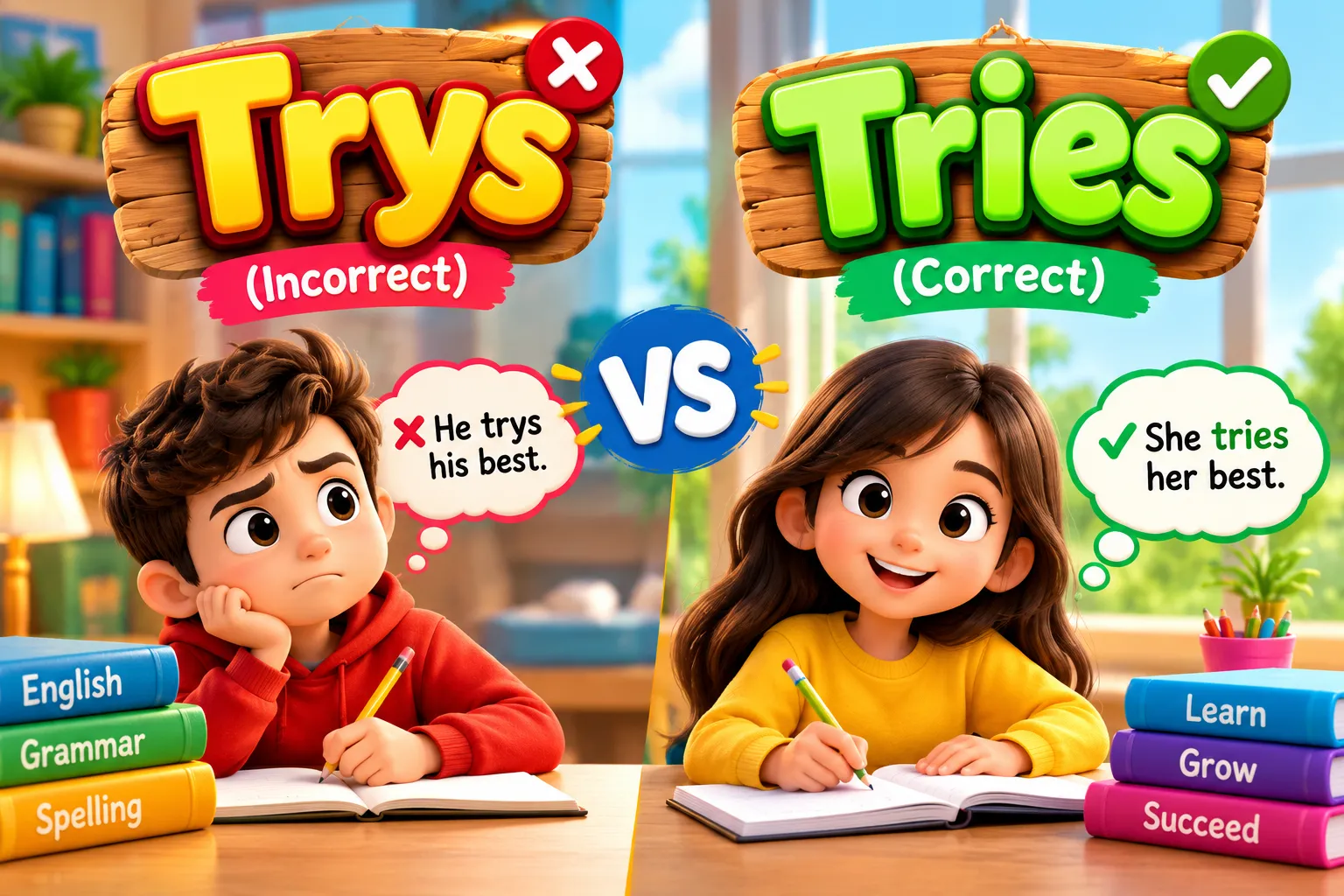
❌ He trys to help.
✅ He tries to help.
If you mean more than one attempt, use tries:
❌ I made three trys.
✅ I made three tries.
Which Version Should You Use?
The answer depends on the grammar role, but the spelling is still tries.
For students
Use tries when the subject is he, she, or it.
She tries to finish her homework early.
For professional writing
Use tries in emails, reports, articles, and other formal documents.
The system tries to process the request automatically.
For plural nouns
Use tries when you mean several attempts.
The team made five tries before solving the problem.
For global English
Tries is the standard spelling in both British and American English. This is not like pairs such as colour/color or organise/organize, where regional spelling can differ.
Common Mistakes with Trys or Tries
Mistake 1: Adding only -s
Wrong:
He trys to help.
Correct:
He tries to help.
The error happens because learners may apply the basic add -s rule without changing the final y.
Mistake 2: Using trys as a plural noun
Wrong:
She made several trys.
Correct:
She made several tries.
The plural noun follows the same spelling pattern.
Mistake 3: Confusing tries with tried
Wrong:
Yesterday, she tries to call me.
Correct:
Yesterday, she tried to call me.
Tries is present tense. Tried is the past tense and past participle of try. Cambridge confirms that tried is the past form of try.
Mistake 4: Changing every word ending in y
Not every word ending in y follows the same rule.
Compare:
- play → plays
- enjoy → enjoys
- try → tries
- study → studies
The letter before y matters.
Mistake 5: Forgetting the subject
❌ They tries to help.
✅ They try to help.
The -ies form is used with a third-person singular subject, not with I, you, we, or they.
Trys or Tries in Real-World Examples
Professional Email
“The support team tries to respond to all customer requests within one business day.”
News Headline
Local School Tries New Approach to Reading Lessons
Social Media Post
“When a recipe tries to look simple but takes two hours to finish!”
Formal Report
“The study examines how the software tries to reduce repeated data entry.”
Everyday Conversation
“She always tries to find a simple solution.”
These examples show how tries works naturally in different types of writing.
Trys or Tries Data, Trends & Usage
The search intent behind trys or tries is mainly informational. People searching the phrase are usually checking spelling or grammar rather than looking for a product or service.
Exact monthly search-volume figures for this specific spelling pair can vary by country, language, and SEO database. Public sources do not provide a reliable universal monthly figure that can be stated here without access to a paid keyword database such as Semrush or Ahrefs.
A useful alternative is corpus evidence. Google Books Ngram Viewer lets users compare word frequencies across large collections of published books and currently provides English corpora covering historical periods through 2022.
For this particular question, dictionary and grammar evidence is more useful than a raw search-volume number. Cambridge explicitly uses tries in its dictionary examples and identifies tries as the plural of try.
Search Intent
| Search Element | Likely Intent |
| trys or tries | Informational |
| tries meaning | Informational |
| try plural | Grammar/spelling |
| tries grammar | Educational |
| trys meaning | Usually spelling checking |
The topic also matters for ESL learners, students, bloggers, and workplace writers because a single missing letter can make otherwise clear writing look incorrect.
Try vs Tries vs Tried vs Trying
This related group is useful because many learners confuse the different forms of the same verb.
| Term/Variant | Meaning | Region/Context | Best Used When |
| try | Base form of the verb | Standard English | With I, you, we, they or after to |
| tries | Third-person singular present | Standard English | With he, she, it or a singular noun |
| tries | Plural noun | Standard English | For two or more attempts |
| tried | Past tense/past participle | Standard English | For completed past actions |
| trying | Present participle/gerund | Standard English | For an action in progress or as a noun-like form |
| trys | Nonstandard spelling | Not standard usage | Avoid in normal English writing |
A Simple Pattern
You can remember the main forms like this:
try → tries → tried → trying
Examples:
- I try to learn.
- She tries to learn.
- She tried to learn yesterday.
- She is trying to learn.
Once you learn the pattern, trys becomes much easier to spot as an error.
Frequently Asked Questions
Q: What does “tries” mean?
A: Tries can be the third-person singular present form of try, meaning makes an effort or attempts something. It can also be the plural noun meaning more than one attempt.
Q: Is “trys” a correct English word?
A: In standard English, trys is normally considered a misspelling. Use tries for the third-person singular verb or plural noun.
Q: Why is it “tries” and not “trys”?
A: When try changes to the third-person singular present form, the final y changes to i and -es is added. Therefore, try becomes tries.
Q: Is “tries” a verb or a noun?
A: It can be either. In “She tries again,” it is a verb. In “He made three tries,” it is a plural noun.
Q: Is “tries” used in both British and American English?
A: Yes. Tries is the standard spelling in both major varieties of English. The difference is not regional.
Q: What is the past tense of “try”?
A: The past tense is tried. Cambridge Dictionary identifies tried as both the past simple and past participle of try.
Q: Can I use “tries” in formal writing?
A: Yes. Tries is completely appropriate in formal writing when the grammar requires it. You can use it in academic work, reports, business writing, and professional communication.
Conclusion: Trys or Tries?
The choice between trys or tries becomes simple once you know the spelling rule.
Tries is the standard form. Use it when try becomes a third-person singular present-tense verb, such as with he, she, or it. It is also the correct plural form of the noun try.
Remember these four useful forms:
- try — base form
- tries — third-person singular or plural noun
- tried — past tense and past participle
- trying — present participle
The spelling trys does not normally belong in standard English writing. If your spell checker flags it, the correction is usually simple: change it to tries.
You do not need to memorize a long grammar rule. Just remember that try + third-person singular = tries.
Bookmark this guide so you never have to second-guess “trys or tries” again.
Read More:
Chili or Chilli: The Easy Way to Tell Them Apart

I’m Daniel sultan, an English language writer and SEO content specialist with experience researching spelling, grammar, vocabulary, and English usage. Through SpellComparison.com, I create clear, accurate, and well-researched guides that help readers understand commonly confused words, spelling differences, and grammar rules with confidence.
Every article I write is based on trusted language references, established style guides, and real-world usage to ensure it is accurate, practical, and easy to understand. My goal is to make learning English simple and reliable by providing fact-checked content, clear explanations, and real-life examples that students, writers, educators, and professionals can trust.