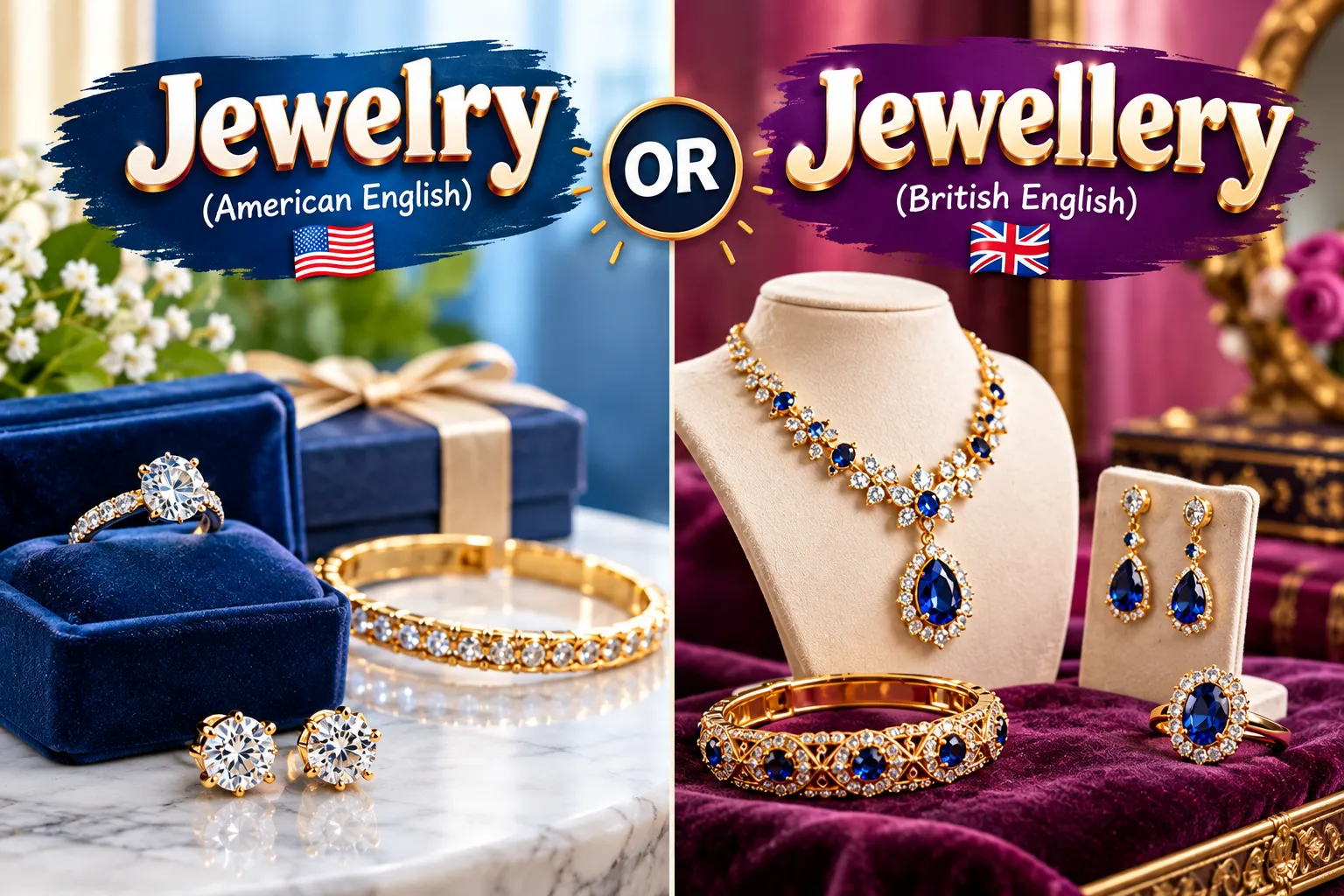
Jewelry and jewellery have the same meaning; jewelry is the standard American spelling, while jewellery is the standard British spelling.
I have often paused when writing jewelry, wondering whether jewellery might be the better spelling. I have noticed this small difference while helping English learners and editing online content. The extra l may seem minor, but it can make even a familiar word feel uncertain.
The good news is that both spellings are correct.
The difference is mainly based on regional English. American English usually uses jewelry, while British English uses jewellery. Both words have the same meaning and refer to decorative items such as rings, necklaces, bracelets, and earrings.
I have found that the easiest way to remember the difference is to think about your audience. If you are writing for American readers, jewelry is the usual choice. For British readers, jewellery is more appropriate.
In this guide, I will explain where both spellings come from, when to use each one, common mistakes to avoid, and a simple rule that makes the choice easy.
Jewelry or Jewellery Quick Answer
Jewelry and jewellery are two regional spellings of the same noun.
- Jewelry → American English
- Jewellery → British English
- Meaning → decorative objects worn on the body or clothes
For example:
She bought a beautiful jewelry set for the wedding.
She bought a beautiful jewellery set for the wedding.
The spelling changes, but the basic meaning stays the same. Cambridge Dictionary identifies jewelry as the US spelling of jewellery and jewellery as the UK spelling of jewelry.
The Origin and Background of Jewelry
The history of this word is much older than the modern spelling difference.
According to Etymonline, jewelry dates to the late 14th century. It came from Old French juelerye, meaning precious ornaments or jewel work. The word is connected to jewel.
Oxford also traces jewellery to late Middle English and Old French forms. Its entry connects the word with juelerie and juelier, ultimately linking it to older words associated with a jewel .
So the difference between jewelry and jewellery is not a difference in origin or meaning. It is mainly a difference in spelling tradition.
This is common in English. Other examples include:
- color / colour
- favorite / favourite
- center / centre
- traveler / traveller
- jeweler / jeweller
The pattern can be especially confusing for English learners because both forms may appear online.
Jewelry Explained: Key Differences and Variations
The easiest way to understand the pair is to focus on regional usage.
| Term | Meaning | When to Use | Region/Context |
| jewelry | Decorative items worn on the body | Use in American English | US English |
| jewellery | Decorative items worn on the body | Use in British English | UK English |
| jewels | Individual valuable stones or decorative items | Use when referring to specific jewels | General English |
Cambridge Dictionary defines the noun as decorative objects worn on the body or clothes, often made from valuable metals and precious stones.
Jewelry
Use jewelry when following American English spelling.
Examples:
The store sells handmade jewelry.
She wore silver jewelry to the event.
He bought a new jewelry box.
Jewellery
Use jewellery when following British English spelling.
Examples:
The museum displayed ancient jewellery.
She designs handmade jewellery.
The shop has a large collection of gold jewellery.
Oxford specifically lists jewellery as the British form and jewelry as the US form.
Which Version Should You Use?
Your audience should guide your choice.
If you write for Americans
Choose jewelry.
This is the normal spelling in American English. It is also the form used by Cambridge’s American English entry.
If you write for British readers
Choose jewellery.
This is the normal British spelling and appears in Oxford’s British English dictionary entry.
If you write for a global audience
Either spelling can work. The key is consistency.
If your website uses British English, keep jewellery throughout. If it follows American English, use jewelry.
Do not switch between the two without a reason. Consistent spelling makes your writing look cleaner and more professional.
Common Mistakes With Jewelry and Jewellery
1. Treating one spelling as wrong
Mistake:
“Jewellery is incorrect.”
Correction:
“Jewellery is the usual British spelling.”
Both forms are accepted English spellings.
2. Mixing regional spelling
Mistake:
Our jewelry shop sells handmade jewellery.
Better:
Our jewelry shop sells handmade jewelry.
Or, in British English:
Our jewellery shop sells handmade jewellery.
The main issue is consistency.
3. Using jewelrys as the plural
Mistake:
She sells beautiful jewelrys.
Correction:
She sells beautiful jewelry.
The noun is normally uncountable when referring to jewelry as a group or category. Oxford marks jewellery/jewelry as uncountable.
4. Using jeweller with American spelling
American English normally uses jeweler, while British English uses jeweller. Cambridge confirms this regional difference.
5. Assuming pronunciation changes completely
The spelling differs, but both words refer to the same thing and have closely related pronunciations. The main issue here is spelling, not meaning.
Jewelry in Real-World Examples
Here is how the word can appear in different types of writing.
Professional email
Thank you for sending the details of your new jewelry collection. We would be happy to discuss the next steps.
News headline
Local Museum Opens Exhibition of Historic Jewellery
Social media post
Our new handmade jewelry collection is now available. Each piece has its own simple, timeless design.
Formal document
All jewellery displayed in the exhibition was examined and documented before installation.
Notice that the choice depends on the style of English being used. A British publication may prefer jewellery, while an American publication may use jewelry.
Jewelry Data, Trends & Usage
Search data for individual spellings can change over time, and exact monthly search volumes depend on the SEO platform, country, language, and date. Public sources do not provide a reliable universal monthly search-volume figure that can be stated here without a specific SEO database.
Google Trends is useful for comparing relative search interest, but it does not report absolute search volume. Google explains that Trends displays search interest over time and by geography.
For written usage, Google Books Ngram Viewer can compare words across its book corpus. The current Ngram system includes datasets through 2022 and notes that corpus results can change as datasets and language processing improve.
What the usage pattern tells us
The useful SEO lesson is simple:
- jewelry strongly fits American English content.
- jewellery strongly fits British English content.
- Search intent is mainly informational when people search “jewelry or jewellery.”
- People often want to know whether the two forms have different meanings.
- Regional spelling matters for websites targeting specific English-speaking markets.
For SEO, do not force both spellings into every paragraph. Use the spelling that matches your target audience and mention the alternative naturally where useful.
Jewelry vs Jewellery: Standalone Comparison
| Term/Variant | Meaning | Region/Context | Best Used When |
| jewelry | Decorative items worn on the body | American English | Writing for US readers |
| jewellery | Decorative items worn on the body | British English | Writing for UK readers |
| jeweler | Person who sells or repairs jewelry | American English | US-focused writing |
| jeweller | Person who sells or repairs jewellery | British English | UK-focused writing |
| jewel | A precious stone or individual decorative object | General English | Referring to one jewel or gem |
The related forms are useful because the regional pattern continues beyond the main noun. Cambridge lists jeweler as the US spelling and jeweller as the UK spelling.
FAQs About Jewelry and Jewellery
Q: What does jewelry mean?
A: Jewelry means decorative items worn on the body or clothes, such as rings, bracelets, necklaces, and earrings. It is the usual American spelling of jewellery.
Q: How do you use jewelry correctly?
A: Use jewelry as a noun when following American English spelling. For example, “She sells handmade jewelry.”
Q: Jewelry vs jewellery — what is the difference?
A: There is no major difference in meaning. Jewelry is the usual American form, while jewellery is the usual British form.
Q: Is jewelry acceptable in formal writing?
A: Yes. Jewelry is standard in formal American English. For British English, use jewellery instead.
Q: Which version is correct, jewelry or jewellery?
A: Both are correct. Select the spelling that matches your chosen variety of English.
Q: Where does jewelry come from?
A: Etymonline traces the word to late 14th-century English and Old French juelerye. Oxford also traces jewellery through Middle English and Old French forms.
Q: Can I use jewelry in British English?
A: It can be understood, but jewellery is the normal British spelling. If you are writing specifically for a British audience, keeping the British form is the clearer choice.
Conclusion
The choice between jewelry and jewellery is much easier once you know the regional rule. Both words describe the same type of decorative items. Neither spelling changes the basic meaning.
Remember these three points:
- Jewelry is the standard American spelling.
- Jewellery is the standard British spelling.
- Your most important goal is consistent regional spelling.
The same pattern appears in related words. American English uses jeweler, while British English uses jeweller.
If you are writing for an American audience, choose jewelry. For a British audience, choose jewellery. For international content, pick one style and use it consistently.
Once you remember the US -elry form and UK -ellery form, this spelling question becomes much easier.
Bookmark this guide so you never second-guess jewelry or jewellery again.
Read More:
Use up and down arrow keys to resize the meta box pane.
Aisle or Isle: Easy Meaning and Usage Guide

I’m Daniel sultan, an English language writer and SEO content specialist with experience researching spelling, grammar, vocabulary, and English usage. Through SpellComparison.com, I create clear, accurate, and well-researched guides that help readers understand commonly confused words, spelling differences, and grammar rules with confidence.
Every article I write is based on trusted language references, established style guides, and real-world usage to ensure it is accurate, practical, and easy to understand. My goal is to make learning English simple and reliable by providing fact-checked content, clear explanations, and real-life examples that students, writers, educators, and professionals can trust.