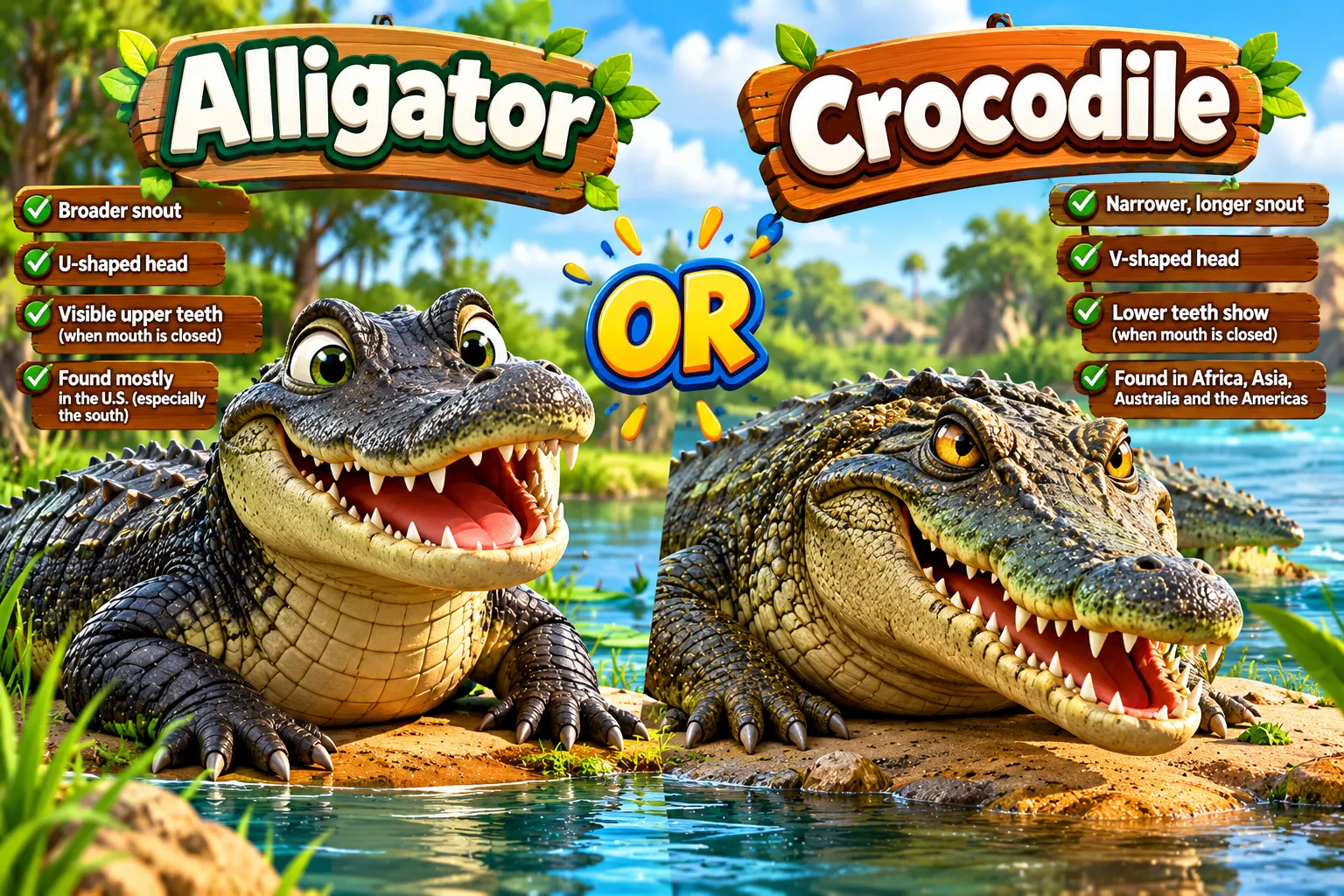
An alligator has a wider, rounded snout and usually lives in freshwater, while a crocodile often has a longer, narrower snout and can handle saltwater better.
I have often found myself wondering whether I was looking at an alligator or crocodile, especially when watching wildlife videos or reading about reptiles. At first, they can look almost identical. Both have powerful jaws, long tails, rough skin, and sharp teeth, so it is easy to mix them up.
Over time, I learned that a few simple features make them much easier to tell apart. The shape of the snout is one of the clearest clues. An alligator usually has a wide, rounded snout, while a crocodile tends to have a longer, narrower snout. Their teeth and habitats can also help.
I know this difference can be confusing, especially if you are learning English or simply interested in wildlife. In this guide, I will break down the key differences between alligator and crocodile, explain how to identify each one, and share simple examples that make the distinction easy to remember.
Alligator or Crocodile Quick Answer
An alligator and a crocodile are both crocodilians, but they belong to different groups within that larger family of reptiles.
The easiest clues are snout shape, teeth, habitat, and body appearance.
For example:
- A broad, rounded snout points toward an alligator.
- A long, pointed snout may indicate a crocodile.
- An alligator’s lower teeth are usually hidden when its mouth is closed.
- A crocodile may show both upper and lower teeth.
Cambridge Dictionary describes an alligator as a large reptile with a nose that is shorter and wider than a crocodile’s. It describes a crocodile as having a nose that is usually longer and narrower. These simple definitions capture one of the easiest visual differences between them.
The Smithsonian’s National Zoo also uses the snout, teeth, and habitat as key ways to tell the two apart.
The Origin and Background of Alligator and Crocodile
| Feature | Alligator | Crocodile |
| Meaning | A type of crocodilian reptile | A type of crocodilian reptile |
| Snout | Usually broad and rounded, often U-shaped | Usually longer and narrower, often V-shaped |
| Teeth | Lower teeth are mostly hidden when the mouth is closed | Some lower teeth remain visible when the mouth is closed |
| Body shape | Generally wider and less streamlined | Generally longer and more streamlined |
| Color | Often dark gray, olive, or nearly black | Often lighter, with shades varying by species |
| Habitat | Mainly freshwater areas such as swamps, marshes, lakes, and rivers | Freshwater, brackish water, and some coastal or saltwater habitats |
| Saltwater tolerance | Lower tolerance for saltwater | Some species have strong saltwater tolerance |
| Main regions | Mainly the southeastern United States and China | Africa, Asia, Australia, the Americas, and other tropical regions |
| Common species | American alligator and Chinese alligator | American, Nile, saltwater, and other crocodile species |
| Informal term | Gator | Croc |
| Broader group | Crocodilian | Crocodilian |
| Best identification clue | Wide, rounded snout and hidden lower teeth | Narrower snout and visible lower teeth |
Alligator vs Crocodile Explained Key Differences
The quickest way to compare them is to look at several features at once.
| Term | Meaning | When to Use | Region/Context |
| Alligator | A crocodilian with a broad, rounded snout | When referring to an alligator species | Mainly the southeastern U.S. and the Chinese alligator’s range |
| Crocodile | A crocodilian with many species around the world | When referring to a crocodile species | Africa, Asia, Australia, the Americas, and other tropical regions |
| Crocodilian | A broader scientific group | When discussing alligators, crocodiles, caimans, and gharials together | Zoology and wildlife writing |
1. Snout shape
This is often the first clue.
Alligators usually have a short, broad snout with a rounded end. It is often described as U-shaped.
Crocodiles generally have a longer and narrower snout. It can look more V-shaped.
There are exceptions. Not every crocodile has an extremely narrow snout, so snout shape should not be your only test.
2. Teeth
Teeth provide another strong clue.
In an alligator, the upper jaw sits over the lower jaw. When the mouth closes, the lower teeth are mostly hidden.
A crocodile has a different jaw shape. Some lower teeth remain visible when the mouth is closed.
The U.S. National Park Service explains this distinction as one of the practical ways to separate an American alligator from an American crocodile.
3. Habitat
Habitat can also help.
American alligators commonly live in freshwater environments, including swamps, marshes, lakes, and slow-moving rivers.
Some crocodiles can tolerate brackish and saltwater because certain species have salt glands. This gives them access to coastal habitats that are less suitable for alligators.
Still, habitat is not an absolute rule. Some crocodiles live mainly in freshwater.
4. Body and color
Alligators are often darker than crocodiles. American alligators can appear dark gray, olive, or nearly black.
Many crocodiles have a lighter or more varied appearance, although color depends heavily on the species and environment.
For that reason, color alone is not a reliable identification test.
Which One Should You Use?
If you are writing about a specific animal, use the name that matches the species.
- For an American alligator, write alligator.
- For an American crocodile, write crocodile.
- For a broader discussion of both groups, crocodilian may be the better scientific term.
- For beginner-friendly writing, describe the snout or habitat if readers need help identifying the animal.
If you are describing a reptile you saw in the wild, avoid guessing from color alone. Look at several clues together.
For students, the easiest memory trick is:
Alligator = wider, rounder snout.
Crocodile = longer, narrower snout.
Common Mistakes with Alligator or Crocodile
Mistake 1: Treating the words as exact synonyms
Wrong idea: “Alligator and crocodile mean exactly the same animal.”
Better: They are different crocodilians with different biological classifications.
The confusion happens because both animals share many physical features.
Mistake 2: Using habitat as an absolute rule
Wrong idea: “Alligators only live in freshwater, so every freshwater crocodilian must be an alligator.”
Better: Use habitat together with physical features and species information.
Some crocodiles also live in freshwater.
Mistake 3: Assuming every crocodile has a very thin snout
Wrong idea: “A crocodile always has an extremely narrow nose.”
Better: Crocodiles generally have longer, narrower snouts than alligators, but species vary.
Mistake 4: Identifying one by color alone
Wrong idea: “It is dark, so it must be an alligator.”
Better: Check the snout, teeth, body shape, and habitat.
Mistake 5: Confusing crocodilians with lizards
Wrong idea: “An alligator is basically a giant lizard.”
Better: Alligators and crocodiles are crocodilians, a separate reptile group.
Alligator or Crocodile in Real-World Examples
Professional email
The wildlife team identified the animal as an American alligator after reviewing photographs of its snout and teeth.
News headline
Crocodile Spotted Near Coastal Wetland During Morning Survey
Social media post
I finally learned how to tell an alligator from a crocodile: the snout and teeth give you useful clues.
Formal report
The survey recorded several crocodilians in the wetland, including observations that were consistent with the local alligator population.
Each sentence uses the terms for a slightly different purpose. Alligator identifies a particular group. Crocodile identifies another group. Crocodilian works as the broader scientific term.
Alligator or Crocodile Data, Trends & Usage
This topic has strong informational search intent. People usually search for it because they want to identify an animal or understand the difference between the two names.
What does search data show?
Google Trends provides relative search-interest data rather than a simple worldwide monthly search-volume count. Its public interface lets users compare terms by location and time, but the currently accessible results do not expose a reliable monthly search-volume figure for “alligator” vs. “crocodile.” It would be misleading to invent a number.
For SEO work, use Google Trends for relative interest and tools such as Ahrefs or Semrush for estimated monthly keyword volume. Those third-party figures can change over time and should be labeled as estimates.
What about book frequency?
Google Books Ngram Viewer can compare word frequency across its book corpus from 1500–2022. It is useful for studying how often words appear in published books, but corpus frequency is not the same thing as modern Google search volume.
For this topic, Ngram data can help show historical usage patterns, while Google Trends is better suited to search-interest patterns.
Why does the topic matter?
The distinction is useful in several settings:
- Students learning animal vocabulary
- Travelers visiting areas where crocodilians live
- Wildlife writers describing species accurately
- ESL learners building vocabulary
- Content creators writing nature or animal articles
- Teachers explaining biological classification
The topic also shows why context matters in English. Two words can describe closely related animals without being interchangeable.
Alligator vs Crocodile: A Second Comparison
| Term/Variant | Meaning | Region/Context | Best Used When |
| American alligator | A large alligator species | Southeastern United States | Identifying the common U.S. alligator |
| Chinese alligator | A smaller alligator species | China | Referring to the species native to the Yangtze region |
| American crocodile | A crocodile species found in parts of the Americas | Southern Florida, Caribbean, Central America, and northern South America | Identifying that specific crocodile |
| Crocodilian | Broad group containing crocodiles, alligators, caimans, and gharials | Scientific and educational contexts | Talking about the group as a whole |
| Gator | Informal short form of alligator | Especially American English | Casual speech and informal writing |
The Smithsonian National Zoo notes that only two species are commonly called alligators: the American alligator and Chinese alligator. It also explains that the Chinese alligator is much smaller and is highly endangered.
FAQ: Alligator or Crocodile
Q: What does alligator mean?
A: An alligator is a crocodilian reptile with a broad, rounded snout. The two commonly recognized alligator species are the American alligator and Chinese alligator.
Q: How do you tell an alligator from a crocodile?
A: Start with the snout. An alligator usually has a wider, rounded snout, while a crocodile generally has a longer, narrower one. Teeth and habitat can provide extra clues.
Q: Is an alligator a crocodile?
A: An alligator is not a crocodile, although both belong to the broader crocodilian group. They are related reptiles with different biological classifications.
Q: Which is bigger, an alligator or a crocodile?
A: Size varies greatly by species, so there is no simple rule for every individual. Some crocodile species grow much larger than American alligators.
Q: Can alligators live in saltwater?
A: Alligators are mainly adapted to freshwater and have limited tolerance for saltwater. Some crocodiles are better suited to salty or brackish environments because of specialized salt glands.
Q: Where does the word alligator come from?
A: Etymonline traces alligator to Spanish el lagarto, meaning “the lizard.” English forms of the word appeared in the 1500s and 1600s.
Q: Is crocodile a formal word?
A: Yes. Crocodile is the standard English noun for members of the crocodile group. Cambridge Dictionary also records the informal short form croc.
Q: What is the difference between a crocodilian and a crocodile?
A: Crocodilian is the broader group name. It includes crocodiles, alligators, caimans, and gharials, while crocodile refers to members of the crocodile group.
Conclusion
The easiest way to remember alligator or crocodile is to start with the snout. Alligators usually have a wider, rounded shape. Crocodiles tend to have a longer, narrower shape. Their teeth and habitat offer more clues when the snout alone is not enough.
The words also have different histories. Alligator came into English through Spanish, while crocodile has a much older path through French, Latin, Greek, and Middle English forms.
For everyday writing, use alligator when you mean an alligator species and crocodile when you mean a crocodile species. When discussing both groups together, crocodilian is the useful broader term.
You do not need to memorize every species to understand the basic difference. Learn the snout, check the teeth, consider the habitat, and then look at the species.
Bookmark this guide so you can quickly tell an alligator from a crocodile the next time you see one.
Read More:
Coke or Pepsi: The Complete Comparison Guide

I’m **Rubab Naaz**, an English language content writer with over 10 years of experience creating educational and SEO-focused articles. I specialize in spelling comparisons, grammar, vocabulary, synonyms, commonly confused words, and English usage. My passion is helping students, writers, and professionals improve their language skills through accurate, well-researched, and easy-to-understand content. Every article I write is designed to make learning English simple, practical, and engaging.










